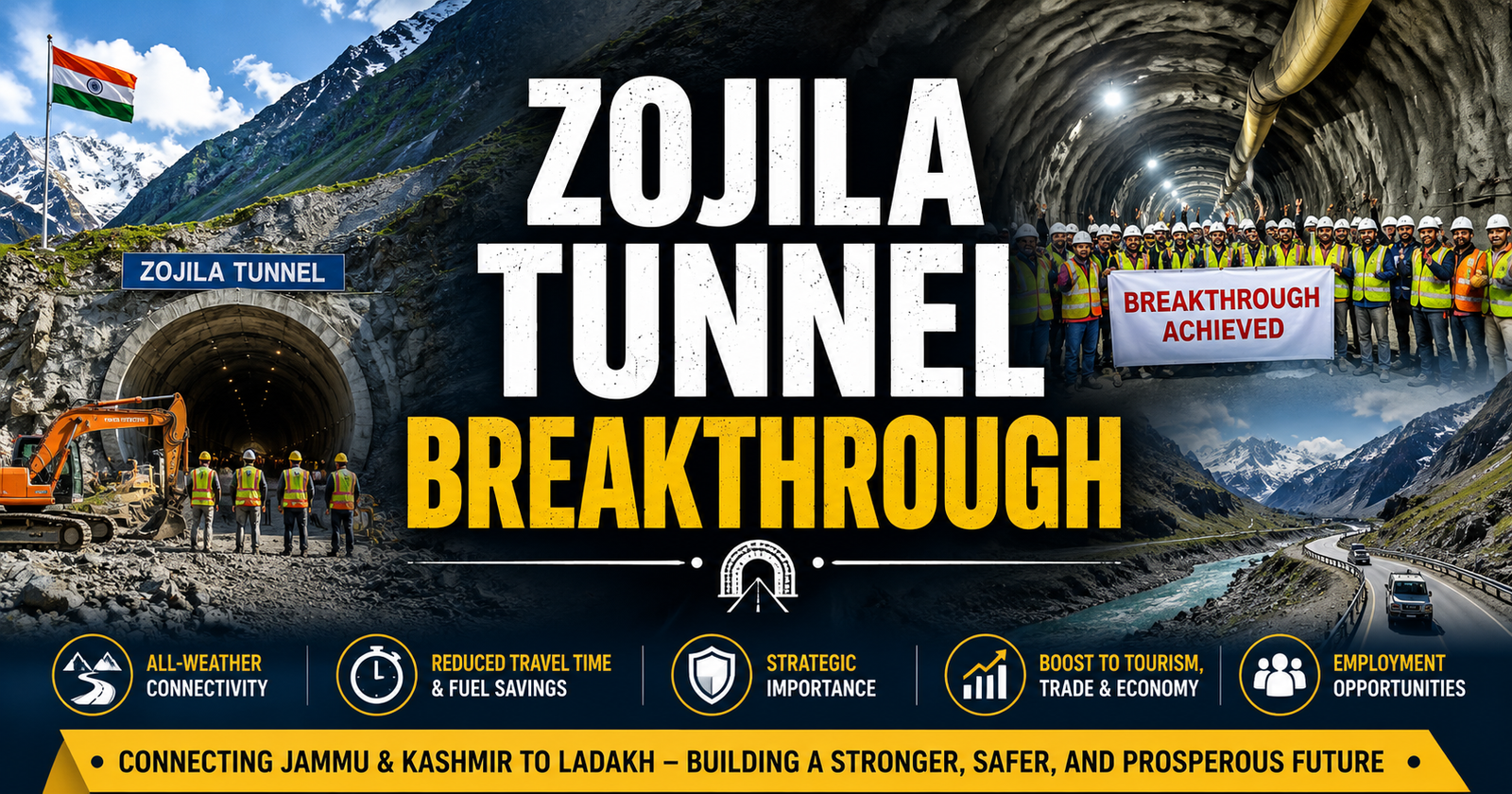
India achieves a major milestone with the Zojila Tunnel breakthrough, ensuring all-weather connectivity between Jammu & Kashmir and Ladakh, boosting tourism, trade, regional development, strategic mobility, and national security.
Syllabus Areas:GS III - Infrastructure |
The Government of India achieved a major milestone in the Zojila Tunnel Project with the successful breakthrough of the main tunnel at the eastern portal near Minamarg in Ladakh. The project is expected to provide all-weather connectivity between Jammu & Kashmir and Ladakh, significantly boosting regional development, tourism, trade, and national security.
About Zojila Tunnel
-
Located between Baltal (J&K) and Minamarg (Ladakh) on National Highway-1.
-
Approximately 14 km long bi-directional tunnel.
-
Project cost: Around ₹6,800 crore.
-
Constructed at altitudes ranging from 2,900 m to 3,310 m.
-
One of India's most ambitious mountain infrastructure projects.
-
Designed to overcome heavy snowfall, avalanches, and difficult terrain that often cut off Ladakh during winter months.
Key Features of the Tunnel
Advanced Safety Infrastructure
The tunnel will include:
-
Modern ventilation systems.
-
Automatic fire detection systems.
-
Advanced CCTV surveillance.
-
Pedestrian cross-passages for emergency evacuation.
-
State-of-the-art safety management systems.
Supporting Infrastructure
The project also includes:
-
8 cut-and-cover sections.
-
4 bridges.
-
40 culverts.
-
Snow galleries.
-
Catch dams.
-
Avalanche protection structures.
-
Approach roads and related facilities.
Benefits of the Zojila Tunnel
1. All-Weather Connectivity
-
Ensures year-round road connectivity between Jammu & Kashmir and Ladakh.
-
Eliminates seasonal isolation caused by heavy snowfall and avalanches.
-
Provides uninterrupted access to remote areas.
2. Reduced Travel Time
-
Travel time between Sonamarg and Minamarg will reduce:
-
From nearly 2 hours
-
To approximately 30 minutes
-
Significant savings in fuel consumption and transportation costs.
3. Tourism Development
The project is expected to:
-
Improve access to Ladakh's tourist destinations.
-
Increase tourist arrivals throughout the year.
-
Promote adventure tourism and eco-tourism.
-
Boost local hospitality and service sectors.
4. Economic Growth
-
Facilitates trade and movement of goods.
-
Generates employment opportunities.
-
Improves market access for local producers.
-
Supports regional economic integration and development.
5. Strategic and Defence Significance
The tunnel has immense strategic importance because it:
-
Ensures uninterrupted military logistics.
-
Enables faster movement of troops, equipment, and supplies.
-
Strengthens India's border infrastructure.
-
Enhances national security preparedness in sensitive border regions.
Broader Connectivity Push in Ladakh
The Government is implementing road and tunnel projects worth approximately ₹18,000 crore between Kargil and Leh-Ladakh. Major projects include:
1. Kargil–Zanskar–Padum Highway
-
Improves accessibility to Zanskar region.
-
Strengthens strategic connectivity.
-
Facilitates defence movement.
2. Leh South and North Bypass Projects
-
Reduce congestion in Leh.
-
Enable seamless travel towards Srinagar, Manali, and Khardung La.
3. Proposed Tunnels
-
Fatu-La Twin-Tube Tunnel.
-
Kela Pass Tunnel.
These projects will further strengthen all-weather connectivity and tourism infrastructure.
Manali–Leh Connectivity Enhancement
The government is planning tunnels at:
-
Baralacha La.
-
Lachulung La.
-
Tanglang La.
Expected outcomes:
-
Reduced journey times.
-
Improved reliability of travel.
-
Enhanced year-round access to Ladakh.
Massive Highway Development in Jammu & Kashmir
Investment Scale
-
Highway projects worth approximately ₹1.35 lakh crore are under implementation across Jammu & Kashmir.
-
Includes completed, ongoing, and upcoming projects.
Major High-Speed Corridors
Jammu–Udhampur–Srinagar Corridor
-
Nearing completion.
-
Will significantly reduce travel time.
Jammu–Chenani–Anantnag Corridor
-
Improves connectivity between Chenab Valley and Kashmir Valley.
Srinagar–Baramulla–Uri Corridor
-
Strengthens connectivity in North Kashmir.
Jammu–Akhnoor–Poonch Corridor
-
Enhances connectivity in border districts.
Other Strategic Connectivity Projects
-
Katra–Srinagar High-Speed Corridor.
-
Rafiabad–Kupwara–Chowkibal–Tangdhar Road.
-
Srinagar–Sonamarg–Gumri Corridor.
-
Surankote–Bufliaz–Supen–Doodhpathri–Magam Corridor (proposed).
These projects aim to:
-
Improve border accessibility.
-
Promote tourism.
-
Support horticulture.
-
Strengthen strategic infrastructure.
The Zojila Tunnel is not merely a transport project; it represents a strategic infrastructure initiative aimed at ensuring all-weather connectivity, strengthening national security, boosting tourism, accelerating economic growth, and integrating the remote Himalayan regions of Jammu & Kashmir and Ladakh into the national development framework.
Prelims Questions:
1. Match List-I with List-II
|
List-I (Tunnel) |
List-II (Connects) |
|
A. Zojila Tunnel |
1. Manali – Lahaul Valley |
|
B. Atal Tunnel |
2. Jammu & Kashmir – Ladakh |
|
C. Sela Tunnel |
3. Tezpur – Tawang Axis |
|
D. Chenani-Nashri Tunnel |
4. Jammu – Srinagar Corridor |
Select the correct answer:
A. A-2, B-1, C-3, D-4
B. A-1, B-2, C-4, D-3
C. A-2, B-3, C-1, D-4
D. A-4, B-1, C-2, D-3
Answer: A
2. Match the Following
|
List-I (Mountain Pass) |
List-II (State/UT) |
|
A. Zojila |
1. Arunachal Pradesh |
|
B. Nathu La |
2. Ladakh/J&K |
|
C. Sela |
3. Sikkim |
|
D. Rohtang |
4. Himachal Pradesh |
A. A-2, B-3, C-1, D-4
B. A-3, B-2, C-1, D-4
C. A-2, B-1, C-3, D-4
D. A-4, B-3, C-1, D-2
Answer: A
3. Match the Following
|
List-I (Pass) |
List-II (Mountain Range) |
|
A. Zojila |
1. Greater Himalayas |
|
B. Nathu La |
2. Eastern Himalayas |
|
C. Rohtang |
3. Pir Panjal Range |
|
D. Banihal Pass |
4. Pir Panjal Range |
A. A-1, B-2, C-3, D-4
B. A-2, B-1, C-3, D-4
C. A-1, B-2, C-4, D-3
D. A-3, B-2, C-1, D-4
Answer: A