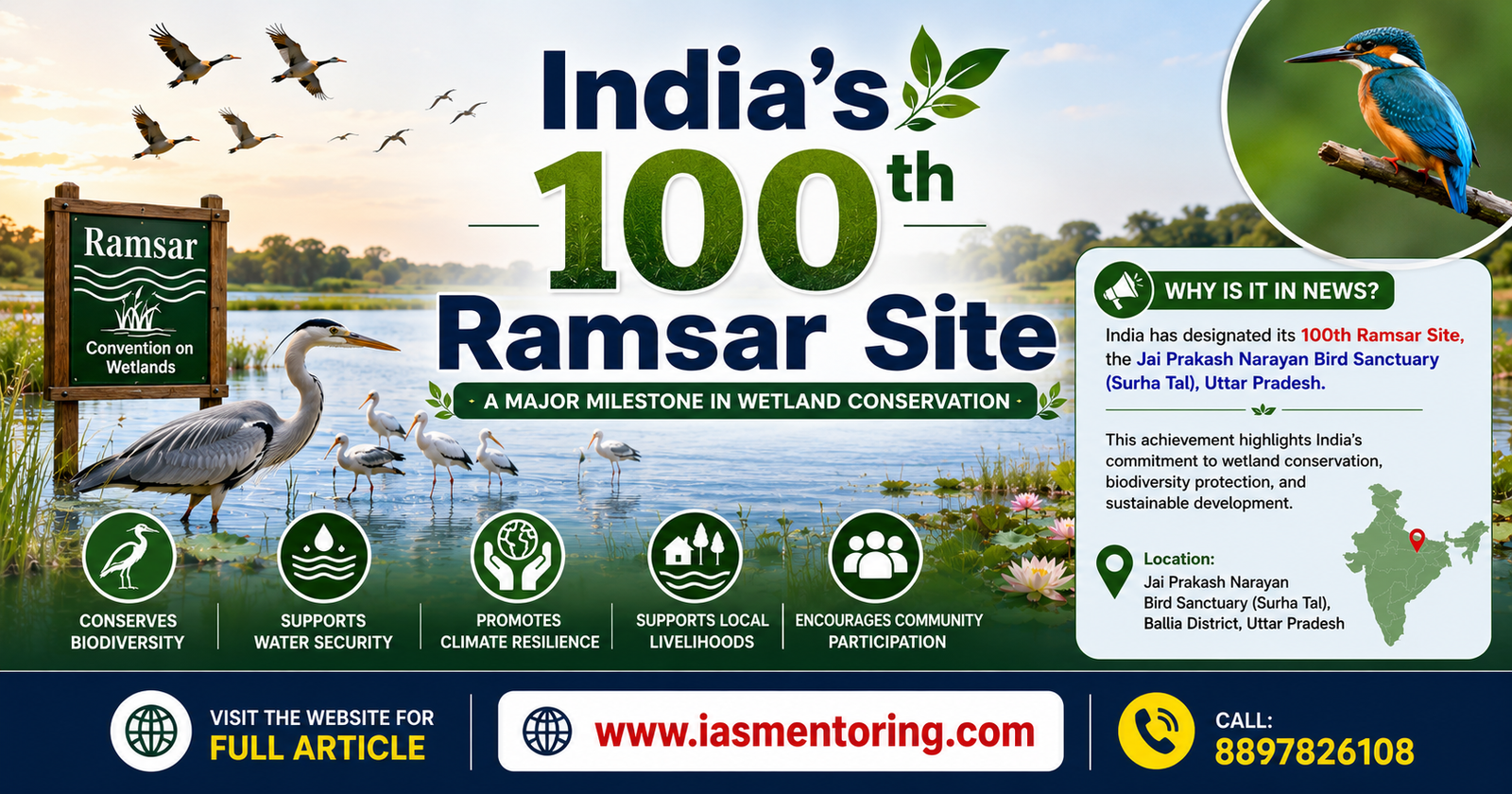
100th Ramsar Site of India, Jai Prakash Narayan Bird Sanctuary (Surha Tal), highlights the our commitment to wetland conservation, biodiversity protection, and sustainable development.
Syllabus Areas:
GS III - Environment & Ecology
India's 100th Ramsar Site is the Jai Prakash Narayan Bird Sanctuary (Surha Tal), located in Ballia district of Uttar Pradesh. It was designated as India's 100th Wetland of International Importance under the Ramsar Convention on World Environment Day (5 June 2026). This reflects the country's growing commitment towards wetland conservation, biodiversity protection, climate resilience, and sustainable development.
The achievement places India among the countries with the highest number of Ramsar Sites globally.
What is a Wetland?
Wetlands are areas where water covers the soil permanently or seasonally. They form a transitional ecosystem between terrestrial and aquatic environments.
Examples include:
-
Lakes
-
Marshes
-
Swamps
-
Mangroves
-
Floodplains
-
Estuaries
-
Peatlands
-
Coastal lagoons
Wetlands are among the most productive ecosystems on Earth.
Ramsar Convention
The Ramsar Convention on Wetlands is an international treaty aimed at the conservation and sustainable use of wetlands.
Key Facts
-
Adopted in 1971.
-
Signed in Ramsar, Iran.
-
Came into force in 1975.
-
India became a Contracting Party in 1982.
The Convention promotes:
-
Conservation of wetlands.
-
Wise use of wetland resources.
-
International cooperation for transboundary wetlands and migratory species.
What is a Ramsar Site?
A Ramsar Site is a wetland recognized as being of international importance under the Ramsar Convention.
Sites are selected based on:
-
Biodiversity value.
-
Ecological uniqueness.
-
Presence of threatened species.
-
Importance for migratory birds.
-
Hydrological significance.
Designation does not change ownership but promotes better management and conservation.
Jai Prakash Narayan Bird Sanctuary (Surha Tal)
Name: Jai Prakash Narayan Bird Sanctuary (Surha Tal)
Location: Ballia District, Uttar Pradesh
Status: India's 100th Ramsar Site
Declared on: 5 June 2026 (World Environment Day)
Type: Freshwater wetland and bird sanctuary
Importance: Supports rich biodiversity, especially migratory and resident waterbirds
Why is Surha Tal Important?
-
It is one of the largest natural freshwater wetlands in eastern Uttar Pradesh.
-
Provides habitat for numerous species of:
-
Migratory birds
-
Fish
-
Aquatic plants
-
Amphibians
-
Plays a crucial role in:
-
Flood moderation
-
Groundwater recharge
-
Biodiversity conservation
-
Livelihood support for local communities.
Significance of Ramsar Sites:
1. Strengthening Biodiversity Conservation
-
Wetlands support Fish, Amphibians, Reptiles, Migratory birds, Aquatic plants
-
Many endangered species depend on wetlands for survival.
2. Climate Change Mitigation
-
Wetlands act as natural carbon sinks by storing large quantities of carbon in vegetation and soil.
They help:
-
Reduce greenhouse gas concentrations.
-
Enhance climate resilience.
3. Flood Control: Wetlands absorb excess water during heavy rainfall and floods, reducing disaster risks.
4. Groundwater Recharge: They facilitate infiltration of water into aquifers and maintain groundwater levels.
5. Livelihood Support
Millions of people depend on wetlands for:
-
Fishing
-
Agriculture
-
Tourism
-
Traditional livelihoods
6. Water Purification: Wetlands naturally filter pollutants and improve water quality.
Wetlands in India: Current Status
India possesses a diverse range of wetlands due to its varied climatic and geographical conditions.
Major wetland types include:
-
Himalayan wetlands
-
Riverine wetlands
-
Coastal wetlands
-
Inland lakes
-
Mangrove ecosystems
States such as Tamil Nadu, Uttar Pradesh, Maharashtra, Gujarat, and West Bengal host several Ramsar Sites.
Challenges Facing Wetlands
-
Urbanization: Rapid expansion of cities has led to encroachment and destruction of wetlands.
-
Pollution: Industrial waste, sewage discharge, and agricultural runoff degrade wetland ecosystems.
-
Invasive Species: Non-native plants and animals disrupt ecological balance.
-
Climate Change: Changes in rainfall patterns and rising temperatures affect wetland hydrology.
-
Unsustainable Resource Extraction: Overfishing, sand mining, and excessive groundwater extraction threaten wetland health.
Government Initiatives for Wetland Conservation
1. National Plan for Conservation of Aquatic Ecosystems (NPCA)
-
Integrated conservation programme.
-
Supports restoration and management of wetlands and lakes.
2. Wetlands (Conservation and Management) Rules, 2017
-
Regulate activities affecting wetlands.
-
Encourage state-level conservation efforts.
3. Amrit Dharohar Scheme
-
Announced in Budget 2023-24.
-
Promotes sustainable use of Ramsar Sites.
-
Encourages local community participation and eco-tourism.
Biodiversity Hotspots and Wetlands
Several wetlands occur within or near biodiversity-rich regions.
India contains parts of four global biodiversity hotspots:
-
Himalayas
-
Indo-Burma
-
Western Ghats–Sri Lanka
-
Sundaland (Nicobar Islands)
Wetlands in these regions support numerous endemic and threatened species.
Way Forward
-
Strengthen wetland mapping and monitoring.
-
Enhance community participation in conservation.
-
Improve scientific management of Ramsar Sites.
-
Promote sustainable tourism.
-
Increase funding for restoration projects.
-
Integrate wetland conservation into climate adaptation strategies.
The recognition of India's 100th Ramsar Site marks a major achievement in environmental governance. Wetlands are essential for biodiversity conservation, climate resilience, water security, and sustainable livelihoods. Continued protection and scientific management of these ecosystems will play a crucial role in India's environmental sustainability and ecological security.