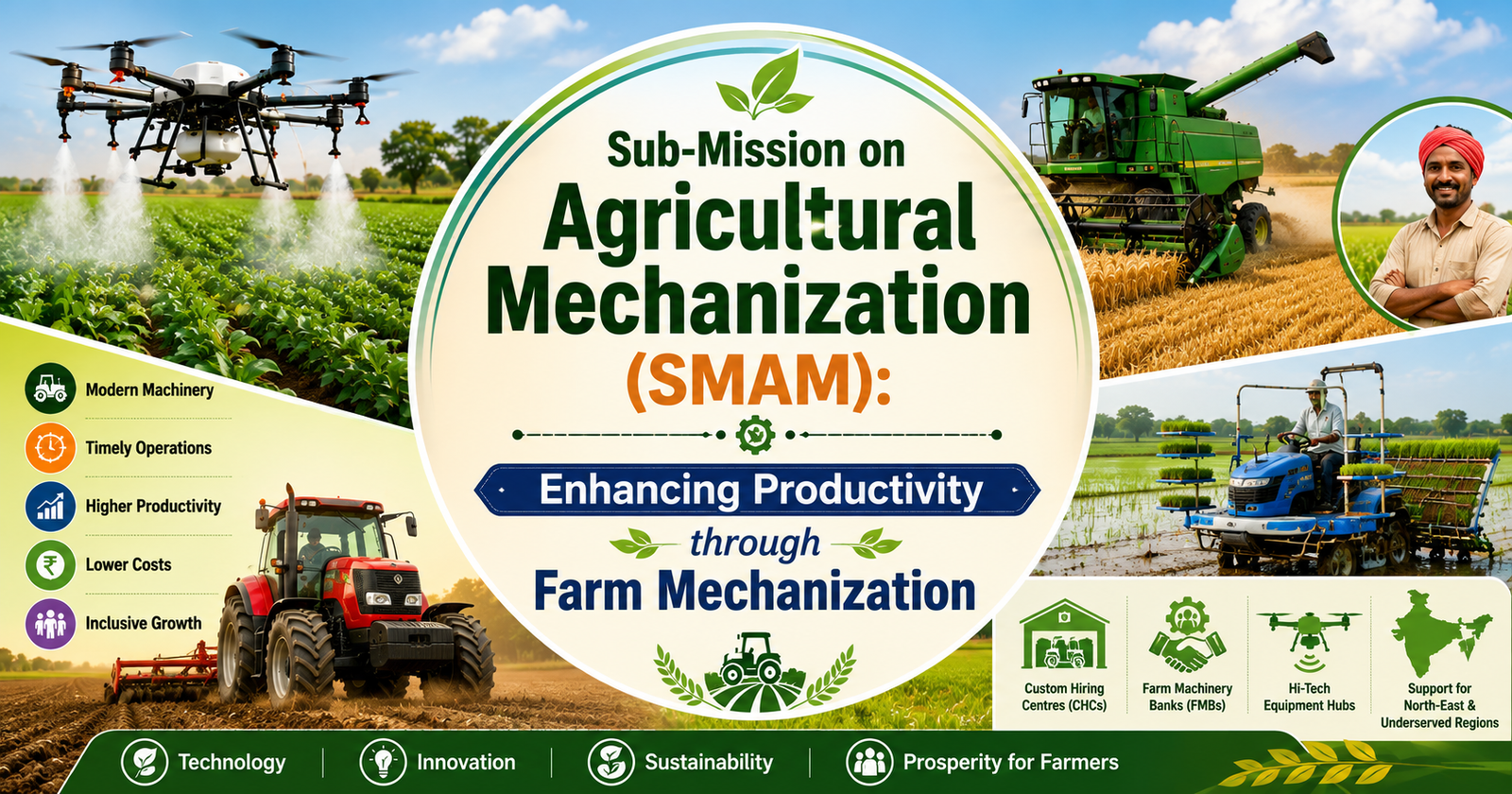
The Sub-Mission on Agricultural Mechanization (SMAM) enhances farm productivity by promoting modern machinery, financial assistance, drone technology, and inclusive mechanization for farmers across India.
Syllabus Areas:
GS III - Economy
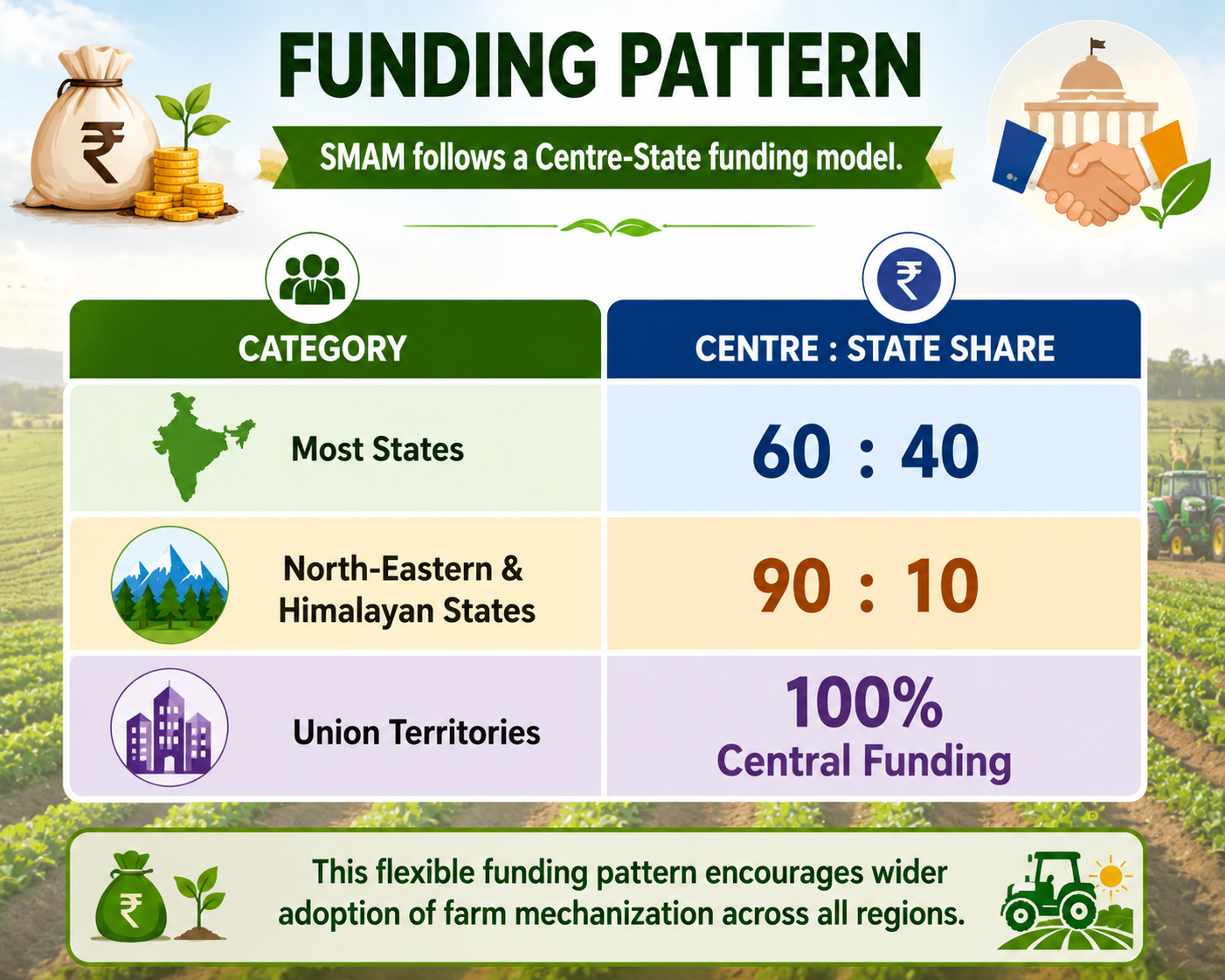
Sub-Mission on Agricultural Mechanization (SMAM) adopts a flexible Centre–State funding pattern to promote agricultural mechanization nationwide, ensuring greater financial support for special regions while enabling wider access to modern farm machinery and technologies.
What is the Sub-Mission on Agricultural Mechanization (SMAM)?
The Sub-Mission on Agricultural Mechanization (SMAM) is a Centrally Sponsored Scheme (CSS) launched in 2014-15 under the Rashtriya Krishi Vikas Yojana (RKVY).
Its primary objective is to:
-
Increase farm productivity through mechanization.
-
Reduce dependence on manual labour.
-
Lower cultivation costs.
-
Improve efficiency in agricultural operations.
-
Ensure small and marginal farmers have access to modern farm machinery.
The scheme particularly focuses on:
-
Small and marginal farmers
-
Women farmers
-
Scheduled Castes (SC)
-
Scheduled Tribes (ST)
-
Farmer Producer Organizations (FPOs)
-
Self Help Groups (SHGs)
-
Rural entrepreneurs
-
North-Eastern States and other underserved regions
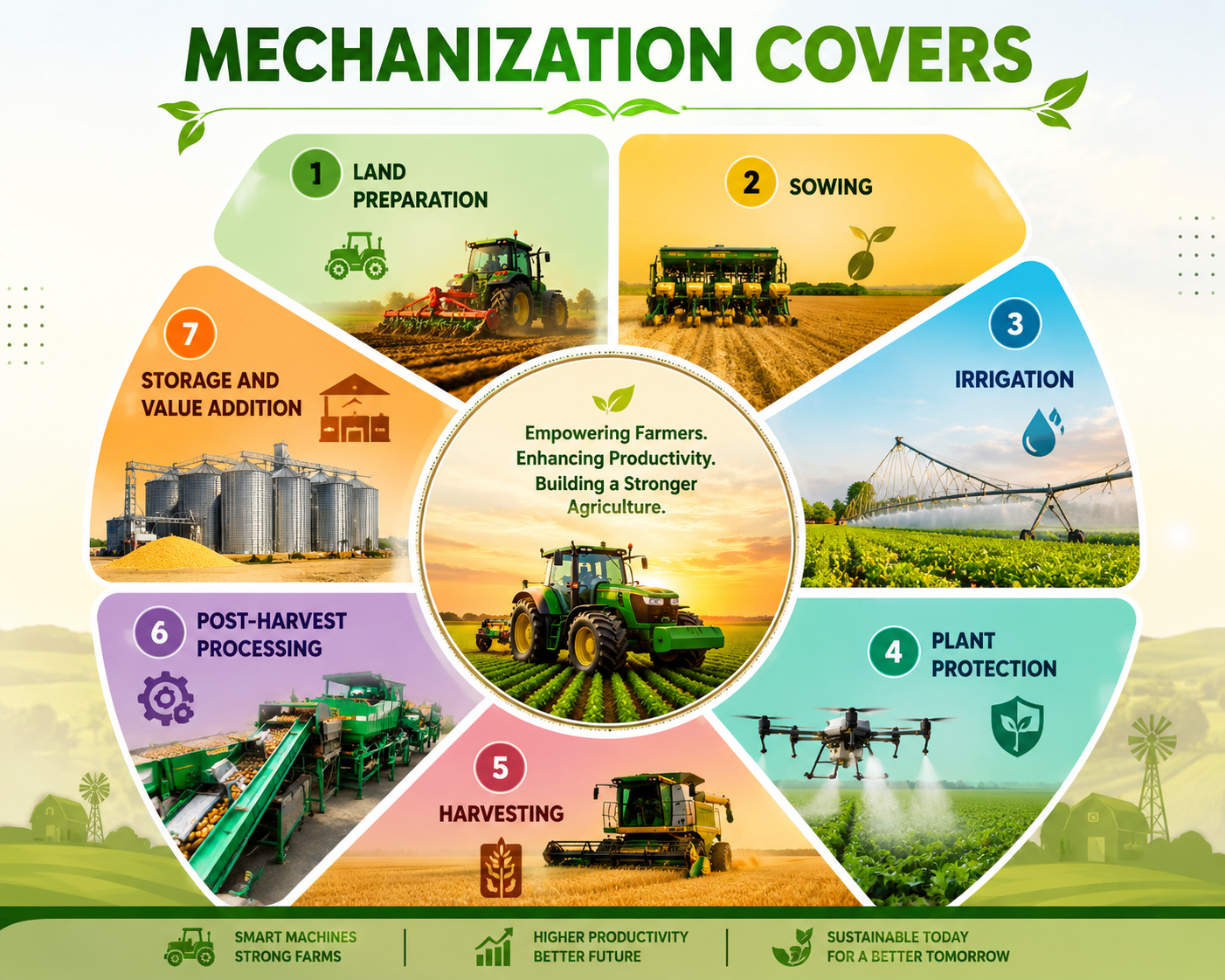
Need for Agricultural Mechanization
Farm mechanization plays an important role in modern agriculture by:
-
Increasing crop productivity.
-
Ensuring timely agricultural operations.
-
Improving precision in farming.
-
Reducing labour shortages.
-
Lowering production costs.
-
Improving post-harvest management.
-
Enhancing overall farm profitability.
Major Components of SMAM
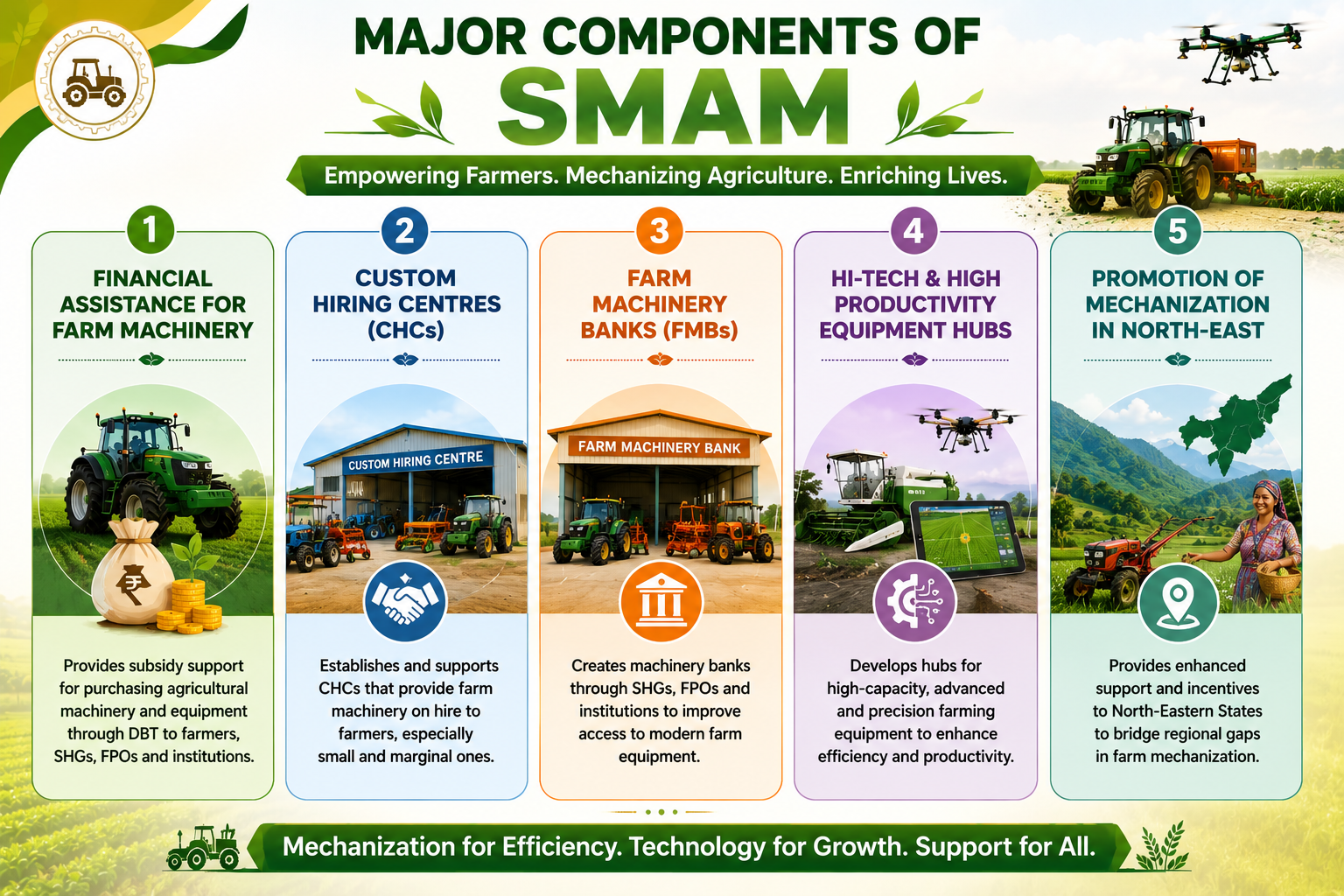
1. Financial Assistance for Farm Machinery
SMAM provides subsidy for purchasing agricultural machinery through the Direct Benefit Transfer (DBT) system.
Subsidy Pattern
-
40% subsidy for general category farmers.
-
50% subsidy for:
-
SC/ST farmers
-
Small & Marginal farmers
-
Farmers of North-Eastern States
Small farmers also receive assistance of ₹2,000 per hectare for hiring mechanized services through CHCs, SHGs and FPOs.
2. Custom Hiring Centres (CHCs)
Custom Hiring Centres are community-based centres that rent farm machinery to farmers.
Importance
-
Helps small farmers use expensive machines without purchasing them.
-
Reduces capital investment.
-
Increases mechanization in small landholdings.
-
Makes advanced machinery affordable.
Financial support:
-
40% assistance for projects up to ₹250 lakh.
3. Farm Machinery Banks (FMBs)
Farm Machinery Banks are established mainly through:
-
SHGs
-
FPOs
-
Local institutions
Financial assistance:
-
80% support for projects up to ₹30 lakh.
Purpose:
-
Improve availability of farm equipment.
-
Promote shared use of machinery.
-
Reduce machinery shortages in rural areas.
4. Hi-Tech & High Productivity Equipment Hubs
These hubs provide access to:
-
High-capacity machinery
-
Precision farming equipment
-
Crop-specific mechanization
-
Modern agricultural technologies
They improve operational efficiency and reduce production costs.
5. Promotion of Mechanization in North-East
Special incentives are provided for North-Eastern States.
These include:
-
Up to 100% subsidy for small agricultural machinery.
-
95% financial support for Farm Machinery Banks.
This aims to reduce regional disparities in access to mechanization.
Focus Areas of SMAM
The scheme focuses on:
-
Expanding mechanization access.
-
Providing financial assistance.
-
Promoting Custom Hiring Centres.
-
Establishing Farm Machinery Banks.
-
Creating Hi-Tech Equipment Hubs.
-
Testing and certification of agricultural machinery.
-
Capacity building.
-
Farmer awareness programmes.
-
Demonstrations of modern technologies.
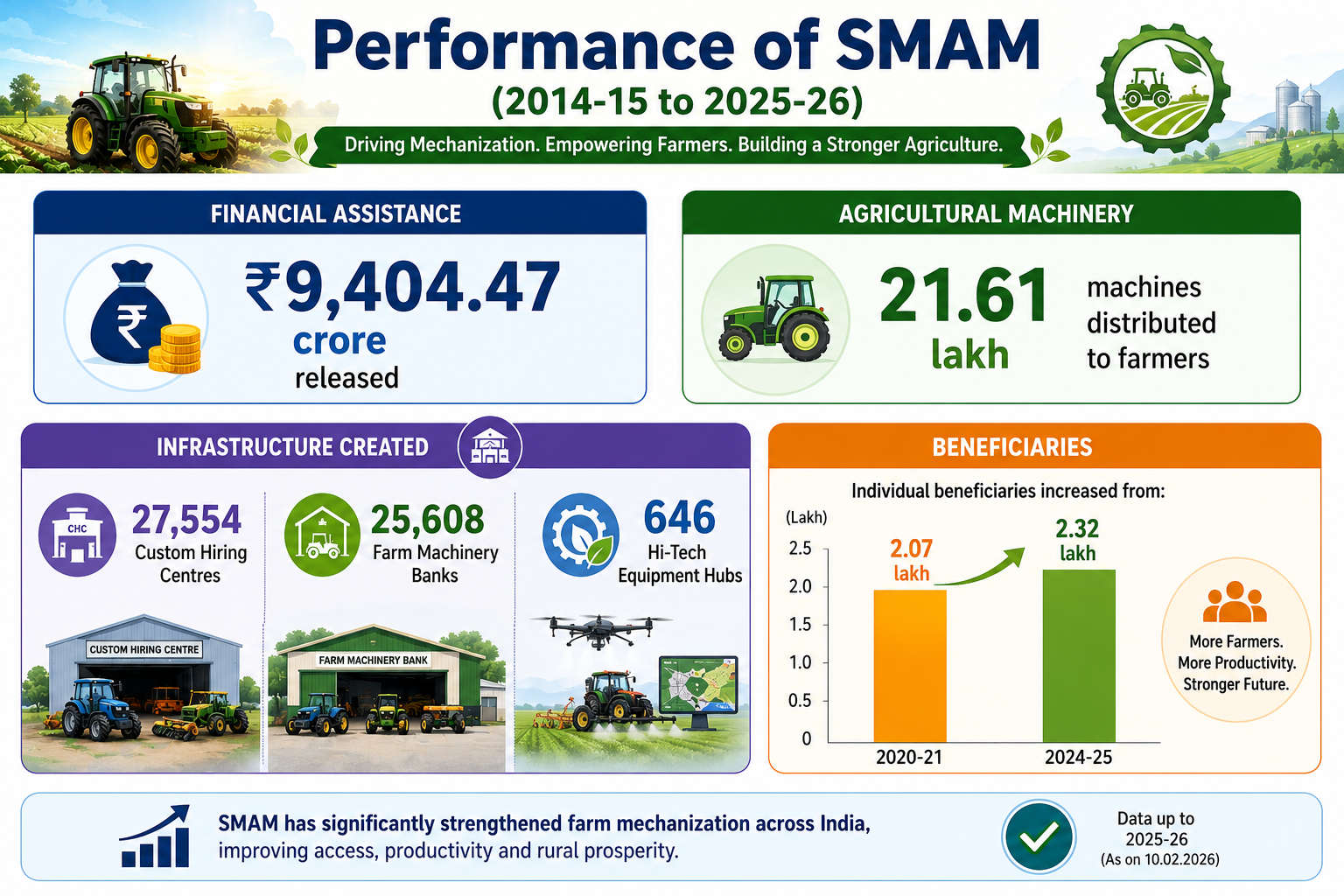
This flexible pattern encourages wider adoption across different regions.
Drone-Based Farming under SMAM
One of the most significant features of SMAM is the promotion of agricultural drones.
Key Achievements
-
₹52.50 crore financial support.
-
40,928 drone demonstrations conducted.
-
Demonstrations covered 40,918 hectares.
These demonstrations focused on:
-
Precision spraying
-
Nutrient application
-
Fertilizer application
-
Agro-chemical spraying
The activities were carried out by:
-
ICAR Institutes
-
Krishi Vigyan Kendras (KVKs)
-
State Agricultural Universities.
Financial Support for Agricultural Drones under SMAM
To encourage the adoption of drone technology in agriculture, the Sub-Mission on Agricultural Mechanization (SMAM) provides financial assistance to institutions and farmer organizations for purchasing and demonstrating agricultural drones.
1. Support for Eligible Institutions
The following institutions are eligible:
-
ICAR Institutes (Indian Council of Agricultural Research)
-
KVKs (Krishi Vigyan Kendras)
-
State Agricultural Universities (SAUs)
Financial Assistance
-
100% financial support is provided.
-
Assistance is available up to ₹10 lakh per drone.
Purpose
These institutions use drones to:
-
Conduct field demonstrations.
-
Train farmers on drone operations.
-
Promote precision agriculture.
-
Demonstrate spraying of fertilizers, pesticides, and nutrients.
-
Encourage large-scale adoption of drone technology across India.
2. Support for Farmer Producer Organizations (FPOs)
Farmer Producer Organizations (FPOs) are groups of farmers registered as collective enterprises to improve their bargaining power and access to modern technologies.
Financial Assistance
-
FPOs receive up to 75% grant support for purchasing agricultural drones.
Purpose
This support enables FPOs to:
-
Purchase drones for shared use by member farmers.
-
Offer drone services on a rental basis.
-
Reduce the cost of drone technology for small and marginal farmers.
-
Improve efficiency in spraying, crop monitoring, and precision farming.
-
Increase farm productivity while reducing labour costs.
Why this Support is Important
-
Makes expensive drone technology affordable.
-
Promotes precision farming and resource efficiency.
-
Encourages collective farming through FPOs.
-
Reduces excessive use of fertilizers and pesticides.
-
Helps modernize Indian agriculture and supports sustainable farming practices.
Drone Service Providers
Receive contingency assistance of:
-
₹6,000 per hectare
Individual Ownership
-
50% subsidy (up to ₹5 lakh) for:
-
Women farmers
-
SC/ST farmers
-
Small & marginal farmers
-
Farmers from North-East
-
40% subsidy (up to ₹4 lakh) for other farmers.
Women-Centric Provision
SMAM reserves:
-
30% of total funds for women farmers.
This aims to:
-
Increase ownership of agricultural machinery.
-
Promote women-led mechanized farming.
-
Improve gender inclusion in agriculture.
Link with Rashtriya Krishi Vikas Yojana (RKVY)
SMAM operates under the umbrella of Rashtriya Krishi Vikas Yojana (RKVY).
About RKVY
-
Launched in 2007.
-
Encourages states to increase investment in agriculture.
-
Provides flexibility to states in designing projects.
-
Covers crop production, infrastructure, mechanization and value addition.
-
Restructured as RKVY-RAFTAAR in 2017-18, with greater emphasis on innovation and strengthening pre- and post-harvest infrastructure.
Significance of SMAM
The scheme has significantly contributed to:
-
Modernizing Indian agriculture.
-
Increasing productivity and efficiency.
-
Reducing labour shortages.
-
Lowering cultivation costs.
-
Improving timely farm operations.
-
Encouraging precision farming.
-
Supporting climate-smart agriculture.
-
Promoting inclusive growth by targeting small farmers, women and disadvantaged communities.
-
Enhancing rural entrepreneurship through Custom Hiring Centres and Farm Machinery Banks.
-
Accelerating digital agriculture through drone technology.
Challenges
-
Small and fragmented landholdings.
-
High cost of advanced machinery.
-
Limited awareness among farmers.
-
Shortage of trained operators.
-
Maintenance and repair issues in rural areas.
-
Uneven mechanization across states.
-
Need for greater adoption of precision agriculture technologies.
Way Forward
-
Expand Custom Hiring Centres in remote regions.
-
Increase adoption of AI, IoT and drones in farming.
-
Strengthen skill development for machine operators.
-
Improve rural repair and maintenance infrastructure.
-
Promote climate-smart and precision agriculture.
-
Enhance support for women farmers and FPOs.
-
Integrate mechanization with digital agriculture initiatives.
-
Encourage state-specific mechanization strategies based on cropping patterns.
SMAM is transforming Indian agriculture by promoting mechanization, supporting small farmers, expanding drone technology, improving productivity, reducing cultivation costs, and making modern farming more inclusive, efficient, and sustainable nationwide.