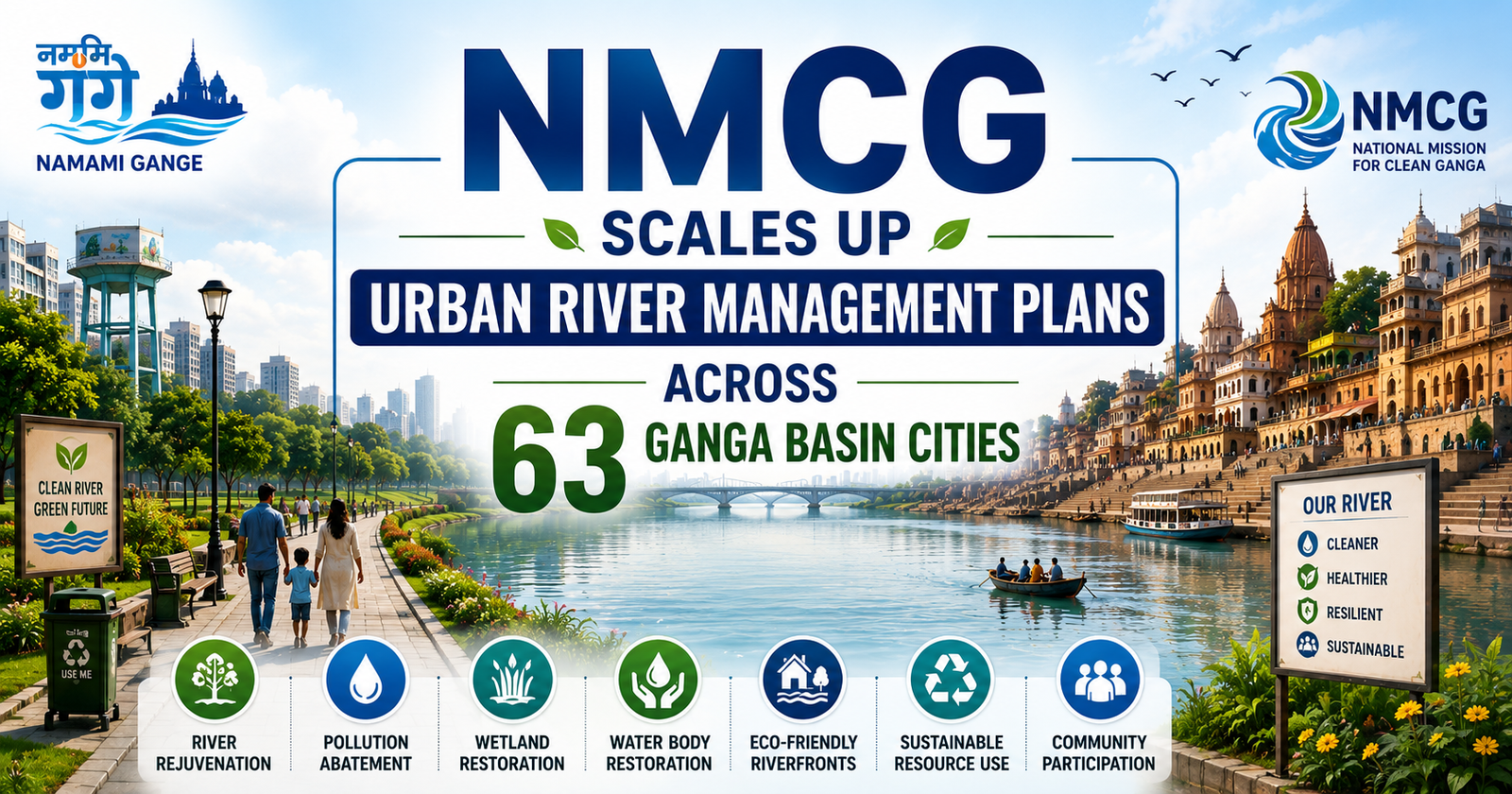
NMCG expands Urban River Management Plans across 63 Ganga Basin cities, integrating river conservation with sustainable urban planning through ecological restoration, pollution control, flood resilience, and community participation.
Syllabus Areas:
GS I - Geography
GS II - Governance
GS III - Environment and Ecology
The National Mission for Clean Ganga (NMCG), in collaboration with the National Institute of Urban Affairs (NIUA), has completed Urban River Management Plans (URMPs) for 13 cities and is expanding the initiative across 63 Ganga Basin cities. The programme seeks to integrate river conservation with urban planning, making rivers the focal point of sustainable city development.
The initiative originates from the vision articulated by the Prime Minister during the National Ganga Council Meeting (Kanpur, December 2019), where emphasis was laid on:
-
Protecting rivers while planning cities
-
Improving river ecology
-
Integrating urban development with river conservation
-
Enhancing citizens' relationship with rivers
What is the National Mission for Clean Ganga (NMCG)?
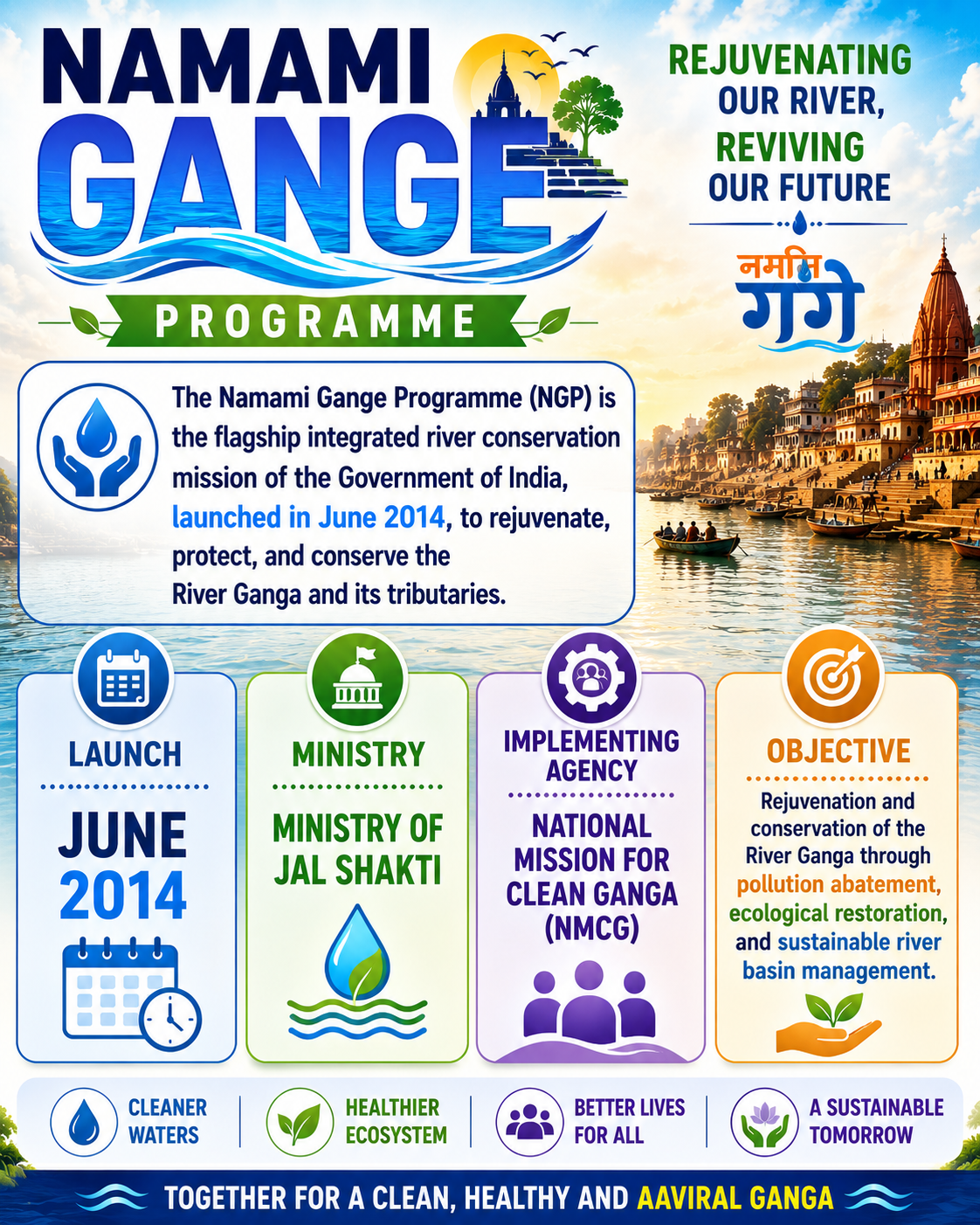
The National Mission for Clean Ganga (NMCG) is the implementation arm of the Namami Gange Programme under the Ministry of Jal Shakti.
Objectives
-
Reduce pollution in the River Ganga
-
Restore river ecology
-
Conserve biodiversity
-
Promote sustainable urban and rural sanitation
-
Improve riverfront management
-
Ensure ecological flows (e-flows)
Legal Status
-
Registered as a Society in 2011.
-
Declared as the implementation authority under the Environment (Protection) Act, 1986.
Urban River Management Plan (URMP)
-
A city-level planning framework integrating river conservation with urban planning.
-
Developed jointly by NMCG and NIUA.
-
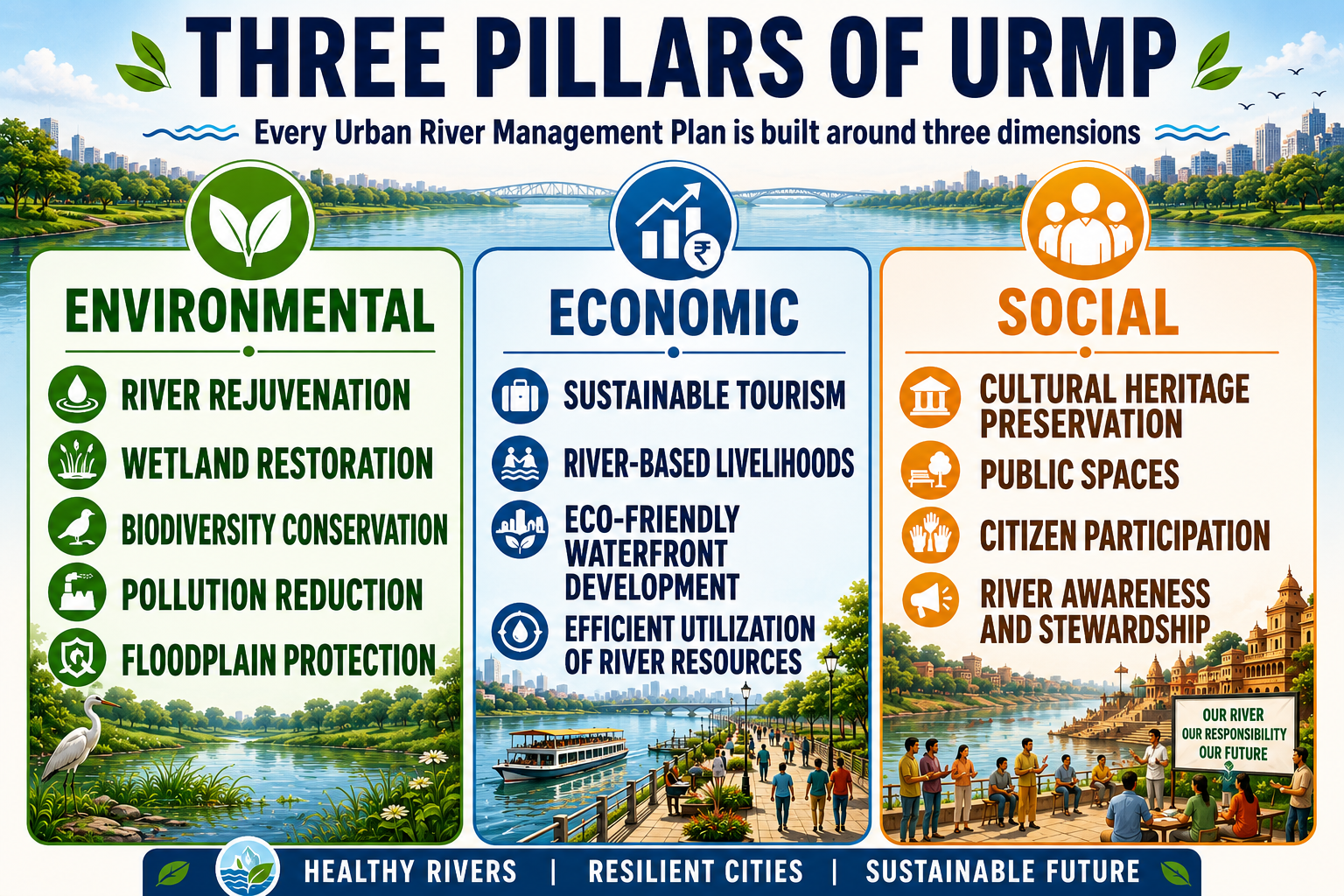
Based on environmental, economic and social sustainability.
-
Promotes nature-based solutions, flood resilience, pollution control, wetland restoration, and citizen participation.
-
Intended to become a national model for river-sensitive urban planning.
Ten Major Components of URMP
The framework includes:
-
Floodplain regulation: Floodplain regulation controls land use in areas adjacent to rivers that are prone to flooding.
-
Pollution abatement:
-
Pollution abatement involves measures to reduce the discharge of untreated sewage, industrial waste, and solid waste into rivers.
-
It improves water quality, protects aquatic life, and restores river ecosystems.
-
Wetland rejuvenation:
-
Wetland rejuvenation restores degraded wetlands to improve their ecological functions.
-
Healthy wetlands enhance biodiversity, naturally filter pollutants, and reduce flood risks.
-
Restoration of water bodies: This involves reviving lakes, ponds, streams, and other water bodies affected by pollution or encroachment.
-
Riparian buffer development
-
Riparian buffers are vegetated strips along riverbanks that protect rivers from erosion and pollution.
-
They stabilize banks, filter runoff, and provide habitat for wildlife.
-
Reuse of treated wastewater: Treated wastewater is recycled for irrigation, industries, landscaping, and other non-potable uses.
-
Eco-sensitive riverfront development: It promotes riverfront development while preserving the natural ecology and cultural heritage of rivers.
-
Maintaining environmental flows: Environmental flows ensure that sufficient water remains in rivers to sustain ecosystems throughout the year.
-
Sustainable economic utilization of rivers: It promotes responsible use of river resources for tourism, fisheries, navigation, and livelihoods without degrading ecosystems.
-
Community engagement and public participation: Local communities are encouraged to participate in river conservation through awareness, monitoring, and clean-up activities.
Nature-Based Solutions Promoted
A distinguishing feature of URMP is the adoption of Nature-Based Solutions (NbS).
Examples include:
-
Constructed wetlands
-
Sponge landscapes: Sponge landscapes are urban green spaces designed to absorb, store, and slowly release rainwater, reducing floods, recharging groundwater, and improving climate resilience.
-
Bioswales: Bioswales are vegetated drainage channels that capture, filter, and infiltrate stormwater runoff, removing pollutants, reducing flooding, and improving groundwater recharge and water quality
-
Riparian restoration
-
Ecological drains
-
Wetland rejuvenation
-
Rainwater infiltration systems
-
Groundwater recharge
-
Green riverfronts
These reduce pollution while increasing flood resilience and biodiversity.
Pilot Cities and Scale-Up
The programme evolved from successful pilot projects in:
-
Ayodhya
-
Kanpur
-
Chhatrapati Sambhaji Nagar
Based on these successes, URMP is now being expanded across the Ganga Basin using a scalable and locally adaptable model rather than a "one-size-fits-all" approach.
Future Roadmap
The government plans to:
-
Expand URMP beyond the Ganga Basin
-
Institutionalise river-sensitive urban planning nationwide
-
Develop basin-based planning frameworks for all major rivers
-
Create resilient, climate-adaptive and sustainable cities
This marks a transition from isolated river-cleaning projects to integrated river basin governance.