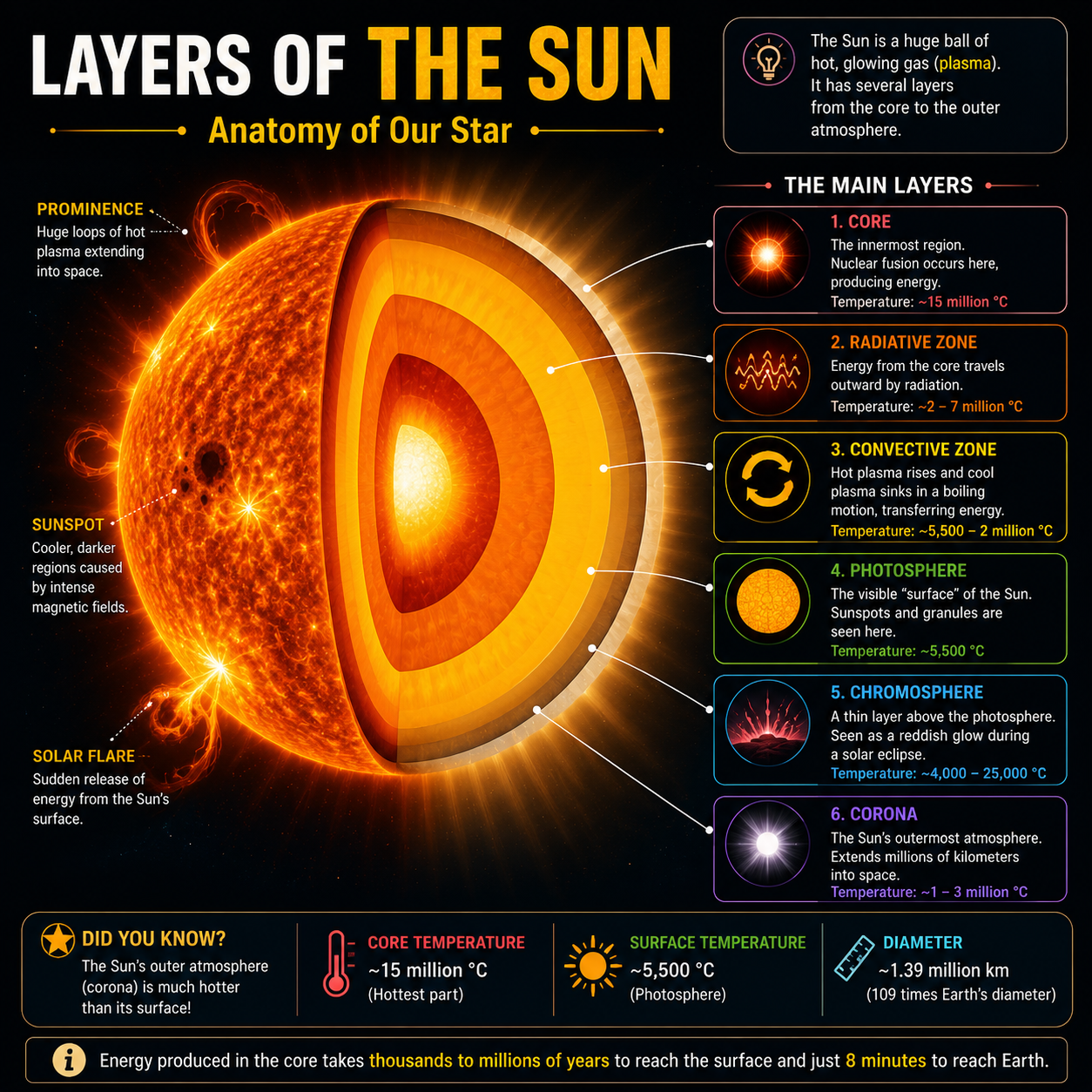
Scientists discovered that the upper atmosphere of the Sun remains magnetically connected to its deep interior, supporting the Magnetic Tree Hypothesis and improving understanding of solar activity and space weather.
Syllabus Areas:
GS I - Geography
GS III - S & T
Scientists have discovered that the Sun's slow-moving plasma flow extends much higher into its atmosphere than previously known. The study provides the first strong observational evidence for the "Magnetic Tree" hypothesis, improving our understanding of the Sun's magnetic field, solar activity, and space weather that affects Earth.
Hidden Plasma Flow Discovered
-
Researchers identified a hidden connection between the Sun's surface and its upper atmosphere.
-
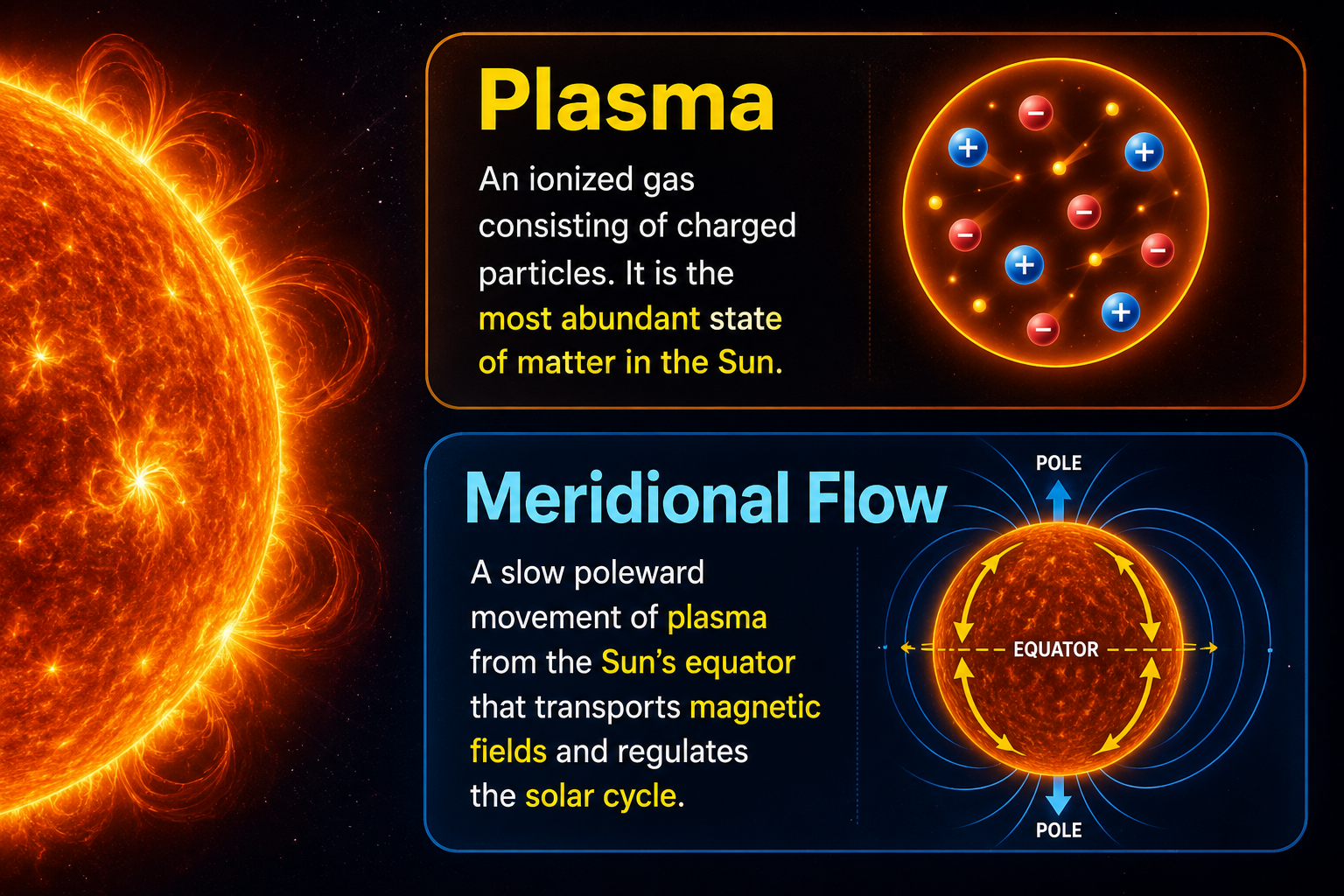
The Sun contains a slow movement of hot ionized gas (plasma) called the Meridional Flow.
-
This plasma moves from the equator toward the poles.
-
Earlier, scientists believed this flow existed only in the Sun's lower atmosphere.
-
The latest study proves that it continues nearly 3,000 km above the visible surface into the upper chromosphere.
Meridional Flow:
-
It plays a crucial role in the 11-year solar cycle and controls the formation of sunspots and other solar activities.
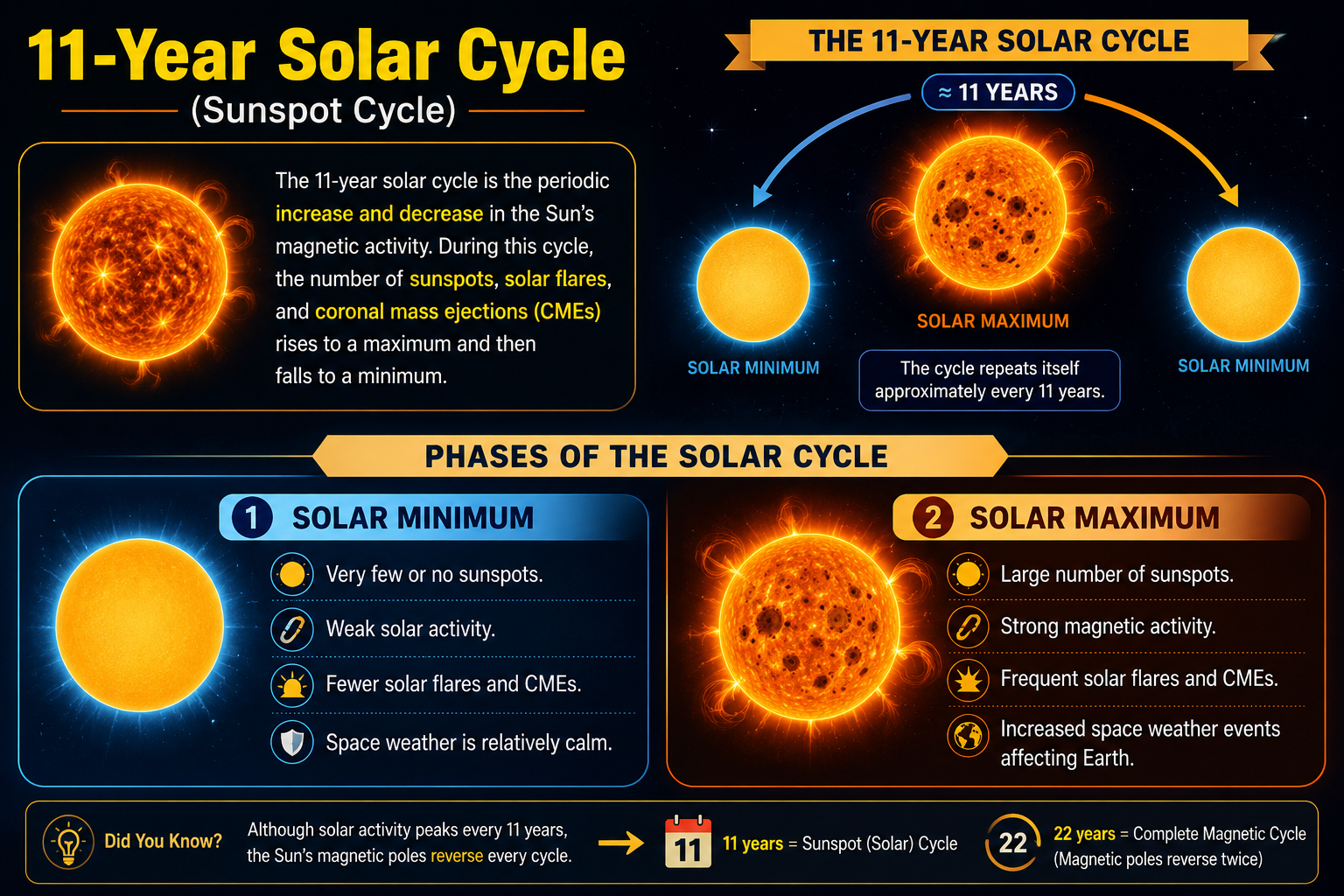
Sunspots: Dark, cooler regions on the Sun's surface caused by intense magnetic fields. They indicate high solar activity and often produce solar flares.
Why is this Discovery Important?
The discovery helps scientists:
-
Understand how the Sun's magnetic field evolves.
-
Improve prediction of solar storms.
-
Better forecast space weather.
-
Protect satellites and spacecraft.
-
Reduce disruptions in communication systems.
-
Improve GPS and navigation reliability.
-
Safeguard electrical power grids from solar disturbances.
How was the Research Conducted?
Researchers analyzed:
-
27 years of radio observations.
-
Data collected by the Nobeyama Radioheliograph (Japan).
Instead of tracking sunspots directly, scientists developed an innovative image-correlation technique.
The Method
-
Compared thousands of full-disk radio images.
-
Images were taken one day apart.
-
Measured tiny shifts in brightness patterns.
-
Tracked large-scale plasma movement over three decades.
This enabled researchers to observe plasma motion in regions previously difficult to study.
Major Findings
Plasma Speed
-
Plasma in the upper chromosphere moves toward the poles at:
-
5–15 metres per second
-
This speed is similar to plasma movement in deeper solar layers.
Solar Cycle Influence
-
Plasma flow changes throughout the solar cycle.
-
Northern and Southern hemispheres behave differently.
-
The variation depends on which hemisphere is magnetically more active.

Relationship Between Plasma and Magnetic Fields
Researchers observed that:
-
Bright radio features move poleward.
-
Their movement closely matches the transport of magnetic fields.
-
This confirms that plasma flow and magnetic field evolution are strongly interconnected.
Importance for Space Weather
Understanding plasma and magnetic field movement is essential because they drive:
-
Solar flares
-
Solar storms
-
Coronal mass ejections (CMEs)
-
Space weather events
These phenomena can impact:
-
Satellites
-
Space missions
-
Radio communications
-
GPS systems
-
Aviation
-
Power transmission networks on Earth.