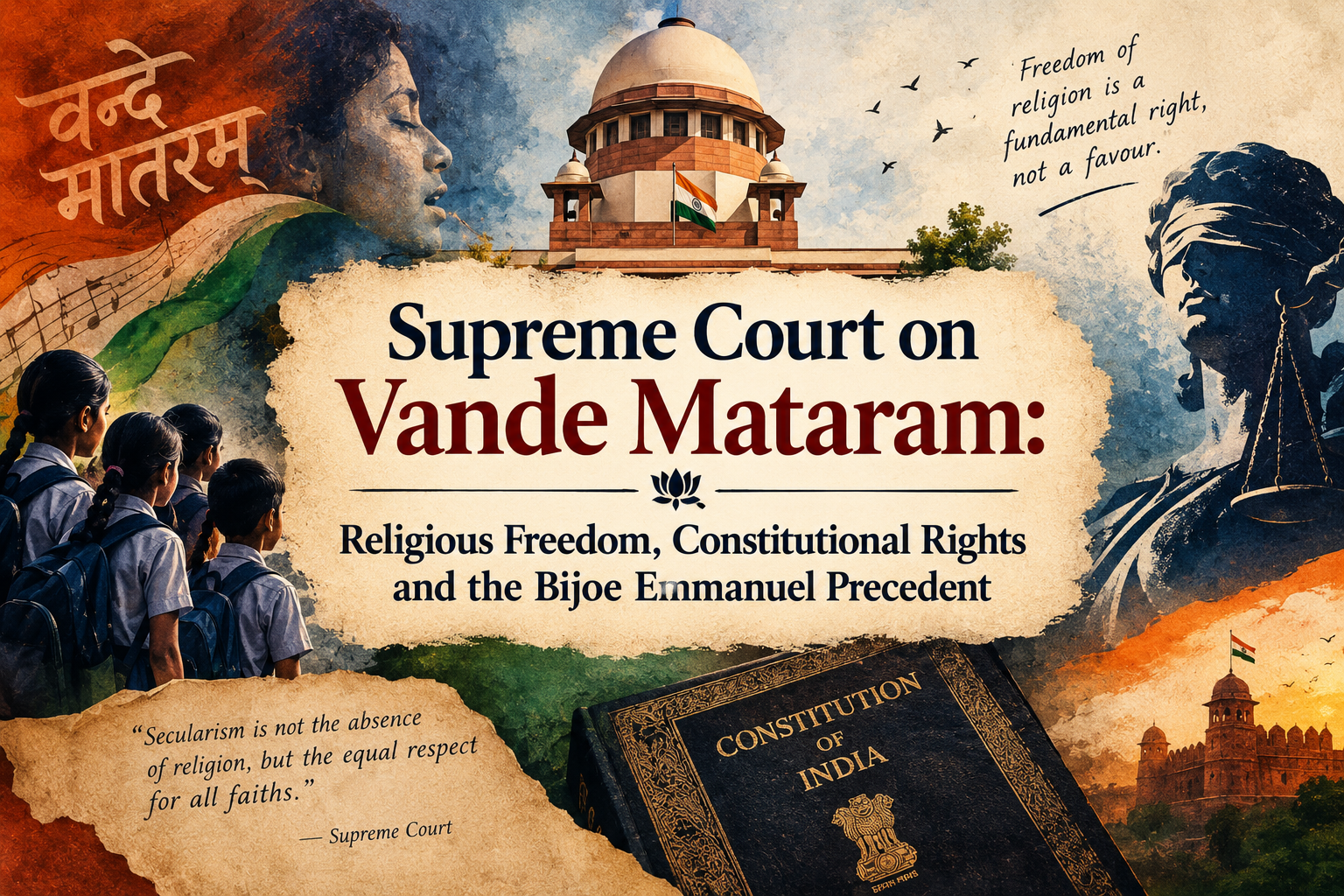
The article examines the Supreme Court’s approach to Vande Mataram, religious freedom and conscientious objection, drawing on the constitutional principles established in Bijoe Emmanuel vs. State of Kerala.
SYLLABUS AREAS:
GS Paper I – Modern Indian History, World History, Indian National Movement, Post-independence India
GS Paper II – International Relations
-
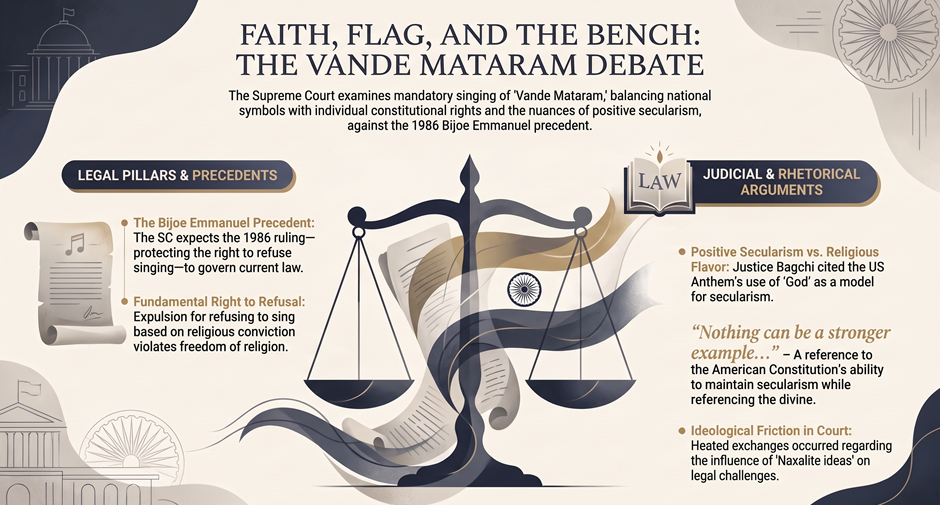
Hearing plea of Carnatic vocalist T M Krishna, SC says it would expect 1986 judgment in Bijoe Emmanuel Vs State of Kerala to govern amended law on Vande Mataram. (SC had then said expulsion of Emmanuel and his sisters from school for refusing to sing national anthem violated their fundamental right to freedom of religion)
-
Heated exchange ensues after solicitor general Tushar Mehta says law-making could not go by the 'diktat of Naxalite ideas'. Petitioner's counsel S Muralidhar says comment does not 'befit' a law officer. Mehta stands by the remark
-
On argument against singing of stanzas with religious flavour, Justice Bagchi says, 'Nothing can be more strong... secularism than the American constitution. But the American anthem uses the word 'God''
Religious flavour or an icon or homage to a particular God may not perhaps impact secularism. "If so, nothing can be a stronger example of positive secularism than the American Constitution, yet the American National Anthem uses the word 'God'," the judge reasoned.
-
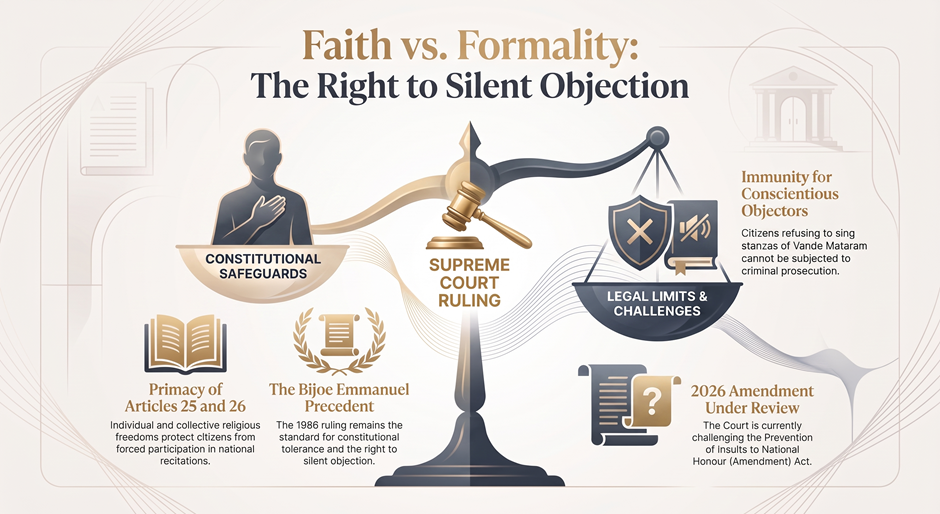
The Supreme Court observed that while a democratically elected government may give shape to the scope and length of the National Song, it cannot violate individual and collective religious freedoms or subject conscientious objectors, who refuse to sing one or all the stanzas of the Vande Mataram, to penal consequences.
-
Nobody can infract Article 25 and 26 [religious freedom] or subject a conscientious objector to penal consequences... It is for the conscientious objector to recite one or all stanzas of the National Song without subjecting himself to criminal prosecution,
-
The 1986 Supreme Court precedent in Bijoe Emmanuel versus State of Kerala, upholding the right to religious freedom, constitutional tolerance, and silent objection, still holds true.
-
The court sought a response from the Union government on a petition filed by renowned Carnatic vocalist and author T.M. Krishna challenging the Prevention of Insults to National Honour (Amendment) Act, 2026, read with the administrative directions issued by the Union Home Ministry in January.
SC Adds More Safeguards for Re-Arrest: Article 22(1), (2)
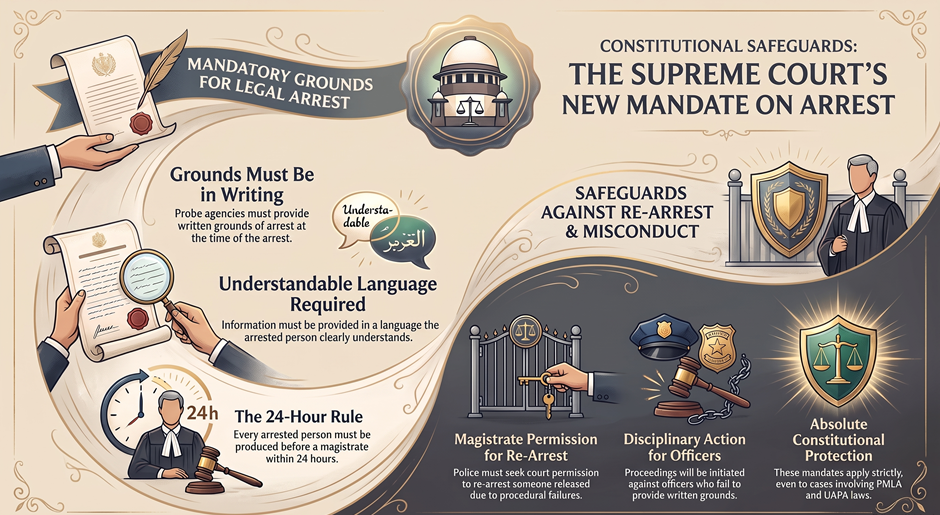
IN a far-reaching order, the Supreme Court said if a person is not informed of the grounds of his arrest in writing and in a language understood by the accused, it would amount to a violation of his fundamental rights, rendering the arrest illegal.
"An arrested person must be provided the grounds of arrest by the probe agency at the time of arrest and it must be in written form and in language understandable to the arrested person," said a two-judge bench of justices Ujjal Bhuyan and Atul Chandurkar. The court, further, ruled disciplinary proceedings be initiated against any police officer who arrests a person without furnishing the grounds of arrest in writing.
The court made these observations while holding as illegal the arrest of Jaskaranjit Singh, Shiromani Akali Dal-affiliated Mullanpur Dakha constituency in-charge, in a case of alleged sexual assault of a minor.
The court said the grounds of arrest were not furnished to Singh, adding its orders have to be followed for offences even under PMLA and UAPA cases. It also held that police must seek a magistrate's permission to re-arrest a person released by a court for not furnishing grounds of arrest in writing.
Articles 22(1) and 22(2) of the Constitution, which say no person can be arrested without being provided grounds of arrest, and that every person arrested be produced before a magistrate within 24 hours, can't be tinkered with, the court said.
Also read:
1. National Anthem and National Song:
https://iasmentoring.com/current_affairs/details/national-anthem-and-national-song-171
2. Prevention of Insults to National Honour amendment bill 2026: