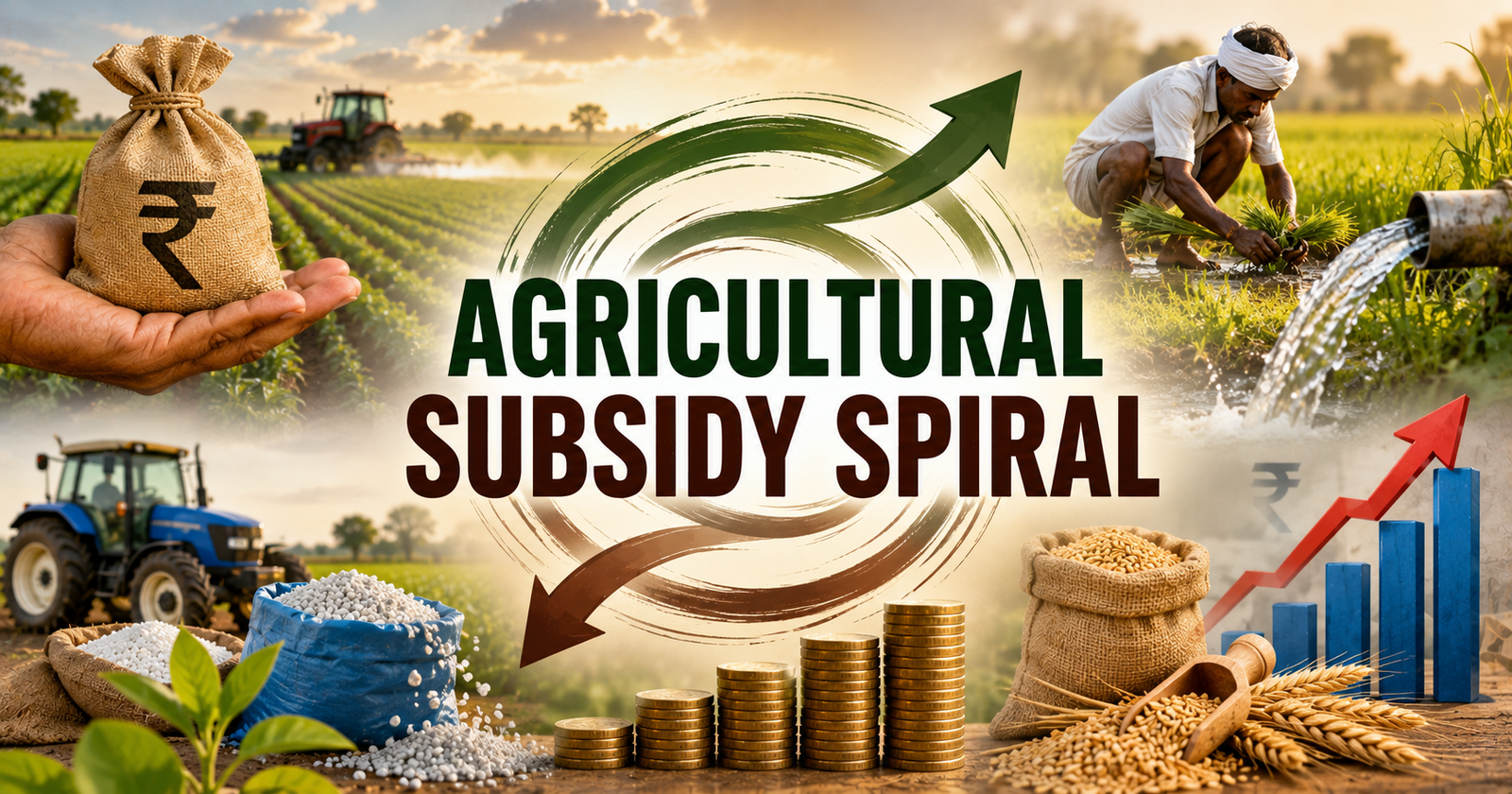
Explore the growing fiscal burden of agricultural subsidies in India, their impact on farmers, economy and environment, and the urgent need for sustainable agricultural reforms and productivity-focused support systems.
Syllabus Areas:GS III - Economy, Agriculture |
Agricultural subsidies have played a major role in supporting Indian farmers since Independence. They helped increase food production, reduce cultivation costs, and strengthen food security during the Green Revolution period. However, over time, the subsidy system has expanded rapidly and is now creating serious fiscal, environmental, and economic concerns.
What are Agricultural Subsidies?
Agricultural subsidies are financial support measures provided by the government to reduce farming costs and support agricultural production.
Major subsidies in India include:
-
Fertilizer subsidy
-
Free or subsidized electricity
-
Irrigation subsidy
-
MSP procurement support
-
Farm loan waivers
These subsidies aim to protect farmers from market risks and income instability.
Why Subsidies Were Important
Subsidies helped India:
-
Achieve food self-sufficiency
-
Increase wheat and rice production
-
Reduce rural poverty
-
Support small and marginal farmers
-
Stabilize food prices
During the Green Revolution, subsidies encouraged farmers to adopt fertilizers, irrigation, and modern farming methods.
Fertilizer Subsidy and Its Problems
India provides huge subsidies on fertilizers, especially urea, to make them affordable for farmers.
Main Concern
Because urea is heavily subsidized, farmers often use excessive nitrogen fertilizers while ignoring balanced nutrient usage.
This has led to:
-
Soil degradation
-
Decline in soil fertility
-
Water pollution
-
Reduced agricultural sustainability
The fertilizer subsidy bill has also increased sharply due to rising global prices of energy and raw materials.
Power Subsidy and Groundwater Crisis
Many states provide free or highly subsidized electricity for agricultural pumps.
Positive Side
-
Reduces irrigation costs
-
Helps poor farmers
Major Problems
Cheap electricity encourages overuse of groundwater because farmers continuously pump water without worrying about cost.
This has caused:
-
Groundwater depletion
-
Falling water tables
-
Water scarcity in states like Punjab and Haryana
State electricity companies also face huge financial losses due to free power schemes.
MSP and Procurement Distortions
The Minimum Support Price (MSP) system protects farmers from price crashes and ensures procurement for food security.
Benefits
-
Stable income for farmers
-
Food grain availability
-
Support for Public Distribution System (PDS)
Problems
MSP procurement mainly focuses on rice and wheat.
As a result:
-
Farmers continue growing water-intensive crops
-
Crop diversification is discouraged
-
Ecological imbalance increases
Even in regions facing water scarcity, farmers prefer rice cultivation because of assured procurement.
Freebies and Populist Policies
Political parties increasingly announce:
-
Loan waivers
-
Free electricity
-
Free farm inputs
-
Cash transfers
These measures provide short-term political benefits but create long-term fiscal pressure.
The editorial warns that excessive freebie politics reduces government capacity to invest in:
-
Irrigation infrastructure
-
Agricultural research
-
Storage facilities
-
Rural development
Fiscal Burden on Government
Agricultural subsidies now consume a large share of government expenditure.
This creates:
-
Higher fiscal deficits
-
Reduced spending capacity in health and education
-
Pressure on public finances
The article argues that India cannot continue expanding subsidies indefinitely without affecting economic stability.
Environmental Consequences
Current subsidy structures encourage unsustainable farming practices.
Major environmental impacts include:
-
Excessive groundwater extraction
-
Soil nutrient imbalance
-
Chemical pollution
-
Monocropping of rice and wheat
Instead of promoting sustainable agriculture, subsidies often encourage overuse of natural resources.
Market Distortions
Subsidies influence farmers’ decisions artificially.
Farmers often choose crops based on:
-
MSP benefits
-
Subsidized inputs
-
Government procurement
rather than:
-
Market demand
-
Ecological suitability
-
Water availability
This reduces efficiency and slows agricultural modernization.
Why Subsidies Cannot Be Removed Completely
Despite the problems, subsidies remain important because Indian agriculture is still highly vulnerable.
Farmers face:
-
Climate uncertainty
-
Monsoon failures
-
Price fluctuations
-
Small landholdings
-
Rising input costs
Sudden withdrawal of subsidies may increase rural distress and farmer insecurity.
Therefore, reforms must be gradual and balanced.
What Reforms are Needed?
1. Shift Towards Income Support
Instead of heavily subsidizing inputs, governments can provide direct income support to farmers through schemes like PM-KISAN.
This reduces market distortions and gives farmers flexibility.
2. Encourage Crop Diversification
Farmers should be encouraged to cultivate:
-
Pulses
-
Oilseeds
-
Millets
-
Horticulture crops
This improves:
-
Water conservation
-
Soil health
-
Nutritional security
3. Promote Sustainable Farming
Government support should encourage:
-
Drip irrigation
-
Organic farming
-
Natural farming
-
Efficient water usage
Subsidies should reward sustainability instead of resource overuse.
4. Invest in Agricultural Infrastructure
Long-term investment is needed in:
-
Cold storage
-
Food processing
-
Irrigation systems
-
Agricultural research
-
Rural logistics
Such investments improve productivity more effectively than excessive subsidies.
Agricultural subsidies were essential in ensuring India’s food security and farmer protection. However, the current subsidy structure is creating fiscal stress, environmental damage, and economic distortions.
India now needs a balanced approach that protects farmers while promoting sustainability and productivity.