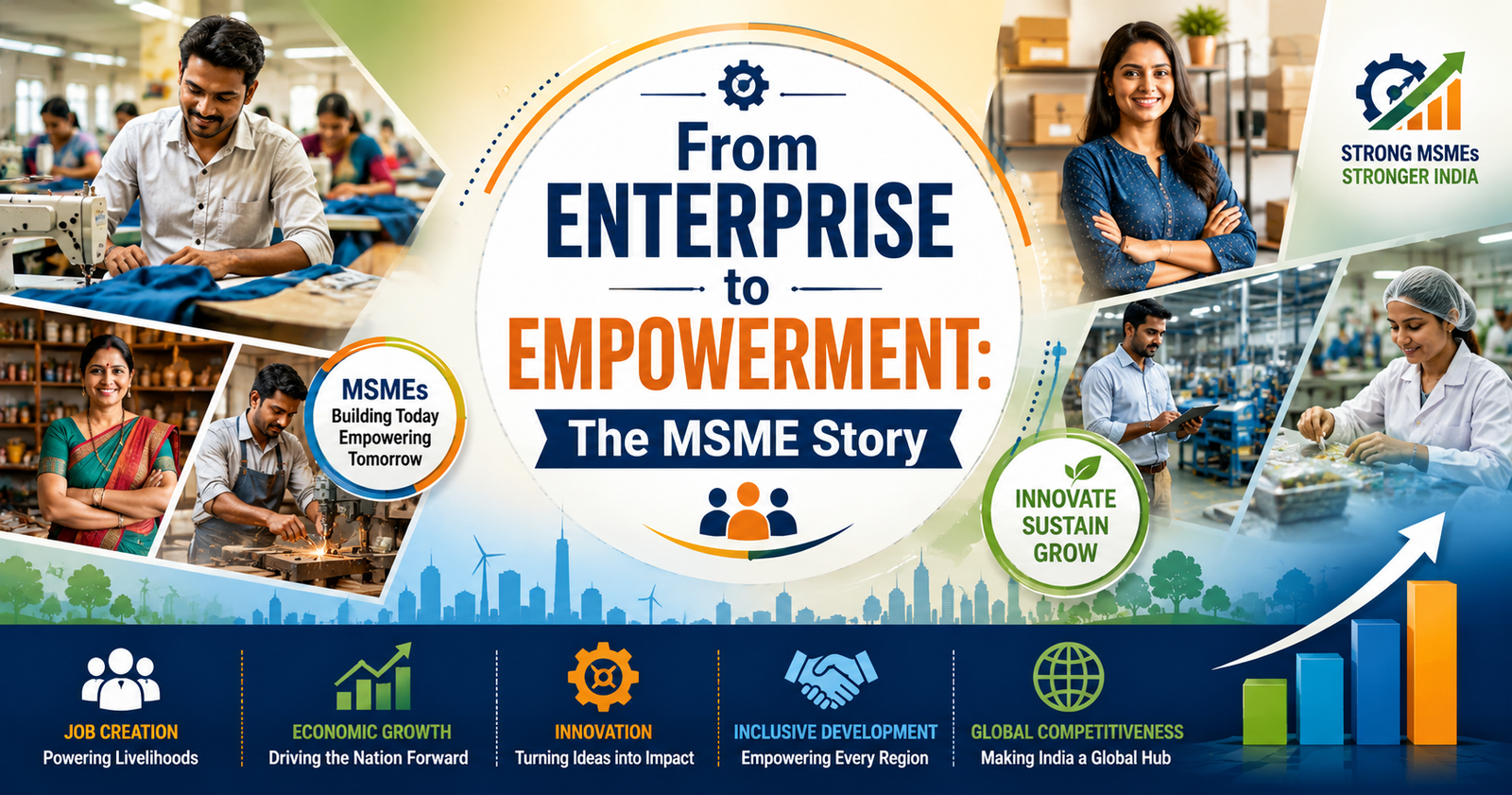
The Press Information Bureau (PIB) released a detailed background note highlighting the transformative role of Micro, Small and Medium Enterprises (MSMEs) in India's economic growth.
Syllabus Areas:
GS III - Economy
Observed annually on 27 June, MSME Day was designated by the United Nations to recognize the vital role of Micro, Small and Medium Enterprises in driving economic growth, employment, and sustainable development. The 2026 theme, "Empowering MSMEs through Innovation and Sustainable Industrial Development," highlights the importance of innovation and sustainability in building resilient and inclusive economies.
What are MSMEs?
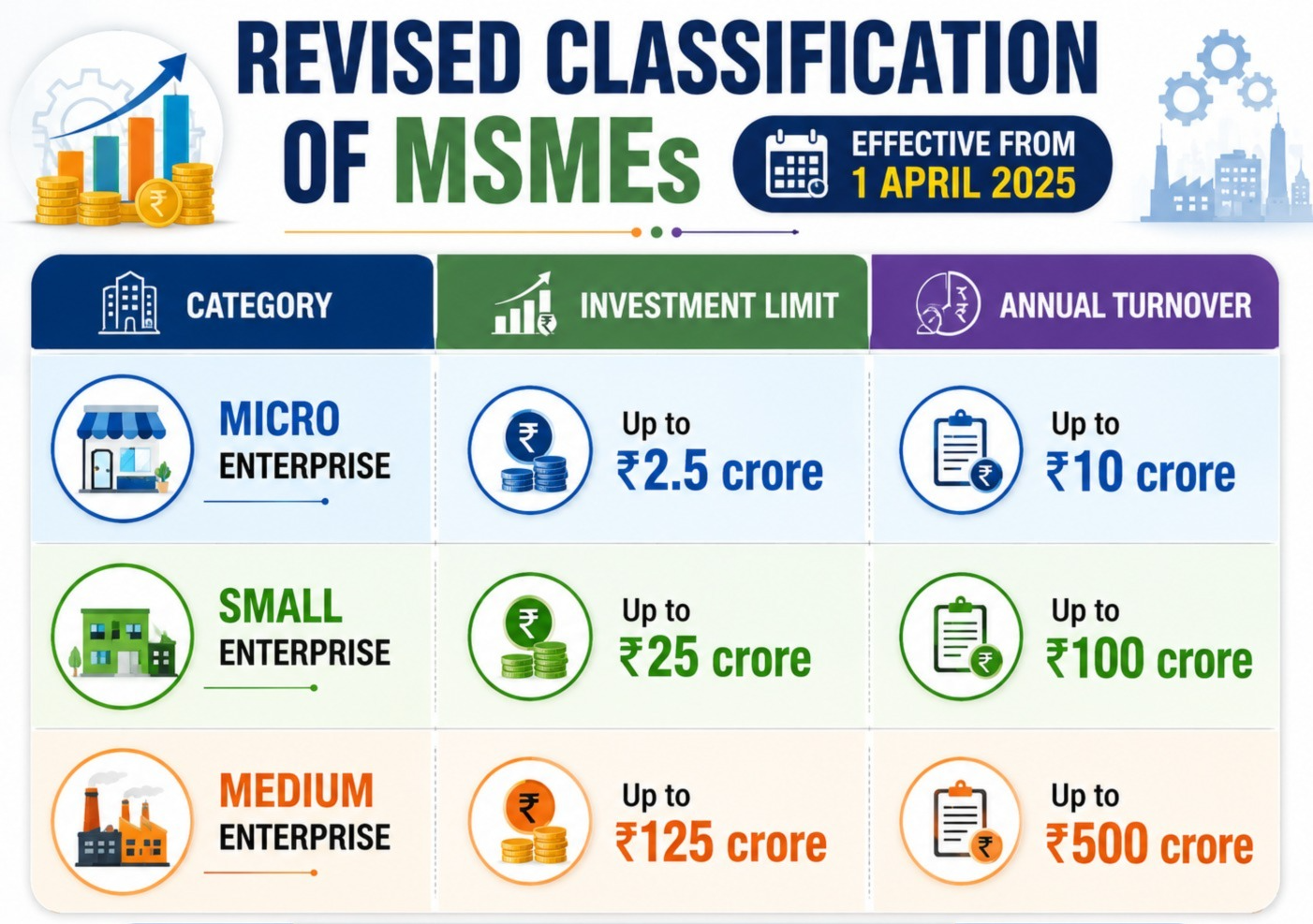
Micro, Small and Medium Enterprises (MSMEs) are businesses engaged in the manufacturing, production, processing, or service sector, classified based on their investment in plant and machinery/equipment and annual turnover.
Why are MSMEs Important?
-
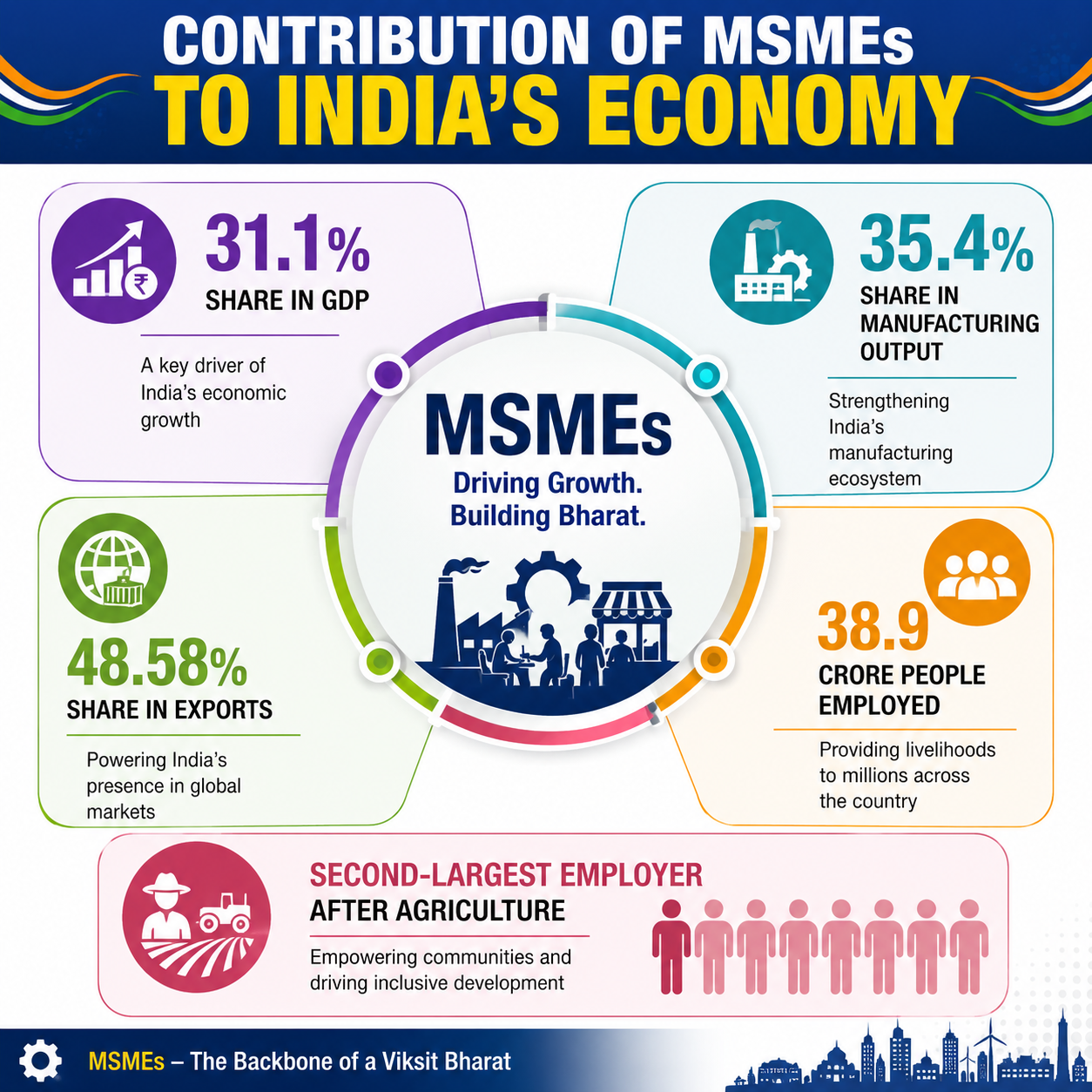
Backbone of the Economy: MSMEs form the foundation of India's industrial and business ecosystem.
-
Generate Employment: They are the second-largest source of employment after agriculture.
-
Boost Manufacturing: They contribute significantly to India's manufacturing output.
-
Increase Exports: MSMEs play a major role in India's exports, enhancing global competitiveness.
-
Promote Entrepreneurship: They encourage startups, self-employment, and innovation.
-
Support Inclusive Growth: They create opportunities for women, rural artisans, SC/ST entrepreneurs, and first-generation entrepreneurs.
-
Drive Balanced Regional Development: MSMEs promote industrialization in rural and semi-urban areas, reducing regional disparities.
Major Achievements (2025–26)
-
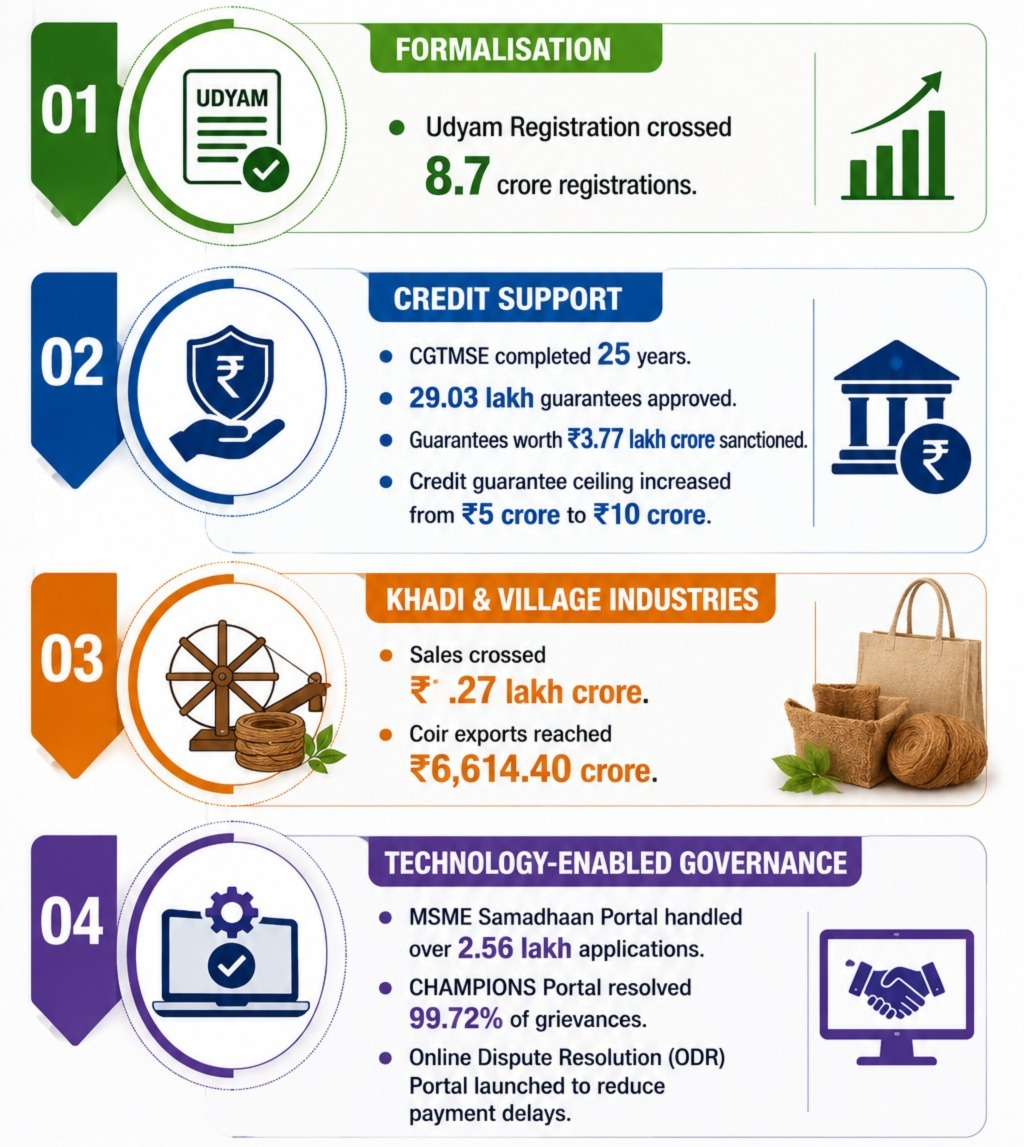
Udyam registrations crossed 8.7 crore; CGTMSE completed 25 years, approving 29.03 lakh guarantees worth ₹3.77 lakh crore, with the guarantee ceiling raised from ₹5 crore to ₹10 crore.
-
Khadi & Village Industries sales crossed ₹1.27 lakh crore, coir exports reached ₹6,614.40 crore, while the MSME Samadhaan Portal, CHAMPIONS Portal, and ODR Portal strengthened technology-driven governance and faster grievance redressal.
Important Government Schemes for MSMEs
1. PM Vishwakarma
Objective:
PM Vishwakarma provides end-to-end support to artisans and craftspeople engaged in 18 traditional trades. The scheme aims to improve their skills, increase income, and promote traditional occupations.
Key Features
-
Skill development and training
-
Toolkit assistance
-
Collateral-free credit support
-
Digital transaction incentives
-
Marketing assistance
Achievements
-
30 lakh registrations completed
-
24 lakh beneficiaries trained
-
₹5,133 crore credit sanctioned
-
7.91 lakh beneficiaries digitally empowered
2. ASPIRE Scheme
Objective:
The ASPIRE (A Scheme for Promotion of Innovation, Rural Industry and Entrepreneurship) promotes rural entrepreneurship by supporting startups and micro-enterprises through incubation facilities.
Key Features
-
Livelihood Business Incubators (LBIs)
-
Skill development
-
Enterprise incubation
Achievements
-
109 approved incubators
-
1.23 lakh beneficiaries trained
-
1,000+ micro-enterprises established
3. Prime Minister's Employment Generation Programme (PMEGP)
Objective:
PMEGP is a credit-linked subsidy scheme that helps individuals establish new micro-enterprises in the non-farm sector.
Achievements
-
10.84 lakh enterprises supported
-
₹29,623 crore provided as margin money subsidy
-
Employment generated for over 97 lakh people
4. MSME Champions Scheme
Objective:
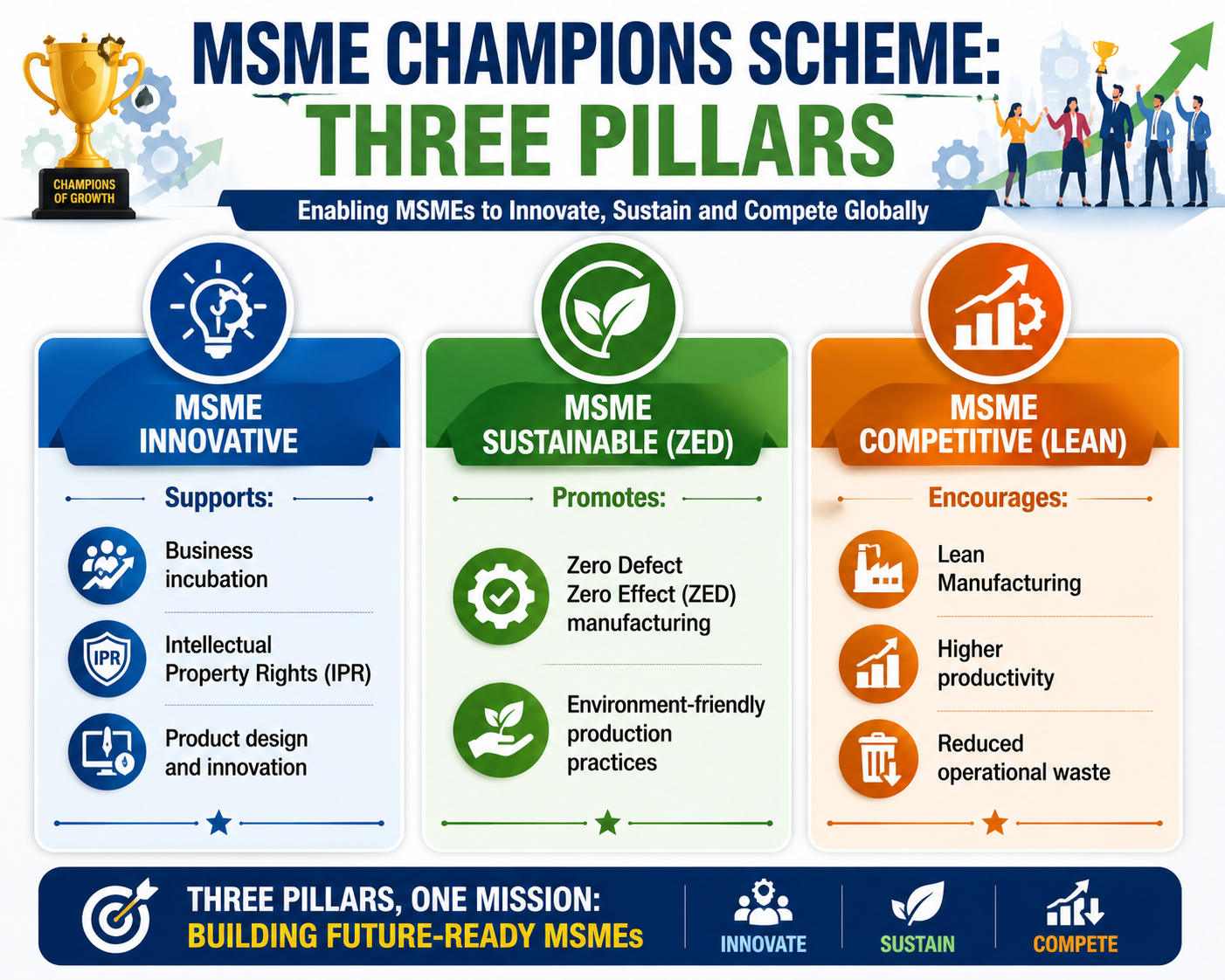
The scheme helps MSMEs become more innovative, sustainable, and globally competitive.
5. Self-Reliant India (SRI) Fund
Objective:
The Fund of Funds (FoF) initiative provides equity support to promising MSMEs, helping them expand and attract investment.
Highlights
-
Additional ₹2,000 crore allocated in Budget 2026–27
-
761 MSMEs supported
-
Investments worth ₹2,851 crore
6. National SC-ST Hub (NSSH)
Objective:
The scheme supports SC/ST entrepreneurs by improving their access to markets, finance, and government procurement opportunities.
Key Features
-
Capacity building
-
Market access
-
Public procurement support
Achievements
-
19,000+ entrepreneurs supported
-
Procurement from SC/ST enterprises increased from ₹99 crore (2015–16) to ₹3,731 crore (2024–25)
7. Micro & Small Enterprises Cluster Development Programme (MSE-CDP)
Objective:
Promotes cluster-based development by improving common infrastructure and technology for MSMEs.
Key Features
-
Common Facility Centres (CFCs)
-
Industrial infrastructure
-
Cluster development
Achievements
-
612 projects approved
-
364 projects completed
8. SFURTI Scheme
Objective:
Scheme of Fund for Regeneration of Traditional Industries (SFURTI) strengthens traditional industries by organizing artisans into clusters and improving market competitiveness.
Achievements
-
513 clusters approved
-
376 clusters operational
-
Benefited over 3 lakh artisans
9. Raising and Accelerating MSME Performance (RAMP)
Objective:
Supported by the World Bank, RAMP strengthens the MSME ecosystem by improving access to finance, markets, and technology.
Focus Areas
-
Market access
-
Credit support
-
Technology adoption
-
State-level MSME reforms
-
Institutional capacity building
10. Technology Centres
Objective:
Technology Centres enhance MSME competitiveness through skill development, innovation, and technical support.
Key Features
-
Skill development
-
Technology and innovation support
-
Tool Rooms
-
Extension Centres
Achievements
-
18 Technology Centres operational
-
20 new Technology Centres under development
-
100 Extension Centres planned
MSMEs remain the backbone of India's economy, driving employment, innovation, manufacturing, and exports. With sustained policy support and digital transformation, the sector is poised to play a pivotal role in achieving the vision of Atmanirbhar Bharat and Viksit Bharat 2047.