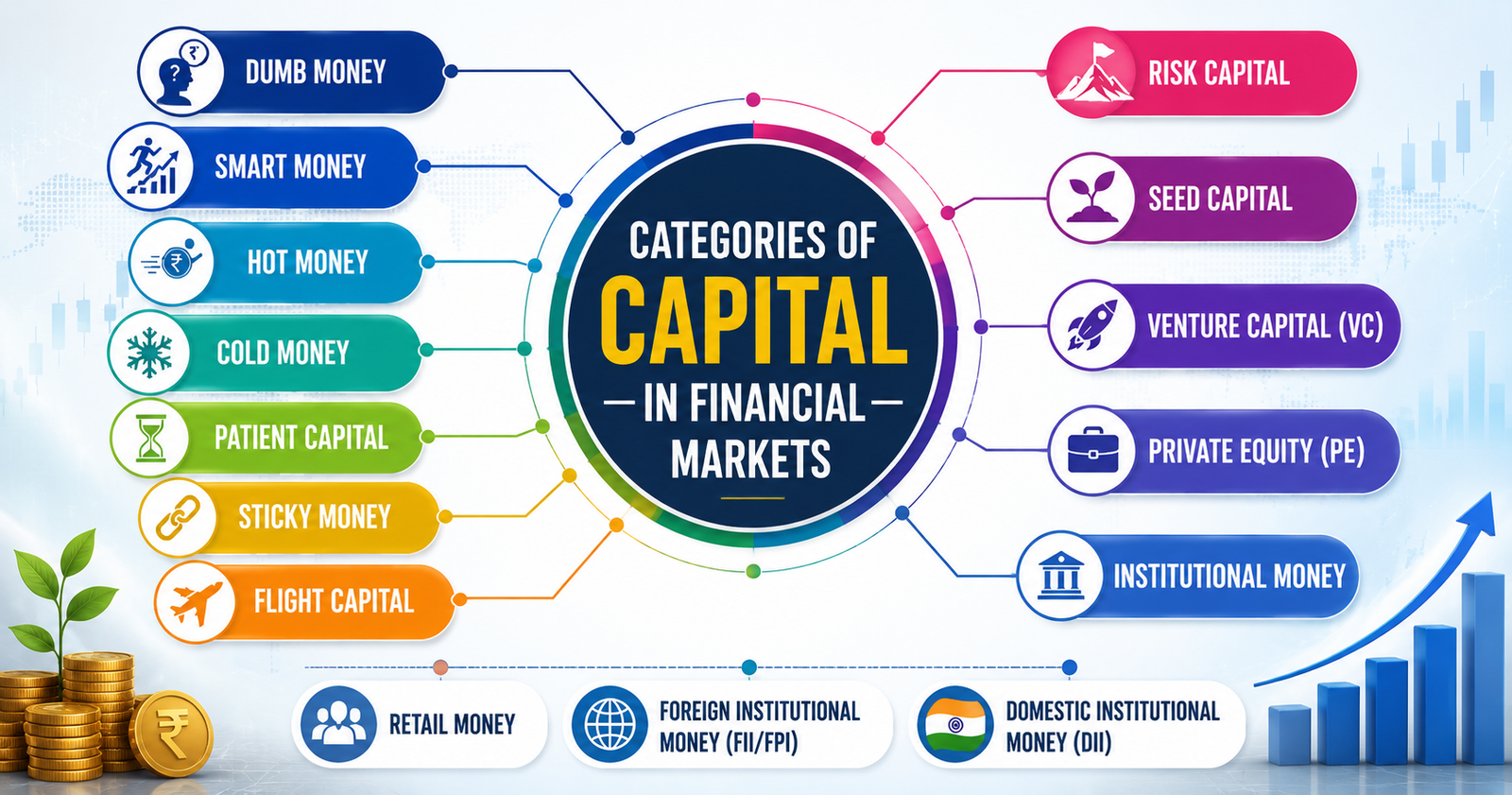
Understand the major categories of capital in financial markets, from dumb money to institutional capital, and learn how different investment sources shape markets and economic growth.
Syllabus Areas:
GS III - Economy
Dumb Money
In finance, "dumb money" refers to capital invested by individuals or groups who are perceived to make investment decisions based on emotion, hype, or limited information rather than rigorous research.
The term is informal and somewhat pejorative—it doesn't mean individual investors are actually "dumb." In fact, there have been many cases where retail investors outperformed professionals.
Dumb Money vs. Smart Money
Dumb Money
-
Typically retail (individual) investors.
-
Often follows trends or news.
-
May buy after prices have already risen.
-
Can be influenced by social media or fear/greed.
Smart Money
-
Institutional investors, hedge funds, banks, and experienced investors.
-
Relies on research, data, and analysis.
-
Often buys before a trend becomes obvious.
-
Uses risk management and long-term strategies.
Examples
Dumb Money Behavior
-
Buying a stock simply because it's trending on social media.
-
Panic selling during a market crash.
-
Investing based on rumors or tips from friends.
Smart Money Behavior
-
Analyzing a company's financial statements before investing.
-
Diversifying a portfolio.
-
Taking positions based on valuation and market fundamentals.
Important Caveat
The distinction isn't always accurate. The GameStop short squeeze in 2021 is a famous example where many retail investors (often labeled "dumb money") collectively beat several sophisticated hedge funds. This challenged the traditional assumption that only institutional investors represent "smart money."
So, in modern markets:
-
Dumb Money = Investors perceived to be less informed or more emotion-driven.
-
Smart Money = Investors believed to have better information, expertise, or analytical resources.
The labels describe perceived behavior rather than intelligence, and either group can make profitable or unprofitable investment decisions.
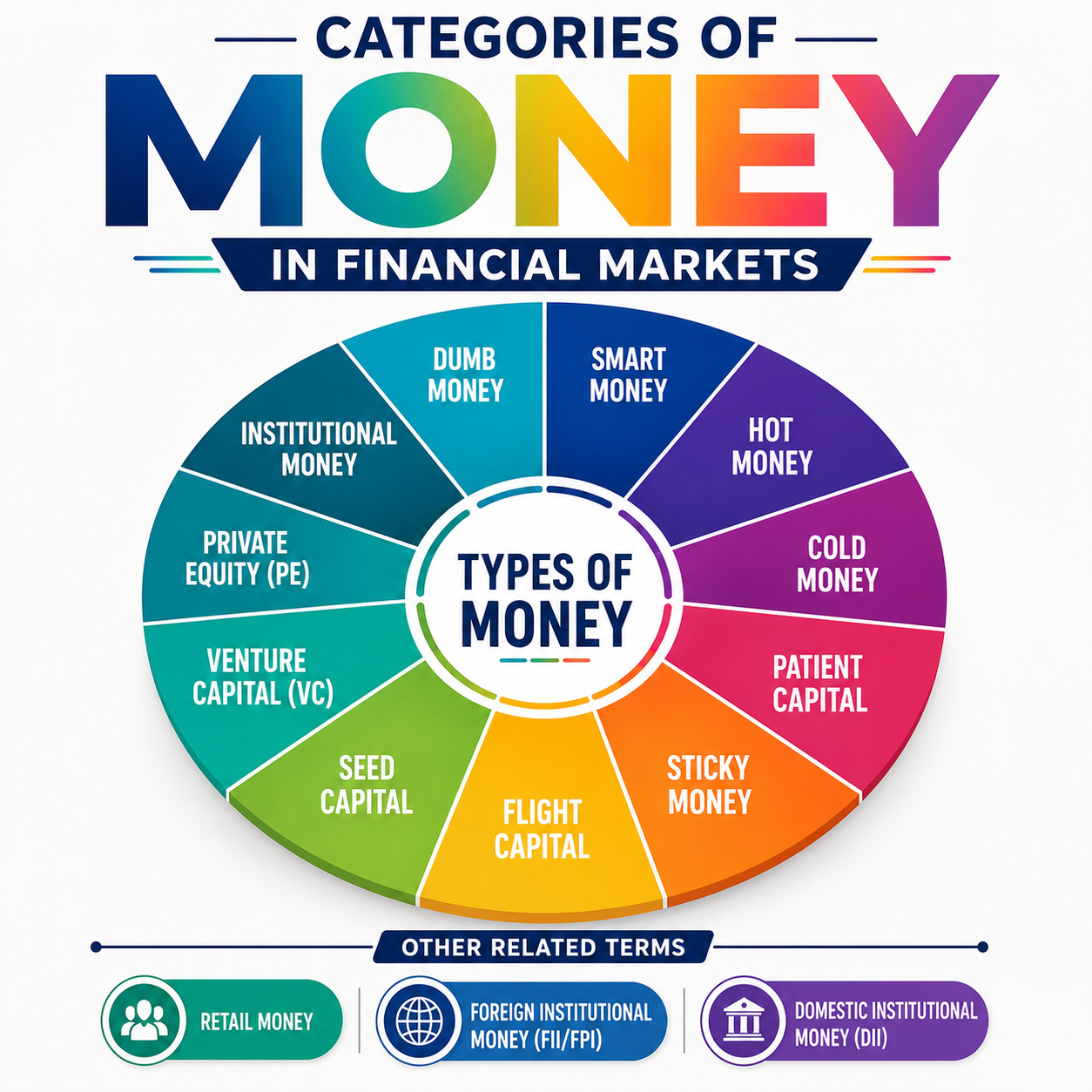
Categories of Money in Financial Markets:
-
Hot Money – Capital that moves quickly between countries or assets to chase the highest short-term returns or interest rates.
-
Cold Money – Long-term, patient capital that is less likely to move based on short-term market fluctuations.
-
Patient Capital – Investments made with a long time horizon, often in startups or infrastructure, where returns may take years.
-
Sticky Money – Funds that tend to remain invested for a long period, making them a stable source of capital.
-
Flight Capital – Money that leaves a country or market rapidly due to political instability, economic crises, or fear.
-
Risk Capital – Money invested in high-risk opportunities such as startups or venture capital with the expectation of high returns.
-
Seed Capital – Initial funding provided to start a new business before it begins operations.
-
Venture Capital (VC) – Professional investment in early-stage, high-growth companies.
-
Private Equity (PE) – Capital used to acquire or invest in mature private companies, often with operational improvements.
-
Institutional Money – Funds managed by pension funds, mutual funds, insurance companies, sovereign wealth funds, etc.
Other Related Terms
-
Retail Money – Investments made by individual investors.
-
Foreign Institutional Money (FII/FPI) – Investments from foreign institutions into a country's financial markets.
-
Domestic Institutional Money (DII) – Investments from institutions within the same country.