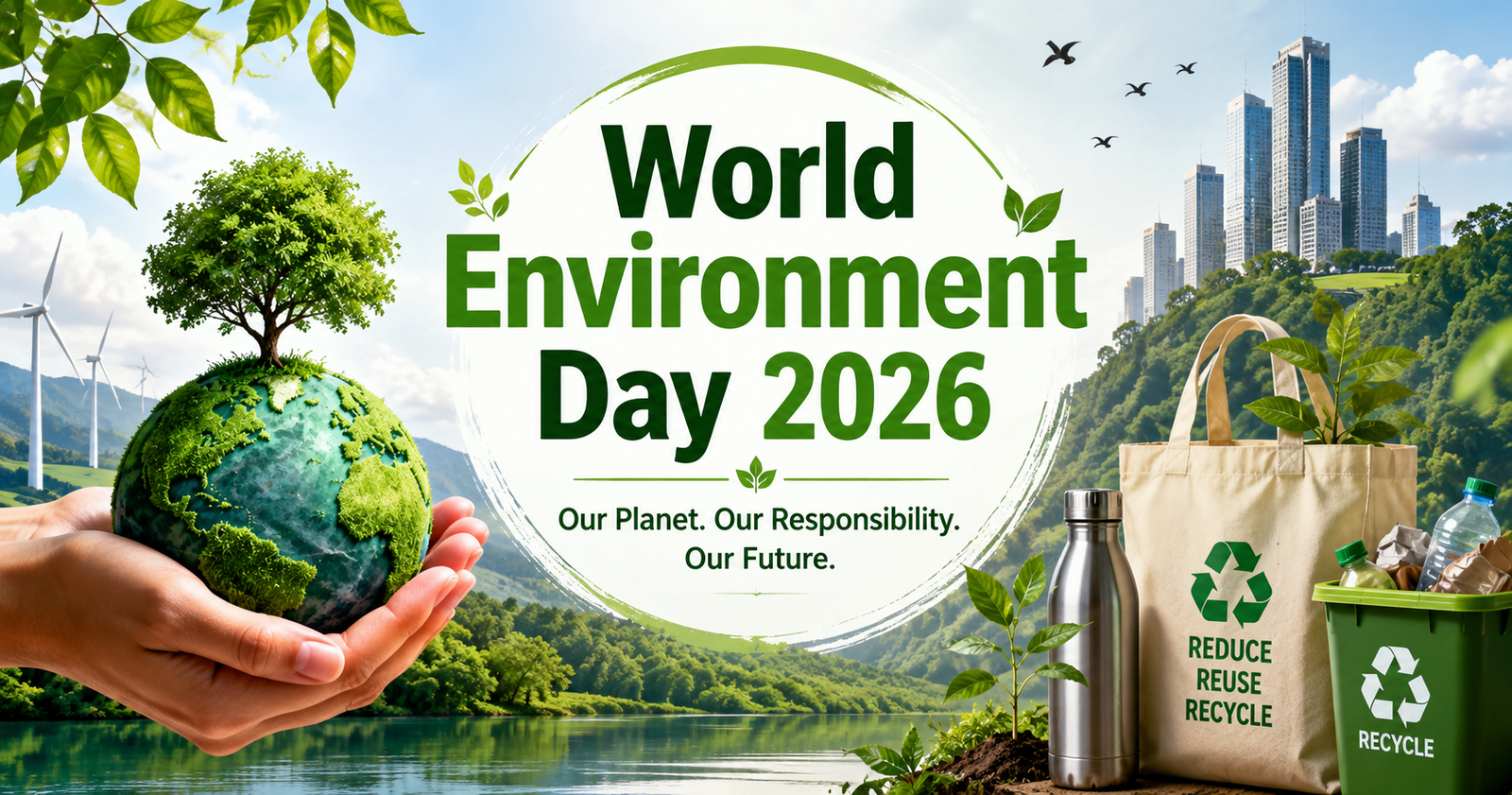
Explore World Environment Day 2026: significance, climate governance, sustainability challenges, plastic pollution, adaptation strategies, environmental policies and community participation with UPSC-focused analysis, key points and detailed explanations.
Syllabus Areas:GS III - Environment and Ecology |
World Environment Day is observed every year on June 5 to promote awareness and action for environmental protection. This year, discussions have focused heavily on climate change, sustainable development, plastic pollution, environmental governance and the role of citizens in achieving ecological sustainability.
Background
-
World Environment Day was established in 1972 following the Stockholm Conference on the Human Environment, which marked the beginning of global institutional efforts toward environmental protection.
-
Since then, the day has evolved into one of the largest global platforms for discussing sustainability challenges and solutions.
-
Environmental issues today are no longer confined to ecological concerns alone.
-
They increasingly affect agriculture, economic growth, public health, migration patterns, urban development and national security.
-
Therefore, environmental governance has become a core developmental issue rather than a purely conservation-oriented subject.
Detailed Key Points
Growing Importance of Climate Adaptation Alongside Climate Mitigation
-
Climate governance today increasingly recognises that countries cannot focus only on reducing emissions; they must also prepare for the impacts of climate change that are already occurring.
-
Climate mitigation refers to measures aimed at reducing the causes of climate change, such as lowering greenhouse gas emissions through renewable energy expansion, afforestation and cleaner technologies.
-
At the same time, climate adaptation focuses on adjusting social and economic systems to withstand climate-related impacts. For example, governments are investing in drought-resistant crops, flood-resilient infrastructure and heat action plans because extreme weather events are becoming more frequent.
-
For countries like India, adaptation has become particularly important because rising temperatures, changing rainfall patterns and increasing disaster frequency are directly affecting agriculture, water resources and livelihoods.
Plastic Pollution Has Emerged as a Major Environmental Governance Challenge
-
Plastic pollution has evolved into one of the most visible environmental challenges because of its widespread impact on ecosystems, biodiversity and human health.
-
Single-use plastics continue to dominate waste generation patterns and contribute significantly to land and marine pollution.
-
Scientists have increasingly raised concerns about microplastics entering food chains and potentially affecting human health.
-
India has attempted to address this challenge through restrictions on certain single-use plastics, Extended Producer Responsibility mechanisms and waste management reforms.
-
However, implementation challenges remain significant due to weak segregation practices, poor recycling infrastructure and limited enforcement capacity.
-
The debate has therefore shifted from merely banning plastics to creating sustainable production and consumption systems.
Circular Economy is Being Viewed as a Sustainable Development Model
-
Traditional economic systems largely operate on a linear model where resources are extracted, used and discarded. This approach has resulted in excessive resource depletion and rising waste generation.
-
The circular economy model proposes an alternative approach by encouraging resource efficiency through reducing consumption, reusing products, repairing materials and recycling waste.
-
Adopting circular economic principles can reduce pressure on natural resources, lower carbon emissions and generate new employment opportunities in recycling and green industries.
-
As countries pursue climate goals, circular economy principles are increasingly being integrated into industrial policy, urban planning and waste management systems.
Community Participation is Essential for Environmental Protection
-
Environmental conservation efforts are increasingly recognising that government regulations alone are insufficient without public participation.
-
Local communities often possess traditional ecological knowledge and play an important role in protecting forests, water bodies and biodiversity-rich regions. Community involvement also improves compliance because citizens become active stakeholders rather than passive beneficiaries.
-
For example, successful waste segregation campaigns, local water conservation projects and community forest management programmes demonstrate that participatory approaches often produce better environmental outcomes.
-
As a result, environmental governance is increasingly moving toward collaborative models that combine state intervention with citizen participation.
Environmental Governance Challenges Continue to Limit Progress
-
Many environmental problems persist not because of the absence of policies but because of implementation gaps.
-
Environmental governance in India faces challenges such as fragmented institutional responsibilities, limited monitoring capacity and delays in enforcement.
-
Urbanisation pressures, infrastructure expansion and industrial growth often create conflicts between development objectives and ecological sustainability.
-
Additionally, environmental regulations sometimes suffer from inadequate coordination among ministries and weak local-level institutional capacity.
-
Therefore, strengthening governance systems has become as important as introducing new environmental policies.
Challenges Facing India
-
India faces multiple environmental challenges simultaneously. Rising heatwaves, increasing water scarcity, biodiversity loss and worsening air pollution are placing significant pressure on both ecosystems and economic systems.
-
Climate change also creates social inequalities because vulnerable communities often experience disproportionate impacts despite contributing least to emissions.
-
Balancing economic growth with environmental sustainability therefore remains one of the central policy challenges facing the country.
Way Forward
-
Addressing environmental challenges requires integrated action across policy, economy and society.
-
Governments must strengthen climate financing, improve environmental monitoring systems and encourage sustainable urban planning practices.
-
Industries should accelerate investments in green technologies and resource-efficient production systems.
-
At the societal level, behavioural change, environmental education and citizen participation must become central components of sustainability strategies.
-
Long-term environmental sustainability can only be achieved when economic development, ecological protection and social inclusion are pursued together.
Environmental sustainability requires balancing development with ecological protection. Strong institutions, public participation and sustainable economic practices are necessary for long-term environmental security. Future environmental governance must focus on resilience, inclusiveness and sustainability.