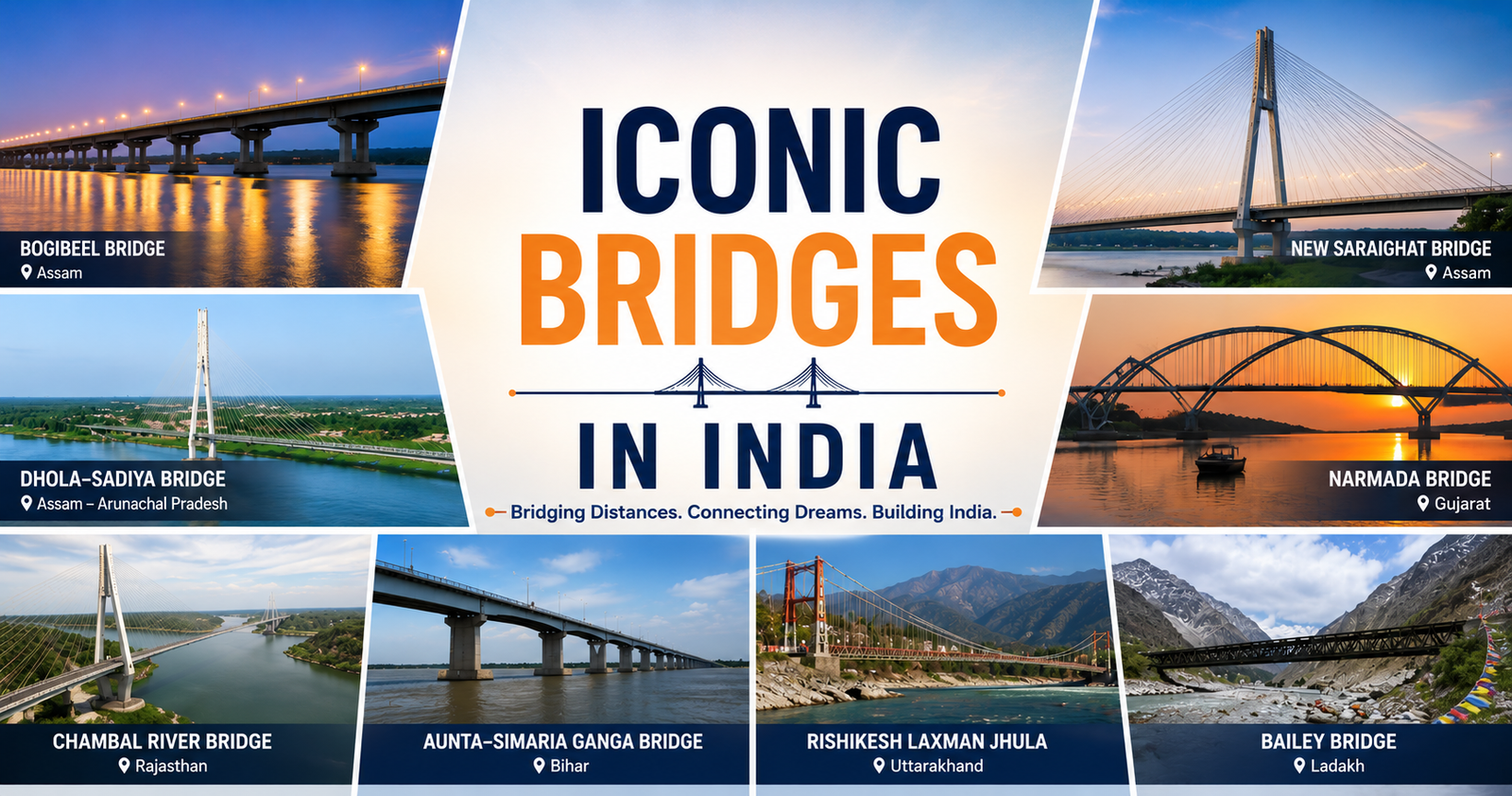
The iconic bridges showcase engineering excellence, enhancing connectivity, economic growth, strategic security, and sustainable development while linking remote regions and strengthening national integration.
Syllabus Areas:
GS III - Economy (Infrastructure)
The Ministry of Road Transport and Highways (MoRTH) has delivered a series of iconic bridge projects that have transformed connectivity, economic integration, strategic mobility, and regional development across India over the last decade. For UPSC, the topic is important from Infrastructure, Economic Development, Transport, Regional Connectivity, and Internal Security perspectives.
Infrastructure development is considered one of the strongest drivers of economic growth because it:
-
Reduces logistics costs.
-
Improves market access.
-
Enhances regional integration.
-
Attracts investment.
-
Generates employment.
-
Strengthens national security.
Government Initiatives Linked to Infrastructure Development
-
PM Gati Shakti National Master Plan
-
Bharatmala Pariyojana
-
National Infrastructure Pipeline (NIP)
-
National Logistics Policy
-
Sagarmala Programme
These bridge projects contribute directly to these initiatives by improving multimodal connectivity.
Types of Bridges
1. Beam Bridge
A Beam Bridge is the simplest and oldest type of bridge. It consists of a horizontal beam (roadway) supported at intervals by piers or pillars. The load of vehicles is transferred directly from the beam to the supporting piers and then to the ground.
Key Features
-
Simplest bridge design.
-
Economical and easy to construct.
-
Suitable for short and medium distances.
-
Requires multiple piers for longer spans.
-
High strength and low maintenance.
-
Commonly used on highways, railways, and river crossings.
Example
Dhola-Sadiya Bridge (Bhupen Hazarika Setu)
2. Cable-Stayed Bridge
A Cable-Stayed Bridge is a bridge in which the deck (roadway) is directly supported by cables connected to one or more tall towers (pylons). The cables transfer the load directly to the towers.
Key Features
-
Modern and aesthetically attractive design.
-
Requires fewer cables than suspension bridges.
-
Suitable for medium and long spans.
-
Towers bear most of the load.
-
Provides excellent stability and strength.
Example
Chambal River Bridge, Kota (Rajasthan)
3. Extradosed Bridge
An Extradosed Bridge is a hybrid structure that combines features of a cable-stayed bridge and a girder (beam) bridge. The cables support the deck, but the towers are much shorter than those of a cable-stayed bridge.
Key Features
-
Intermediate design between beam and cable-stayed bridges.
-
Lower pylons/towers.
-
Uses external prestressing cables.
-
Suitable for medium-to-long spans.
-
More economical than cable-stayed bridges for certain distances.
Examples
Narmada Bridge, Bharuch (Gujarat)
Aunta-Simaria Ganga Bridge (Bihar)
Also Read:

Major Bridges Highlighted by Ministry of Road Transport and Highways (MoRTH):
1. Bridge over Brahmaputra River, Guwahati
-
The 1.49 km long ‘New’ Saraighat Bridge over the mighty Brahmaputra River stands as a vital connector for the state of Assam, running parallel to the historic Old Saraighat Bridge.
-
Its construction has significantly eased traffic congestion and ensured smoother movement for thousands of daily commuters.
-
The bridge enhances travel between North and South Guwahati, while also strengthening movement along the East–West Corridor on NH-27.
2. Bridge over Chambal River, Kota
-
One of the iconic engineering marvels of India is the 6-lane single plane cable-stayed bridge across river Chambal in Kota, Rajasthan.
-
With a length of 1.4 km, it is Rajasthan’s first hanging bridge and was dedicated to the nation in August 2017.
-
The bridge is 30-metre-wide with 1.5-metre-wide footpaths on both sides. The stay cables are composed of individually sheathed strands having triple protection.
-
The external cable ducts are capable of eliminating rain and wind-induced vibrations, enhancing strength and longevity of the structure.
Environmental Significance of Chambal River Bridge (Kota)
1. Pier-Free Eco-Sensitive Design
-
Nearly 300 metres of the bridge is suspended through cables without any pier in the riverbed.
-
Minimizes disturbance to the river ecosystem and natural flow of water.
2. Protection of National Chambal Gharial Sanctuary
-
The bridge passes through the ecologically sensitive National Chambal Gharial Sanctuary.
-
Special design features were adopted to avoid habitat destruction and biodiversity loss.
3. Conservation of Endangered Species
-
Protects the habitat of the Critically Endangered Gharial.
-
Safeguards the Critically Endangered Red-Crowned Roof Turtle.
-
Helps conserve the Endangered Ganges River Dolphin, India's National Aquatic Animal.
4. Preservation of River Ecology
-
Maintains natural river currents and sediment flow.
-
Prevents habitat fragmentation and ecological disruption.
5. Reduction in Construction Impact
-
Avoids extensive riverbed excavation and dredging.
-
Reduces water pollution, noise, and vibration during construction.
6. Model of Sustainable Infrastructure
-
Demonstrates how infrastructure development can coexist with wildlife conservation.
-
Serves as a successful example of balancing economic growth with environmental protection.
3. Bridge over Narmada River, Bharuch
-
The 1.34 km long Bridge is built over river Narmada on NH-8 in Bharuch, Gujarat.
-
It is an extradosed bridge with one of the longest spans in the country, was open to traffic in March 2017 and was completed in a span of 34 months.
-
The bridge is 20.8 metres wide with 3 metre footpath on either side of the structure.
-
The bridge is part of Ahmedabad-Mumbai section of NH-8 in Baruch district of Gujarat and has provided impetus to speed, safety and economic development of the region.
4. Bridge over River Ganga, Bihar
-
The 1.8 km long six-lane bridge over the majestic river Ganga is located on the Aunta –Simaria section of NH-31 in the state of Bihar.
-
The project features one of India's widest extradosed bridge designed with a single segmental structure having 34-metre-wide deck, over the river.
-
With span lengths ranging from 57 meter to 115 metre and 70 metre cantilever arms, the structure exemplifies engineering excellence. The bridge is constructed parallel to old Rajendra Setu, a two-lane rail-cum-road bridge built nearly seven decades ago.
-
Age and extensive repairs rendered it inadequate for heavy vehicles, forcing them onto lengthy detours.
-
The new six-lane extra-dosed bridge over river Ganga provides direct link between North & South Bihar and was inaugurated by the Hon’ble Prime Minister in August 2025.
5. Dhola–Sadiya Bridge
-
The 9.15 km long Dhola–Sadiya Bridge, also known as the Bhupen Hazarika Setu, is a vital link between Assam and Arunachal Pradesh, providing the first permanent road connection between northern Assam and eastern Arunachal Pradesh.
-
Built as a beam bridge, it sweeps over the Lohit River, one of the Brahmaputra’s major tributaries, connecting Dhola in Tinsukia district to Sadiya in the North.
-
The Bridge is built to withstand load of 60-tonne military tanks, including the Indian Army’s Arjun and T-72 models. This capability adds significant strategic value to the structure.
Broader Significance of India's Major Bridges
1. Economic Benefits: Bridges such as the Narmada Bridge (Gujarat) and Aunta-Simaria Ganga Bridge (Bihar) reduce transportation costs, improve freight movement, enhance market access, promote tourism, and support industrial growth.
2. Social Benefits: Bridges like Dhola-Sadiya Bridge connect remote regions to healthcare, education, and economic opportunities, fostering inclusive development.
3. Strategic Benefits: Bogibeel Bridge and Dhola-Sadiya Bridge strengthen border infrastructure, enable rapid military deployment, and improve disaster response capabilities in Northeast India.
4. Environmental Benefits: The Chambal River Bridge demonstrates eco-sensitive engineering by protecting river ecosystems and endangered wildlife while supporting sustainable development.
India's iconic bridges are not just transportation links but catalysts of economic progress, social inclusion, strategic security, and sustainable development. By connecting people, markets, and regions, they strengthen national integration and contribute significantly to the vision of Viksit Bharat 2047.
Mains Question:
1. "Large-scale infrastructure projects such as bridges not only improve connectivity but also act as catalysts for economic growth, regional integration, strategic security, and inclusive development." Explain. 250 Words