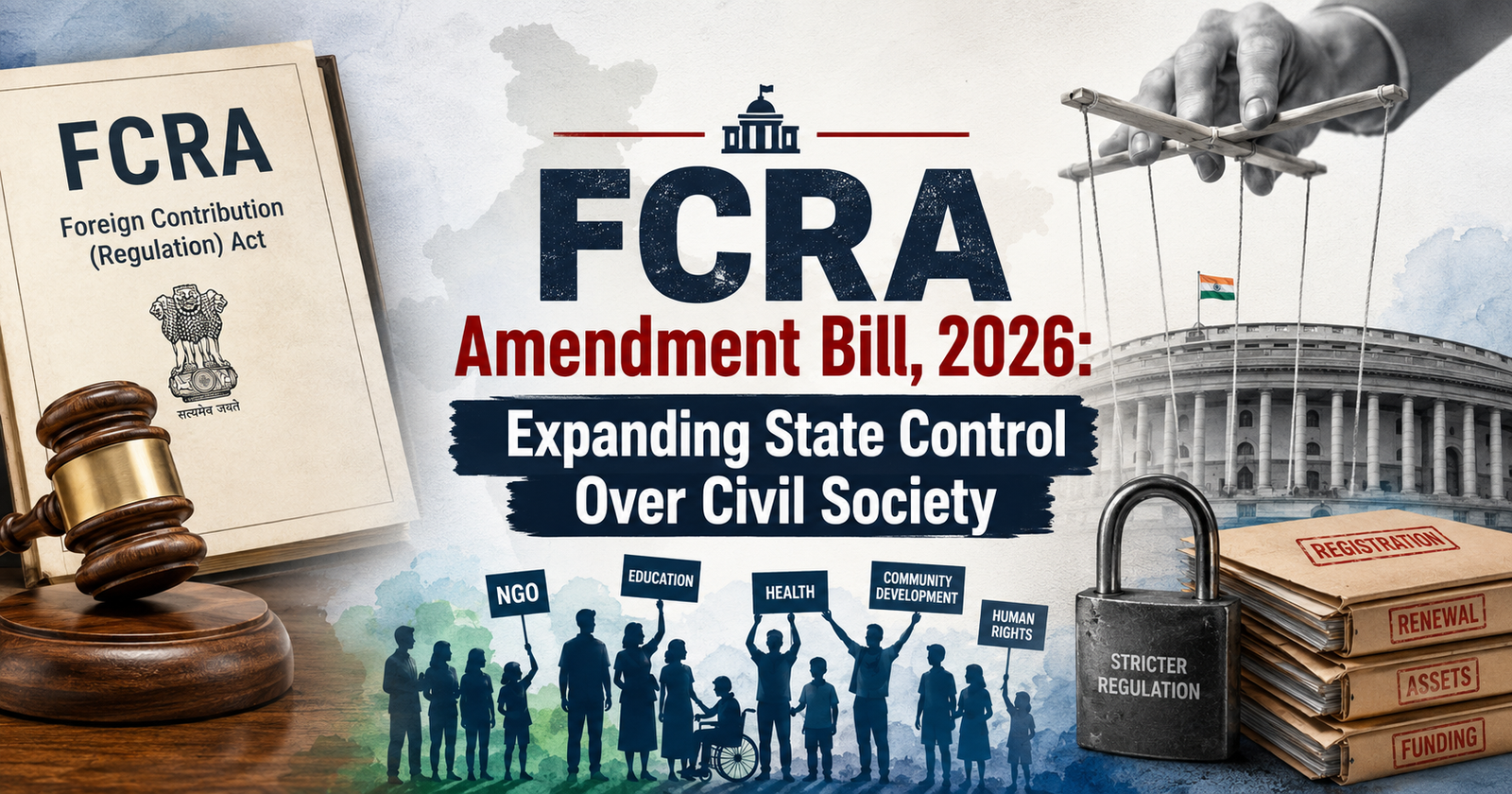
The FCRA Amendment Bill, 2026 proposes stricter regulation of foreign-funded NGOs, expanding government oversight, asset control, and enforcement powers, raising concerns over civil society autonomy, constitutional freedoms, and transparency.
Syllabus Areas:
GS II - Polity and Governance
GS III - Economy
The Foreign Contribution (Regulation) Amendment Bill, 2026 was introduced in the Lok Sabha in March 2026. The Bill proposes major changes to the Foreign Contribution Regulation Act (FCRA), which governs foreign funding received by NGOs, charitable trusts, educational institutions, and religious organizations in India.
Key Highlights of the Bill
1. Greater Government Control Over NGOs
The Bill significantly expands the powers of the Central Government over organizations receiving foreign contributions. Critics argue that it moves beyond regulation and creates mechanisms for direct state control over civil society institutions.
2. Automatic Cancellation of FCRA Registration
A new provision allows an organization's FCRA registration to cease automatically if:
-
Renewal is denied,
-
Renewal applications remain pending,
-
The organization fails to apply for renewal on time.
This could result in organizations losing their legal ability to receive foreign funding even without proven misconduct.
3. Government Control Over Assets
One of the most controversial provisions is the proposed Section 16A.
Under this provision:
-
If an organization's FCRA registration is cancelled, surrendered, or ceases to exist, its foreign-funded assets can automatically vest in a government-designated authority.
-
No prior judicial review is required.
-
The authority may manage, transfer, sell, or dispose of these assets.
-
Sale proceeds may be credited to the Consolidated Fund of India.
Assets affected may include:
-
Schools
-
Hospitals
-
Orphanages
-
Religious institutions
-
Charitable facilities
-
Vehicles, buildings, and land purchased through foreign contributions
4. Expanded Powers During Suspension
The Bill strengthens government powers during investigations.
During suspension:
-
Organizations may be prevented from managing their assets.
-
Financial and operational activities can be restricted.
-
Institutional functioning may effectively be paralysed.
5. Centralization of Enforcement
The revised provisions require:
-
State agencies to obtain approval from the Union Government before investigating FCRA-related violations.
-
Greater centralization of regulatory authority.
6. Increased Liability of Office Bearers
The Bill broadens the definition of "key functionaries" and increases personal accountability of trustees and office bearers, exposing them to greater legal scrutiny.
7. Removal of Existing Asset Disposal Provisions
The Bill proposes removing Section 22, which currently governs disposal of assets of defunct organizations, replacing it with a more expansive framework that grants wider executive discretion.
Concerns Raised by Critics
1. Threat to Civil Society
Experts argue that the Bill may:
-
Discourage voluntary organizations from functioning.
-
Create fear among NGOs receiving foreign funds.
-
Reduce civic participation and advocacy.
2. Impact on Minority Institutions
Many minority-run institutions such as:
-
Schools,
-
Hospitals,
-
Charitable trusts,
-
Religious organizations
depend partly on foreign contributions. Critics fear these institutions may be disproportionately affected.
3. Lack of Transparency
The Bill does not prescribe:
-
Clear timelines for approvals,
-
Renewal decisions,
-
Registration applications.
This may result in delays and uncertainty for organizations.
4. Constitutional Concerns
Legal experts argue that broad terms such as "public interest" may:
-
Allow arbitrary cancellations,
-
Restrict freedom of association,
-
Affect freedom of religion and expression,
-
Increase executive discretion without adequate safeguards.
Economic and Social Impact
According to data cited in the article:
Contribution of Civil Society
-
The voluntary sector contributes roughly 2% of India's GDP.
-
It supports millions of beneficiaries through education, health, skill development, and welfare programmes.
Employment Generation
-
Around 27 lakh jobs are generated by civil society organizations.
-
Nearly 34 lakh full-time volunteers are engaged in the sector.
Local Community Support
A significant share of NGOs serves as a primary source of employment and social services in many localities.
Potential Consequences
If enacted in its present form, critics argue that the Bill could:
-
Increase state control over NGOs.
-
Discourage foreign donors.
-
Reduce welfare and development activities.
-
Affect education, healthcare, and community services.
-
Create uncertainty for charitable and religious institutions.
Supporters, however, may argue that stronger oversight is necessary to ensure transparency, accountability, and national security in the use of foreign funds.
The FCRA Amendment Bill, 2026 represents one of the most significant changes to India's foreign funding regulatory framework. While the government presents it as a measure to enhance transparency and accountability, critics view it as a substantial expansion of executive authority that may affect the functioning of NGOs, charitable institutions, and civil society organizations across the country. The debate ultimately revolves around balancing national security and regulatory oversight with constitutional freedoms and the autonomy of civil society.