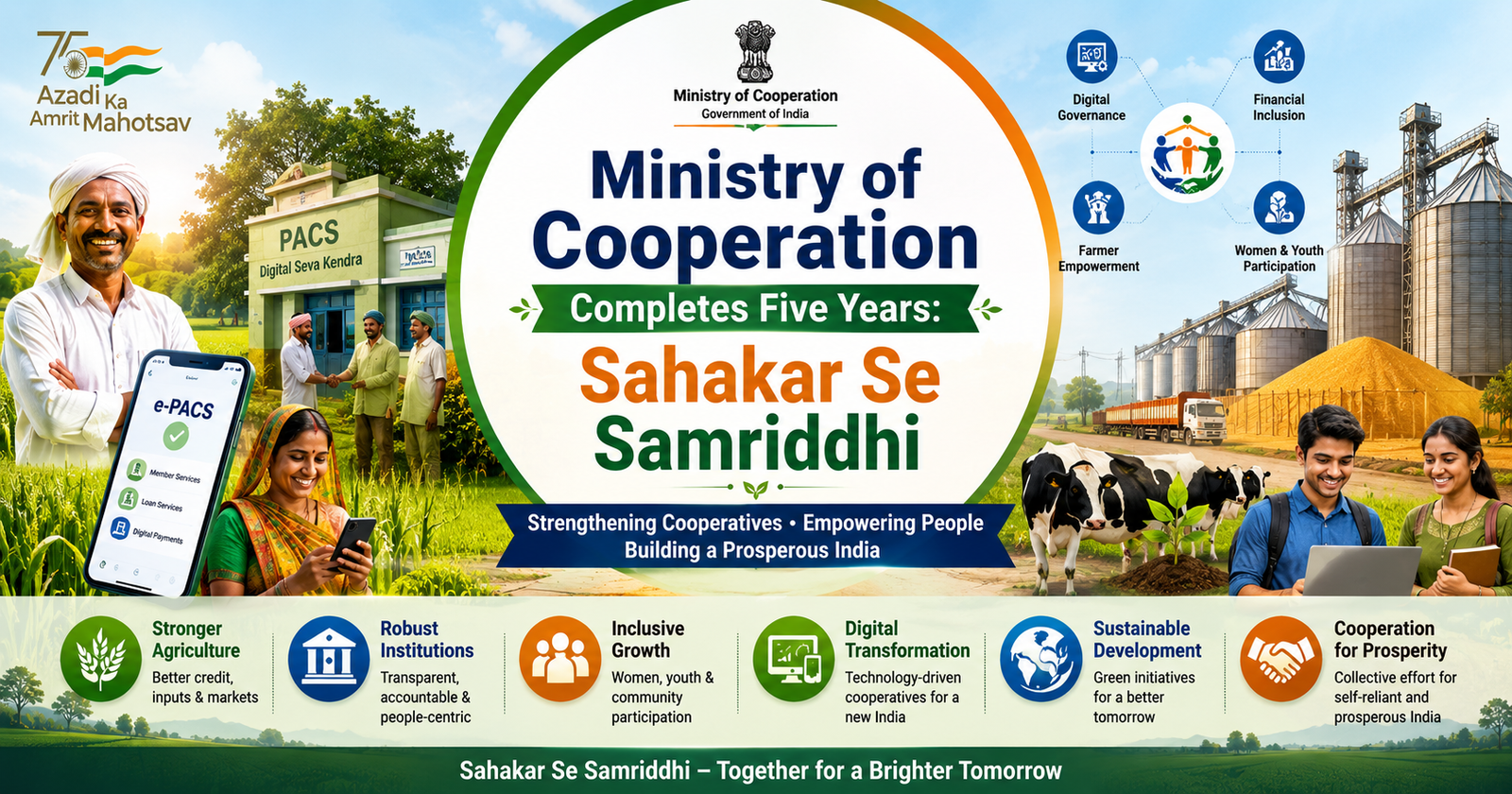
Explore the Ministry of Cooperation's five-year achievements, major reforms, digital initiatives, cooperative growth, and vision of Sahakar Se Samriddhi for India.
Syllabus Areas:
GS II - Governance
GS III - Economy
The Ministry of Cooperation, established in July 2021, completed five years of its functioning in 2026. To commemorate this milestone, the Government organized week-long nationwide celebrations from 29 June to 6 July 2026 under the theme "Sahakar Se Samriddhi" (Prosperity through Cooperation).
The celebrations aimed to spread awareness about cooperative reforms, digital transformation, financial inclusion, farmer welfare, and grassroots empowerment across India.
What is the Ministry of Cooperation?
The Ministry of Cooperation was established in July 2021 with the objective of providing a separate administrative, policy and institutional framework for strengthening India's cooperative movement.
The Ministry seeks to build a "Whole-of-Government" approach towards cooperative development by coordinating with States, cooperative societies, financial institutions, dairy federations and agricultural organizations.
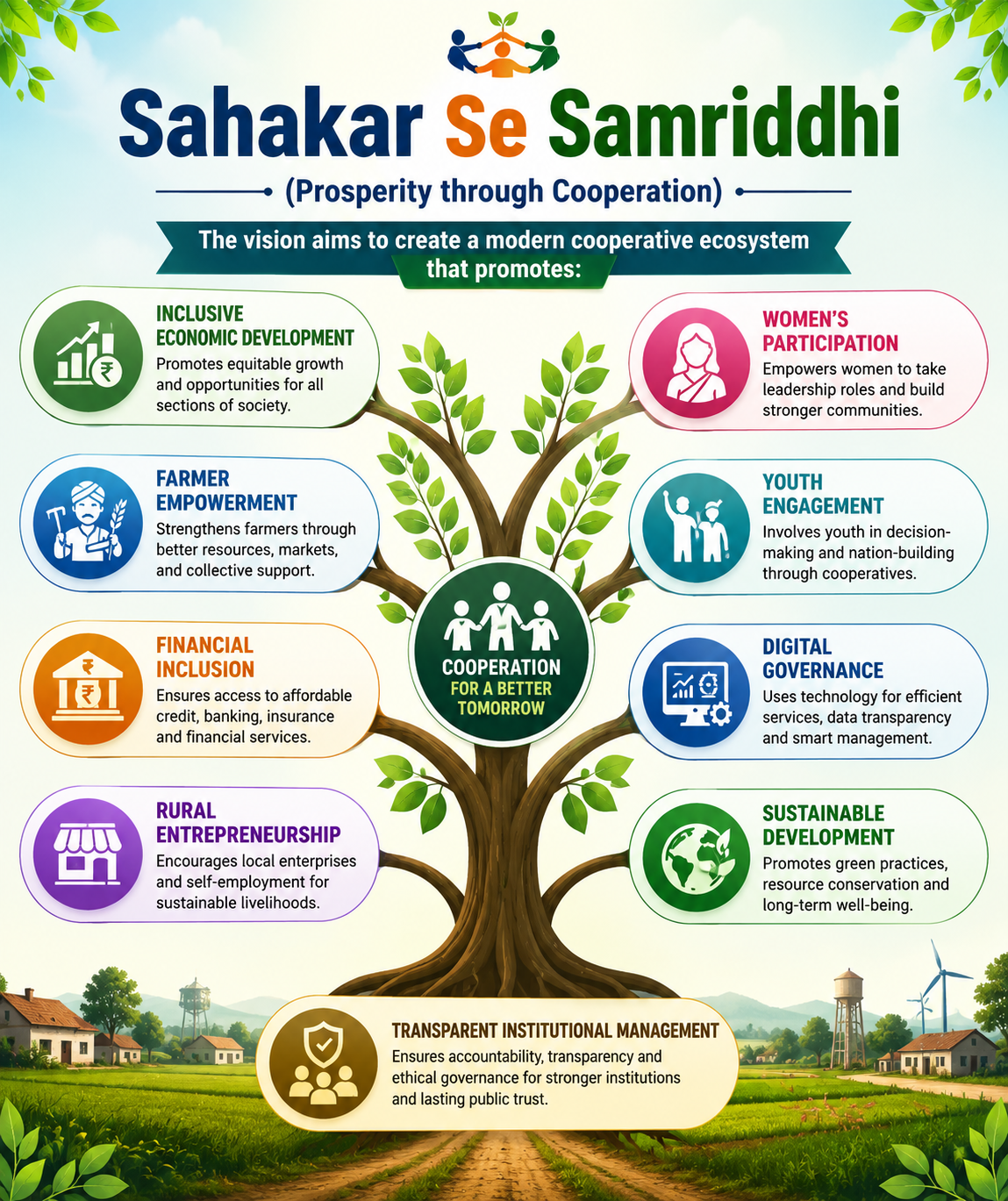
Its guiding vision is: Sahakar Se Samriddhi (Prosperity through Cooperation)
Why Were the Five-Year Celebrations Organised?
The five-year celebrations marked an important milestone in the Ministry of Cooperation's journey. They aimed to showcase key achievements, raise awareness about cooperative institutions, encourage public participation, promote digital transformation, highlight future reforms, and strengthen grassroots cooperatives, reaffirming the Government's commitment to making cooperation a major driver of inclusive and sustainable economic growth.
The celebrations were organized from 29 June – 6 July 2026 under the theme: "Sahakar Se Samriddhi" The week concluded with a grand national programme at Bharat Mandapam, New Delhi, on 6 July 2026.
Day-wise Themes of the Celebrations
Each day of the celebration focused on a specific area of cooperative development.
1. Transformation of PACS
Primary Agricultural Credit Societies (PACS) are the foundation of India's cooperative credit structure.
The Ministry emphasized:
-
Computerisation of PACS
-
Enterprise Resource Planning (ERP)
-
Modern accounting systems
-
Online service delivery
-
Digital governance
-
Better financial management
Digital transformation is expected to improve transparency, reduce delays and increase operational efficiency.
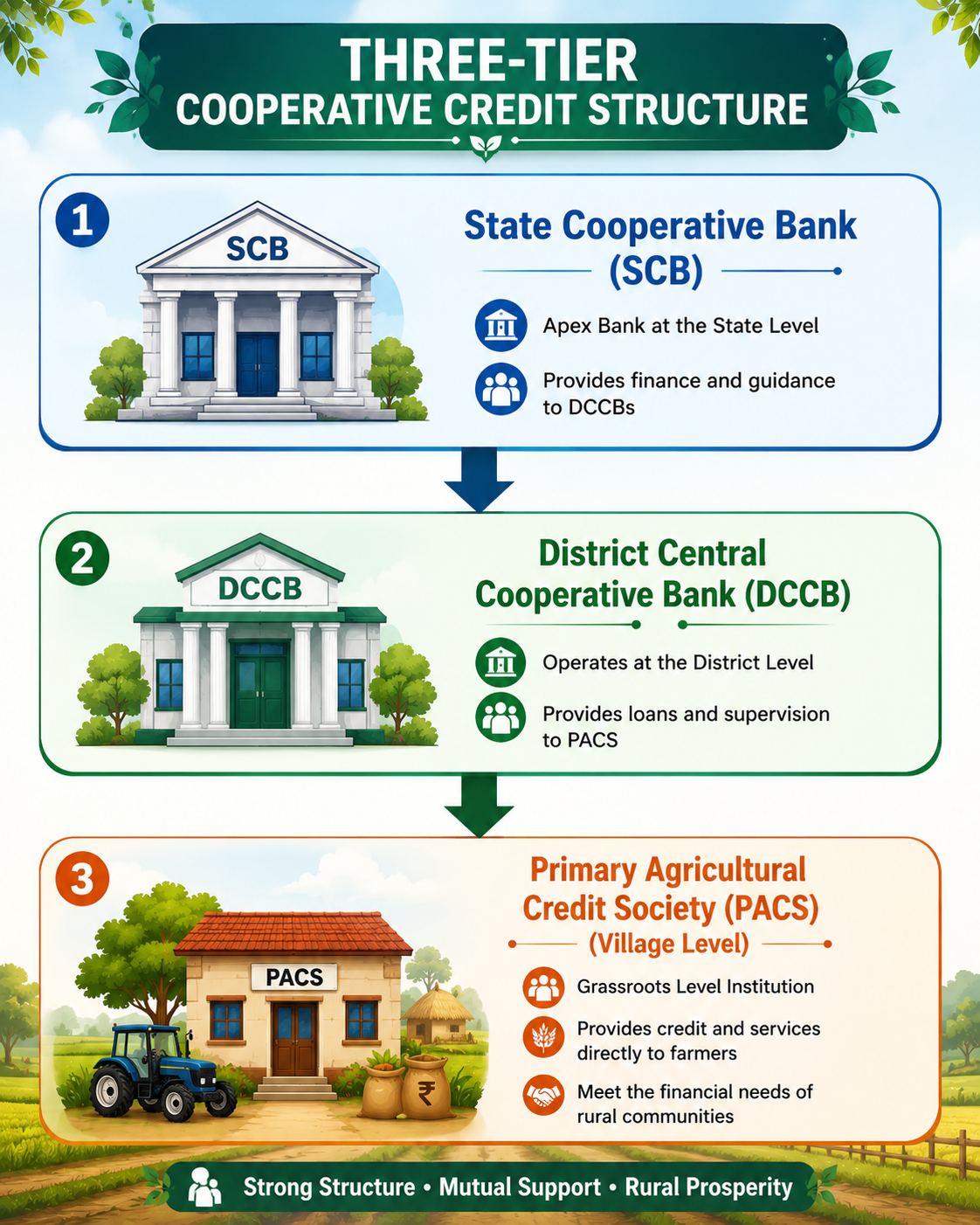
What are PACS?
A Primary Agricultural Credit Society (PACS) is a village-level cooperative society owned and managed by its members (mainly farmers) that provides short-term and medium-term agricultural credit and other essential services to support rural livelihoods.
Major Functions of PACS
1. Agricultural Credit: Provides short-term and medium-term loans to farmers. Offers crop loans at concessional interest rates.
2. Distribution of Agricultural Inputs: Seeds, Fertilizers, Pesticides, Farm equipment
3. Procurement of Crops: Procures crops at the Minimum Support Price (MSP) on behalf of government agencies.
4. Public Distribution System (PDS): Many PACS operate Fair Price Shops under the Public Distribution System.
5. Storage Facilities: Operate warehouses and grain storage facilities. Help reduce post-harvest losses.
6. Banking Services: Some PACS provide Deposit facilities, Banking correspondents' services, Digital payments, Aadhaar-enabled banking
7. Other Rural Services: Dairy and fisheries support, Common Service Centres (CSCs), LPG distribution. Rural entrepreneurship support
2. Digital Cooperatives
Technology is becoming an essential component of modern cooperative institutions.
Activities highlighted:
-
Digital payment systems
-
Online banking
-
Mobile applications
-
AI-based cooperative services
-
Digital documentation
-
Technology-enabled governance
The objective is to make cooperative institutions more efficient, transparent and citizen-friendly.
3. Financial Literacy
Financial literacy programmes educated cooperative members on Digital banking, Savings, Credit management, Insurance, Responsible borrowing, Government financial schemes
Improving financial awareness helps strengthen rural financial inclusion.
4. Farmer Welfare
Farmer-centric programmes covered:
-
Kisan Credit Cards (KCC)
-
Direct Benefit Transfer (DBT)
-
Crop loans
-
MSP procurement
-
Seed distribution
-
Scientific farming
-
Crop diversification
-
Better marketing
These initiatives aim to increase agricultural productivity and farmer incomes.
5. Dairy and Fisheries Cooperatives
The Ministry promoted stronger cooperative models in:
-
Dairy Sector: Milk procurement, Milk processing, Value addition, Dairy marketing
-
Fisheries: Fish production, Storage, Marketing, Infrastructure support
These sectors generate substantial rural employment and income.
6. Grain Storage
Special emphasis was placed on improving storage infrastructure through cooperative institutions.
Objectives include:
-
Reducing post-harvest losses
-
Scientific warehousing
-
Food security
-
Better MSP procurement
-
Increased farmer income
7. Artificial Intelligence and Emerging Technologies
Technology demonstrations showcased:
-
Artificial Intelligence
-
Drone technology
-
Geo-tagging
-
Micro-ATMs
-
FinTech applications
-
Online cooperative services
Technology adoption is expected to improve service delivery and governance.
8. Green Cooperatives
Environmental sustainability formed another major pillar.
Activities included Tree plantation, Climate-resilient agriculture, Cleanliness campaigns, Environmental awareness. Sustainable resource management
9. Women and Youth Participation
The Ministry promoted greater inclusion through:
-
Youth competitions
-
Student outreach
-
Women leadership programmes
-
Cooperative entrepreneurship
-
College seminars
-
Public awareness campaigns
Women and youth are expected to become key stakeholders in the future cooperative movement.
Significance of the Reforms
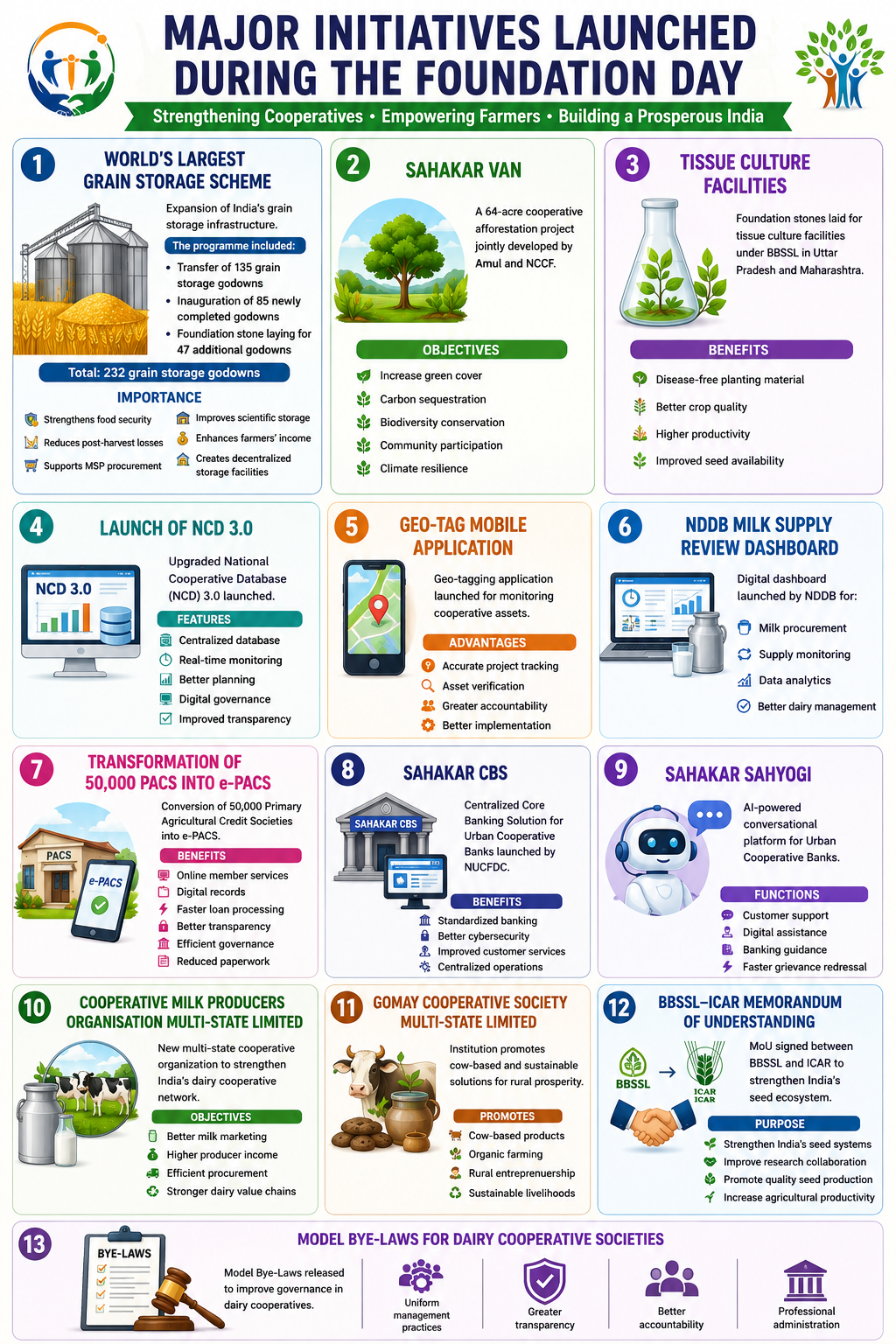
The initiatives launched during the Foundation Day reflect a comprehensive strategy to modernize India's cooperative sector. Their expected outcomes include:
-
Strengthening grassroots cooperative institutions.
-
Enhancing transparency through digital governance.
-
Expanding scientific storage infrastructure for food security.
-
Improving access to institutional credit.
-
Increasing farmers' incomes through better market linkages.
-
Empowering women and youth within cooperative institutions.
-
Promoting environmentally sustainable practices.
-
Leveraging artificial intelligence and digital platforms for efficient service delivery.
-
Advancing the vision of an Atmanirbhar Bharat through a vibrant and inclusive cooperative ecosystem.
The Ministry of Cooperation has evolved from a newly created department into a central pillar of India's rural development strategy within five years. With initiatives such as the digital transformation of 50,000 PACS, expansion of grain storage infrastructure, AI-enabled banking solutions, strengthened seed systems, and environmentally focused projects like Sahakar Van, the Ministry is positioning cooperatives as engines of inclusive growth.
Going forward, sustained collaboration among the Union Government, State Governments, cooperative institutions, financial organizations, farmers, women, and youth will be crucial for realizing the vision of "Sahakar Se Samriddhi". By combining technology, transparency, institutional reforms, and community participation, India's cooperative movement has the potential to become a key driver of rural prosperity, agricultural modernization, and sustainable economic development in the years ahead
Prelims Questions:
1. Consider the following statements regarding Primary Agricultural Credit Societies (PACS):
-
They are village-level cooperative institutions.
-
They are the lowest tier of the short-term cooperative credit structure.
-
They provide agricultural credit directly to farmers.
Which of the statements given above are correct?
A. 1 only
B. 2 and 3 only
C. 1 and 3 only
D. 1, 2 and 3
Answer: D
2. "Sahakar Van" is associated with:
A. Cooperative seed production
B. Cooperative dairy marketing
C. Cooperative afforestation
D. Organic certification
Answer: C
3. The Sahakar Van project has been jointly developed by:
A. NABARD and NDDB
B. ICAR and BBSSL
C. Amul and NCCF
D. NAFED and FCI
Answer: C
4. The Geo-tag Mobile Application launched by the Ministry is mainly intended for:
A. Crop forecasting
B. Monitoring cooperative assets
C. Soil testing
D. Livestock vaccination
Answer: B
5. Match List I with List II.
List I - List II
A. Sahkar Van - 1. AI Platform
B. Sahakar CBS - 2. Afforestation
C. Sahakar Sahyogi - 3. Core Banking
D. NCD 3.0 - 4. Cooperative Database
Codes:
A. A-2, B-3, C-1, D-4
B. A-1, B-2, C-3, D-4
C. A-2, B-1, C-4, D-3
D. A-3, B-2, C-1, D-4
Answer: A