
The proposed Defence Manufacturing Clusters bring together states, IITs, industries, MSMEs, and startups to boost indigenous defence production, innovation, exports, skill development, and self-reliance under the Atmanirbhar Bharat initiative.
Syllabus Areas:
GS III - Defence Technology
For the first time, the Centre is working towards creating clusters of states and UTs, each backed by IITs, to build a federal architecture for defence manufacturing aimed at reducing import dependence and boosting economic growth.
The 7 proposed clusters are independent of existing defence industrial corridors in Uttar Pradesh and Tamil Nadu.
Each cluster has lead state, co-lead state, participating states or UTs, designated IITc etc. for R&D support.
What are Defence Industrial Corridors (DICs)?
Defence Industrial Corridors are dedicated industrial regions developed to promote indigenous defence manufacturing, attract investments, strengthen the defence supply chain, encourage MSMEs and startups, and reduce India's dependence on defence imports under the Atmanirbhar Bharat initiative.
Existing Defence Industrial Corridors in India
1. Uttar Pradesh Defence Industrial Corridor (2018)
-
Nodes:Lucknow, Kanpur, Agra, Aligarh, Jhansi, Chitrakoot
-
Specialization: Defence equipment, Armoured systems, Ammunition, Aerospace components
2. Tamil Nadu Defence Industrial Corridor (2019)
-
Nodes: Chennai, Coimbatore, Hosur, Salem, Tiruchirappalli
-
Specialization: Aerospace, Defence electronics, Precision engineering, Missile and avionics components
What are Defence Manufacturing Clusters?
Defence Manufacturing Clusters (DMCs) are a newly proposed federal framework of 7 state clusters, each led by a Lead State, supported by a Co-Lead State, participating states/UTs, and an IIT/IISc-backed R&D institution.
The objective is to accelerate indigenous defence manufacturing, reduce import dependence, strengthen innovation, and increase defence exports.
Proposed 7 Defence Manufacturing Clusters
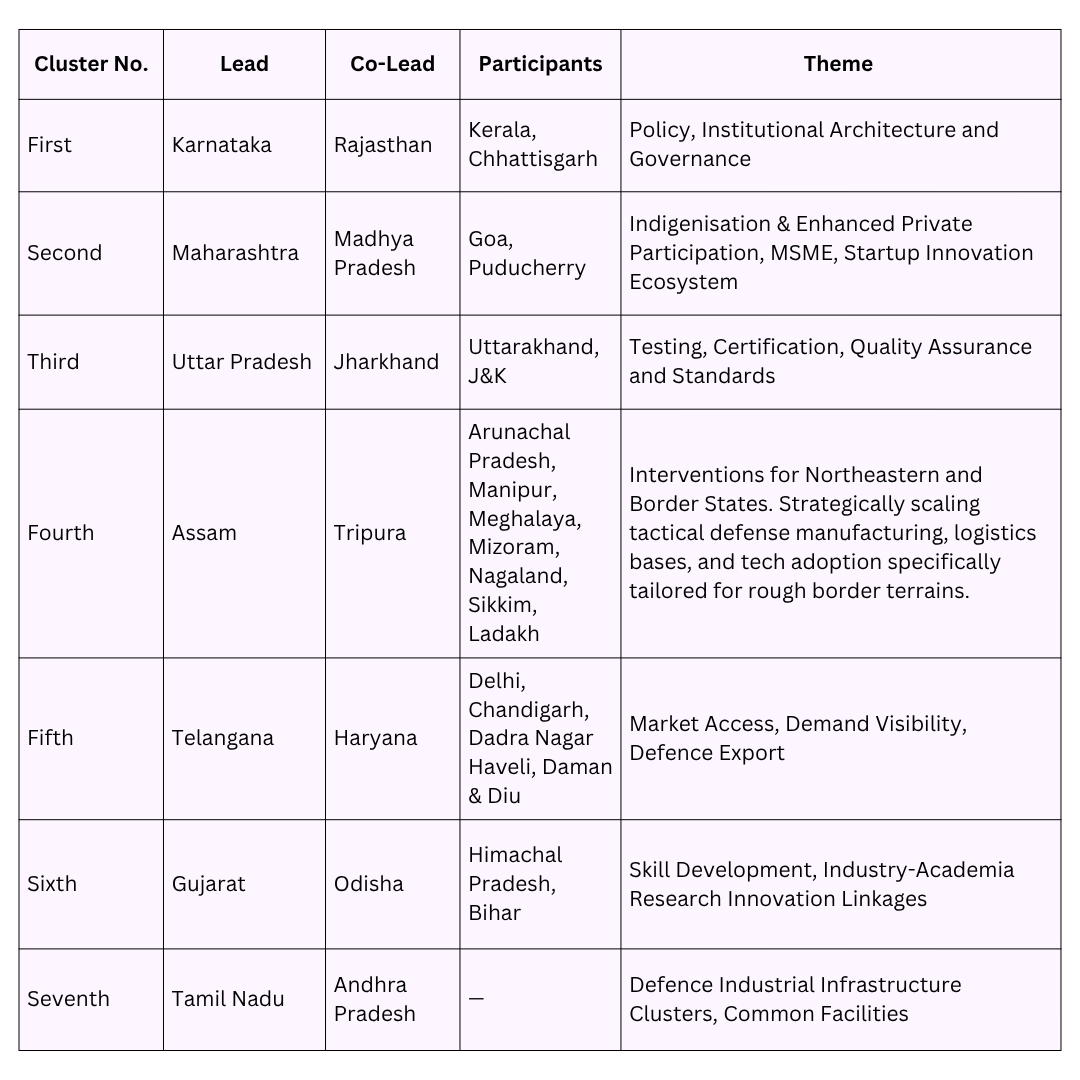
Significance of Defence Manufacturing Clusters:
India is one of the world's largest defence spenders, but a significant portion of advanced military equipment has traditionally been imported. To achieve Atmanirbhar Bharat in Defence, the government has proposed 7 Defence Manufacturing Clusters.
1. To Reduce Import Dependence
-
India imports engines, sensors, avionics, electronics, and advanced materials.
-
Clusters will promote indigenous design, development, and manufacturing.
-
Helps save foreign exchange and improve strategic autonomy.
2. To Leverage State-Specific Strengths
Different states have different industrial capabilities:
-
Tamil Nadu – Aerospace & precision engineering
-
Telangana – Defence electronics & missiles
-
Karnataka – R&D and aerospace ecosystem
-
Assam & North-East – High-altitude and specialized materials
The cluster model combines these strengths into a coordinated network.
3. IIT-Backed Innovation and R&D
Each cluster is linked to an IIT/IISc.
-
Promotes defence research.
-
Facilitates technology transfer from academia to industry.
-
Encourages innovation by startups and MSMEs.
4. To Develop Specialized Defence Ecosystems
Each cluster focuses on a specific theme:
-
Testing & Certification
-
Defence Exports
-
Advanced Materials
-
Skill Development
-
Infrastructure Development
-
Startup Innovation
This avoids duplication and creates centres of excellence.
5. To Boost MSMEs and Startups
-
Over 16,000 MSMEs contribute to India's defence supply chain.
-
Clusters provide market access, common facilities, testing infrastructure, and funding support.
-
Encourages indigenous defence innovation.
6. To Increase Defence Exports
India aims to become a major defence exporter.
-
Dedicated export-oriented clusters will help Indian firms access global markets.
-
Supports the target of making India a global defence manufacturing hub.
7. To Create a Nationwide Defence Manufacturing Network
Unlike the two existing Defence Industrial Corridors (UP and Tamil Nadu), these clusters:
-
Cover multiple states and UTs.
-
Integrate regions like the North-East and Himalayan states.
-
Create a federal architecture for defence production.
Defence Manufacturing Clusters represent a shift from isolated industrial corridors to a collaborative, innovation-driven, multi-state ecosystem integrating industry, academia, startups, and government to achieve defence self-reliance and export competitiveness.