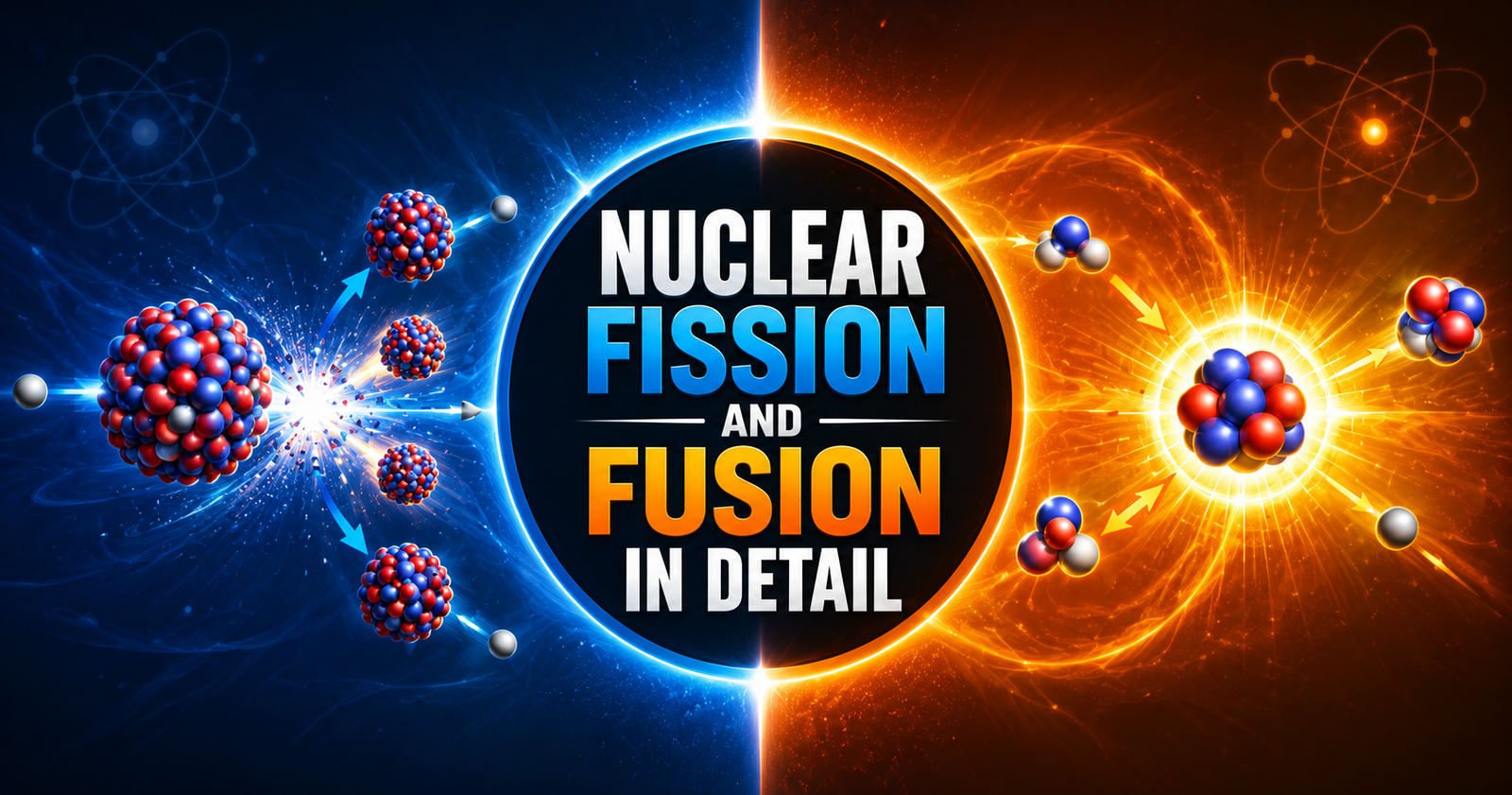
Explore nuclear fission and fusion, their mechanisms, reactor types, moderators, coolants, chain reactions, energy production, advantages, limitations, and significance for nuclear programmes of India
Syllabus Areas:
GS III - Science and Technology
Nuclear Energy
Nuclear energy is the energy stored in the nucleus (center) of an atom. This energy is released through nuclear fission or nuclear fusion.
Nuclear Fission Reaction
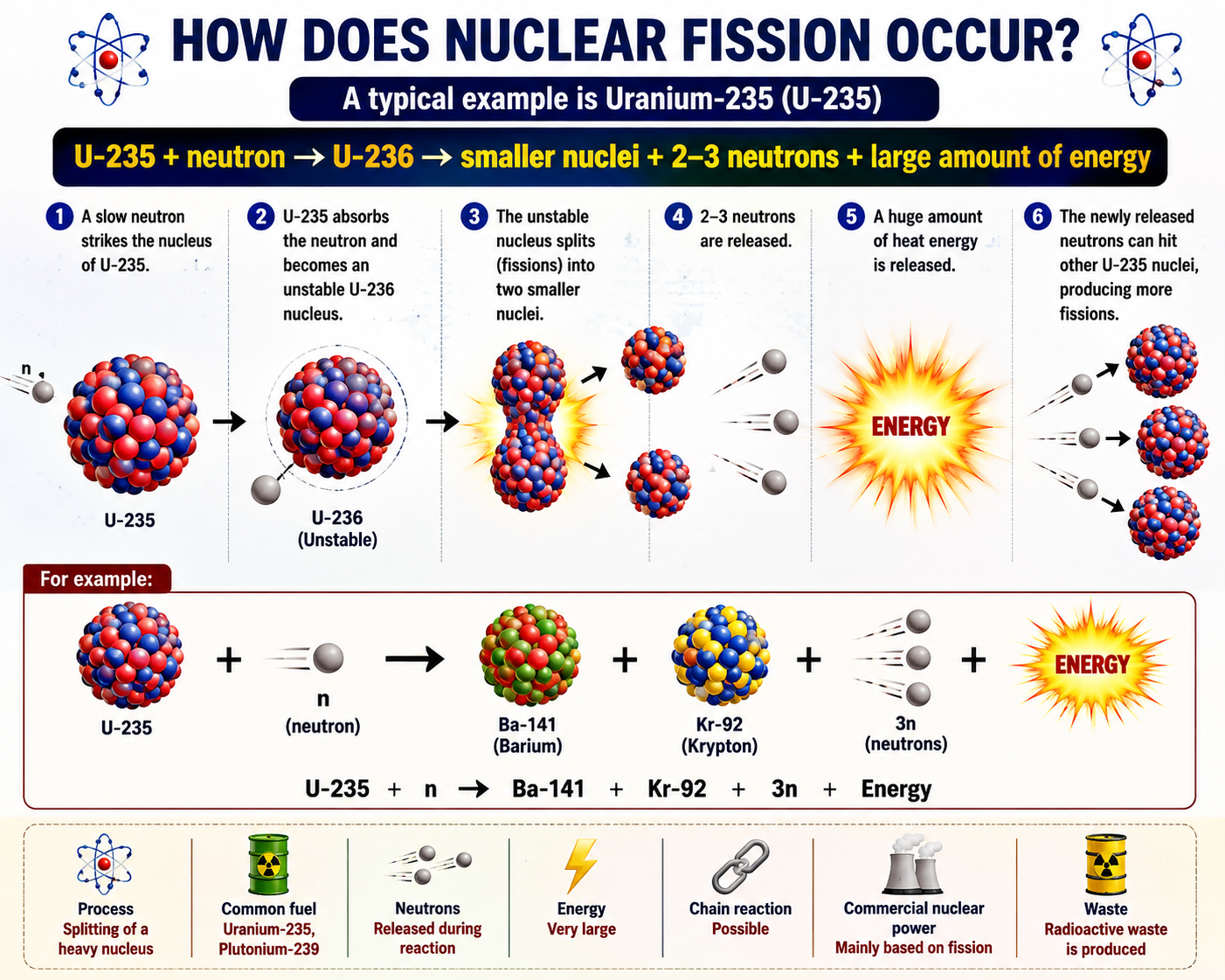
Nuclear fission is a nuclear reaction in which the nucleus of a heavy atom splits into two or more smaller nuclei, releasing a very large amount of energy.
Nuclear Chain Reaction
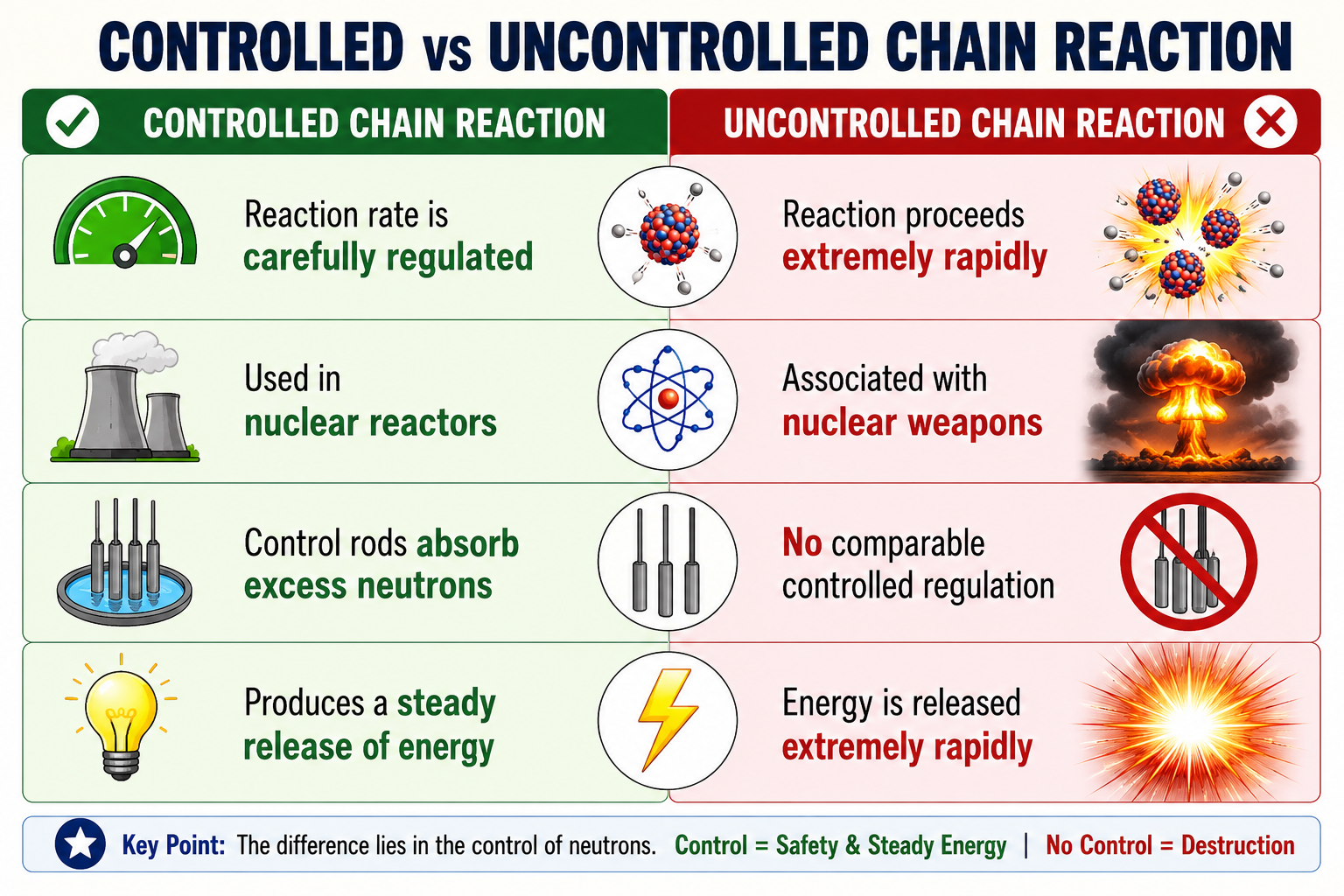
A nuclear chain reaction is a self-sustaining series of nuclear reactions in which one nuclear reaction triggers further nuclear reactions.
-
Controlled chain reaction → Nuclear reactor → Electricity generation
-
Uncontrolled, extremely rapid chain reaction → Nuclear weapon
Nuclear Fusion Reaction
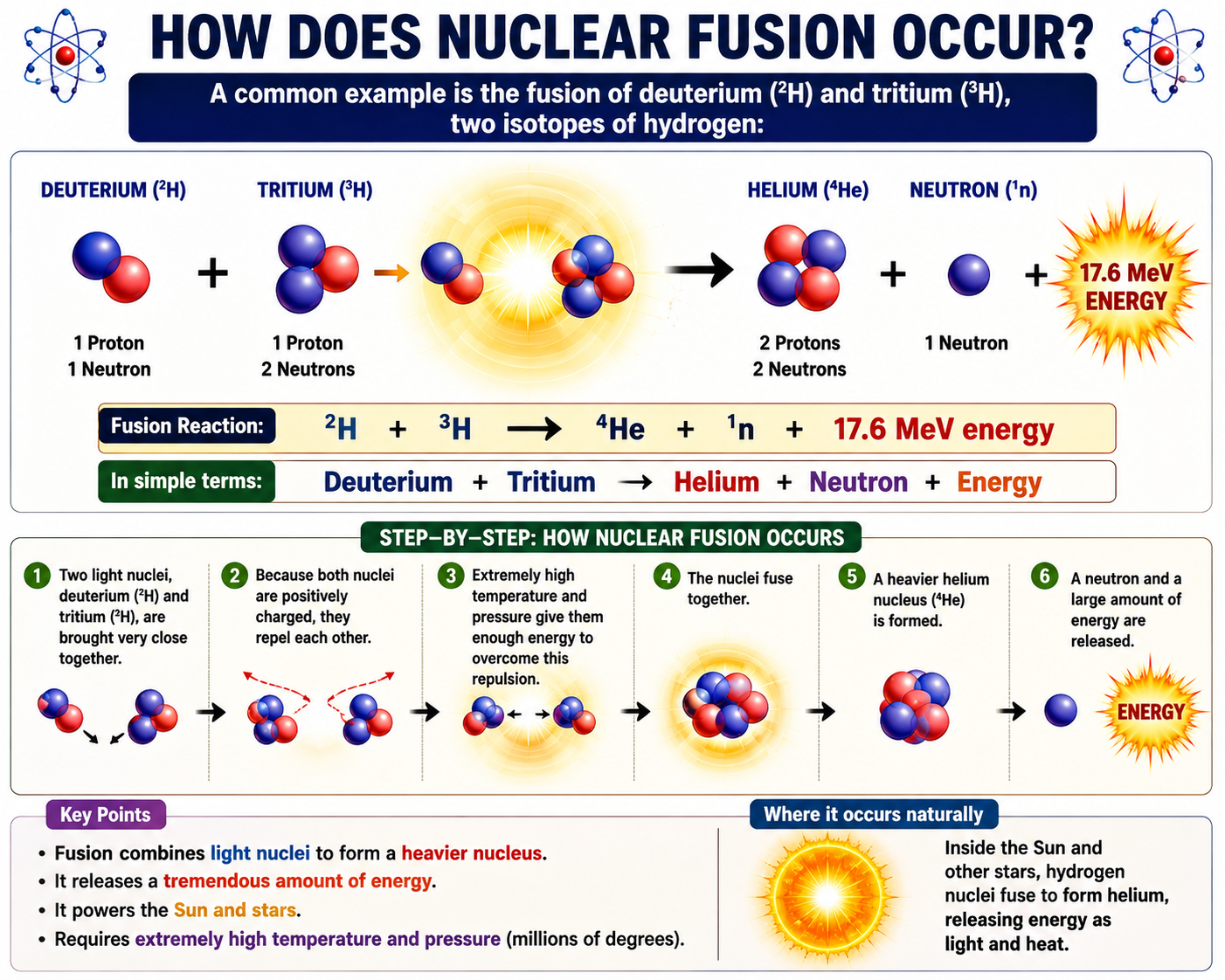
Nuclear fusion is a nuclear reaction in which two or more light atomic nuclei combine to form a heavier nucleus, releasing a tremendous amount of energy.
Different Types of Nuclear Reactors
A nuclear reactor is a device in which a controlled nuclear chain reaction is maintained to produce heat, which can be used to generate electricity or for other purposes.
Nuclear reactors can be classified based on their fuel, moderator, coolant, and neutron energy.
1. Pressurized Water Reactor — PWR
-
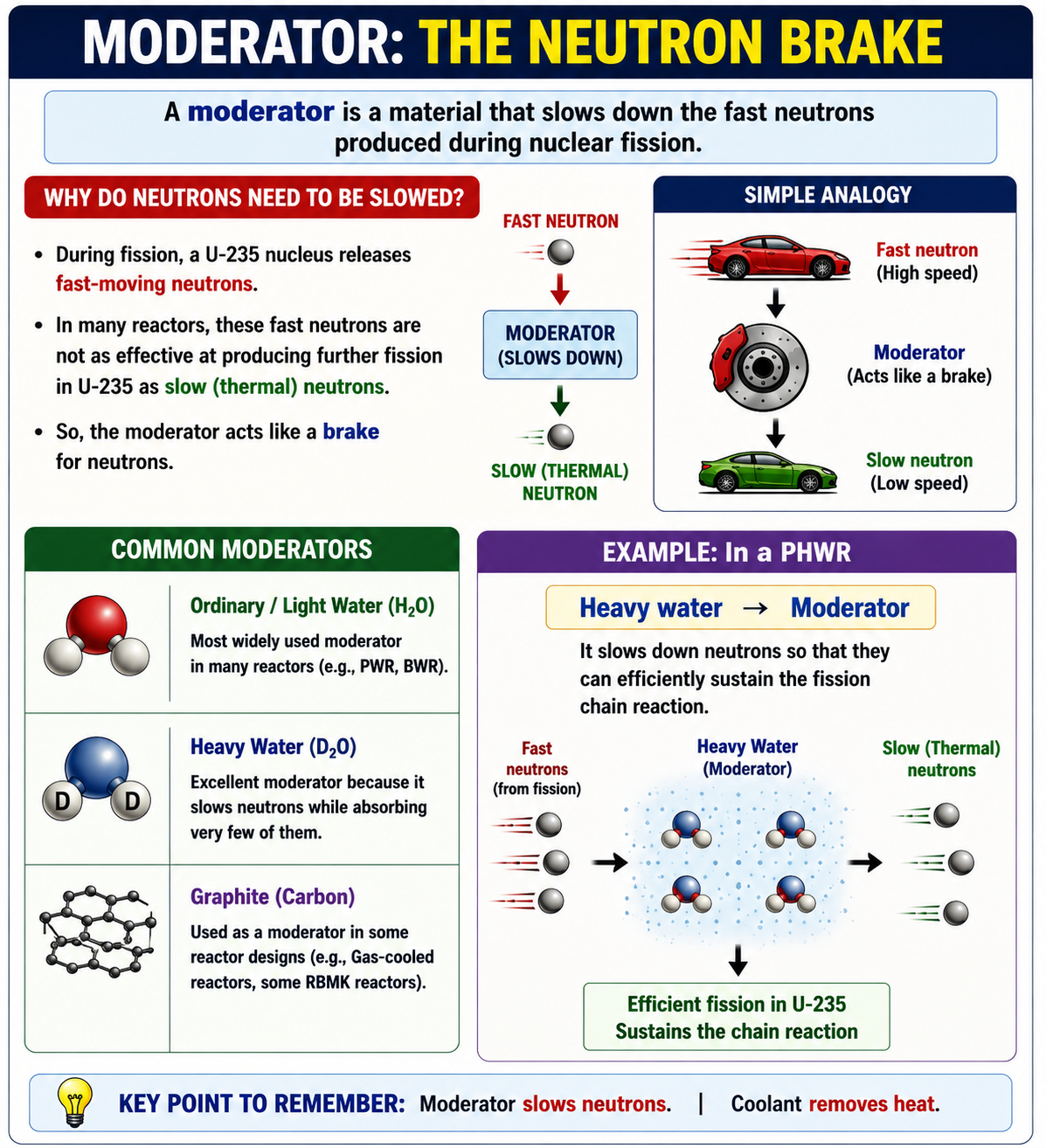
Uses ordinary/light water as both coolant and moderator.
-
Water is kept under very high pressure so that it does not boil inside the reactor.
-
Heat is transferred to a secondary water circuit, which produces steam.
-
Enriched uranium is generally used as fuel.
-
One of the most widely used reactor designs globally.
Pressurized water → transfers heat → secondary steam → turbine → electricity
2. Boiling Water Reactor — BWR
-
Uses ordinary water as both coolant and moderator.
-
Unlike a PWR, the water is allowed to boil inside the reactor vessel.
-
The steam produced directly drives the turbine.
PWR vs BWR:
PWR: water boils in a separate/secondary loop.
BWR: water boils inside the reactor.
3. Pressurized Heavy Water Reactor — PHWR
This is particularly important for India.
-
Uses heavy water (D₂O) as moderator and coolant.
-
Uses natural uranium as fuel in the conventional PHWR design.
-
Heavy water is an excellent neutron moderator.
-
India developed considerable expertise in PHWR technology because it reduces dependence on uranium enrichment.
Important example:
India's 220 MWe and 540 MWe PHWRs are major examples of indigenous reactor technology.
PHWR → Heavy Water + Natural Uranium
4. Fast Breeder Reactor — FBR
Unlike thermal reactors, fast reactors do not use a moderator to slow down neutrons.
-
Uses fast neutrons.
-
Can convert fertile material such as Uranium-238 into Plutonium-239.
-
A breeder reactor can produce more fissile material than it consumes.
-
Liquid sodium is commonly used as a coolant in sodium-cooled fast reactors.
This is extremely important for understanding India's three-stage nuclear power programme.
Fast neutrons → No moderator → Breeding of fissile material
5. Advanced Heavy Water Reactor — AHWR
India has developed the Advanced Heavy Water Reactor (AHWR) concept.
-
Uses heavy water as moderator.
-
Designed to use thorium-based fuel along with other fissile/fertile materials.
-
Intended to demonstrate technologies relevant to India's long-term thorium utilisation strategy.
-
It is an important part of India's research toward the third stage of its nuclear programme.
6. Gas-Cooled Reactors
These reactors use a gas rather than water as the coolant.
Common coolants include:
-
Carbon dioxide
-
Helium
Some designs use graphite as the moderator.
Advantage: High operating temperatures can improve thermal efficiency.
7. Molten Salt Reactors — MSR
Here, the reactor uses molten salt either as a coolant or, in some designs, as the medium in which nuclear fuel is dissolved.
Potential advantages include:
-
High operating temperatures
-
Low-pressure operation
-
Possibility of using different fuel cycles
-
Potentially improved safety characteristics in some designs
They remain an important area of advanced-reactor research rather than a dominant commercial reactor type.
8. Small Modular Reactors — SMRs
SMRs are reactors with smaller power output that can be manufactured in modules and deployed individually or in groups.
Typical features:
-
Smaller size than conventional large reactors
-
Modular construction
-
Potentially lower upfront project costs
-
Passive safety features in many designs
-
Potential applications in remote locations and industrial heat
Important: SMR is primarily a size/design and deployment concept, not one single reactor technology. SMRs can use different reactor types.