Rising out-of-pocket costs for schooling and private coaching can put learning opportunities beyond the reach of poorer households. The article argues that India’s poverty standard should account for minimum education costs alongside food and healthcare.
UPSC relevance:
|
GS Paper I |
Poverty and developmental issues, rural–urban disparities in education spending |
|
GS Paper II |
Social justice and education, affordability of schooling and private coaching, access to education for vulnerable households |
|
GS Paper III |
Indian economy, inclusive growth, employment, wage disparities and informal employment in the education sector |
India’s calorie-based poverty line, introduced in the 1970s, says little about whether households can afford a decent standard of living. The Tendulkar and Rangarajan Committees revised earlier norms without defining what households need to spend on non-food essentials. A revised poverty standard should include minimum expenditure norms for education and healthcare, both of which can help households escape poverty.
A calorie-based measure can miss education poverty. When access to learning or exam preparation depends on paid private coaching, poorer households may be unable to afford it. Recent National Sample Survey (NSS) data on education, employment and unincorporated enterprises, read alongside surveys from 2010–12, help explain how the growing role of private providers affects poorer households.
The growing role of non-public education providers
National accounts do not break down education value added by institutional sector. Subtracting public-sector other services from total education value added gives a lower-bound estimate of the non-public share. This estimate rose from 10% in 2011–12 to 19% in 2015–16 and 33% in 2023–24.
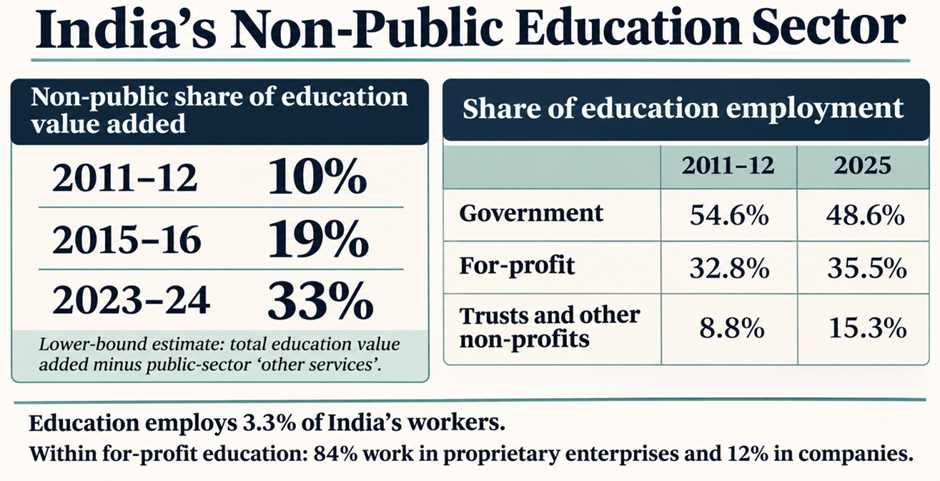
Education employs 3.3% of India’s workers. Between 2011–12 and 2025, the government’s share of education employment fell from 54.6% to 48.6%. The for-profit share rose from 32.8% to 35.5%, while the share of trusts and other non-profits rose from 8.8% to 15.3%. Within for-profit education, 84% of workers were employed in proprietary enterprises and 12% in companies.
What households spend on schooling and coaching
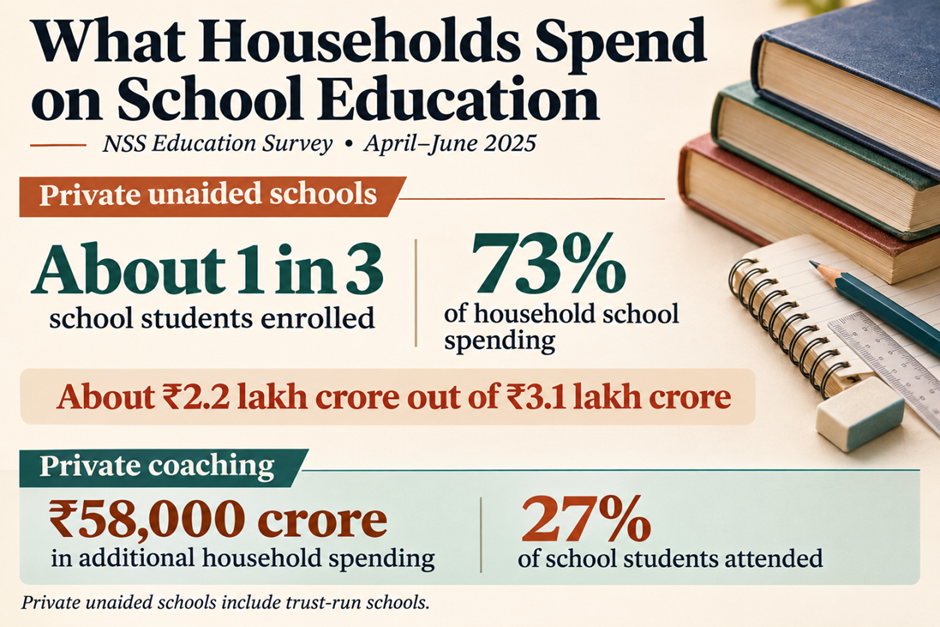
The April–June 2025 NSS education survey found that private unaided schools enrolled about one-third of students and accounted for 73% of household school spending, or about ₹2.2 lakh crore out of ₹3.1 lakh crore. The private unaided category includes both for-profit and trust-run schools. Households spent a further ₹58,000 crore on private coaching, which 27% of school students attended.
Coaching adds to household costs even where children attend government schools. Government schools enrol 56% of students, and their students account for 43% of household coaching expenditure. Coaching participation is 27% among government-school students, 24% among private unaided-school students and 35% among aided-school students.
Among students who take coaching, annual expenditure averages ₹6,900 for those in government schools and ₹11,700 for those in private unaided schools. For government-school families using coaching, it costs nearly twice what they spend on school itself. For private unaided-school families using coaching, it costs about one-third of their school expenditure. Coaching participation is highest in Tripura (79%), West Bengal (75%), Odisha (57%) and Bihar (53%).
The coaching market and gaps in survey coverage
Enterprise surveys counted 4.9 lakh unincorporated tuition and coaching establishments in 2010–11, 8.6 lakh in 2022–23 and about 15 lakh in 2025. Changes in survey design explain part of the increase.
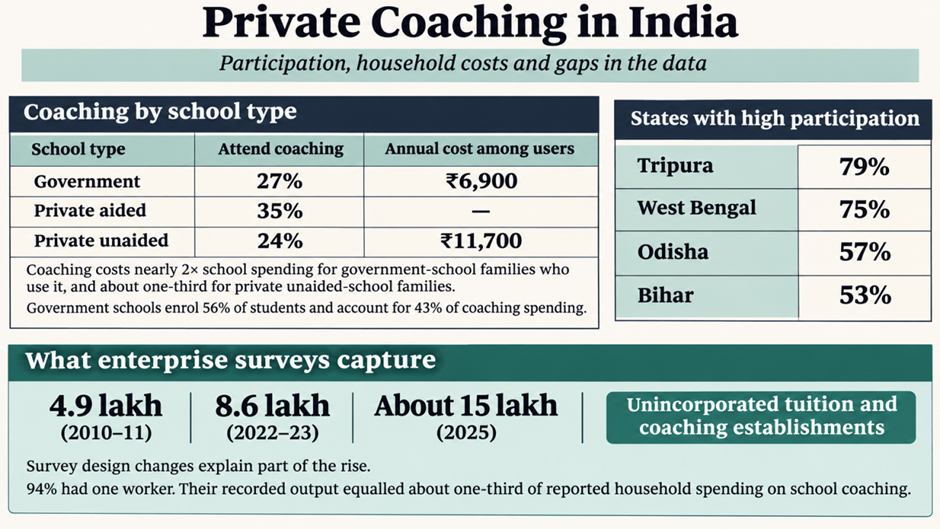
94% of these establishments had a single worker. Their recorded output amounted to about one-third of what households reported spending on school coaching. The gap suggests that substantial spending may go to companies, institutes and individual tutors outside the enterprise surveys’ coverage.
The education burden on poorer households
Households with school-going children spend 13.9% of their total consumption on schooling, coaching and hostels. The share is 11% in rural areas and 18% in urban areas. Coaching alone accounts for 2.2% of total consumption. The poorest fifth of households with school-going children spends 12.7% of its consumption on schooling, coaching and hostels.
The expenditure share can understate the burden because poorer households have more children and spend less per student. The poorest fifth averages 1.6–1.8 children aged 0–14 per household, compared with 0.4 in the richest fifth. Monthly education expenditure per student is ₹646 in the poorest fifth, ₹1,162 in the middle fifth and ₹2,544 in the richest fifth.
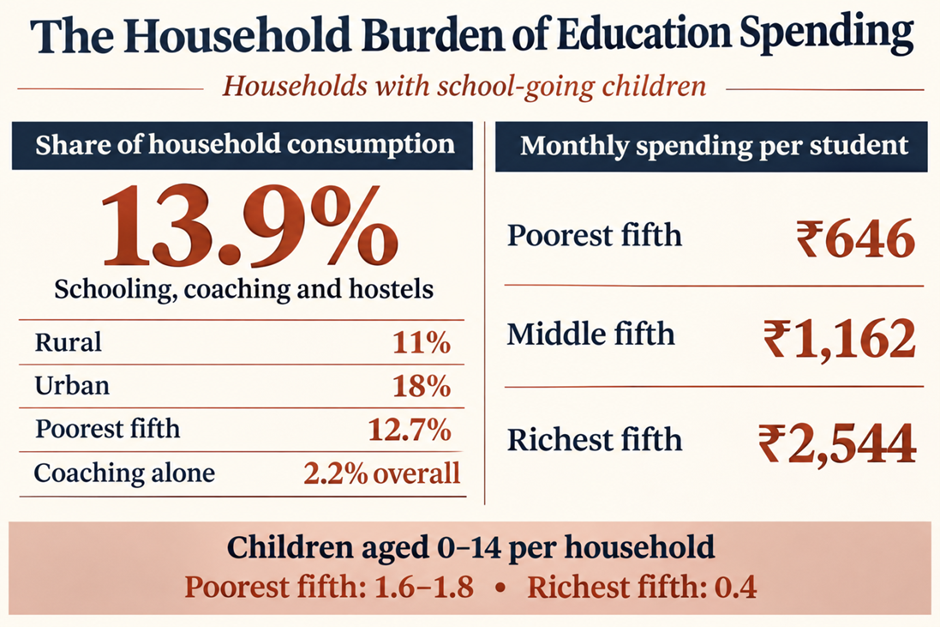
If the poorest fifth of households with school-going children matched the middle fifth’s expenditure per student, education would absorb about 23% of their total consumption. This comparison raises a policy question about what constitutes adequate education expenditure. India lacks a benchmark for that minimum.
Wages and job security in education
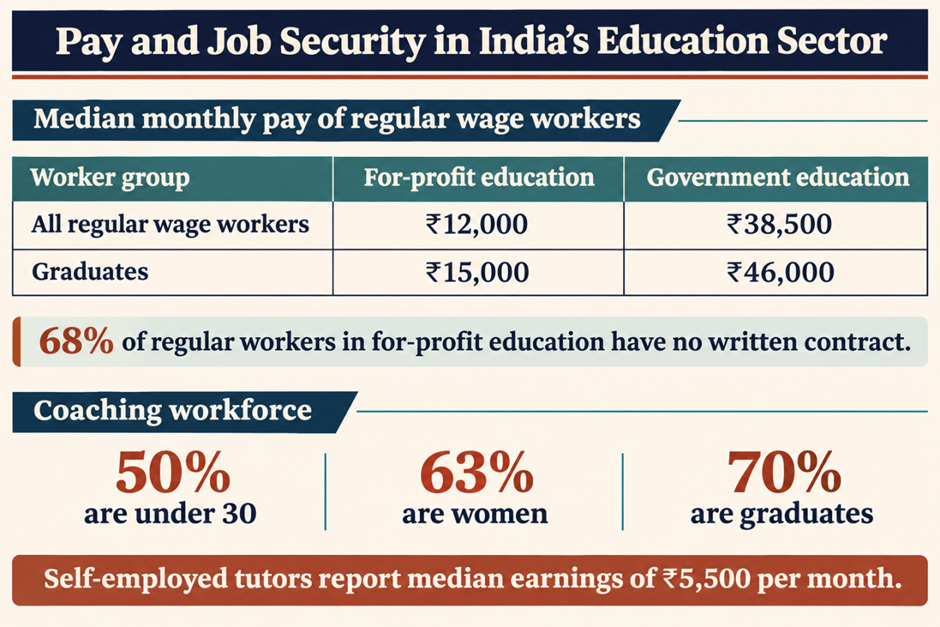
Regular wage workers in for-profit education earn a median ₹12,000 per month, compared with ₹38,500 in government education. Among graduates, the corresponding figures are ₹15,000 and ₹46,000. In for-profit education, 68% of regular workers lack a written contract.
Half of coaching workers are under 30, 63% are women and 70% are graduates. Self-employed tutors report median monthly earnings of ₹5,500.
An education benchmark for poverty measurement
A revised poverty standard should assess whether households can afford minimum education, food and healthcare needs together. The education benchmark should account for out-of-pocket schooling costs and provide for either school education of sufficient quality to make private tuition unnecessary or access to affordable tuition.
China’s 2021 reforms, aimed at reducing the household burden of for-profit tutoring in school subjects, offer a comparative policy example. For India, defining a minimum education standard would allow poverty estimates to assess whether families can meet schooling costs alongside their food and healthcare needs.
Also read today's article on:
Lawa’s Solar-Powered Community TV and Last-Mile Governance in Dantewada