GST reforms can affect States differently through changes in collections, settlements and refunds. Discover why aggregate revenue growth may conceal individual States’ fiscal challenges.
GST rate changes affect States differently through SGST collections, IGST settlements and refunds. While aggregate revenue growth may appear stable, it can conceal losses in individual States. Assessing a reform therefore requires examining both overall collections and the distribution of revenue gains and losses.
UPSC relevance:
GS II: Cooperative federalism, GST Council and Centre–State relations.
GS III: Taxation, public finance, fiscal policy and State finances.
GST Rate Cuts Without Compensation Protection
States adopted GST in 2017, backed by five years of statutory compensation for specified revenue shortfalls. This protection ended in June 2022.
The September 2025 rate cuts, described as GST 2.0, were the first major rate changes States had to absorb without this cushion. Revenue losses could therefore directly affect their expenditure planning and fiscal flexibility.
The GST Council estimated the reform’s annual cost at ₹48,000 crore. However, this aggregate estimate did not show how the cost would be distributed among States.
How States Receive GST Revenue
A State’s GST revenue has two main streams:
|
Revenue stream |
Source |
|
Own SGST collections |
Tax collected on intra-State supplies. |
|
IGST settlement |
Amounts apportioned from IGST collected on inter-State supplies and imports. |
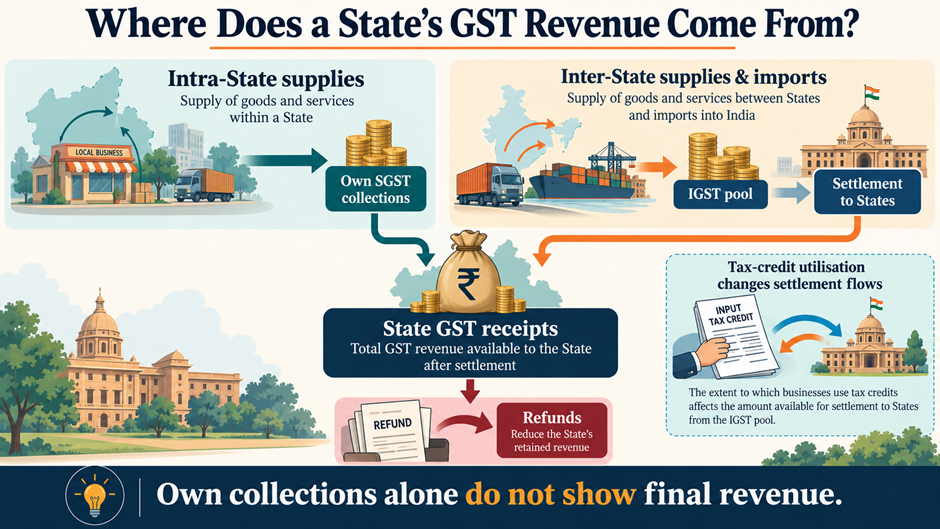
Tax-credit utilisation influences settlement flows, while refunds reduce retained revenue. Consequently, own SGST collections alone cannot indicate a State’s final GST receipts.
Even when own collections rise, lower settlement receipts or higher refunds can outweigh those gains.
Aggregate Growth Conceals Changes in Revenue Sources
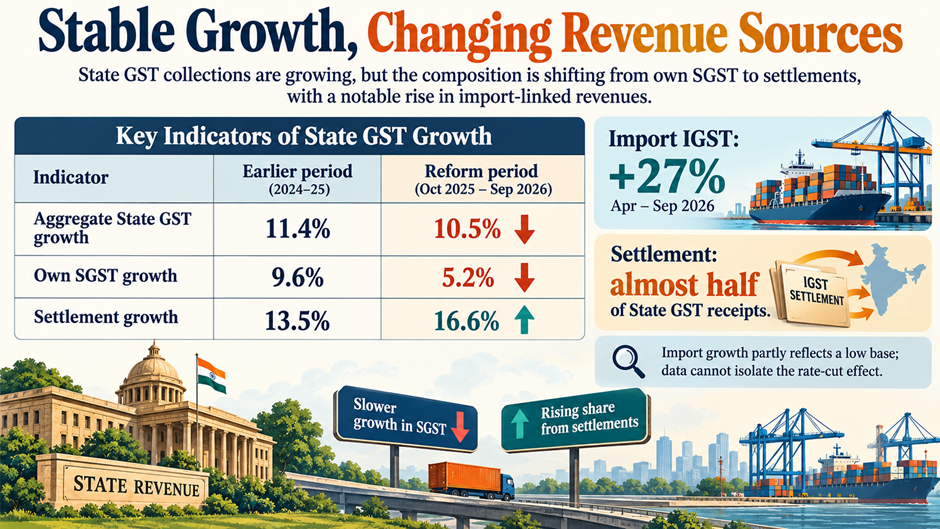
Aggregate State GST revenue grew 10.5% during October 2025–September 2026, compared with 11.4% in 2024–25. However, the two revenue streams followed different paths.
|
Indicator |
Earlier growth |
Growth following the reform |
|
Own SGST collections |
9.6% |
5.2% |
|
IGST settlement |
13.5% |
16.6% |
Higher settlements largely offset slower growth in own SGST collections. Settlement now accounts for almost half of States’ GST receipts.
A 27% rise in import IGST during April–September 2026 supported this increase, although part of the growth reflected an unusually low base.
The timing suggests that rate cuts may have contributed to slower SGST growth, but the available data cannot isolate their precise effect.
Unequal Outcomes Across States
IGST settlement depends on inter-State trade, imports and businesses’ use of tax credits—factors beyond State governments’ direct control.
The 18 major States experienced different revenue outcomes:
|
Revenue trend |
States or findings |
|
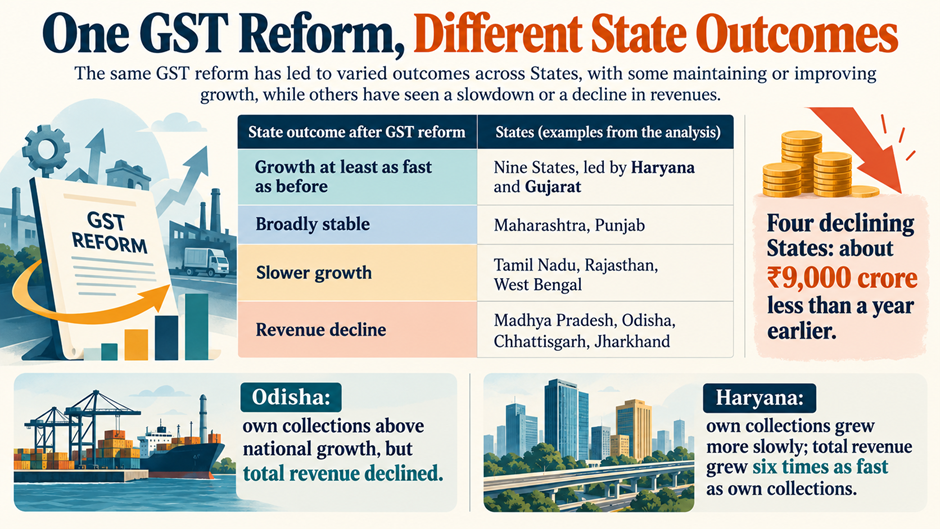
Growth at least as fast as before |
Nine States, led by Haryana and Gujarat. |
|
Broadly stable growth |
Maharashtra and Punjab. |
|
Slower growth |
Tamil Nadu, Rajasthan and West Bengal. |
|
Revenue decline |
Madhya Pradesh, Odisha, Chhattisgarh and Jharkhand. |
The four States recording declines together received about ₹9,000 crore less than a year earlier.
Why Own Collections Are an Incomplete Guide
Odisha’s own collections grew faster than the national average, yet its overall revenue declined. Haryana’s own collections grew more slowly, while its total revenue grew six times faster than those collections.
These contrasting outcomes demonstrate why collection growth and final revenue receipts must be assessed separately.
What Explains the Differences?
Imports and Input Tax Credit
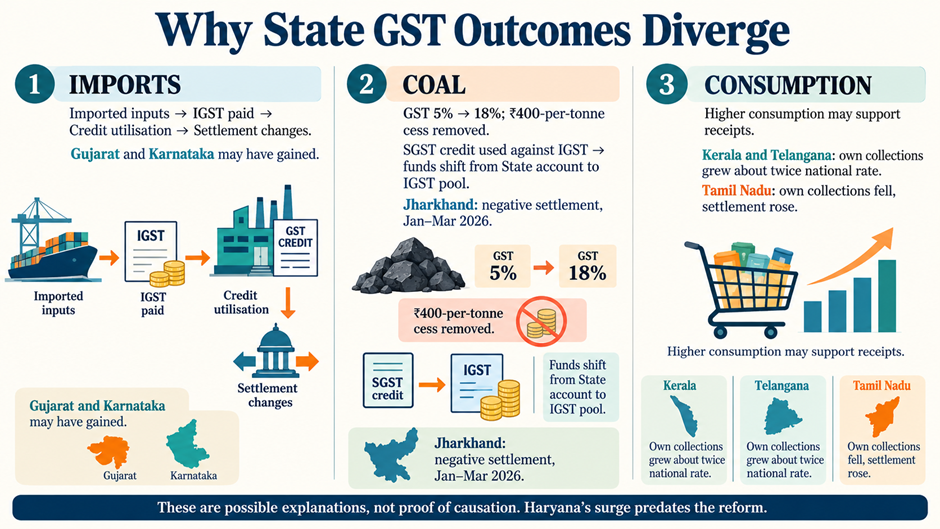
Manufacturers paying IGST on imported inputs can use the resulting credit against other tax liabilities. This moves revenue between the IGST pool and State accounts.
Rising import IGST may have benefited Gujarat and Karnataka. However, Haryana’s revenue surge predates the reform, indicating that not every change can be attributed to GST 2.0.
Coal Tax Changes and Mineral-Producing States
Coal GST increased from 5% to 18%, while the ₹400-per-tonne cess was removed, partly enabling coal companies to use accumulated credits.
When SGST credit is used against IGST liabilities, funds move from State accounts to the IGST pool. This could help explain why some mineral-producing States maintained own collections but experienced falling settlement receipts.
Jharkhand recorded negative settlement during January–March 2026. The GST Council should clarify how much the coal tax changes contributed to this outcome.
Consumption Patterns
Higher taxable consumption supports destination-based GST receipts.
-
Kerala and Telangana: Own SGST collections grew about twice the national rate, possibly supported by higher consumption.
-
Tamil Nadu: Own collections fell while settlement increased, potentially reflecting greater use of IGST credit against SGST liabilities.
Industrial structure also matters because it shapes input credits, inter-State sales and refunds.
Refunds and the Difference Between Gross and Net Revenue
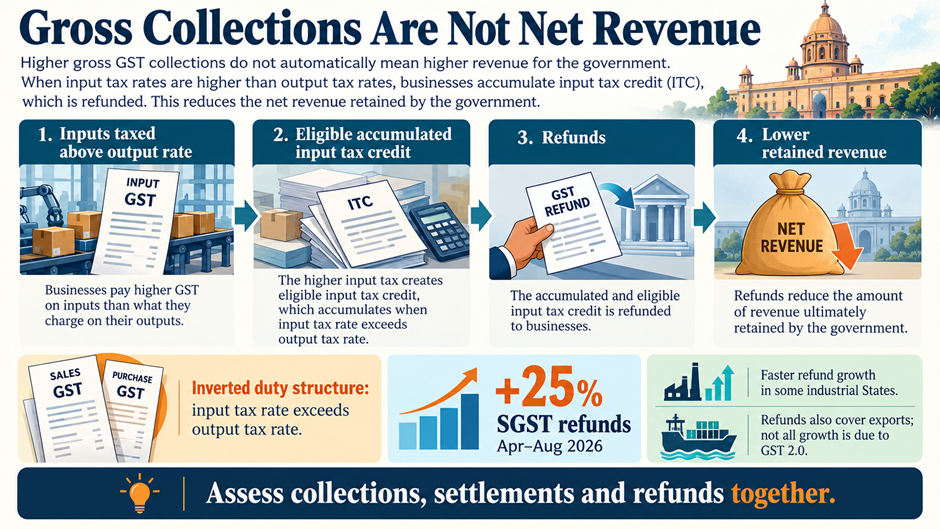
An inverted duty structure arises when inputs face higher tax rates than outputs. Eligible accumulated input tax credits may then be refunded.
SGST refunds rose 25% during April–August 2026, with faster growth in some industrial States.
Refunds also cover exports, so their increase cannot be attributed entirely to GST 2.0. Nevertheless, they reduce the revenue States retain.
Gross collections therefore overstate net revenue when refunds are not accounted for.
Different Perspectives on the Reform
|
Perspective |
Main argument |
|
Overall reform performance |
Higher settlements largely offset slower SGST growth, keeping aggregate revenue growth relatively stable. |
|
Individual States’ concerns |
Aggregate figures conceal losses, including in States with stronger own collections. |
|
Economic and tax-credit factors |
Imports, consumption, industrial structure and credit utilisation influence outcomes independently of rate changes. |
|
Refunds and retained revenue |
Rising refunds reduce net receipts, making gross collections an incomplete measure. |
|
Federal accountability |
States need transparent information on how common tax decisions affect their individual finances. |
GST Council’s Agenda: Assessing State-Level Impact
Before future rate changes, the GST Council should publish State-wise revenue impact assessments covering:
-
Own SGST collections.
-
IGST settlements.
-
Refunds.
It should also release monthly State-wise settlement data, explaining significant adjustments.
Such information would help States understand revenue changes, improve budgeting and participate in informed deliberations within the Council. It would also strengthen trust, accountability and coordination under cooperative federalism.
The central issue is not whether GST 2.0 has failed, but whether its effects are being measured adequately. Aggregate revenue growth alone cannot reveal how a reform’s costs and benefits are distributed among States.
Mains question:
"Examine how GST 2.0 affects States’ revenues differently and assess implications for India’s fiscal federalism."
Also read today's article on:
Centre–State Fiscal Relations: Tax Sharing, Grants and Fiscal Autonomy