India’s Gnani Artha launches a sovereign AI stack, strengthening indigenous AI capabilities, technological self-reliance, strategic autonomy, innovation, governance, and India’s global technological leadership.
Syllabus Areas:
GS II - Governance
GS III - Science and Technology
Vice President Shri C. P. Radhakrishnan launched ‘Gnani Artha’, described as a sovereign AI stack, at Uparashtrapati Bhavan, New Delhi. The platform combines Evon 3.3, a large language model, with Plexus, a platform designed to connect AI intelligence with real-world work and institutions.
The launch highlights India's growing emphasis on indigenous artificial intelligence capabilities, technological self-reliance and sovereign AI infrastructure.
What is ‘Gnani Artha’?
Gnani Artha is a sovereign AI stack developed by GNANI AI.
It brings together two key components:
Evon 3.3
-
A large language model (LLM).
-
Forms the AI intelligence component of the stack.
-
Represents India's effort to develop advanced AI technologies domestically.
Plexus
-
A platform that connects AI intelligence with real-world work and institutions.
-
It provides the practical/institutional layer through which AI capabilities can be applied.
In simple terms:
Evon 3.3 = AI intelligence
Plexus = application/institutional interface
Gnani Artha = integrated sovereign AI stack
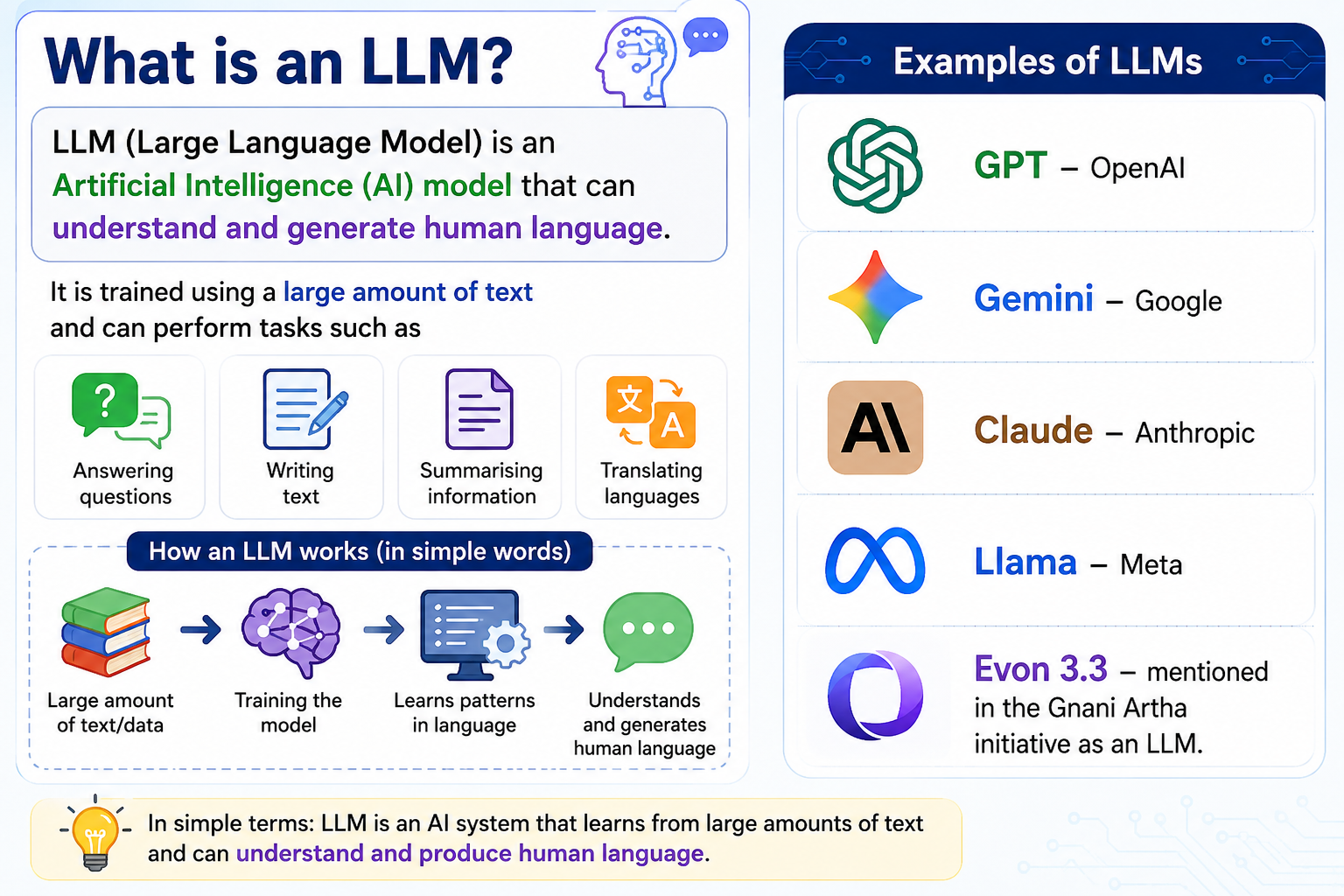
What is a “Stack”?
A stack means a group of technologies or tools that work together to perform a particular function.
In the Gnani Artha article, “AI stack” means a combination of different AI technologies working together.
What is a Sovereign AI Stack?
The launch places significant emphasis on the concept of sovereign AI capabilities.
A sovereign AI ecosystem aims to strengthen a country's ability to develop and deploy AI technologies using indigenous technological capabilities, rather than remaining dependent entirely on external technology providers.
The Vice President stressed that India should develop its own technological capabilities and should not remain merely a consumer of technology.
“We should not be consumers always; we need to create, so that others can consume.”
This reflects the broader objective of moving India from being primarily a technology consumer to a technology creator and global technology leader.
India’s Push for Technological Self-Reliance
The launch was presented as an example of India's increasing technological capabilities.
According to the Vice President:
-
India's technology ecosystem is becoming stronger.
-
Indian engineers are demonstrating the ability to work on frontier technologies.
-
India needs to build indigenous capabilities in strategic technologies.
-
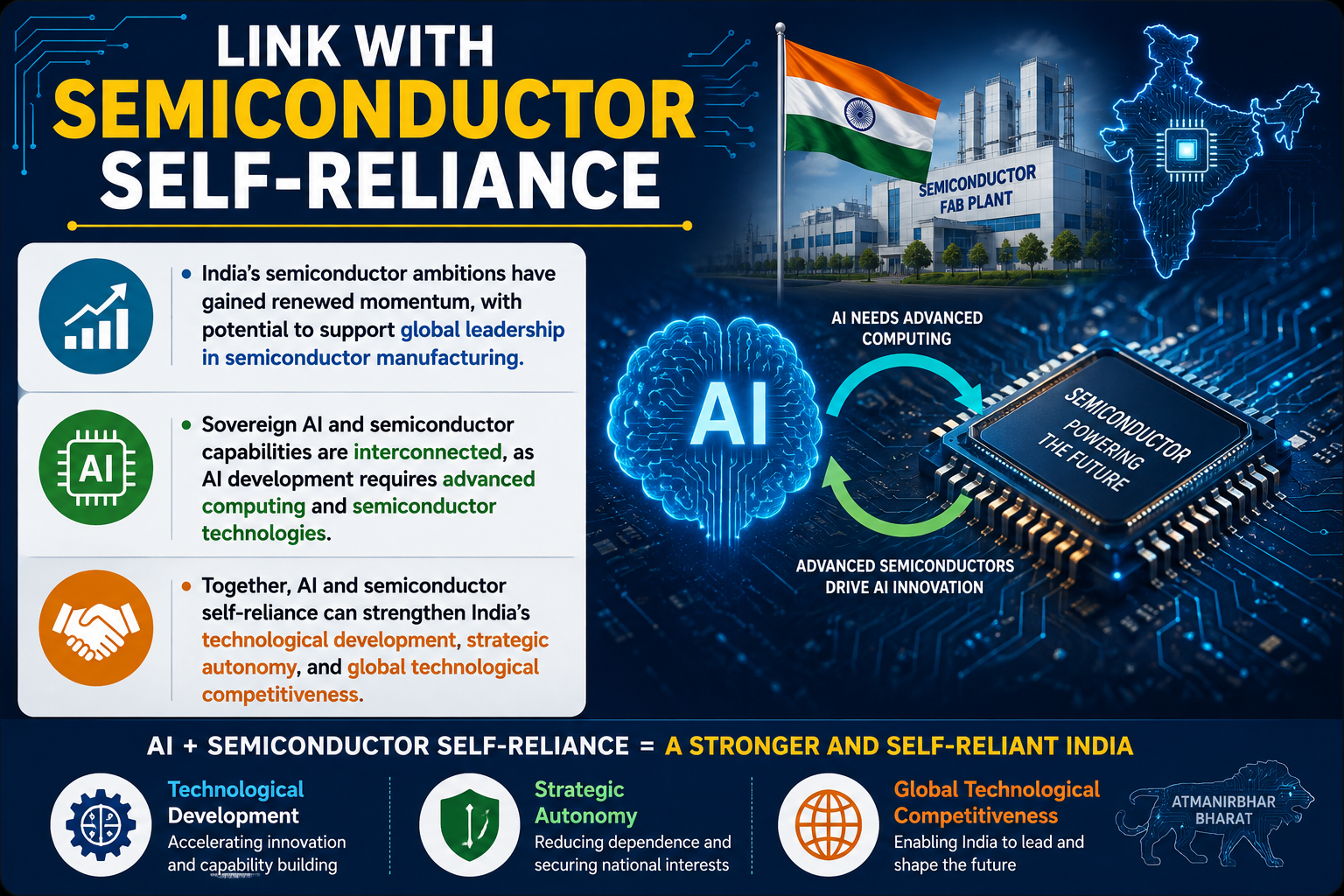
Sovereign AI is important for strengthening India's technological and strategic autonomy.
The initiative therefore fits into the broader objective of technological self-reliance.
AI as a Driver of Economic Growth
The Vice President highlighted AI’s potential to transform the economy. Like the IT sector created jobs instead of eliminating them, AI can create new jobs, economic opportunities, innovation and growth, helping take India’s economic progress to the next stage.
IndiaAI Mission & Centres of Excellence
-
IndiaAI Mission and AI Centres of Excellence aim to build a comprehensive ecosystem supporting artificial intelligence, research, innovation, and indigenous technology development.
-
These initiatives promote institutional AI applications and technological self-reliance, strengthening India's capacity to develop and deploy advanced technologies independently.
Strategic Importance of Sovereign AI
-
Sovereign AI strengthens India's technological autonomy, enabling independent technological choices aligned with national economic, security, administrative, and developmental priorities.
-
Indigenous AI capabilities can enhance economic competitiveness, national security, public administration, innovation, industrial development, and India's global technological leadership.
Why is Gnani Artha Important?
-
For India’s technology ecosystem: It demonstrates the ability of Indian technology companies and engineers to work on frontier AI technologies.
-
For strategic autonomy: Indigenous AI capabilities can reduce excessive dependence on external technological ecosystems.
-
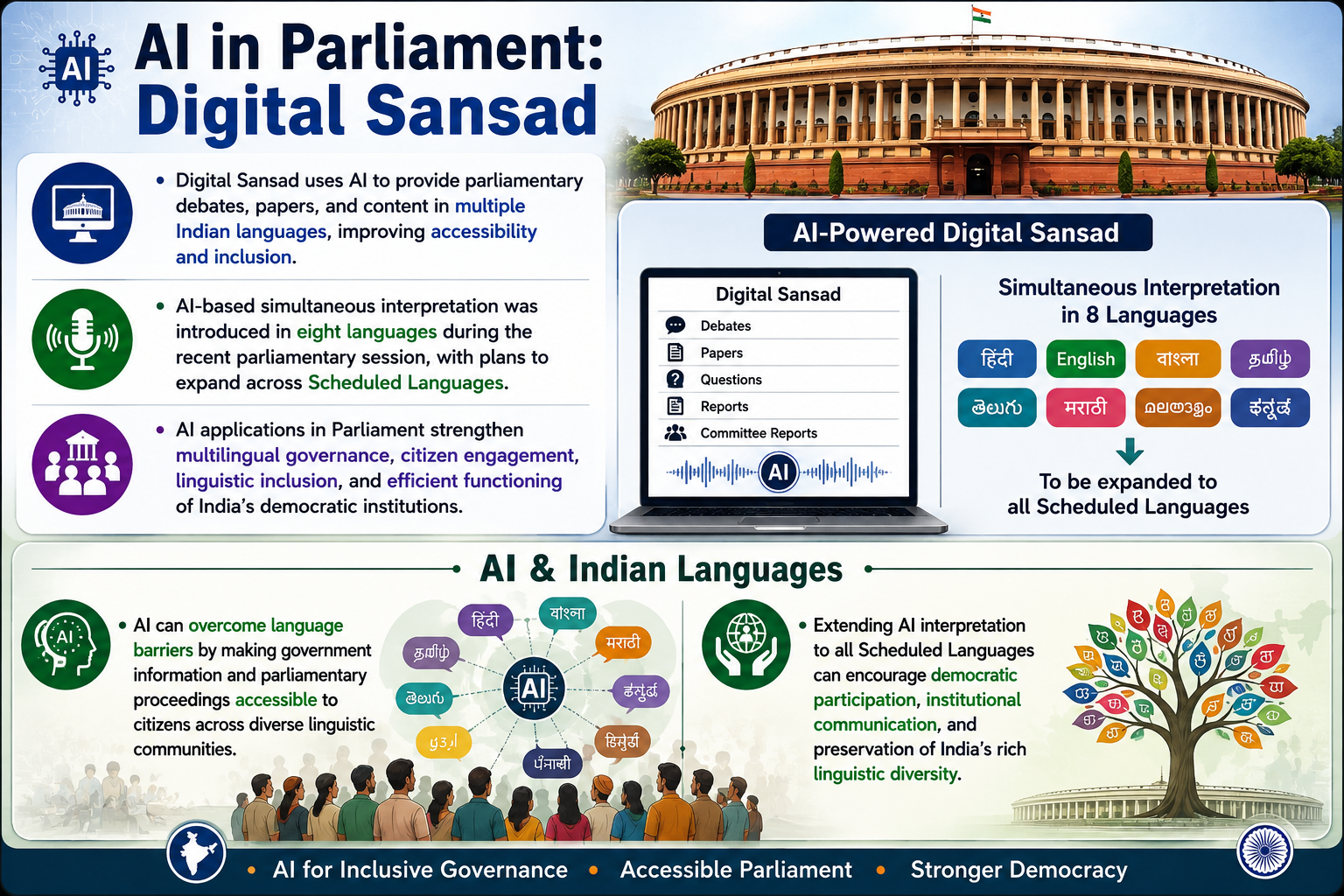
For governance: AI can be integrated into government and parliamentary processes to improve accessibility and efficiency.
-
For linguistic inclusion: AI-based interpretation can make public institutions more accessible across India's diverse linguistic landscape.
-
For economic growth: AI can generate new avenues for employment, innovation and economic expansion.
-
For Viksit Bharat: Technological capability is positioned as an important component of India's development journey towards 2047.
UPSC Prelims 2026
Q. Which of the following statements with regard to Large Language Models (LLMs) used in machine learning is/are correct?
-
LLMs assign probabilities to the next possible words and then pick the one with the highest probability.
-
LLMs process data through mathematical optimization to minimise prediction errors.
-
LLMs produce unbiased outputs.
Select the correct answer using the code given below:
(a) 1 only
(b) 1 and 2 only
(c) 2 and 3 only
(d) 1, 2 and 3
Answer: (b) 1 and 2 only
Explanation
-
Statement 1 – Correct: LLMs use probabilities to predict the next possible token/word.
-
Statement 2 – Correct: During training, mathematical optimisation is used to reduce prediction errors.
-
Statement 3 – Incorrect: LLMs can produce biased outputs because their training data and design may contain biases.