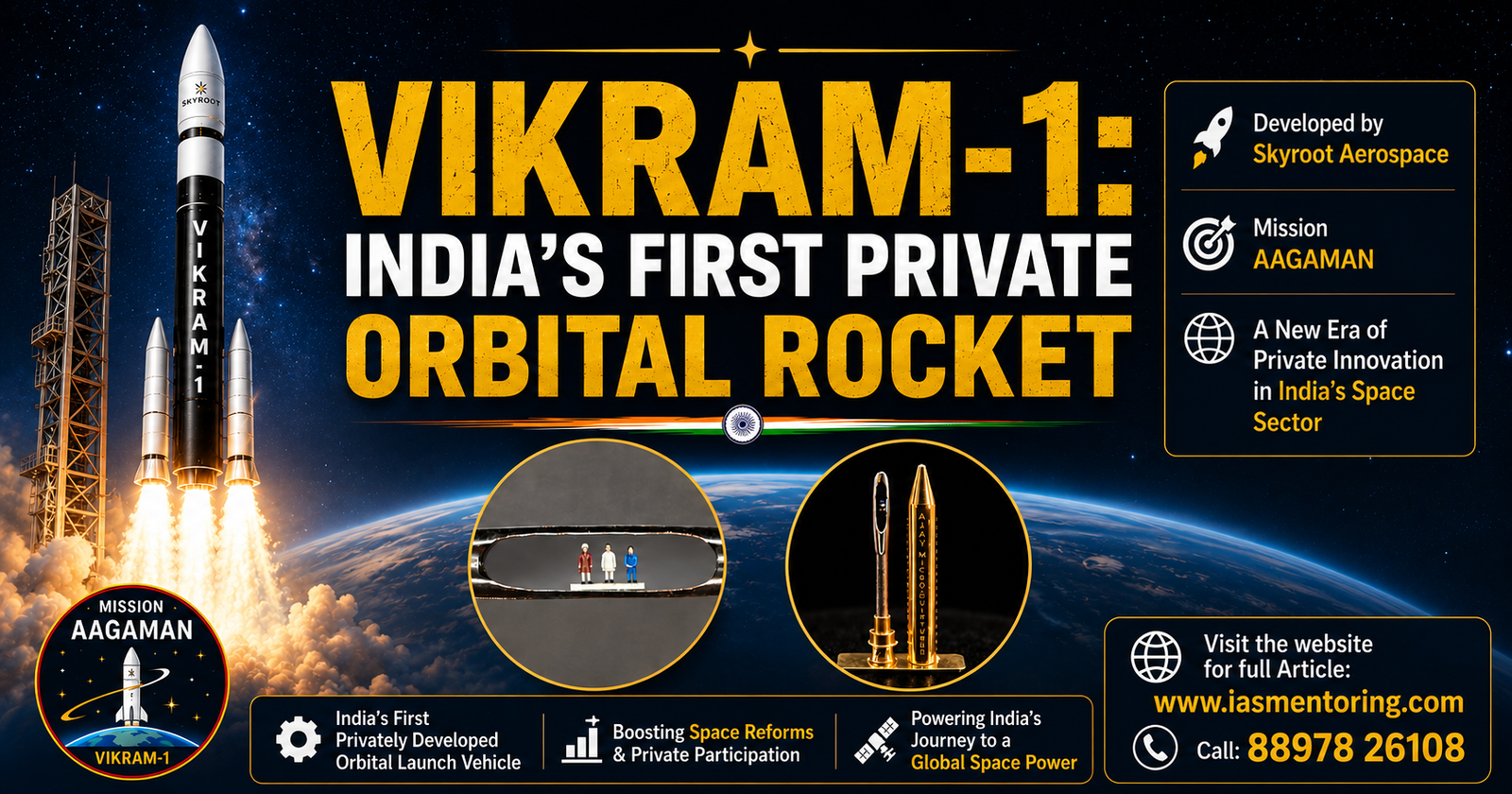
Discover Vikram-1, first privately developed orbital rocket of India, Mission Aagaman, payloads, space reforms, private sector participation, and its significance in shaping future space economy and innovation.
Syllabus Areas:
GS III - S & T (Space Technology)
India's first privately developed orbital launch vehicle, Vikram-1, developed by Skyroot Aerospace, is set to launch under Mission Aagaman, marking a major milestone in India's space sector reforms and the growing participation of private companies in the space ecosystem.
India's Private Space Sector:
-
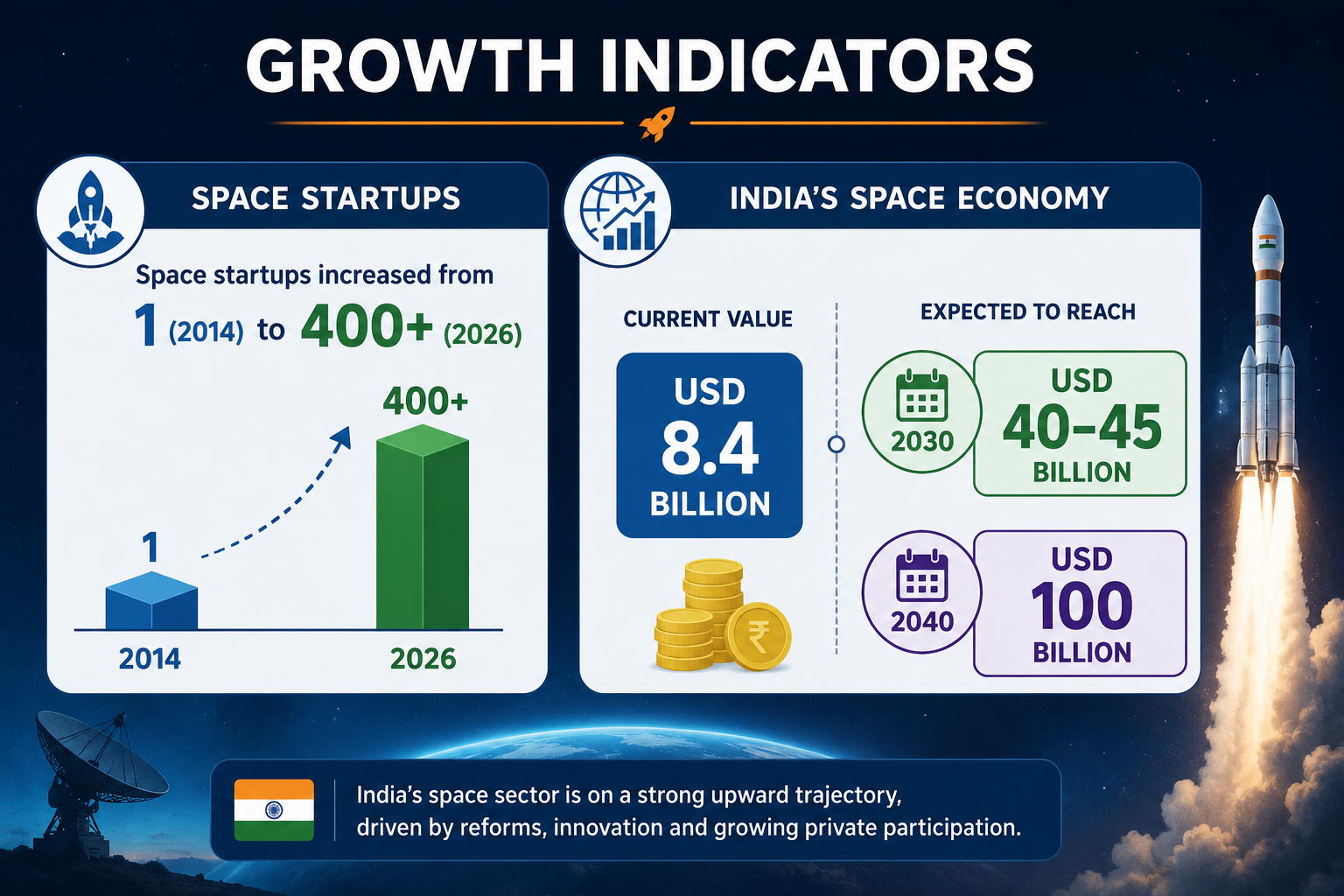
India's space sector has undergone a major transformation due to policy reforms aimed at encouraging private participation.
-
The Indian Space Policy 2023 opened the entire space value chain to private companies.
Mission Aagaman – Vikram-1
About Vikram-1
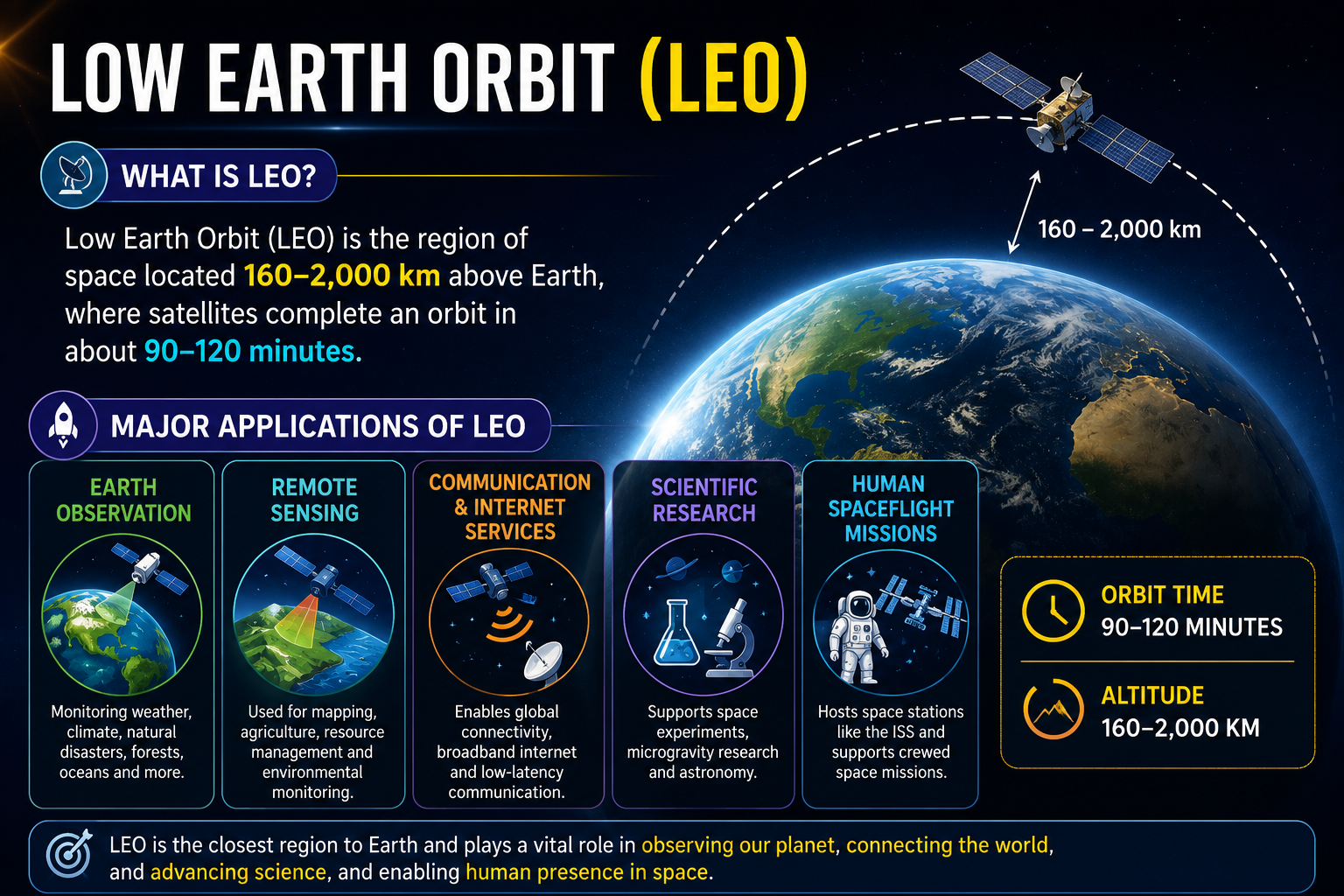
Vikram-1 is India's first privately developed orbital launch vehicle, designed and developed by Skyroot Aerospace, a Hyderabad-based space technology startup. Vikram-1 is capable of placing 350 kg of payload into Low Earth Orbit (LEO). The launch is scheduled under Mission Aagaman during the launch window from 12 July to 4 August 2026.
Orbital Launch Vehicle (OLV):
An Orbital Launch Vehicle (OLV) is a rocket designed to carry satellites or spacecraft and place them into a stable orbit around the Earth or another celestial body.
Technical Features of Vikram-1
-
Vikram-1 features an all-carbon composite structure, reliable solid-fuel boosters, and a 3D-printed liquid engine.
-
These indigenous technologies make the launch vehicle lighter, stronger, and more efficient while reducing manufacturing time and launch costs.
-
Together, they enhance reliability, operational efficiency, and India's competitiveness in the global commercial space launch market.
Mission Objectives
Mission Aagaman has been designed with multiple technological and commercial objectives that are crucial for India's emerging private space sector.
The mission aims to:
-
Validate India's commercial orbital launch capability, demonstrating that private Indian companies can independently develop and launch orbital rockets.
-
Demonstrate indigenous private launch technologies, including advanced propulsion systems, lightweight materials and modern manufacturing techniques.
-
Strengthen India's private space ecosystem by encouraging startups, private investors and industries to participate in satellite manufacturing, launch services and downstream space applications.
-
Enhance India's position in the global commercial launch market, providing affordable launch services for domestic and international customers.
-
Support the vision of Atmanirbhar Bharat by promoting indigenous technology development and reducing dependence on foreign launch providers.
Payloads on Mission Aagaman
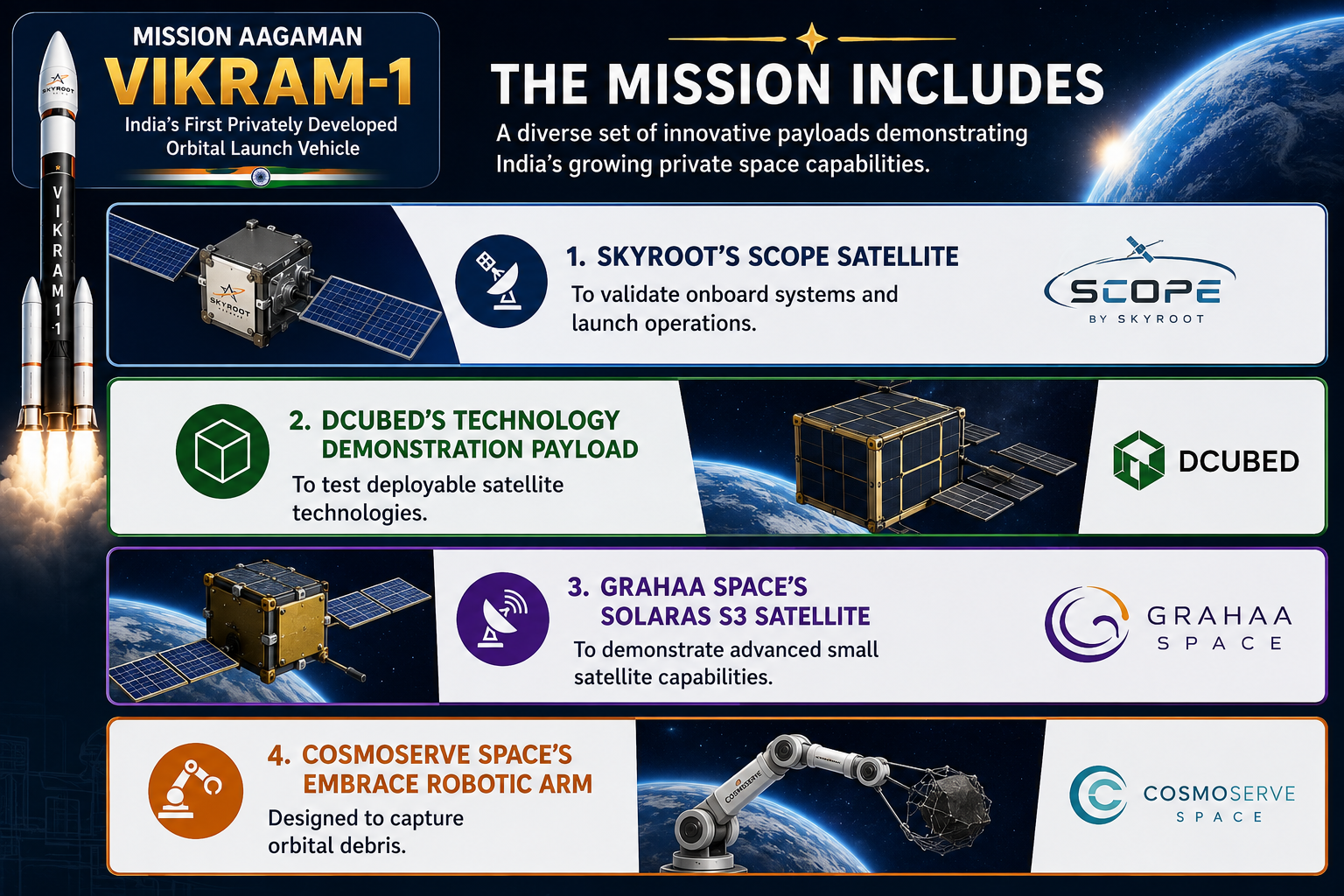
Mission Aagaman will carry multiple customer payloads to Low Earth Orbit (LEO) at an altitude of approximately 450 km (280 miles). These payloads demonstrate the growing collaboration between Indian startups and international space technology companies.
The mission includes:
-
Skyroot's SCOPE satellite to validate onboard systems and launch operations.
-
DCUBED's technology demonstration payload to test deployable satellite technologies
-
Grahaa Space's SOLARAS S3 satellite to demonstrate advanced small satellite capabilities
-
Cosmoserve Space's Embrace robotic arm, designed to capture orbital debris.
Together, these payloads highlight India's growing expertise in satellite technology, commercial space missions, innovation, and sustainable space exploration.
Symbolic Payload – "Cosmic Bloom"
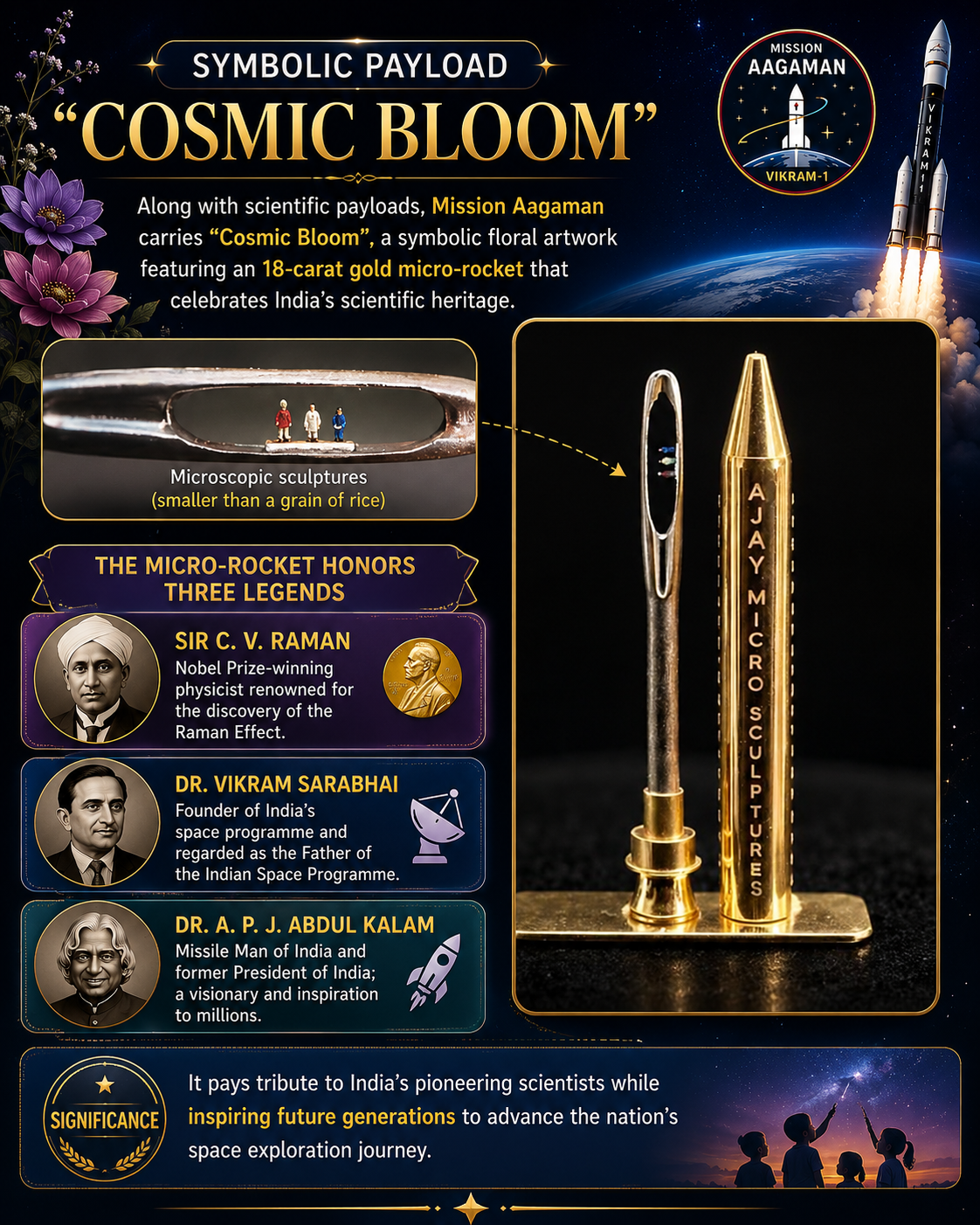
Each sculpture is smaller than a grain of rice, symbolising India's rich scientific legacy and its aspirations for the future of space exploration.
Significance of Mission Aagaman
Mission Aagaman is more than just the launch of a rocket; it represents a transformational phase in India's space sector.
-
It marks the first orbital launch by an Indian private company, demonstrating the maturity of India's startup ecosystem.
-
It showcases the success of Indian Space Policy 2023, which opened the entire space value chain to private participation.
-
It strengthens India's commercial launch capabilities and expands opportunities in the global space economy.
-
It promotes indigenous innovation, advanced manufacturing and public-private partnerships in the space sector.
-
It enhances India's credibility as a reliable and cost-effective launch service provider while contributing to the long-term goal of making India a leading global space power.
Vikram-1 marks a defining milestone in India's space journey, showcasing the success of policy reforms, private innovation, and indigenous technology. As public-private partnerships deepen, India is steadily emerging as a global space power, driving scientific excellence, commercial growth, and sustainable space exploration.