Kalanamak rice highlights how traditional crop conservation, improved varieties, government support, value addition, farmer empowerment, and export promotion can transform agriculture and livelihoods.
Syllabus Areas:
GS III - Economy - Agriculture
Kalanamak rice, a traditional aromatic rice variety associated particularly with Siddharthnagar district of Uttar Pradesh, has witnessed significant growth in cultivation, productivity, farmer participation, processing and market opportunities in recent years. The government is supporting the crop through financial assistance, improved varieties, seed production, processing infrastructure, branding and export promotion.
Significant Growth in Kalanamak Rice Cultivation
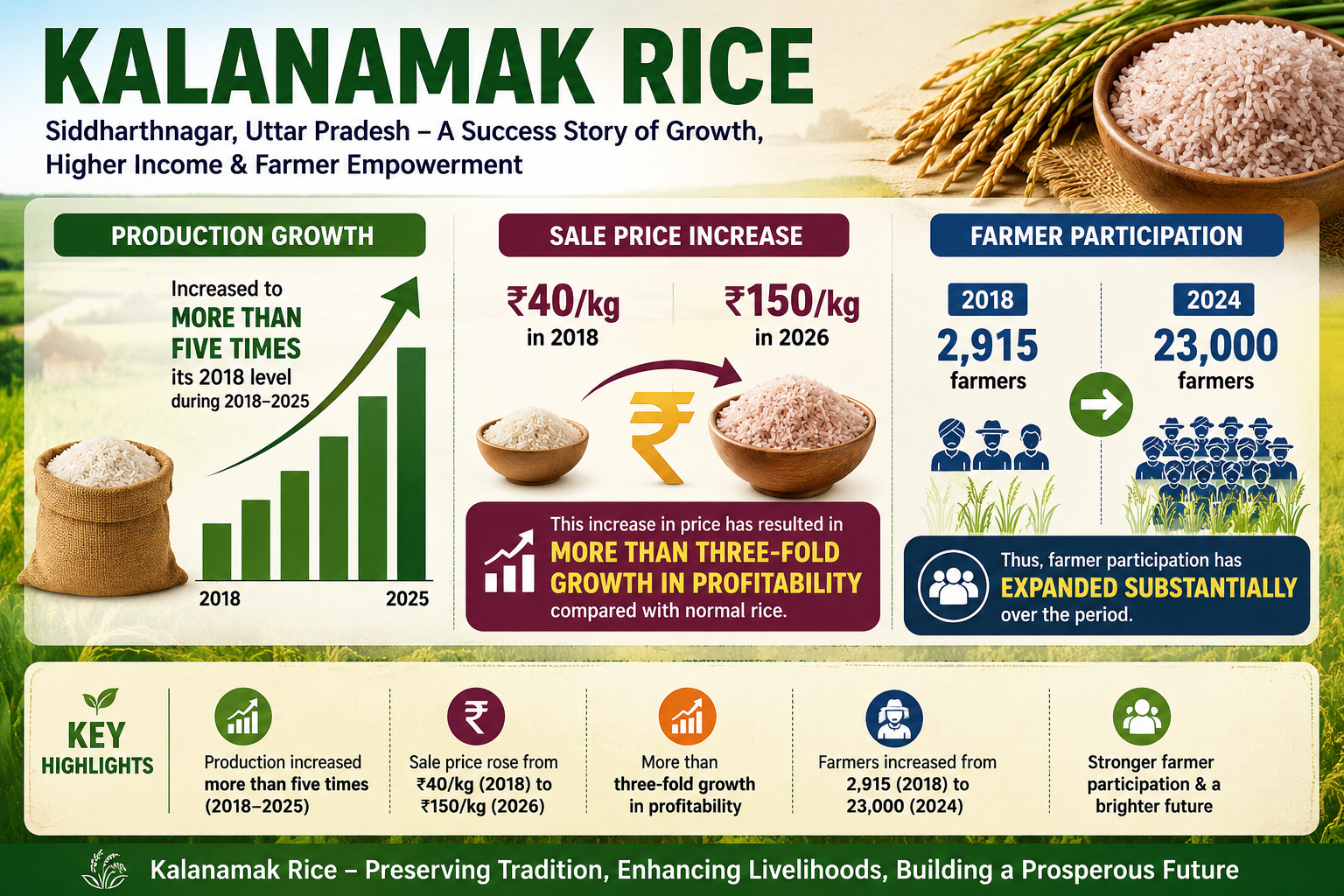
Kalanamak rice cultivation has expanded considerably in recent years, accompanied by improvements in productivity and farmer income.
Why it matters
The growth of Kalanamak demonstrates how a traditional crop can be converted into a higher-value agricultural commodity through better varieties, branding, processing, market access and government support.
Government Support for Kalanamak Farmers
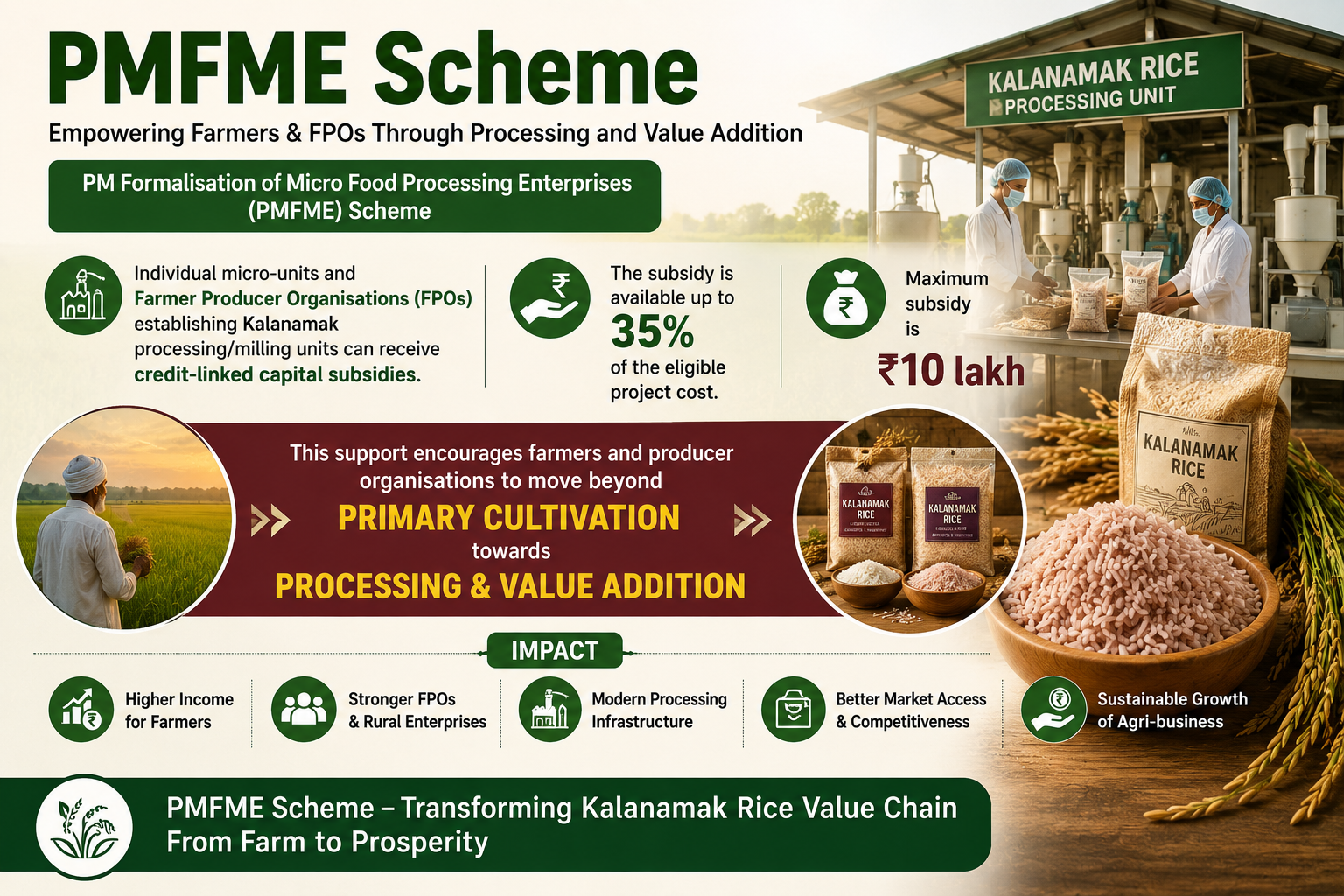
Both the Central Government and State Government are providing financial, technical and marketing support to Kalanamak rice farmers.
One District One Product (ODOP) Initiative
Kalanamak has also been promoted through the One District One Product (ODOP) framework.
Important initiatives
-
The ODOP Margin Money Scheme provides support for eligible Kalanamak-related enterprises.
-
A Common Facility Centre (CFC) for Kalanamak rice has been established in Siddharthnagar.
-
The CFC provides local farmers with modern facilities for:
-
Processing
-
Packaging
-
Export support
The State Government has also earmarked dedicated project funding for the promotion, production and processing of Kalanamak rice.
Significance
This reflects a shift from merely increasing agricultural production towards developing an integrated value chain:
Cultivation → Processing → Packaging → Branding → Marketing → Export
Read Full Article on Districts as Export Hubs
Research & Development of Improved Kalanamak Varieties
-
ICAR/National Agricultural Research System works on developing and conserving Kalanamak varieties.
-
Six improved varieties have been released:
-
Kalanamak KN3
-
Bauna Kalanamak 101
-
Bauna Kalanamak 102
-
Kalanamak Kiran
-
Pusa Narendra Kalanamak 1
-
Pusa CRD Kalanamak 2
-
The last two are dwarf, high-yielding varieties.
-
Average yield: Improved varieties – 4.5 tonnes/ha vs traditional varieties – 2.5 tonnes/ha.
-
KVKs in the Kalanamak GI area conduct multi-location testing of new varieties.
-
Focus: Higher yield + Climate resilience + Local suitability before wider release.
Conservation of Traditional Kalanamak Varieties
-
ICAR institutes and KVKs help farmers register and conserve traditional Kalanamak varieties under PPVFRA, protecting agricultural biodiversity and rice genetic resources, with over 1,700 varieties registered.
Quality Seed Production
-
Under the Breeder Seed Programme, 15–20 quintals of Kalanamak breeder seed are produced annually. During 2021–22 to 2025–26, 389.6 quintals were distributed to farmers.
Promotion in International Markets
-
APEDA promotes Kalanamak exports by linking FPOs with international buyers, facilitating shipments and market access, particularly to Singapore and Nepal, thereby strengthening agricultural export opportunities.

Agri-Export Zone Framework
Siddharthnagar and surrounding Terai districts have been integrated into APEDA's Agri-Export Zone framework for specialty rice.
This integration is intended to support:
-
Export packaging
-
Residue testing
-
Compliance with international requirements
-
Financial assistance for export-related activities
The approach helps create an ecosystem for taking specialty agricultural products from the farm to international markets.
Importance of Kalanamak Rice for Agriculture
The developments highlighted in the article demonstrate several broader agricultural themes.
-
Higher farmer profitability: The increase in the sale price from ₹40/kg to ₹150/kg has substantially improved profitability compared with ordinary rice.
-
Crop diversification: Kalanamak provides an opportunity to diversify beyond conventional rice cultivation and develop a specialty/high-value rice segment.
-
Value addition: Government support for processing and milling allows farmers and FPOs to participate in activities beyond cultivation.
-
Conservation of indigenous varieties: The conservation of traditional Kalanamak varieties helps protect agricultural biodiversity and traditional knowledge.
-
Climate-resilient agriculture: Testing new varieties for high yield and climate resilience indicates an attempt to make the crop more suitable for changing climatic conditions.
-
Export-oriented agriculture: Linking FPOs with international buyers and integrating the region into an Agri-Export Zone can strengthen India's agricultural export value chain.
Kalanamak rice showcases how conserving traditional varieties, ensuring quality seeds, strengthening processing, and promoting exports can enhance farmer incomes while preserving agricultural heritage and supporting sustainable growth.