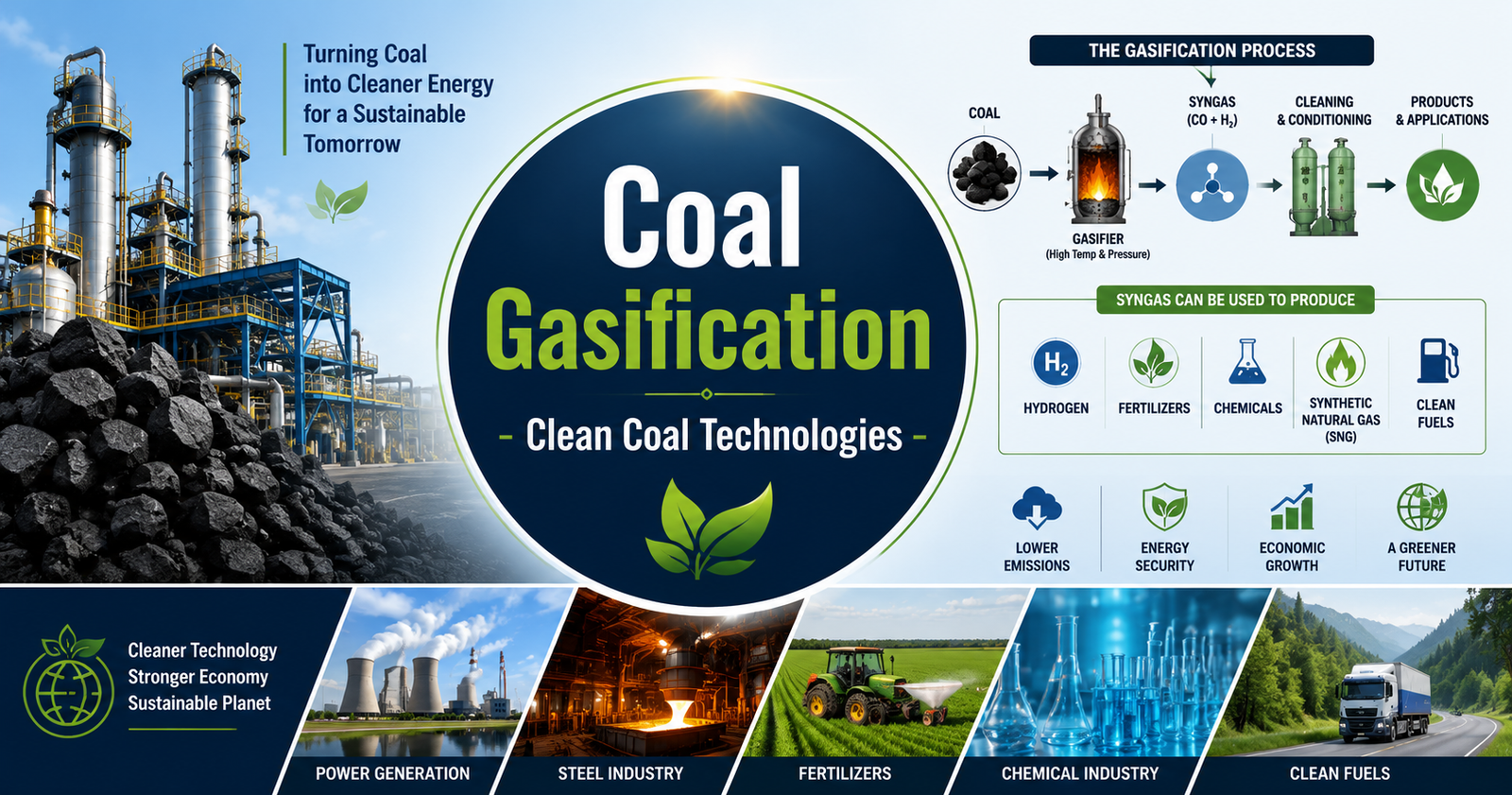
Explore Coal Gasification and Clean Coal Technologies—how coal is transformed into cleaner fuels, hydrogen, fertilizers, and chemicals, supporting energy security, industrial growth, and sustainable development.
Syllabus Areas:
GS I - Geography, Environmental Pollutions
GS III - Science & Technology
The Government of India has intensified efforts to promote coal gasification and clean coal technologies to reduce import dependence, enhance energy security, and improve the value-added utilization of domestic coal. The Ministry of Coal has announced new financial incentives, policy support, and project implementation updates under the National Coal Gasification Mission.
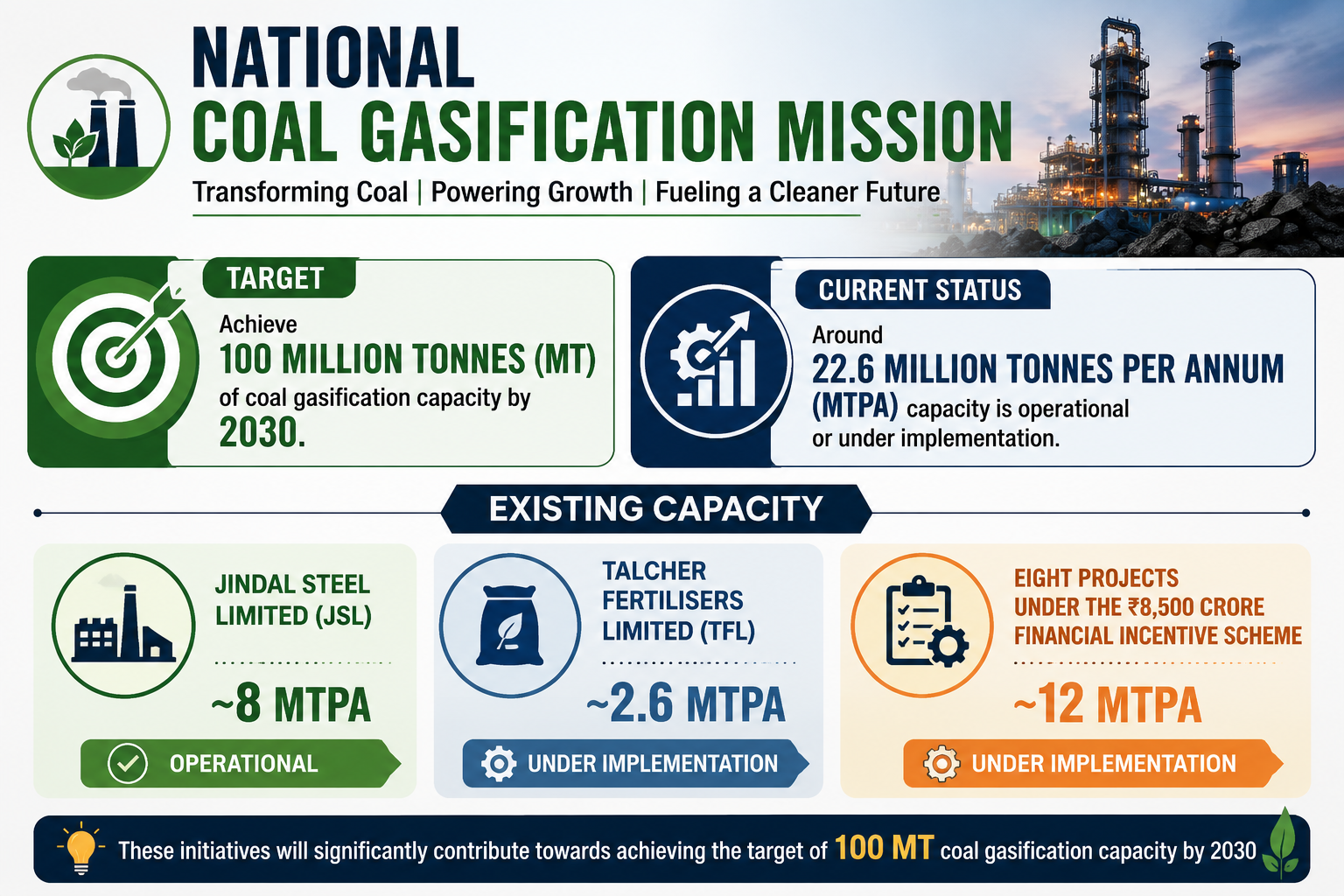
New Government Scheme (Approved on 13 May 2026)
The Government approved a Promotion of Surface Coal/Lignite Gasification Projects Scheme with:
-
Financial Outlay: ₹37,500 crore
-
Expected Coal Utilisation: Approximately 75 MT
-
This scheme is expected to significantly contribute towards achieving the 100 MT coal gasification target by 2030.
What is Coal Gasification?
Coal gasification is a process that converts coal into synthetic gas (Syngas) by reacting coal with oxygen, steam, and controlled heat under limited oxygen conditions.
Syngas is used to produce:
-
Synthetic Natural Gas (SNG)
-
Hydrogen
-
Fertilisers
-
Chemicals
-
Methanol
-
Other downstream industrial products.
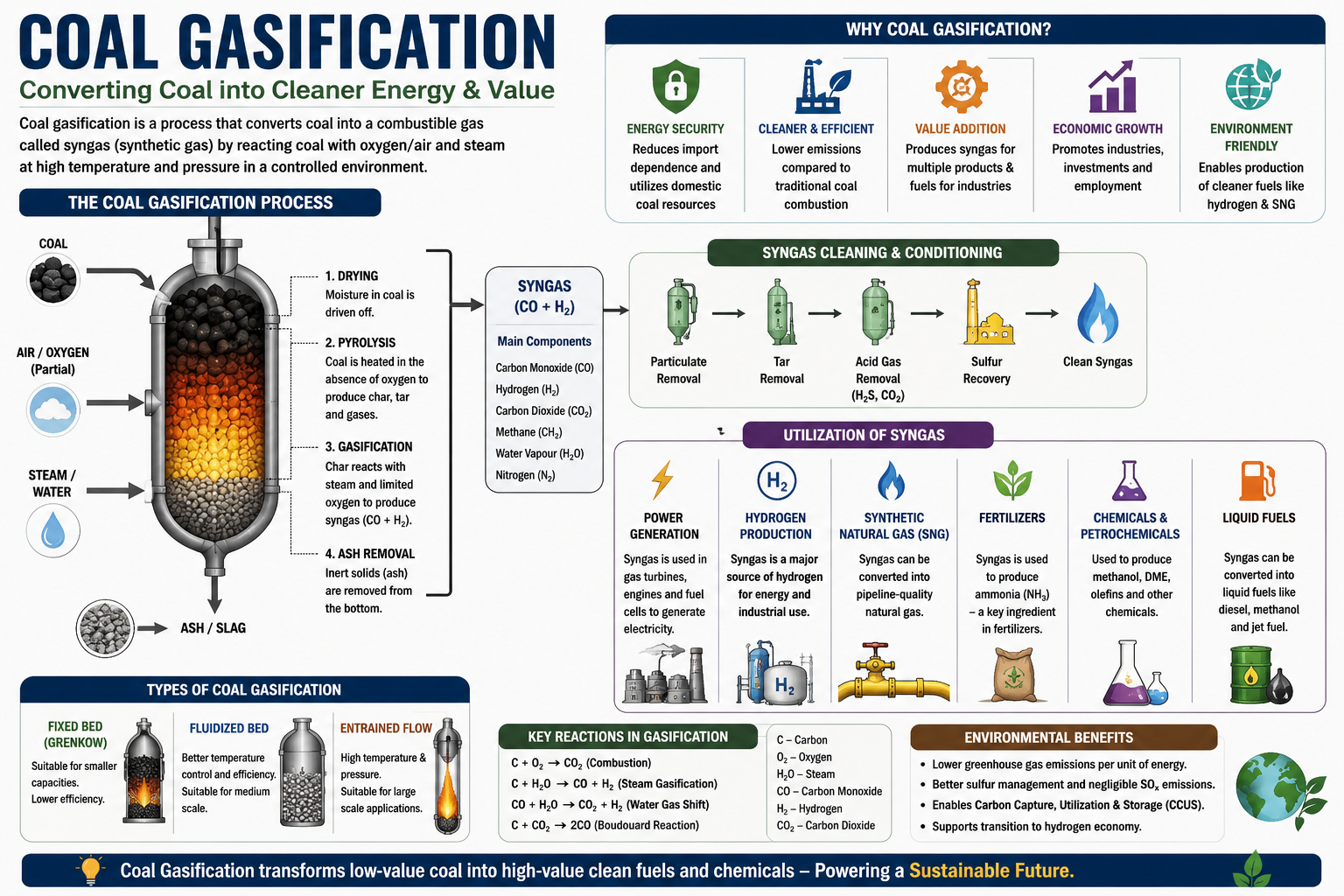
Benefits of Coal Gasification
-
Energy Security: Enhances utilisation of India's abundant domestic coal reserves.
-
Import Substitution: Reduces dependence on imported natural gas, fertilisers, methanol, and chemicals.
-
Value Addition: Converts low-value coal into high-value industrial products.
-
Industrial Growth: Promotes downstream industries and manufacturing.
-
Employment Generation: Creates new investment opportunities and skilled jobs.
-
Efficient Resource Utilisation: Improves productivity through cleaner coal technologies.
Government Support for Coal Gasification
1. Financial Incentives
Under ₹8,500 crore Scheme
-
Financial incentive of 15% of capital expenditure (CapEx).
Under ₹37,500 crore Scheme
-
Financial incentive up to 20% of eligible Plant & Machinery cost.
2. Coal Linkage Support
The Government has introduced several measures:
-
Coal linkage through a dedicated auction sub-sector for Syngas production leading to coal gasification.
-
Floor price kept equivalent to the power sector.
-
Coal linkage tenure extended to 30 years.
-
Projects having auctioned coal mines are eligible for additional coal linkage beyond allocated mine capacity.
3. Policy Support
Major policy initiatives include:
-
50% rebate in revenue share for coal used for gasification.
-
Framework and guidelines issued for Underground Coal Gasification (UCG).
-
Pilot UCG projects exempted from certain requirements.
-
Floor price for UCG coal block auctions reduced from 4% to 2%.
-
Waiver of upfront payment.
-
50% rebate on Performance Bank Guarantee (PBG).
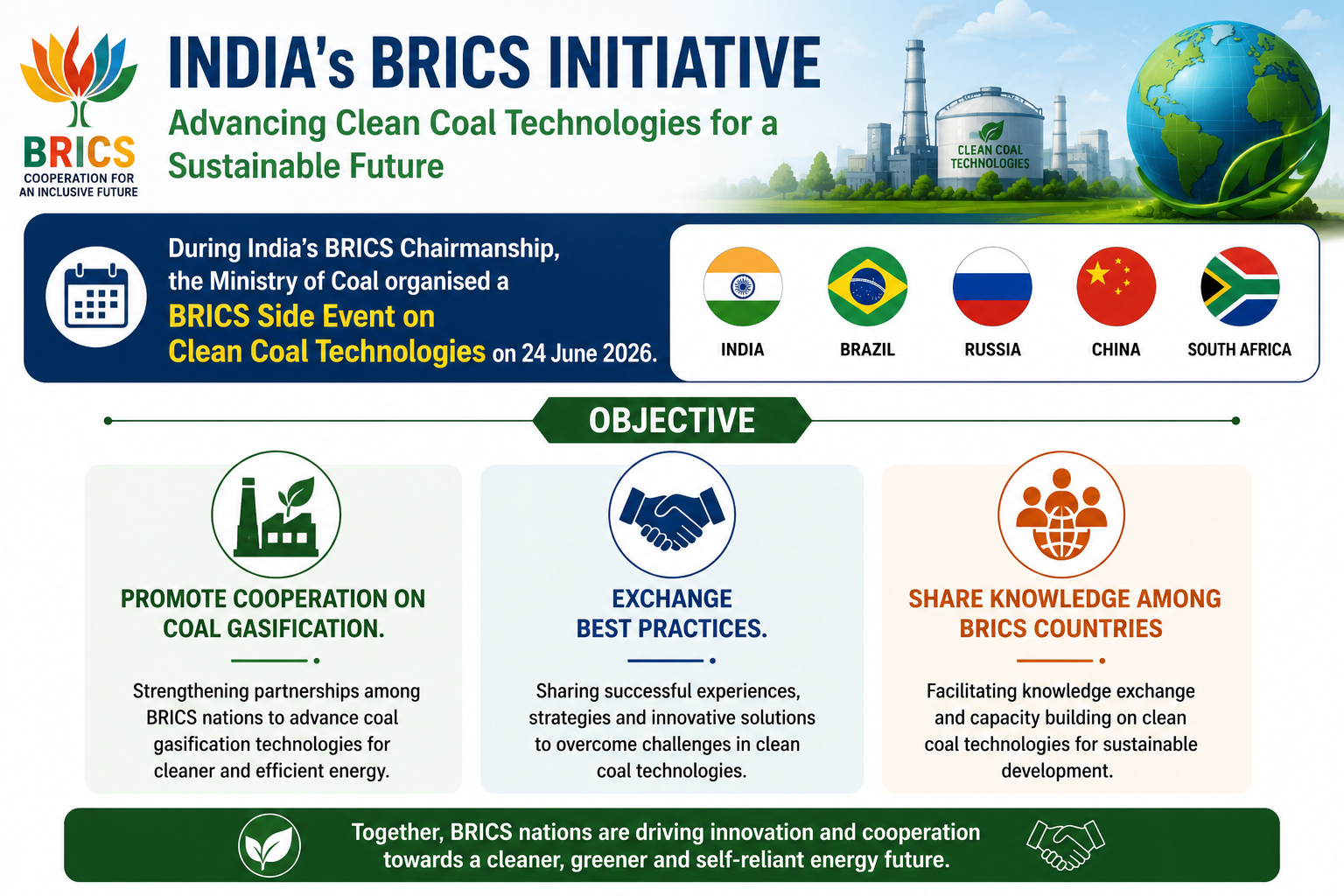
Clean Coal Technologies:
Clean coal technologies (CCTs) are a group of technologies designed to reduce the environmental impacts of using coal for electricity generation and industrial processes. They do not make coal completely "clean," but they aim to reduce pollutants and improve efficiency.
The main clean coal technologies include:
-
Coal Washing (Coal Beneficiation)
-
Removes impurities such as sulfur, ash, and rocks before combustion.
-
Improves combustion efficiency and reduces emissions.
-
High-Efficiency, Low-Emission (HELE) Power Plants
-
Use advanced boilers that operate at higher temperatures and pressures.
-
Examples include:
-
Supercritical plants
-
Ultra-supercritical plants
-
Consume less coal per unit of electricity, reducing carbon dioxide (CO₂) emissions.
-
Integrated Gasification Combined Cycle (IGCC)
-
Converts coal into a synthetic gas (syngas) before burning it.
-
Pollutants such as sulfur and mercury can be removed more easily from the gas.
-
Combined-cycle turbines improve overall efficiency.
-
Carbon Capture, Utilization, and Storage (CCUS)
-
Captures CO₂ produced during coal combustion or gasification.
-
The captured CO₂ is either:
-
Stored deep underground (carbon storage), or
-
Used in industrial processes (carbon utilization).
-
This is the primary technology aimed at reducing greenhouse gas emissions from coal.
-
Flue Gas Desulfurization (FGD)
-
Also called scrubbers.
-
Removes sulfur dioxide (SO₂) from exhaust gases, helping reduce acid rain.
-
Selective Catalytic Reduction (SCR)
-
Reduces nitrogen oxides (NOₓ), which contribute to smog and acid rain.
-
Uses ammonia and a catalyst to convert NOₓ into nitrogen and water.
-
Electrostatic Precipitators (ESPs) and Fabric Filters
-
Remove fine particulate matter (fly ash) from flue gases.
-
Help improve air quality and reduce respiratory health risks.
Advantages
-
Lower emissions of sulfur dioxide, nitrogen oxides, particulates, and mercury.
-
Improved power plant efficiency.
-
Potential reduction in CO₂ emissions when combined with CCUS.
-
Enables continued use of existing coal resources while reducing some environmental impacts.
Limitations
-
Many technologies, especially CCUS, are expensive to install and operate.
-
Even with advanced controls, coal mining and combustion still have environmental impacts.
-
Without carbon capture, coal remains a major source of CO₂ emissions.
-
Renewable energy sources such as wind and solar generally produce much lower lifecycle greenhouse gas emissions than coal.
Clean coal technologies are methods that make coal use more efficient and reduce harmful emissions, but they do not eliminate the environmental impacts of coal. Among these technologies, CCUS offers the greatest potential for reducing carbon dioxide emissions, while technologies like FGD, SCR, and ESPs primarily control conventional air pollutants.
Also Read More About Coal and It's Types, Advantages and Disadvantages: