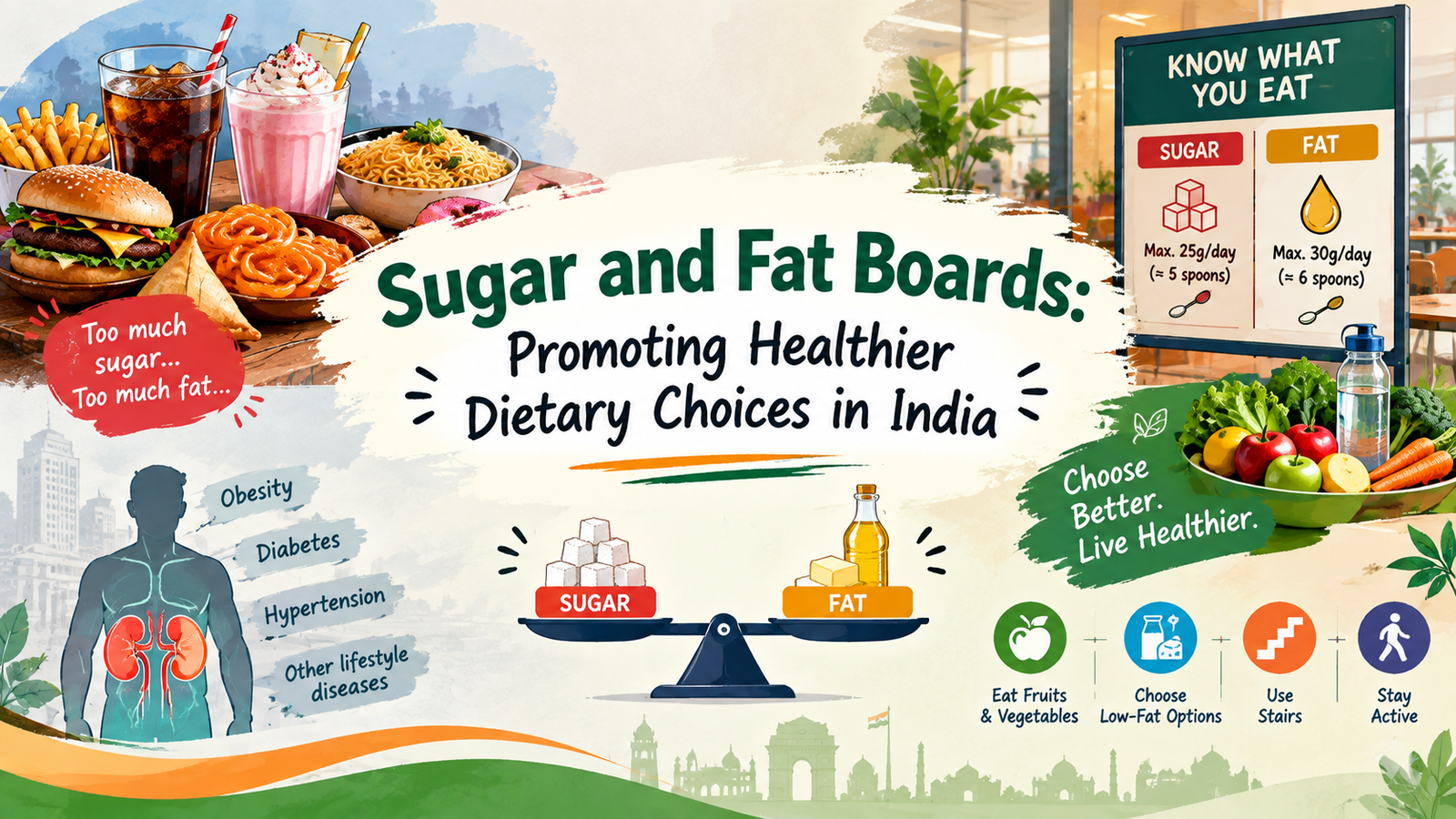
This article examines India’s Sugar and Fat Boards, a behavioural-nudge initiative aimed at raising awareness about hidden sugar and fat in commonly consumed foods.
Syllabus areas:
Essay
GS Paper II – Social Justice
GS Paper III – Science & Technology/Health
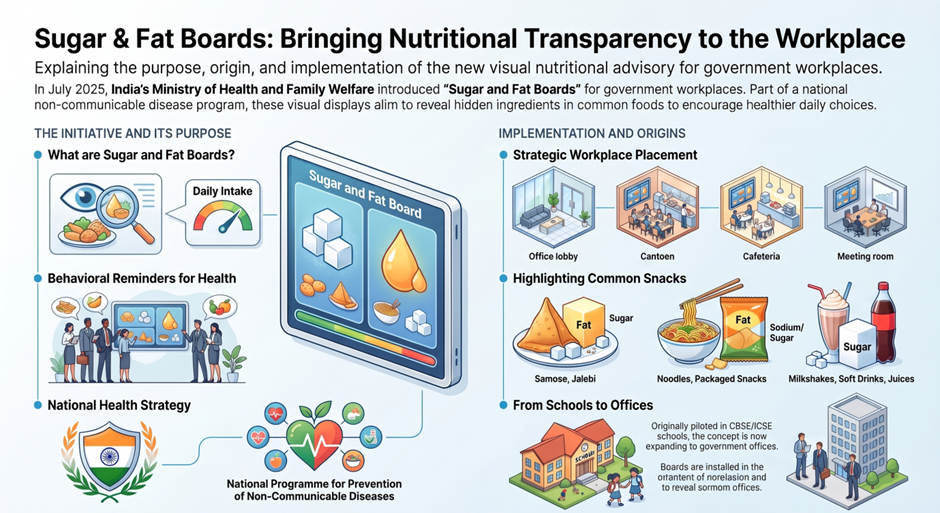
In July 2025, the Ministry of Health and Family Welfare issued an advisory for Sugar and Fat Boards in government workplaces. The initiative aims to create awareness about hidden fats and excess sugar in food and encourage healthier eating habits through simple visual reminders. The advisory is part of the National Programme for Prevention and Control of Non-Communicable Diseases (NP-NCD).
What are Sugar and Fat Boards?
Sugar and Fat Boards are simple visual and informative displays intended to reveal the sugar and fat content of food items available within workplace premises, along with recommended daily intake levels.
The aim is to:
-
Create awareness in workplaces.
-
Encourage healthier eating habits.
-
Draw attention to hidden fats and excess sugar.
-
Serve as daily behavioural reminders for healthier choices.
The advisory envisages such displays in places such as workplace lobbies, canteens, cafeterias and meeting rooms.
Role of ICMR-NIN
The Indian Council of Medical Research (ICMR), through the National Institute of Nutrition (NIN), has released posters highlighting the sugar and fat content of commonly consumed food items such as:
-
Samosa
-
Jalebi
-
Milkshakes
-
Noodles
-
Other snacks
The purpose is to make people more aware of the nutritional content of commonly consumed foods.
From Schools to Government Workplaces
The concept of displaying the amount of sugar in commonly consumed products gained wider public attention after a 2023 video by Revant Himatsingka, also known as the Food Pharmer, showed the amount of sugar in soft drinks and packaged juices.
The concept of such boards was first piloted in schools under CBSE and ICSE. The practice is now being extended to government offices.
Recommended Intake Levels
The material highlights:
-
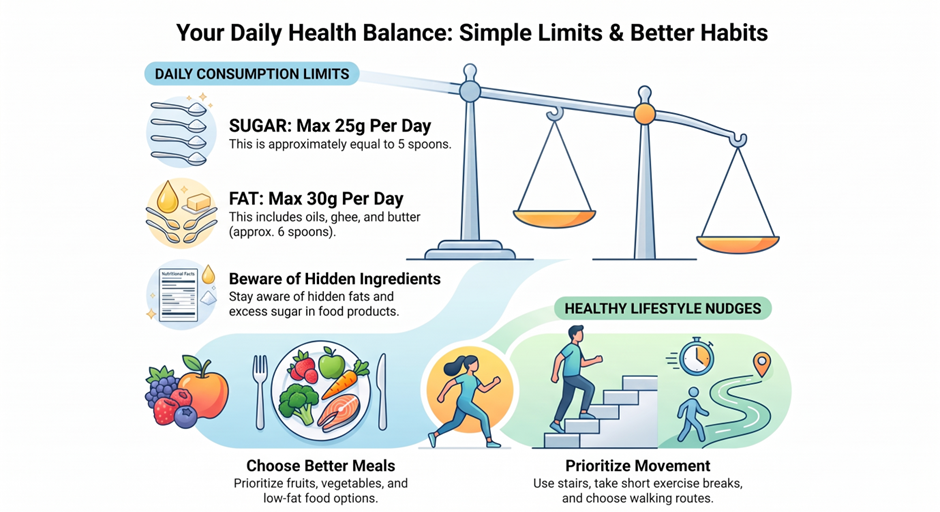
Maximum permissible sugar intake: 25 grams per day, approximately 5 spoons.
-
Daily fat intake from oil, ghee, butter, etc.: 30 grams per day, approximately 6 spoons.
These figures are intended to provide simple visual reference points for daily consumption.
Behavioural Nudges for Healthier Choices
The boards function as behavioural nudges by providing regular reminders about hidden fats and excess sugar.
The Health Ministry clarified that the advisory does not direct warning labels on food products and does not target Indian snacks or India's street-food culture. Instead, it is intended as a general awareness measure concerning excess sugar and hidden fats in food products.
The advisory also promotes:
-
Healthy meals containing fruits and vegetables.
-
Low-fat food options.
-
Use of stairs.
-
Short exercise breaks.
-
Walking routes and other forms of physical activity.
Thus, the initiative combines dietary awareness with encouragement for greater physical activity.
Link with Non-Communicable Diseases
Excessive consumption of oil and sugar is identified in the initiative as a contributor to the rising burden of obesity, diabetes, hypertension and other lifestyle-related diseases.
This places the Sugar and Fat Boards within the broader public-health approach towards prevention and control of non-communicable diseases (NCDs).
India's Growing Focus on Healthy Food Environments
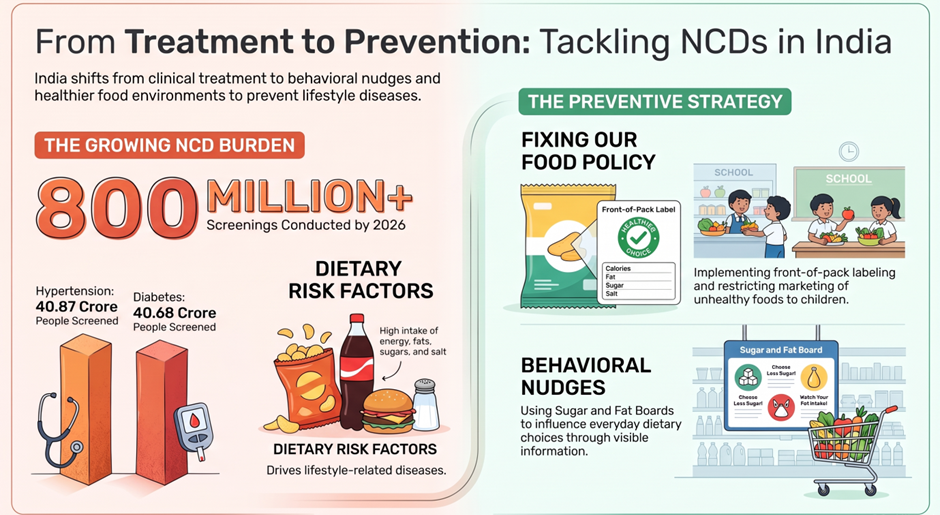
The relevance of such initiatives has continued into 2026. In March 2026, the Ministry reported that, under the NP-NCD, more than 40.87 crore people had been screened for hypertension and more than 40.68 crore for diabetes as of February 2026. The programme also covers health promotion, screening, early diagnosis, treatment and referral for major NCDs.
In July 2026, an ICMR-NIN-led “Let's Fix Our Food” Consortium released policy priorities for healthier diets and food environments among children and adolescents. The recommendations covered areas including nutrition literacy, healthier school food environments, front-of-pack nutrition labelling, marketing of unhealthy food to children, salt reduction and foods high in fat, salt and sugar (HFSS).
The World Health Organization also identifies unhealthy diets, lack of physical activity and other behavioural factors among the major risk factors associated with NCDs. In India, changing lifestyles, urbanisation and greater availability of highly processed convenience foods have contributed to increased consumption of foods high in energy, fats, free sugars and salt/sodium.
Significance
The Sugar and Fat Boards represent a preventive and awareness-oriented approach to public health. Instead of focusing only on treatment, the initiative seeks to influence everyday dietary choices through easily visible information and behavioural nudges.
It also reflects the broader shift towards health promotion, nutrition awareness and prevention of diet-related NCDs in India.
Q1. Consider the following statements regarding “Sugar and Fat Boards”:
- They represent a behavioural intervention rather than a direct regulation of food composition.
- Their placement in government offices attempts to influence food choices at the point of consumption.
- Their primary objective is to eliminate processed foods from the Indian diet.
Which of the statements given above is/are correct?
A. 1 and 2 only
B. 2 and 3 only
C. 1 and 3 only
D. 1, 2 and 3
Answer: A
Q2. A policy displays the quantity of sugar and fat contained in commonly consumed foods without prohibiting their sale. This approach is best understood as:
A. Fiscal regulation
B. Behavioural nudge
C. Price control
D. Production licensing
Answer: B