
India Makhana sector is transforming into a global agri food industry, driven by Bihar production, government schemes, GI tagged Mithila Makhana, rising exports, nutrition, value addition, and technological modernization.
Syllabus Areas:
GS III - Economy (Agriculture)
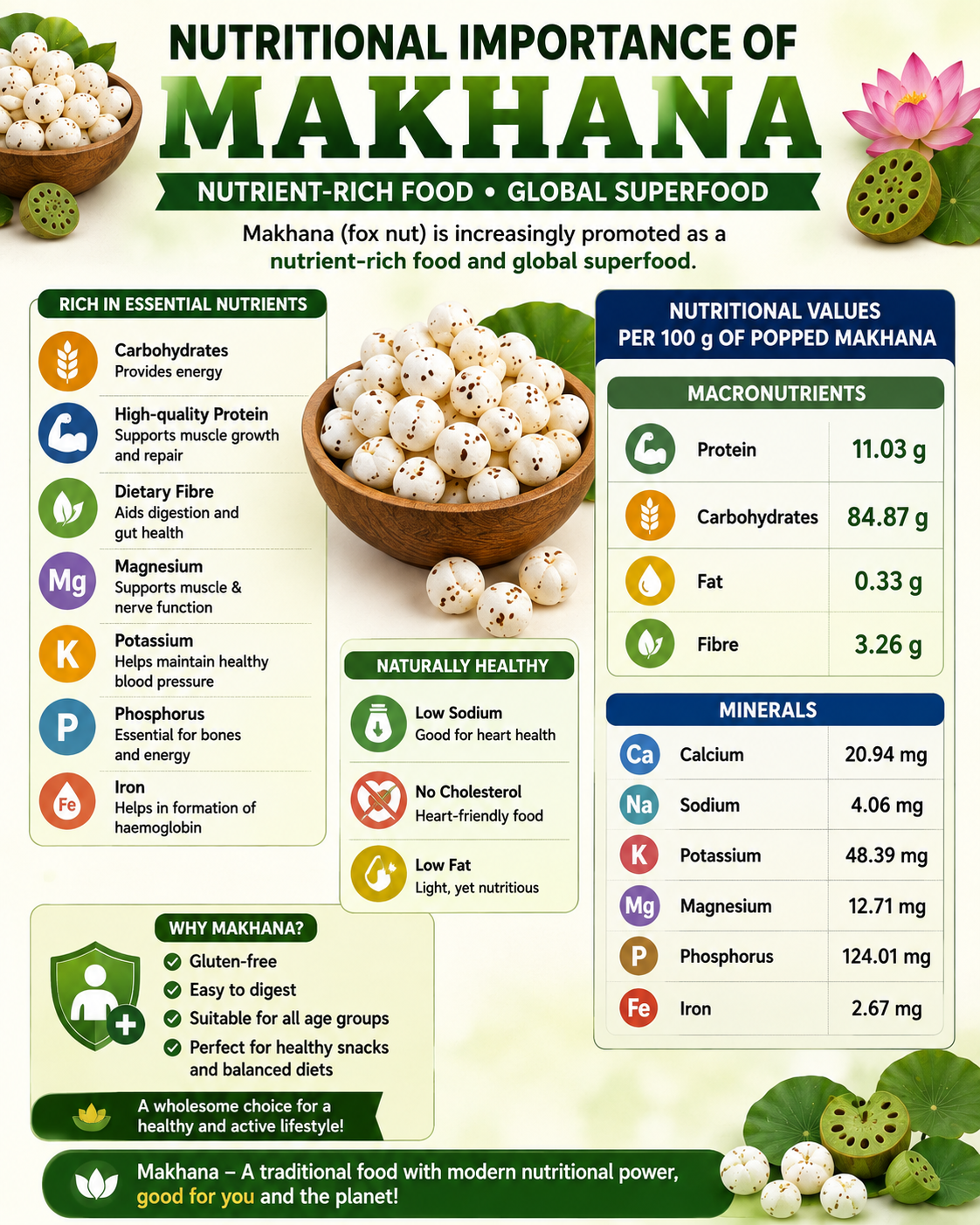
Makhana (fox nut) has emerged as one of India’s rapidly growing agri-food products due to its nutritional value, increasing health awareness, rising domestic consumption and growing international demand.
What is Makhana?
-
Makhana is commonly known as fox nut. Its scientific name is Euryale ferox. It is an aquatic crop. It is primarily cultivated in shallow ponds, lakes, wetlands. The edible portion is the seed.
-
After harvesting and processing, the seeds are popped and consumed as makhana/fox nut.
-
India's major makhana-producing regions include Bihar, West Bengal and Assam, supported by suitable agro-climatic conditions and long-standing cultivation practices.
India’s Position in Global Makhana Production
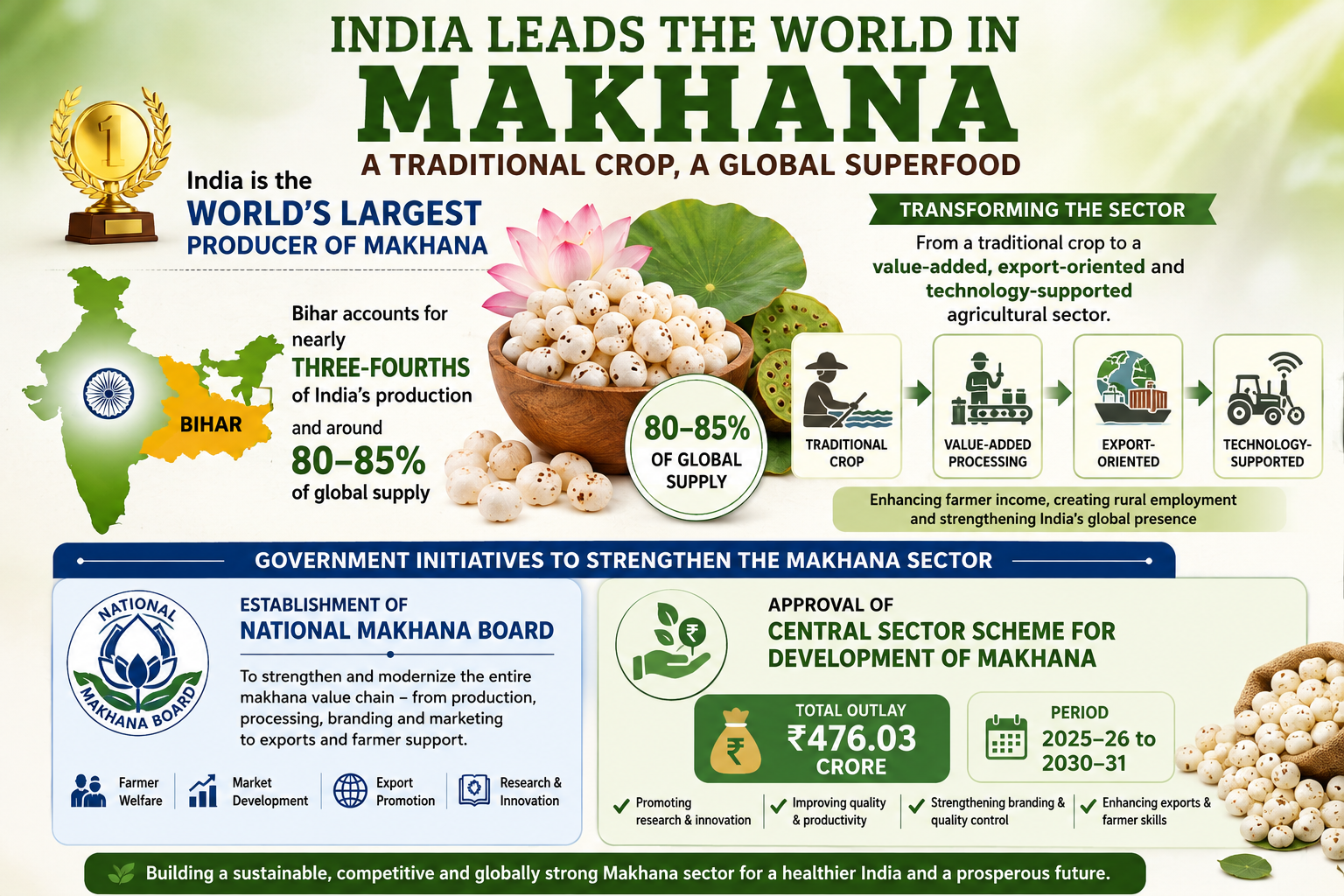
India is the world’s largest producer of makhana.
Bihar – the major production hub
-
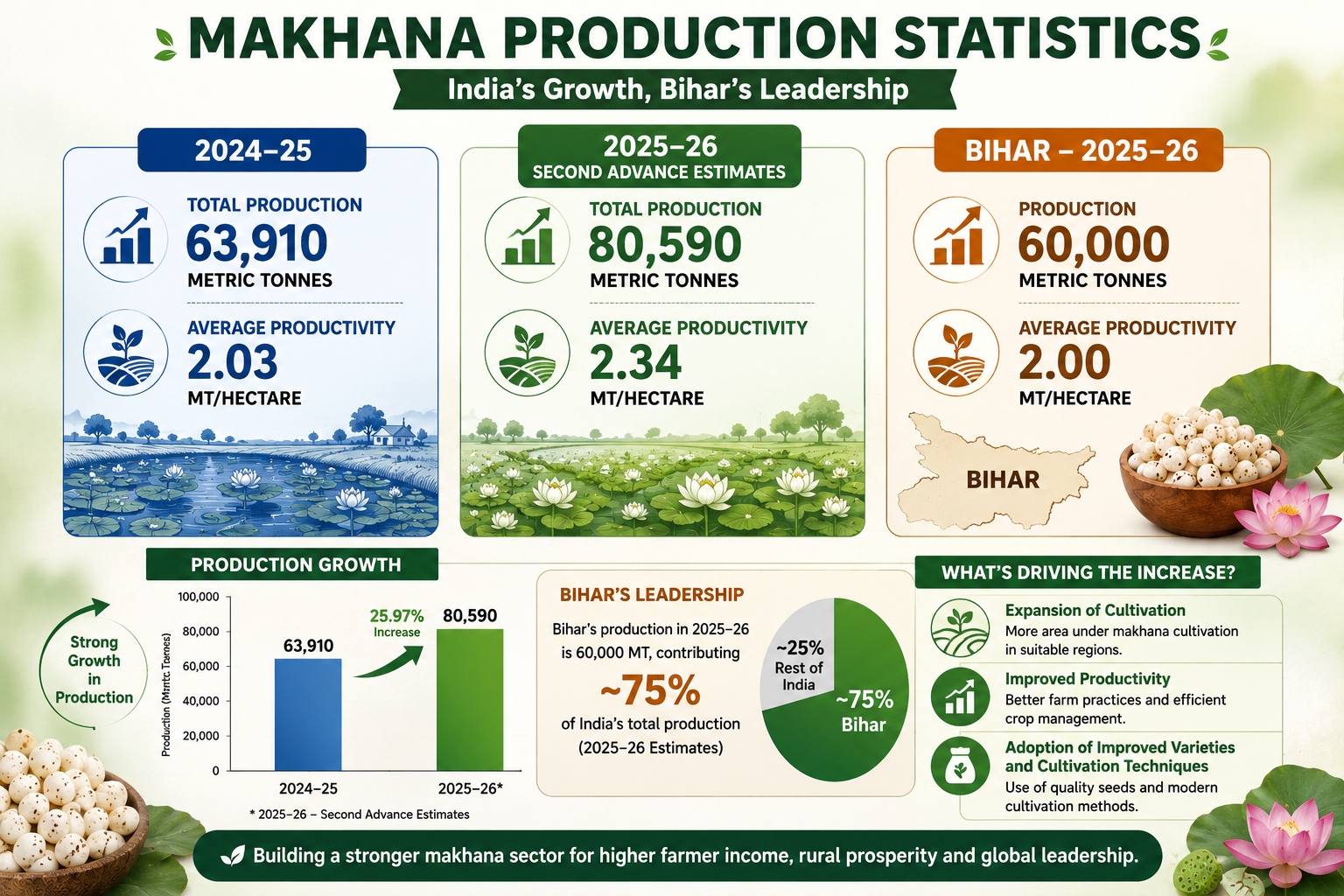
Bihar contributes nearly three-fourths of India's makhana production, around 80–85% of global supply.
-
Makhana cultivation is particularly concentrated in North Bihar. The major production region includes the Kosi basin, especially Supaul, Saharsa, Madhepura
-
It is also prominent in nearby areas of the Mithila region, Seemanchal region
-
Thus, Bihar has emerged as the central hub of India's makhana sector
Improved Cultivation Practices
-
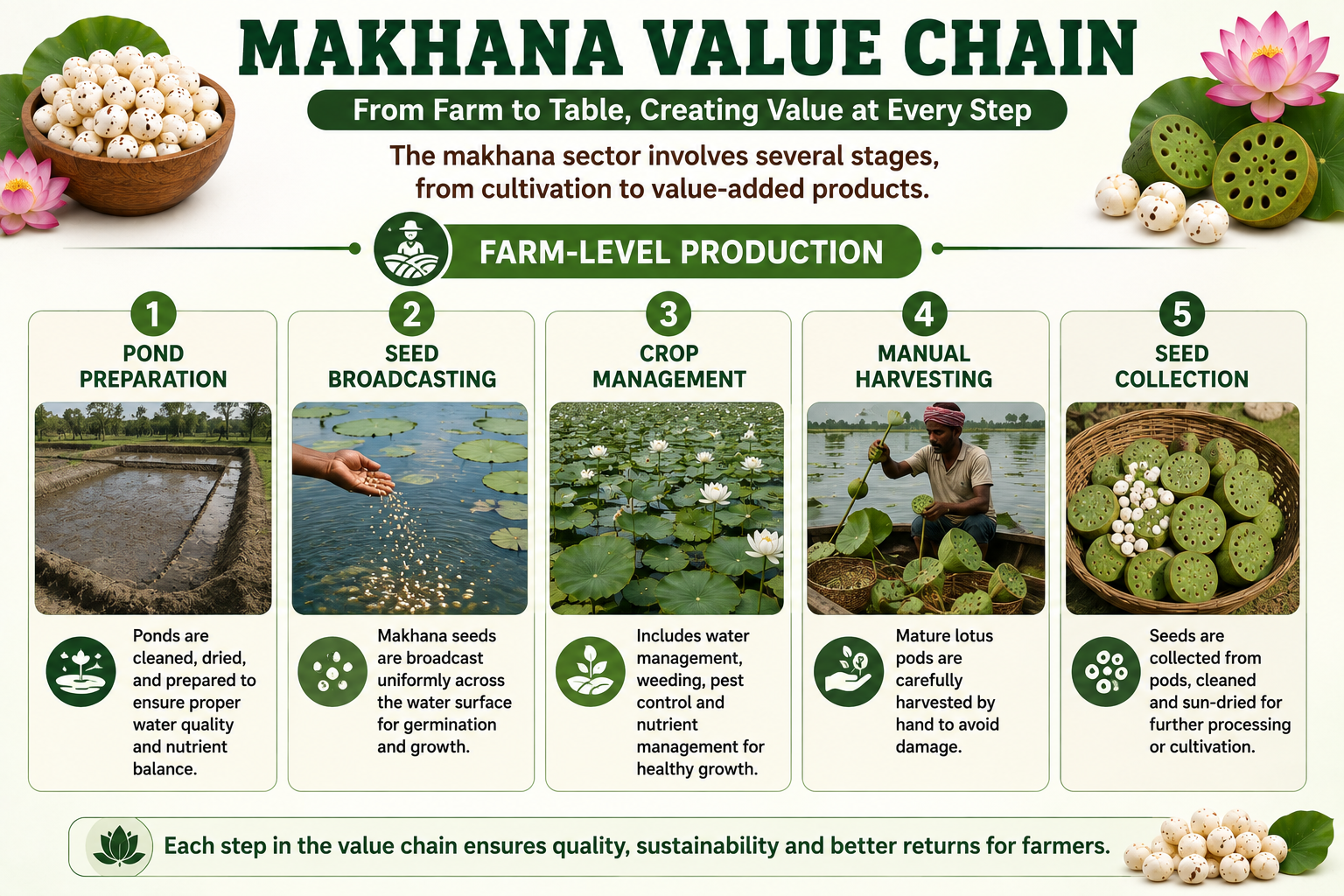
Traditional pond cultivation is being modernized through field-system farming.
-
Improved varieties and better cultivation techniques are boosting productivity.
-
These methods also help reduce cultivation risks.
-
Key varieties: Swarna Vaidehi and Sabour Makhana-1.
Mithila Makhana – GI Tag
-
Mithila Makhana has received a GI Tag.
-
It recognizes its unique quality, reputation and traditional knowledge associated with the Mithila region of Bihar.
-
The GI tag strengthens legal protection, branding and market differentiation.
Also Read More About
Domestic Makhana Market
-
India produces >0.6 lakh MT of makhana annually.
-
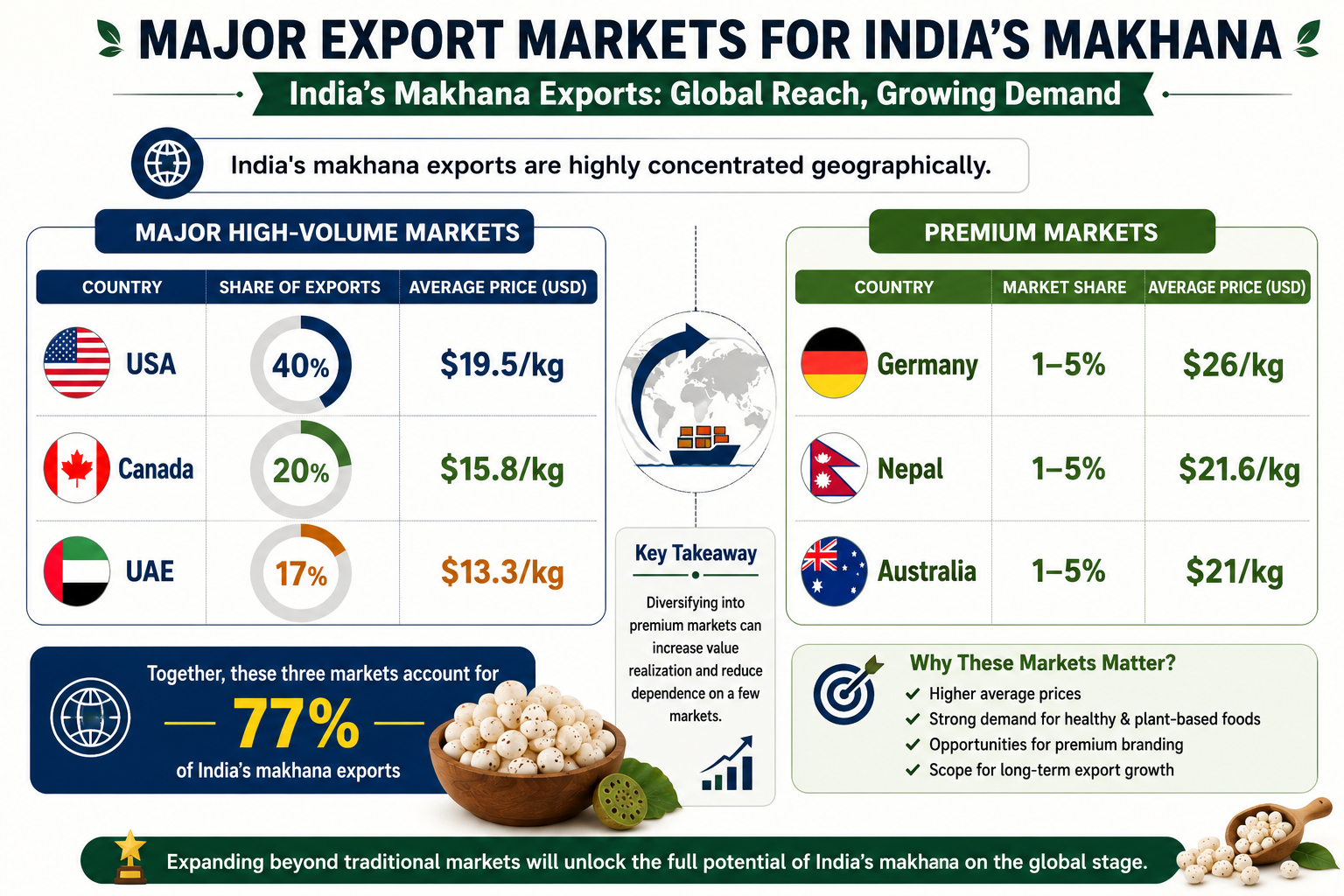
About 40% (0.23–0.25 lakh MT) is exported; the rest is consumed domestically.
-
Domestic market grew 17–18% annually (2021–22 to 2024–25).
-
Growth drivers: health awareness, healthy-snack demand, premiumisation, branded players, organised retail and plant-based food preference.
-
Market expected to reach ₹11,000–12,000 crore by 2029–30.
Price & Consumption Trends
-
Price increased from around ₹500/kg (2020–22) to nearly ₹1,250/kg (2025).
-
Key reasons: rising health-focused demand, premium branding and limited supply response.
-
Production grew only 4–5% between FY2020 and FY2025.
-
Monthly consumption: 3,000–3,500 MT, rising to about 5,000 MT during festivals.
-
Organised/FMCG segment: 1,800–2,000 MT/month.
-
Loose & unorganised retail: 1,200–1,400 MT/month, especially important in Tier-2 and Tier-3 markets.
Also Read About: Commodity Boards and HSN Code for Makhana
Government Support:
The Central Sector Scheme for Development of Makhana has an outlay of ₹476.03 crore for 2025–26 to 2030–31, focusing on research, quality planting material, farmer skills, harvesting, post-harvest management, value addition, branding, marketing, exports and quality control. ₹30 crore was approved for 2025–26 and ₹90 crore for 2026–27. The scheme added 1,010 hectares, covered 73 hectares for seed production, conducted 89 FLDs, and benefited 8,159 farmers through training and demonstrations.
National Research Centre for Makhana (NRCM)
The National Research Centre for Makhana (NRCM) plays an important role in modernizing India's makhana sector.
Major functions
-
Agricultural research
-
Capacity building
-
Improved cultivation practices
-
Processing technology
-
Farmer training
-
Technology transfer
NRCM has developed:
-
High-yielding makhana varieties
-
Thornless water chestnut varieties
-
Water-efficient farming systems
-
Integrated farming systems
-
Makhana-cum-fish farming
Major Challenges in the Makhana Sector
The article highlights several areas where modernization is still needed:
1. Low mechanisation: Traditional cultivation continues to dominate and depends heavily on manual labour.
2. Labour-intensive harvesting: Seed collection is carried out underwater and requires skilled manual work.
3. Post-harvest limitations: Traditional processing methods remain widespread.
4. Export concentration: The US, Canada and UAE together account for 77% of exports, indicating significant geographical concentration.
5. Limited supply response: Despite rising demand and prices, production growth has been relatively modest.
6. Need for value addition: Greater processing, branding and product diversification can help farmers capture a larger share of the final value.
These challenges explain the importance of research, mechanisation, quality improvement, branding and export diversification.
Makhana and Rural Economy
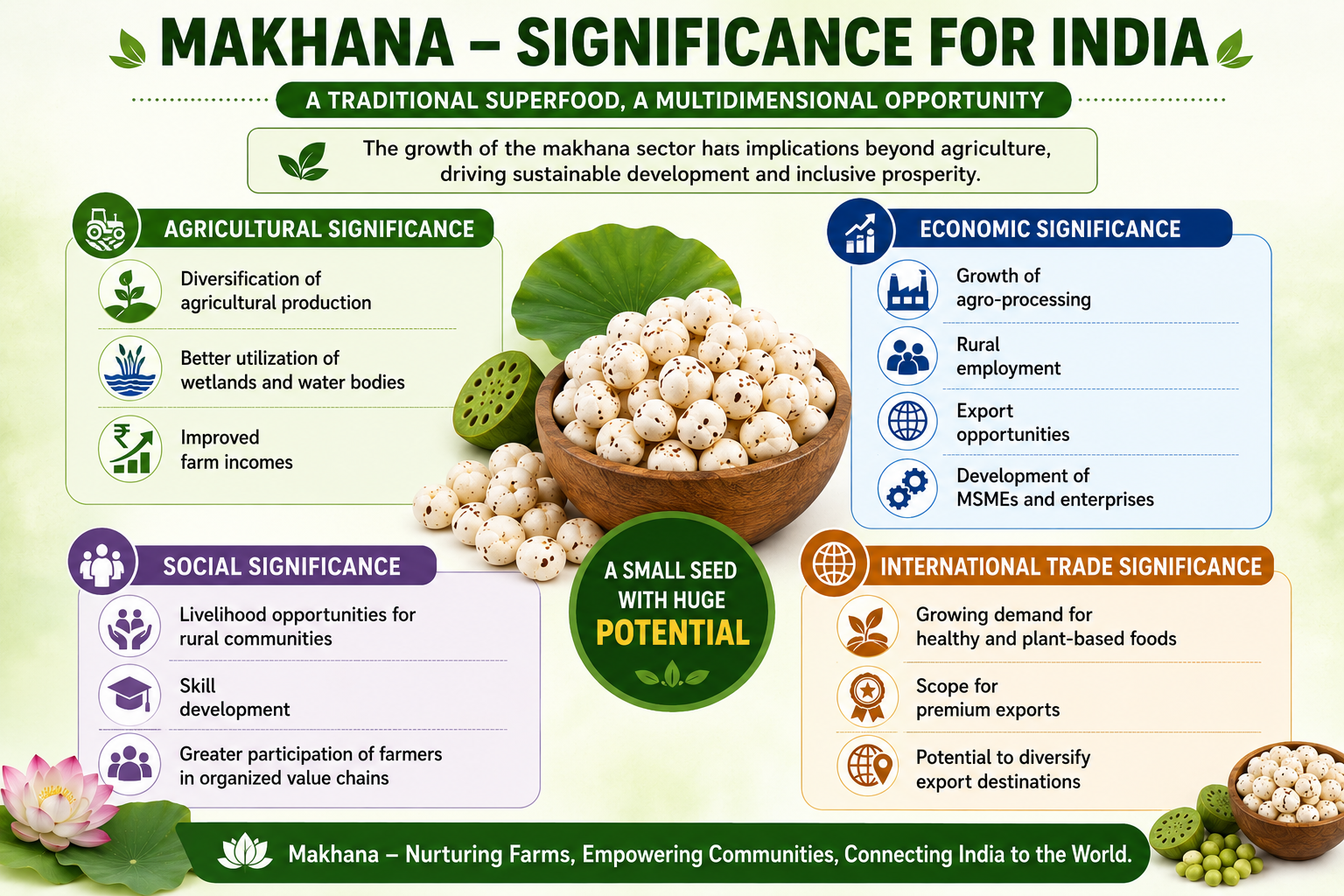
The growth of the makhana sector can contribute to:
-
Higher farmer incomes
-
Rural employment
-
Agro-processing
-
Rural entrepreneurship
-
Farmer-Producer Organizations
-
Export earnings
-
Development of food-processing industries
The article emphasizes that the combination of traditional knowledge + modern technology + value addition + global demand can transform makhana into a stronger agricultural value chain.
Way Forward
Based on the issues and opportunities highlighted in the Backgrounder, India's makhana sector can be strengthened through:
-
Greater mechanisation of cultivation and harvesting
-
Development and adoption of improved varieties
-
Better access to quality planting material
-
Modern post-harvest infrastructure
-
Expansion of processing and value-added products
-
Stronger branding and GI-based marketing
-
Greater participation of FPOs
-
Export-market diversification
-
Targeting premium international markets
-
Improved quality-control systems
-
Continued agricultural research
-
Farmer skill development
-
Technology transfer from research institutions to farmers and enterprises
The National Makhana Board and the Central Sector Scheme provide an institutional framework for pursuing these objectives