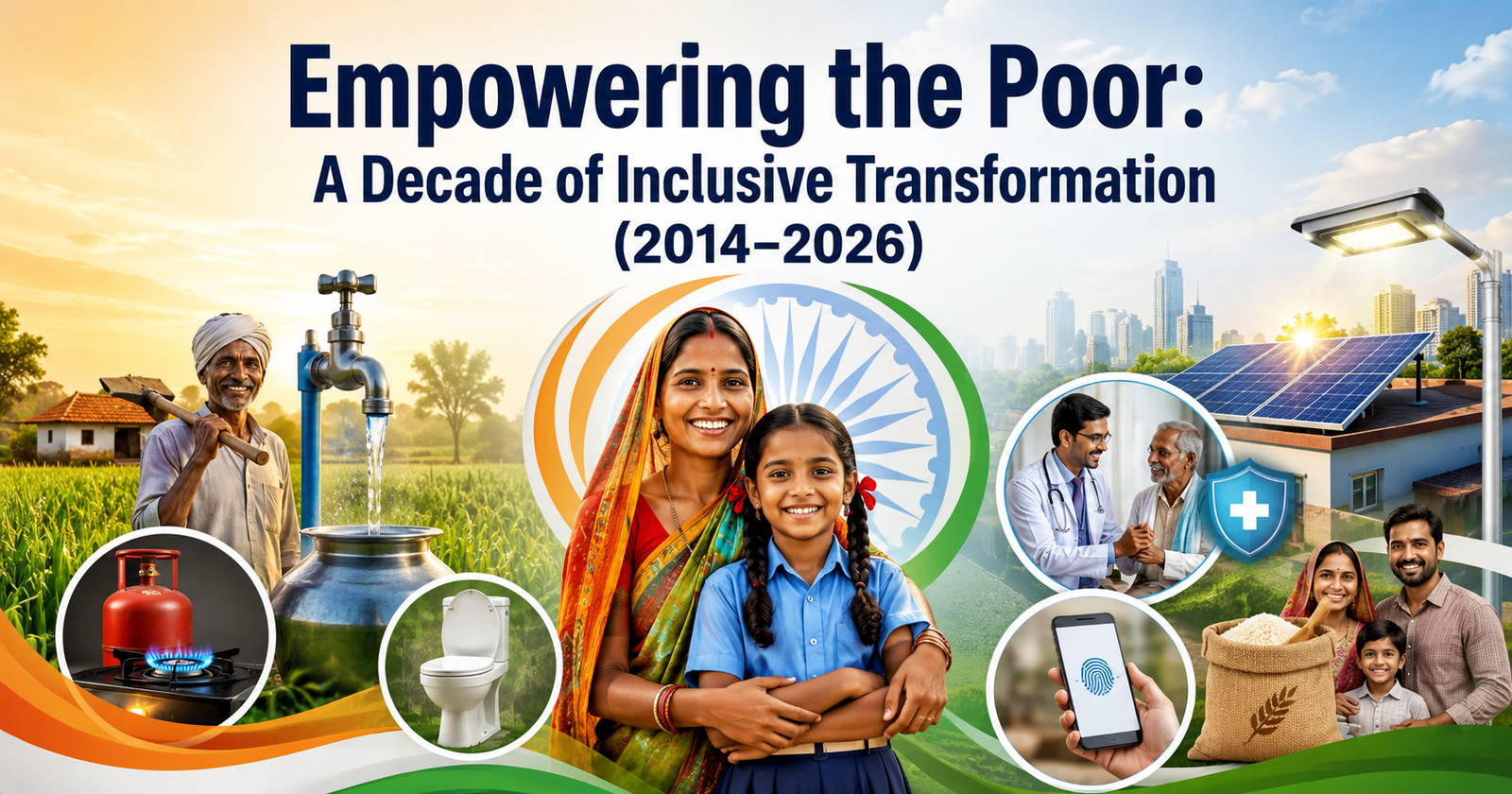
Indias decade-long welfare transformation reduced multidimensional poverty, expanded access to water, sanitation, healthcare, food security, clean energy, and digital services, significantly improving the quality of life for millions.
Syllabus Areas:
GS I - Society
GS II - Governance and Polity
GS III - Economy and Development
This PIB article highlights how India’s welfare and development policies over the last twelve years have focused on reducing poverty, improving living standards, and ensuring last-mile delivery of essential services. The government's approach has combined social welfare schemes, infrastructure development, healthcare expansion, food security, sanitation, and digital governance to improve the lives of millions of citizens.
1. Significant Reduction in Multidimensional Poverty
India has witnessed a substantial decline in multidimensional poverty over the last decade. The proportion of people living in multidimensional poverty reduced from 29.17% in 2013-14 to 11.28% in 2022-23. This means nearly 25 crore people were lifted out of poverty through a combination of welfare interventions, infrastructure expansion, healthcare access, food security, and financial inclusion measures. The decline reflects improvements in education, health, sanitation, housing, and living standards.
Why is it important?
-
Demonstrates the impact of targeted welfare delivery.
-
Indicates improvement in quality of life among vulnerable sections.
-
Supports inclusive growth rather than growth limited to specific sections of society.
2. Jal Jeevan Mission (JJM): Ensuring Tap Water for Every Household
Launched in 2019, the Jal Jeevan Mission aims to provide safe and adequate drinking water through household tap connections to all rural families. The mission was designed to reduce the burden on rural women who traditionally spent hours collecting water from distant sources.
Household tap water connections increased dramatically from 3.23 crore households in August 2019 to 15.84 crore households by May 2026. This means over 81% of rural households now have access to tap water. Additionally, 2.77 lakh villages achieved 100% tap water coverage under the Har Ghar Jal initiative.
Major Outcomes
-
Reduced water collection burden on women.
-
Improved public health by providing safe drinking water.
-
Reduced water-borne diseases.
-
Improved school attendance, especially among girls.
-
Enhanced sanitation and hygiene standards in villages.
Institutional Coverage
Tap water access was extended beyond households to public institutions:
-
Schools with tap water increased from 29,711 to 9.23 lakh.
-
Anganwadi Centres increased from 15,464 to 9.66 lakh.
-
Nearly 3.93 lakh Gram Panchayats and Community Health Centres received tap water facilities.
3. Swachh Bharat Mission (Urban)
The Swachh Bharat Mission (Urban) was launched in 2014 with the objective of eliminating open defecation, improving sanitation infrastructure, and strengthening waste management systems.
The mission has transformed urban sanitation through large-scale construction of toilets and improved waste processing systems. Door-to-door waste collection increased from 43% in 2014 to 98% in 2026, while waste processing increased from 16% to 82%.
Major Achievements
-
63.74 lakh individual household toilets constructed.
-
6.36 lakh community and public toilets established.
-
4,692 cities declared Open Defecation Free (ODF).
-
4,314 cities achieved ODF+ status.
-
1,973 cities achieved ODF++ certification.
Impact
-
Cleaner cities.
-
Better public health outcomes.
-
Improved urban waste management.
-
Reduction in environmental pollution.
4. Swachh Bharat Mission (Grameen)
Before 2014, nearly 550 million rural residents lacked access to proper sanitation facilities. The Swachh Bharat Mission (Grameen) was introduced to address this challenge and improve rural sanitation.
More than 12.11 crore household toilets have been constructed under the mission. Rural sanitation coverage increased from just 39% in 2014 to 100% in 2019, enabling India to declare itself Open Defecation Free (ODF).
Additional Achievements
-
Over 5 lakh villages attained ODF Plus status.
-
Solid waste management systems established in 5.31 lakh villages.
-
Liquid waste management systems established in 5.50 lakh villages.
-
2,415 plastic waste management units established across 5,482 blocks.
Significance
The mission has improved public health, enhanced dignity—especially for women—and promoted a cleaner rural environment.
5. GOBARdhan Initiative and Circular Economy
The GOBARdhan initiative promotes converting organic waste into biogas and other useful resources. The number of operational biogas plants increased from only 14 in 2018-19 to more than 1,213 by May 2026.
Importance
-
Converts waste into energy.
-
Reduces environmental pollution.
-
Supports renewable energy generation.
-
Promotes the circular economy model.
6. Pradhan Mantri Ujjwala Yojana (PMUY)
Launched in 2016, PMUY provides free LPG connections to poor women to replace traditional cooking fuels such as firewood and dung cakes.
As of May 2026, more than 10.57 crore LPG connections had been provided under the scheme. Total LPG connections in India increased from 14.52 crore in 2014 to 33.39 crore in 2026.
Benefits
-
Reduction in indoor air pollution.
-
Improved health of women and children.
-
Reduced drudgery for rural women.
-
Better environmental sustainability.
-
Improved nutrition and living conditions.
7. PM Surya Ghar: Muft Bijli Yojana
Launched in 2024, this scheme promotes rooftop solar installations by providing subsidies and offering up to 300 units of free electricity per month.
By April 2026:
-
36.8 lakh households benefited.
-
Rooftop solar installations increased from 6.3 lakh to 30 lakh.
Significance
-
Reduces electricity bills.
-
Encourages renewable energy adoption.
-
Supports energy self-reliance.
-
Creates opportunities for income through surplus power generation.
8. Universal Electrification
The government achieved universal electrification through schemes such as Saubhagya and Deendayal Upadhyaya Gram Jyoti Yojana.
Achievements
-
100% willing households electrified by March 2019.
-
100% village electrification achieved by 2025.
-
Rural power supply increased from 12.5 hours per day in 2014 to 22.6 hours in 2025.
-
Urban power supply increased from 22.1 hours to 23.4 hours during the same period.
Impact
-
Improved agricultural productivity.
-
Better educational opportunities.
-
Enhanced industrial growth.
-
Improved living standards.
9. Ayushman Bharat: Expanding Healthcare Access
Ayushman Bharat is the world's largest publicly funded health insurance programme. It provides health coverage of ₹5 lakh per family to economically vulnerable households.
Key Achievements
-
Covers about 12.37 crore vulnerable families.
-
More than 43.93 crore Ayushman Cards issued.
-
Hospital admissions increased from 29.96 lakh in 2019 to 12.03 crore by May 2026.
-
Total treatment value crossed ₹1.80 lakh crore.
Digital Health Revolution
Under the Ayushman Bharat Digital Mission:
-
88.33 crore ABHA accounts created.
-
97.81 crore health records digitally linked.
-
Over 1.85 lakh Ayushman Arogya Mandirs facilitated 540 crore visits.
Significance
-
Reduced healthcare expenditure for poor families.
-
Improved healthcare accessibility.
-
Strengthened digital healthcare infrastructure.
10. Maternal and Child Health Improvements
Government initiatives such as Janani Suraksha Yojana, Janani Shishu Suraksha Karyakram, PMSMA, and Mission Indradhanush significantly improved maternal and child healthcare.
Achievements
-
More than 7 crore antenatal check-ups conducted.
-
5.46 crore children immunized.
-
1.32 crore pregnant women immunized.
Health Outcomes
-
Maternal Mortality Ratio declined from 130 to 88 per 100,000 live births.
-
First-trimester antenatal care visits increased from 59% to 76.2%.
-
Four or more ANC visits increased from 51% to 65.2%.
11. Food Security Through PM Garib Kalyan Anna Yojana (PMGKAY)
Launched during the COVID-19 pandemic, PMGKAY provides free food grains to over 81 crore beneficiaries and was extended for five more years in 2024.
Strengthening PDS
-
99.8% of Fair Price Shops automated.
-
100% digitization of ration cards achieved.
-
One Nation One Ration Card facilitated more than 2.07 billion portability transactions.
Impact
-
Strengthened food security.
-
Supported migrant workers through portability.
-
Reduced leakages through digitization.
-
Improved nutrition outcomes.
The last twelve years have witnessed a shift from welfare delivery based on limited access to a comprehensive model focused on universal access, dignity, and inclusion. Programmes related to drinking water, sanitation, healthcare, food security, clean energy, and electrification have collectively contributed to reducing multidimensional poverty and improving the quality of life of millions of Indians. The emphasis on digital governance, targeted interventions, and last-mile delivery has strengthened the effectiveness of welfare schemes and ensured that benefits reach vulnerable populations more efficiently
Prelims Questions:
1. Consider the following regarding ODF+, and ODF++ certification:
-
ODF+ includes effective solid and liquid waste management.
-
ODF++ requires safe treatment of faecal sludge and sewage.
-
ODF++ certification can be granted even if toilets are non-functional.
Which of the statements given above are correct?
A. 1 and 2 only
B. 2 and 3 only
C. 1 only
D. 1, 2 and 3
Answer: A
2. The GOBARdhan initiative is primarily associated with:
A. Promotion of organic exports
B. Converting biodegradable waste into wealth and energy
C. Rural housing development
D. Groundwater recharge structures
Answer: B
Explanation: GOBARdhan promotes biogas production and circular economy through waste-to-energy systems.
3. With reference to Project Indradhanush, consider the following statements:
-
It was launched by the Ministry of Civil Aviation.
-
It focuses on the development of aviation infrastructure in the North-Eastern Region.
-
It aims to achieve universal immunization coverage.
Which of the statements given above is/are correct?
A. 1 and 2 only
B. 2 and 3 only
C. 1 only
D. 1, 2 and 3
Answer: A
Explanation: Statement 3 refers to Mission Indradhanush, not Project Indradhanush.