Explore rural credit architecture of India, institutional framework, major policy reforms, financial inclusion initiatives, and digital innovations driving affordable agricultural finance, rural livelihoods, and inclusive economic development.
Syllabus Areas:
GS III - Economy
Institutional Architecture of Rural Credit
Scheduled Commercial Banks (SCBs)
A SCB is a bank included in the Second Schedule of the RBI Act, 1934. These banks are eligible for loans at the bank rate from the RBI and are members of the clearing house.
-
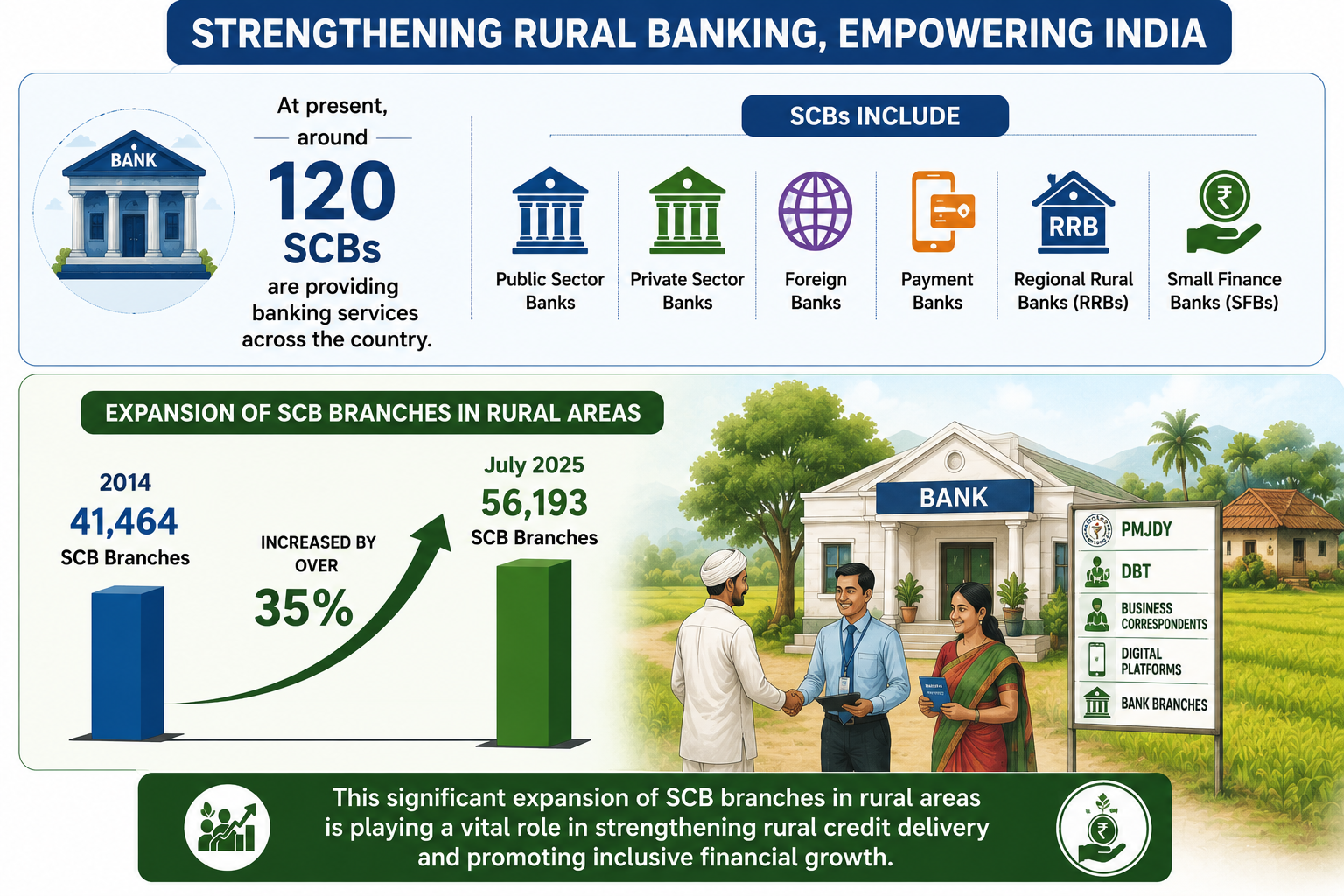
Scheduled Commercial Banks (SCBs) strengthen financial inclusion by providing formal banking services through branches, Business Correspondents (BCs), digital platforms, PMJDY, and Direct Benefit Transfer (DBT).
-
They include Public Sector Banks, Private Sector Banks, Foreign Banks, Regional Rural Banks (RRBs), Small Finance Banks (SFBs), and Payment Banks.
Read How Rural Credit System Has Evolved:
Regional Rural Banks (RRBs):
-
Established under the RRB Act, 1976 to provide credit to small and marginal farmers, agricultural labourers, artisans, and rural entrepreneurs.
-
Presently, 28 RRBs operate through 22,000+ branches across 700 districts, promoting rural development and financial inclusion.
Co-operative Banks:
-
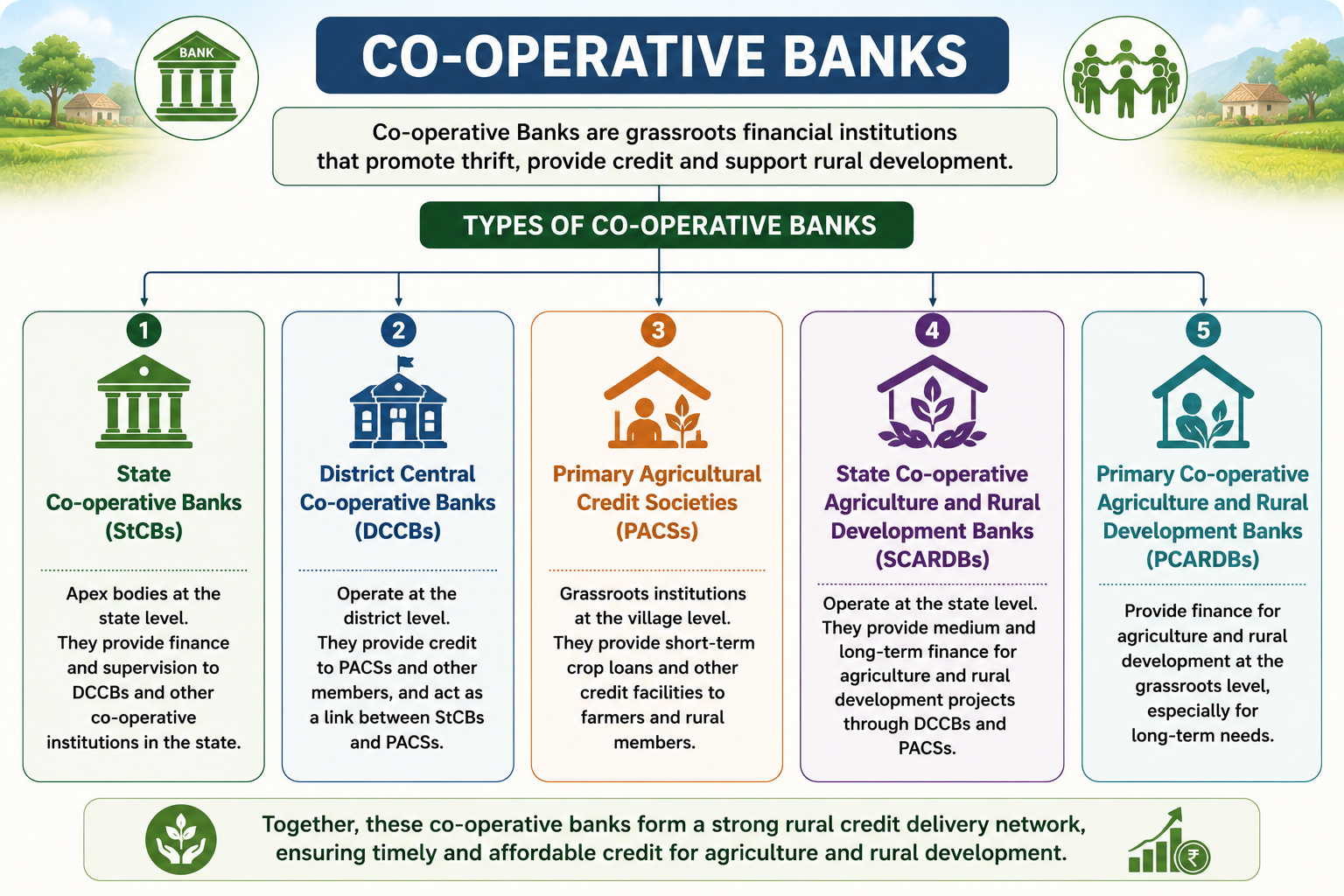
A key pillar of rural finance with a multi-tier structure comprising State Cooperative Banks (StCBs), District Central Cooperative Banks (DCCBs), Primary Agricultural Credit Societies (PACSs), SCARDBs, and PCARDBs.
-
The network includes 1,458 Urban Cooperative Banks, 34 StCBs, and 352 DCCBs, extending institutional credit to rural and remote areas.
Small Finance Banks (SFBs):
-
Introduced after the Union Budget 2014–15 and regulated by the RBI to promote financial inclusion.
-
11 SFBs provide technology-driven banking and credit to small farmers, micro enterprises, and underserved sections.
Major Policy Measures for Strengthening Rural Credit
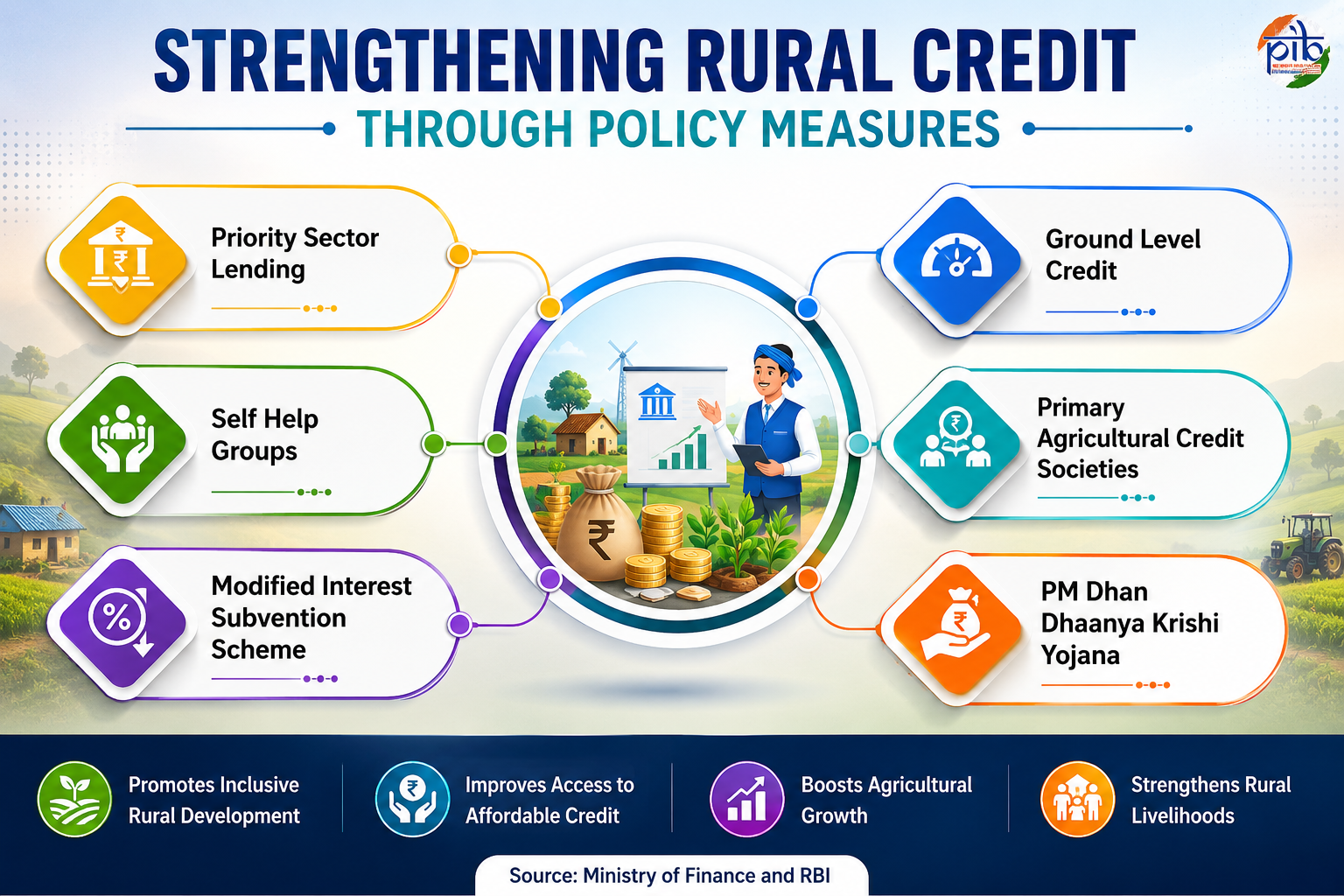
Priority Sector Lending (PSL)
The RBI mandates banks to allocate a specified proportion of lending to priority sectors.
Agriculture Targets
-
18% of Adjusted Net Bank Credit (ANBC) or Credit Equivalent of Off-Balance Sheet Exposure (whichever is higher) must go to agriculture.
-
Within agriculture:
-
14% earmarked for non-corporate farmers.
-
10% for small and marginal farmers.
PSL ensures adequate institutional credit reaches agriculture.
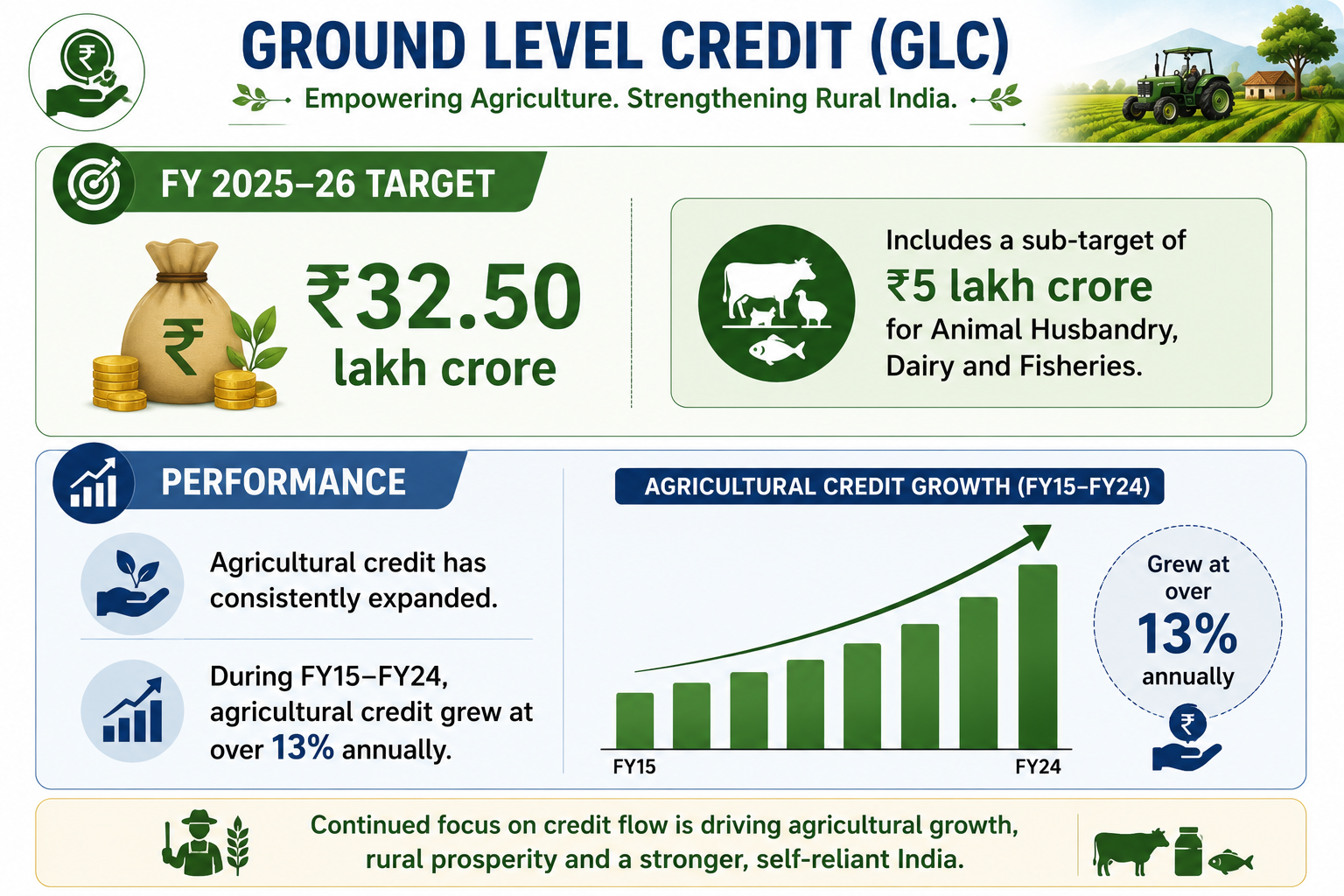
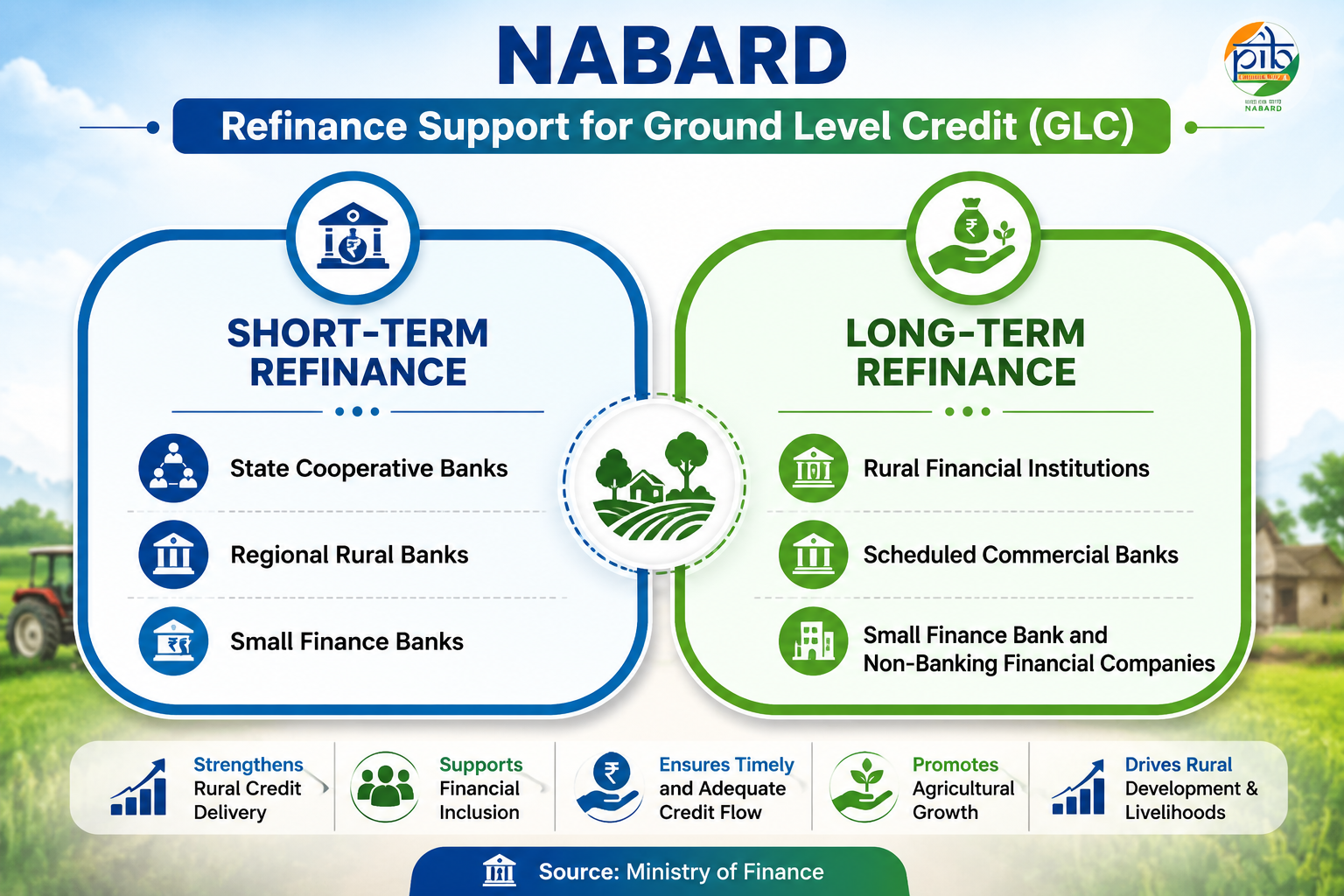
Ground Level Credit (GLC)
Ground Level Credit measures actual credit disbursed for agriculture and allied sectors.
Self-Help Group (SHG) – Bank Linkage Programme (SHG-BLP)
-
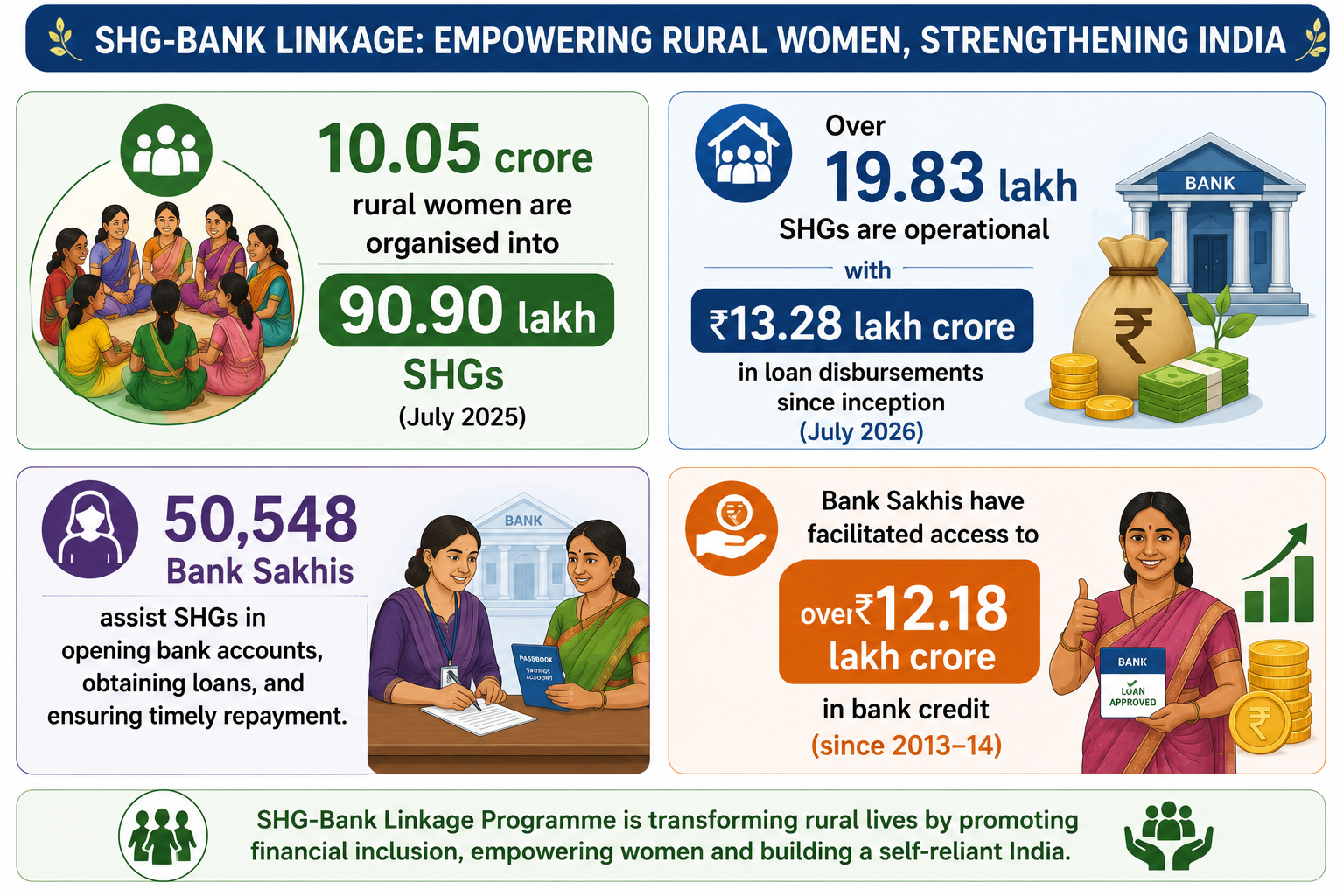
Initiated by: NABARD
-
Objective: To link Self-Help Groups (SHGs) with the formal banking system, providing affordable institutional credit and financial services.
-
Significance: Integrates rural poor households, especially women, into the formal financial system and promotes financial inclusion.
DAY-NRLM
-
Launched: 2010 (by restructuring SGSY)
-
Renamed: Deendayal Antyodaya Yojana – National Rural Livelihoods Mission (DAY-NRLM) in 2016.
-
Purpose: Organises rural poor households into SHGs to enhance livelihoods, reduce poverty, and strengthen women-led SHGs.
Primary Agricultural Credit Societies (PACS)
-
PACS are the grassroots-level institutions of India's short-term cooperative credit system, providing agricultural loans, facilitating repayments, and supporting the distribution and marketing of farm inputs and produce.
-
They serve as the last-mile link between rural borrowers and higher financing institutions such as State Cooperative Banks (SCBs), NABARD, and the RBI.
-
In 2023, the Government approved the establishment of 2 lakh new multipurpose PACS, dairy, and fishery cooperative societies over five years.
-
As of 20 January 2026, 32,836 new societies had been registered and 15,793 dairy and fishery cooperatives strengthened.
-
To improve efficiency, 61,842 out of 79,630 approved PACS had migrated to a Common ERP-based national software by 10 March 2026.
Modified Interest Subvention Scheme (MISS)
-
Type: Central Sector Scheme
-
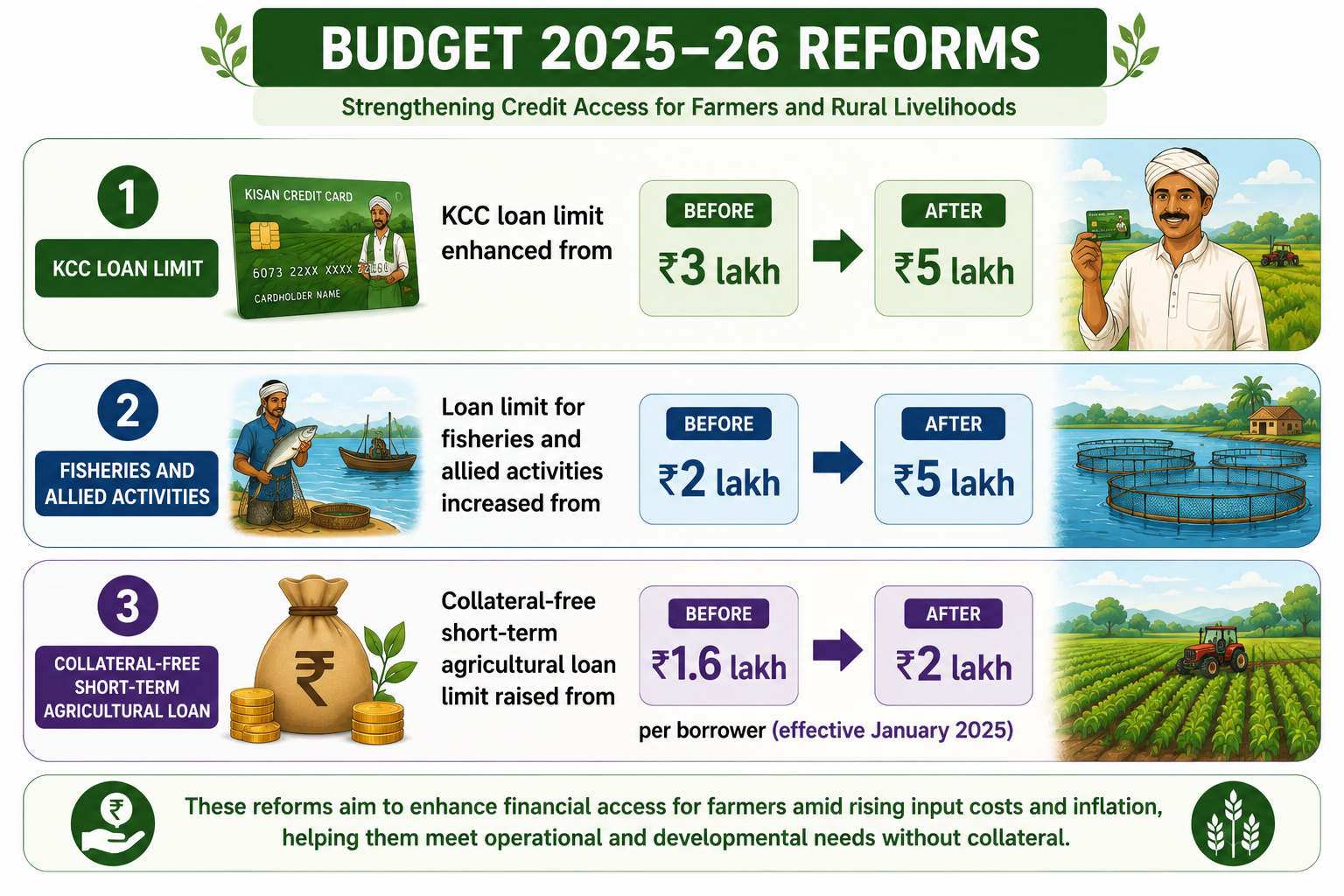
Objective: To provide affordable short-term crop loans to farmers through the Kisan Credit Card (KCC).
-
Interest Rate: Farmers receive loans at 7% interest, with 1.5% interest subvention to lending institutions.
-
Prompt Repayment Benefit: Farmers repaying loans on time receive an additional 3% incentive, reducing the effective interest rate to 4%.
Significance
-
Improves farmers' access to affordable institutional credit.
-
Helps meet rising cultivation costs and inflation.
-
Supports operational and developmental needs without requiring collateral.
PM Dhan Dhanya Krishi Yojana (PM-DDKY)
-
Launched: Approved in July 2025 to accelerate agricultural development in 100 low-performing agri-districts.
-
Approach: Converges 36 Central schemes across 11 Ministries for integrated rural development.
-
Objectives: Improve access to short- and long-term agricultural credit, enhance productivity, promote crop diversification, sustainable farming, irrigation, and post-harvest storage infrastructure.
-
Implementation: Monitored through District, State, and National-level Committees.
-
Top-performing districts (up to May 2026): Banka (Bihar), Mahoba (Uttar Pradesh), Charaideo (Assam), Kishanganj (Bihar), and Tikamgarh (Madhya Pradesh).
Strengthening Rural Financial Inclusion
India has adopted a multi-pronged approach to strengthen rural financial inclusion through digital banking, affordable credit, and universal banking access.
1. Kisan Credit Card (KCC)
Objective: Provides timely and affordable institutional credit to farmers for agricultural and allied activities.
Key Features
-
ATM-enabled RuPay debit card.
-
One-time documentation.
-
Multiple withdrawals within the sanctioned limit.
-
Covers crop cultivation, post-harvest expenses, marketing, farm maintenance, household needs, and allied activities.
Coverage
-
Commercial Banks: 739 lakh KCC applications.
-
Regional Rural Banks: 365 lakh+ applications.
-
Cooperative Banks: 1,178 lakh+ applications (highest).
Recent Reforms
-
Expanded to tenant farmers, sharecroppers, SHGs, and JLGs.
-
Extended to dairy, fisheries, and animal husbandry.
-
e-KCC Portal enables fully digital applications and loan sanction within about 2 days.
2. Pradhan Mantri Jan Dhan Yojana (PMJDY)
Objective: Universal banking access for every household.
Key Benefits
-
Basic savings account.
-
Access to credit, insurance, pension, and RuPay debit card.
-
Supports Direct Benefit Transfer (DBT) through the JAM Trinity.
Achievements (June 2026)
-
58.63 crore accounts opened.
-
Deposits exceed ₹3 lakh crore.
-
55.7% accounts belong to women.
-
77.8% accounts are in rural and semi-urban areas.
3. Jan Samarth Portal
-
Launched: June 2022.
-
One-stop digital platform for government loan and subsidy schemes, including KCC.
-
Simplifies loan applications and ensures end-to-end digital credit delivery.
4. Jan Dhan Darshak App
-
Helps citizens locate bank branches, ATMs, Bank Mitras, and Common Service Centres (CSCs).
-
Assists the Government in monitoring banking infrastructure.
Coverage
-
99.92% of villages have a banking outlet within a 5 km radius.
-
Dadra and Nagar Haveli have achieved 100% banking coverage.
5. Financial Literacy Initiatives
The Government, RBI, NABARD, and banks promote financial awareness through:
-
Centres for Financial Literacy (CFLs)
-
Financial Literacy Camps (FLCs)
-
RBI's Financial Literacy Week (FLW)
These initiatives encourage the use of formal banking services and improve financial literacy among rural households
India's rural credit system has evolved into a robust, institution-driven and digitally enabled framework that ensures timely, affordable, and inclusive credit. Strengthened by policy reforms, financial inclusion initiatives, and technological innovations, it is fostering agricultural growth, rural livelihoods, and sustainable inclusive economic development.
Also Read How Rural Credit System Has Evolved: