Sugar price spike in India reflects declining production, low stocks, seasonal demand and speculative hoarding. The article examines ethanol diversion, El Niño impacts, structural challenges and policy reforms for stability.
Syllabus Areas:
GS III - Economy
Retail sugar prices across India have witnessed a sharp increase, rising from around ₹45–₹48 per kg to ₹58–₹70 per kg. The price rise has raised concerns among policymakers and consumers, particularly ahead of the festival season.
While declining sugar production and weather-related supply constraints have contributed to the situation, speculative stockholding and hoarding by market intermediaries are the major catalysts behind the sharp retail price escalation.
The Reality is:
The current sugar price spike cannot be attributed solely to:
-
El Niño and monsoon deficits
-
Diversion of sugar towards ethanol production
-
Declining sugarcane production
The immediate trigger is speculative behaviour by wholesalers, stockists and large commercial buyers, who may withhold stocks when they anticipate a supply shortage.
This artificial tightening of market availability can amplify an underlying supply constraint and push retail prices significantly higher.
What Caused the hike in Sugar Prices?
-
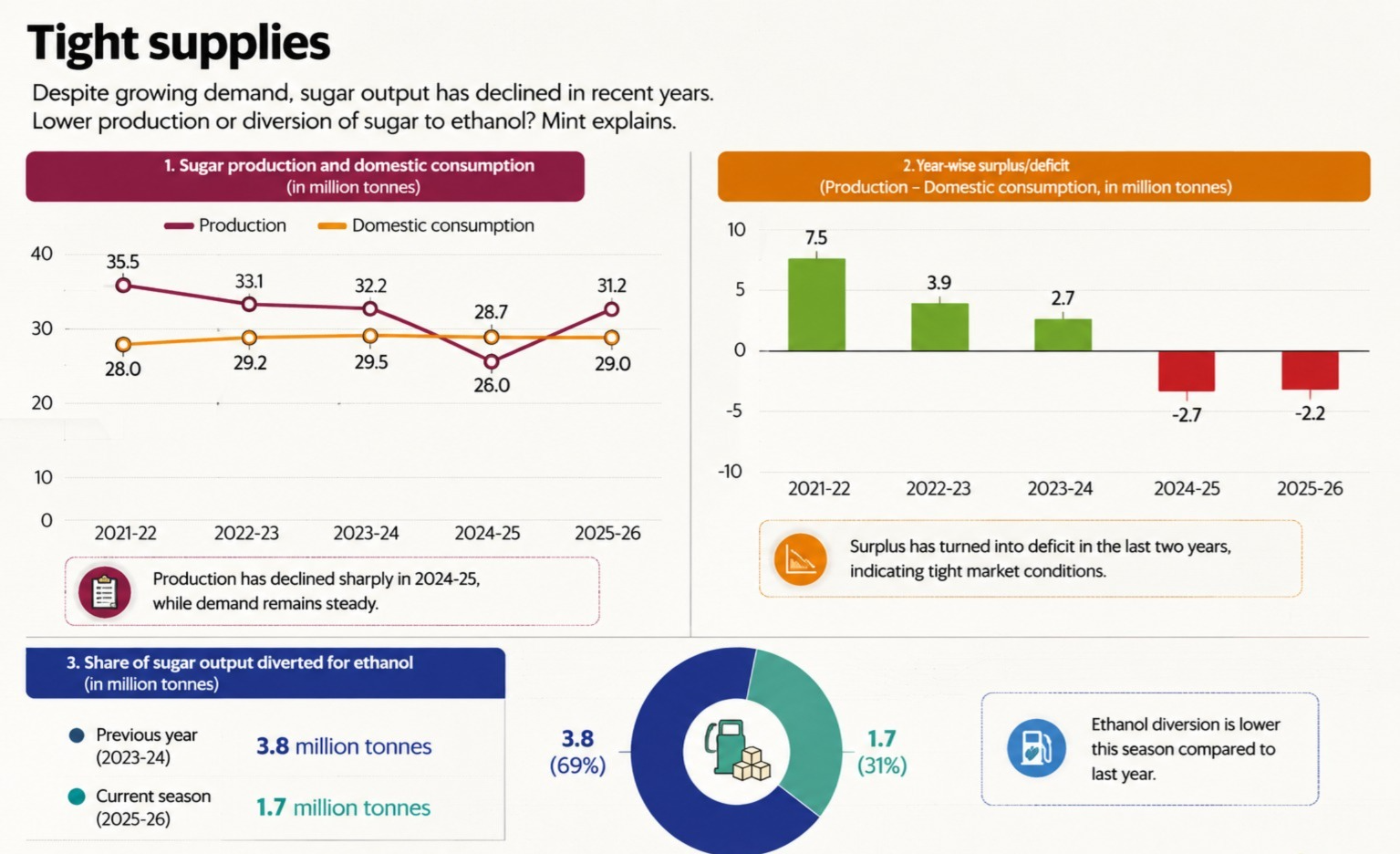
Sugar production declined in 2023-24 and 2024-25 due to lower yields, red rot in Uttar Pradesh and excess rainfall in Maharashtra.
-
Output fell from 32 million tonnes to 26 million tonnes, before recovering to 28 million tonnes in 2025-26, still below annual consumption, contributing to the sugar price spike.
The Cobweb Cycle in Sugar Production
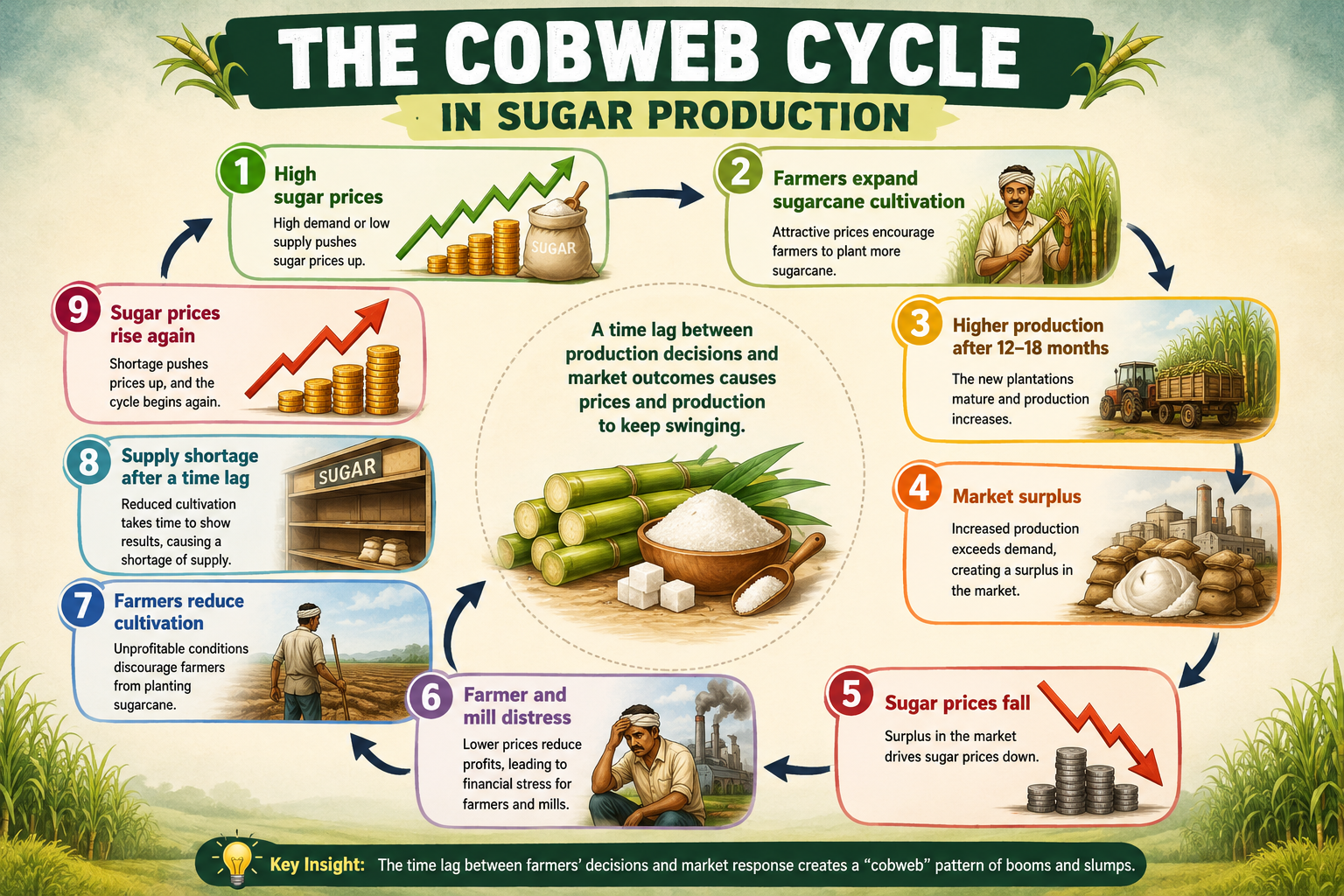
India's sugarcane sector exhibits a Cobweb phenomenon, where production decisions made by farmers today affect market supply and prices with a considerable time lag.
Consequences
-
Sugarcane is a long-duration crop requiring around 12–18 months for harvesting.
-
Farmers respond to prevailing prices while actual supply responds with a substantial delay.
-
Excess production can cause sugar prices to fall sharply.
-
Lower prices can result in payment difficulties for sugar mills.
-
Farmers subsequently reduce sugarcane cultivation.
-
Reduced acreage eventually produces a supply deficit and renewed price escalation.
Role of El Niño and Monsoon Deficit
Sugarcane is a water-intensive crop and depends heavily on:
-
Adequate monsoon rainfall
-
Reservoir water availability
-
Sustained irrigation
-
Favourable weather conditions during cultivation
Weather abnormalities, including dry spells associated with El Niño conditions, can reduce sugarcane yields and ultimately affect sugar production.
Production estimate revision
Initial sugar production projections for the current season were around 34.3 million tonnes → 30.6 million tonnes. This represents a decline of approximately 11% from the initial projection.
But is El Niño the main cause?
The article questions this explanation by pointing out that sugar production had also fallen substantially in 2024–25, to around 29.6 million tonnes, compared with 34.1 million tonnes in the preceding period, without producing a comparable retail price surge.
Therefore, weather-related supply reduction alone does not completely explain the magnitude of the current retail price increase.
Is Ethanol Diversion Responsible?
The diversion of sugar towards ethanol production reduces the quantity of sugar available for human consumption.
How much sugar is used for ethanol?
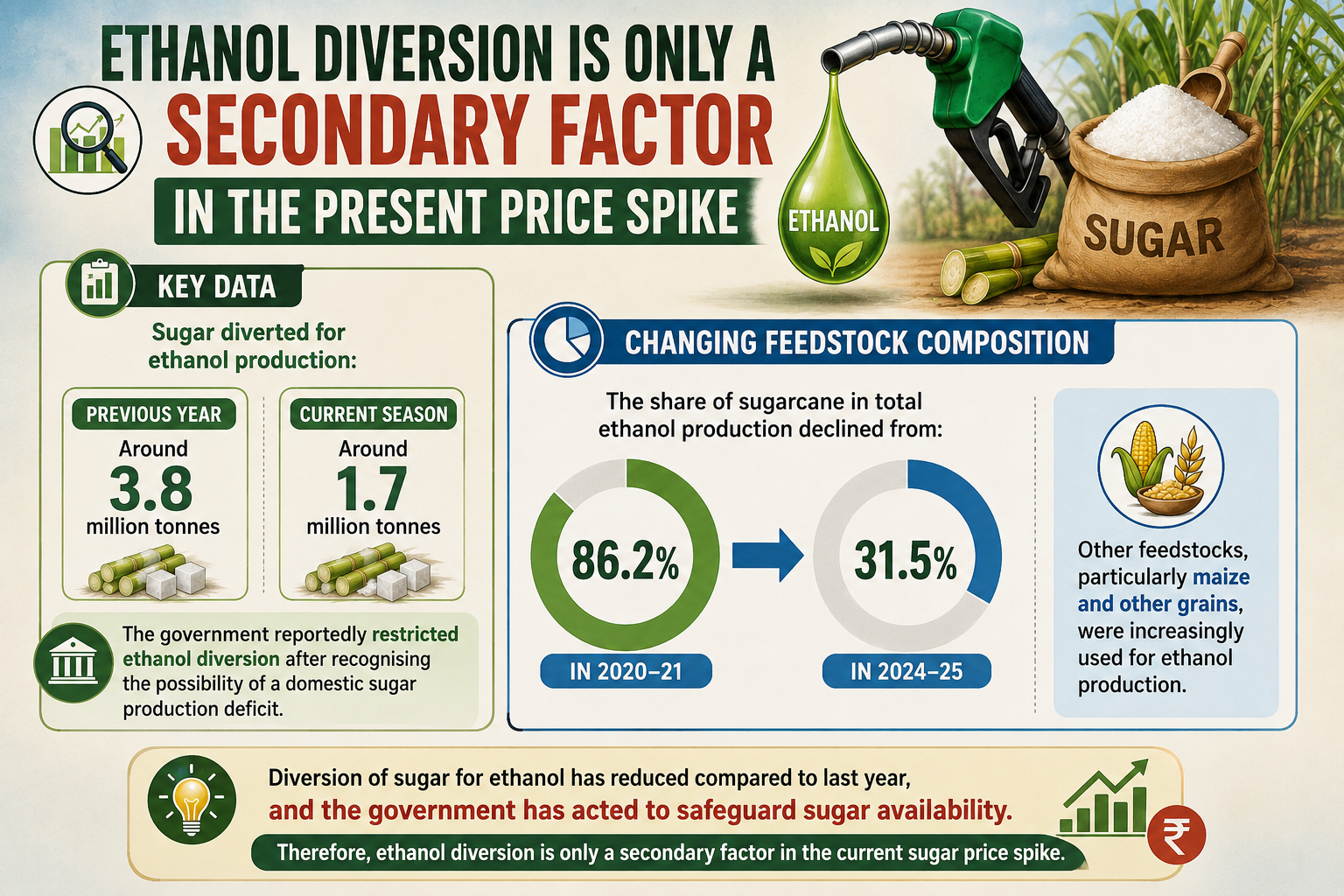
Sugar diverted for ethanol increased nearly four-fold, from 0.8 million tonnes in 2019-20 to over 3 million tonnes in 2025-26, tightening supplies amid production shortfalls. However, the sugar industry argues that nearly 75% of ethanol now comes from grains, while only 25% comes from sugar-based sources.
It concludes that the Ethanol Blending Programme cannot by itself explain the sudden sugar price spike.
Important observation
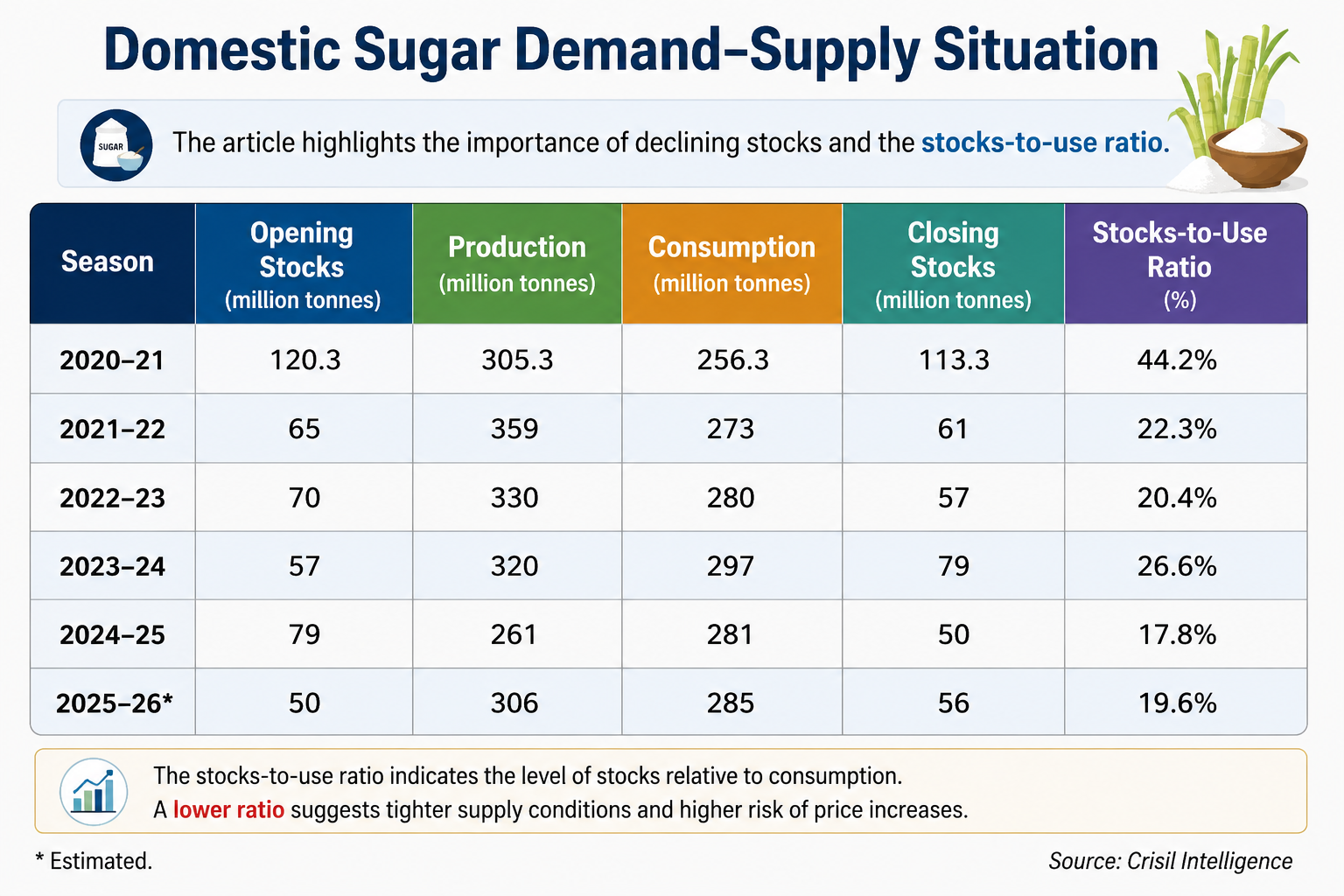
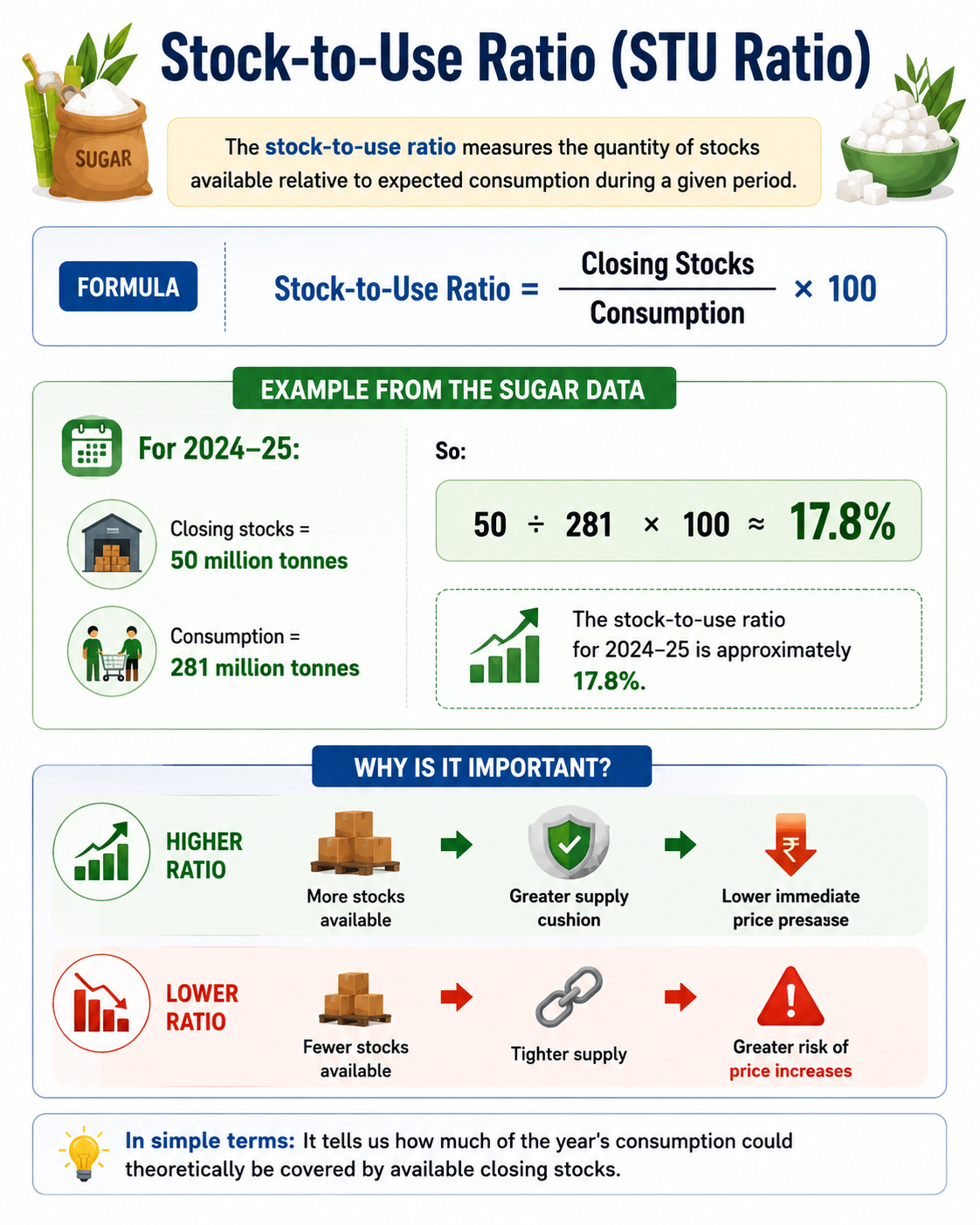
The stocks-to-use ratio fell from 44.2% in 2020–21 to 17.8% in 2024–25.
Lower inventories mean that the market has a smaller buffer against production shocks and sudden increases in demand.
Is any other factor currently at play?
Another important factor is inaccurate estimates of sugarcane production. If production is overestimated at the beginning of the season, more sugar may be diverted for ethanol production or exports.
This can reduce sugar available for domestic consumption. For example, India allowed exports of about 0.7 million tonnes of sugar before announcing an export ban in May.
In simple terms:
Overestimated production → More ethanol diversion & exports → Lower domestic availability → Tighter supply → Higher sugar prices.
Role of Speculative Hoarding
Speculation is the primary catalyst that converts supply tightness into a sharp retail price increase.
When traders anticipate lower sugar availability:
-
Wholesalers and stockists may purchase additional stocks.
-
Large commercial buyers may also increase procurement.
-
Stocks may be withheld from the market.
-
Available market supply becomes artificially tighter.
-
Prices begin to rise.
-
Rising prices can encourage further speculative holding.
-
Retail consumers ultimately face much higher prices.
Thus, it distinguishes between fundamental supply tightness and the market behaviour that magnifies it.
Impact of Festival Demand
Sugar demand normally increases during the festival season.
Major sources of additional demand include:
-
Sweet manufacturers
-
Confectionery businesses
-
Food-processing industries
-
Bakeries
-
Households
When seasonal demand rises at the same time that inventories are relatively low, any speculative stockholding can have a disproportionately large effect on prices.

Major Causes of the Sugar Price Spike
1. Structural Causes
-
The sugar industry follows a cobweb cycle, where delayed farmer responses, long crop duration, declining production, low inventories and stagnant productivity create recurring supply shortages and price volatility.
2. Supply-Side Factors
-
Monsoon deficits, El Niño-related weather stress, lower sugarcane yields and reduced output have constrained domestic sugar availability, tightening supplies and creating upward pressure on market prices.
3. Demand-Side Factors
-
Festival-season demand, increased procurement by sweet and confectionery industries, and higher household consumption have raised sugar demand, intensifying pressure on already limited domestic supplies.
4. Market-Related Factors
-
Speculative stockholding, intermediary hoarding and weak stock visibility can create artificial scarcity. Thus, supply constraints initiate price increases, while speculation significantly amplifies retail price spikes.
Key Problems in India's Sugar Sector
The article identifies several long-term structural challenges:
1. Production-price mismatch: Farmers respond to current prices, while sugarcane production responds with a significant time lag.
2. Low productivity: Sugarcane productivity has remained around 83 tonnes/hectare since 2020–21.
3. Water intensity: Sugarcane requires substantial quantities of water, increasing vulnerability to drought and rainfall variability.
4. Farmer arrears: Falling sugar prices can weaken sugar mills' ability to pay farmers. For the 2024–25 season, farmer arrears were around ₹3,449 crore.
5. Policy trade-offs: Government policy must simultaneously balance:
-
Consumer interests
-
Farmer incomes
-
Sugar mill viability
-
Ethanol blending targets
-
Food security
-
Water sustainability
Suggested Government Remedies
1. Flexible Ethanol Diversion Policy
-
Link ethanol diversion decisions with real-time monsoon performance, reservoir levels, sugarcane production and domestic sugar availability to maintain supply balance.
-
Replace rigid diversion quotas with flexible allocations, adjusting ethanol diversion according to changing sugar production estimates and domestic market requirements.
2. Digital Sugar Stock Tracking
-
Introduce mandatory digital inventory reporting for large traders, stockists, bulk consumers and major intermediaries to improve transparency.
-
Real-time, inter-State inventory data can help authorities identify unusual stock accumulation, detect hoarding and prevent artificial shortages.
3. Improve Sugarcane Productivity
-
Promote modern agricultural technologies, improved varieties, precision farming, efficient irrigation and better farm management to raise productivity.
-
Higher productivity can increase sugarcane output without proportionately expanding cultivated area, reducing production pressure and improving farmer returns.
4. Reform FRP Determination
-
Fair and Remunerative Price (FRP) should better reflect the actual cost of sugarcane cultivation, ensuring adequate returns and sustainable farmer incentives.
-
A realistic pricing mechanism can reduce extreme production fluctuations and help address the boom-and-bust cycle affecting sugarcane cultivation and sugar prices.
5. Promote Drip Irrigation
-
Promote drip irrigation across major sugarcane States such as Maharashtra, Karnataka and Tamil Nadu to improve water-use efficiency and strengthen climate resilience.
-
Shifting from flood irrigation to drip systems can reduce water consumption by up to 40% while helping maintain yields during drought and rainfall variability.
6. Sugar Price Stabilization Fund
-
Establish a Sugar Price Stabilization Fund, potentially financed through a variable cess on industrial sugar users, to manage severe market fluctuations.
-
During low-price periods, the fund can support sugar mills, clear farmer arrears and reduce financial distress, helping stabilize the sugar sector over production cycles.
Way Forward
India needs a more integrated sugar-sector policy that simultaneously addresses:
-
Production + Pricing + Ethanol + Water + Stocks + Market Intermediaries + Farmer Payments + Consumer Prices
-
The focus should shift from short-term crisis management to predictable and data-driven sugar-sector governance.
-
A combination of better production forecasting, flexible ethanol allocation, digital stock monitoring, efficient irrigation, improved productivity and price stabilisation mechanisms can reduce recurring cycles of surplus, distress and shortage.
India's sugar price crisis is not merely a production problem; it is a combination of supply vulnerability, low stocks, seasonal demand and speculative market behaviour requiring structural policy reforms.