Explore decade-long journey of UPI, key milestones, usage patterns, global expansion, and significance as India’s Digital Public Infrastructure powering inclusive digital payments.
Syllabus Areas:
GS III - Economy
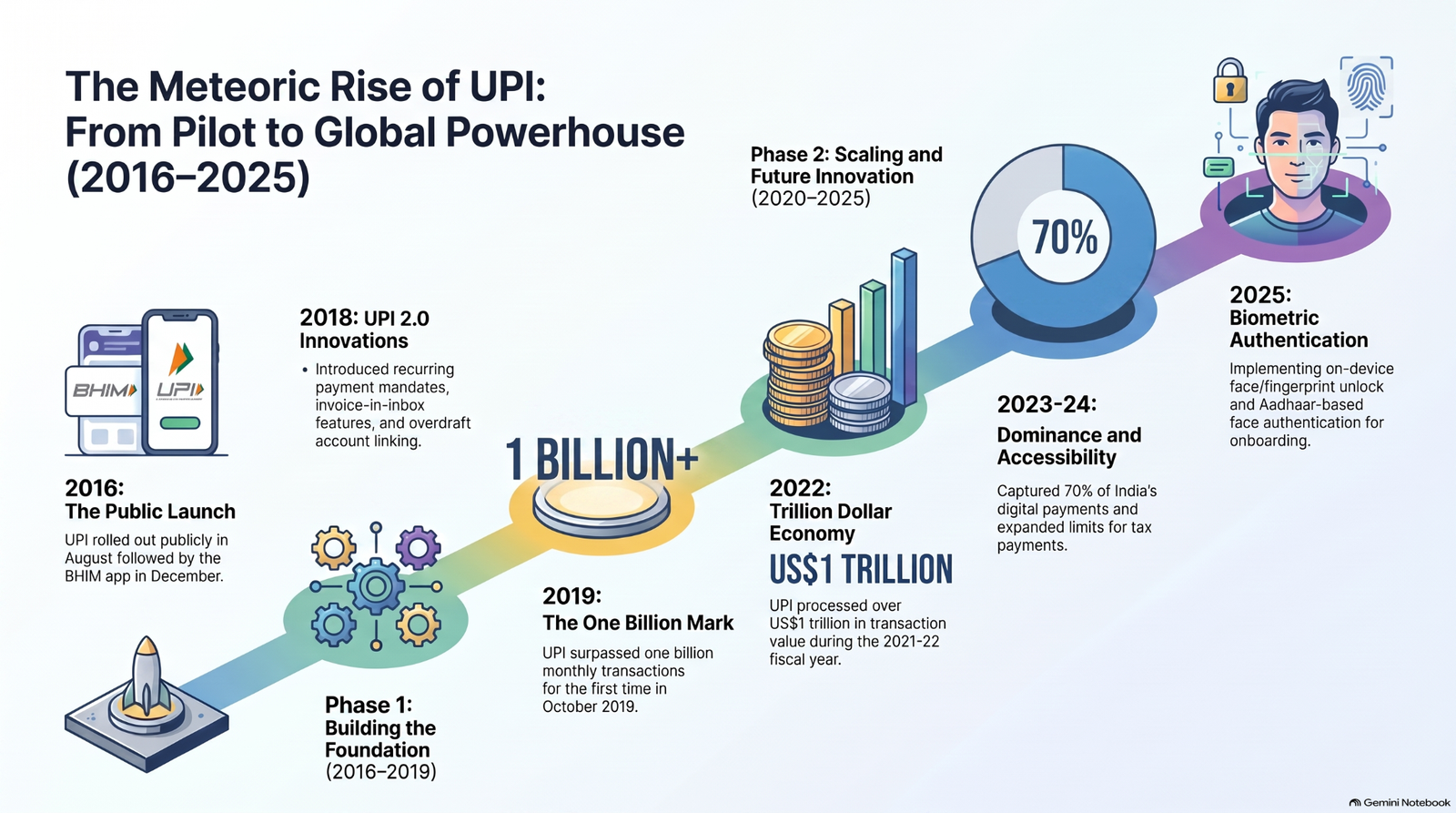
The Unified Payments Interface (UPI) has completed 10 years of operation, emerging as one of the world's largest real-time payment systems and a major pillar of India's Digital Public Infrastructure (DPI). UPI was launched in 2016 by the National Payments Corporation of India (NPCI) under the regulatory oversight of the Reserve Bank of India (RBI).
What is UPI?
Unified Payments Interface (UPI) is an interoperable, real-time digital payment system developed by NPCI.
Key features
-
Enables real-time payments between bank accounts.
-
Allows multiple bank accounts to be accessed through a single mobile application.
-
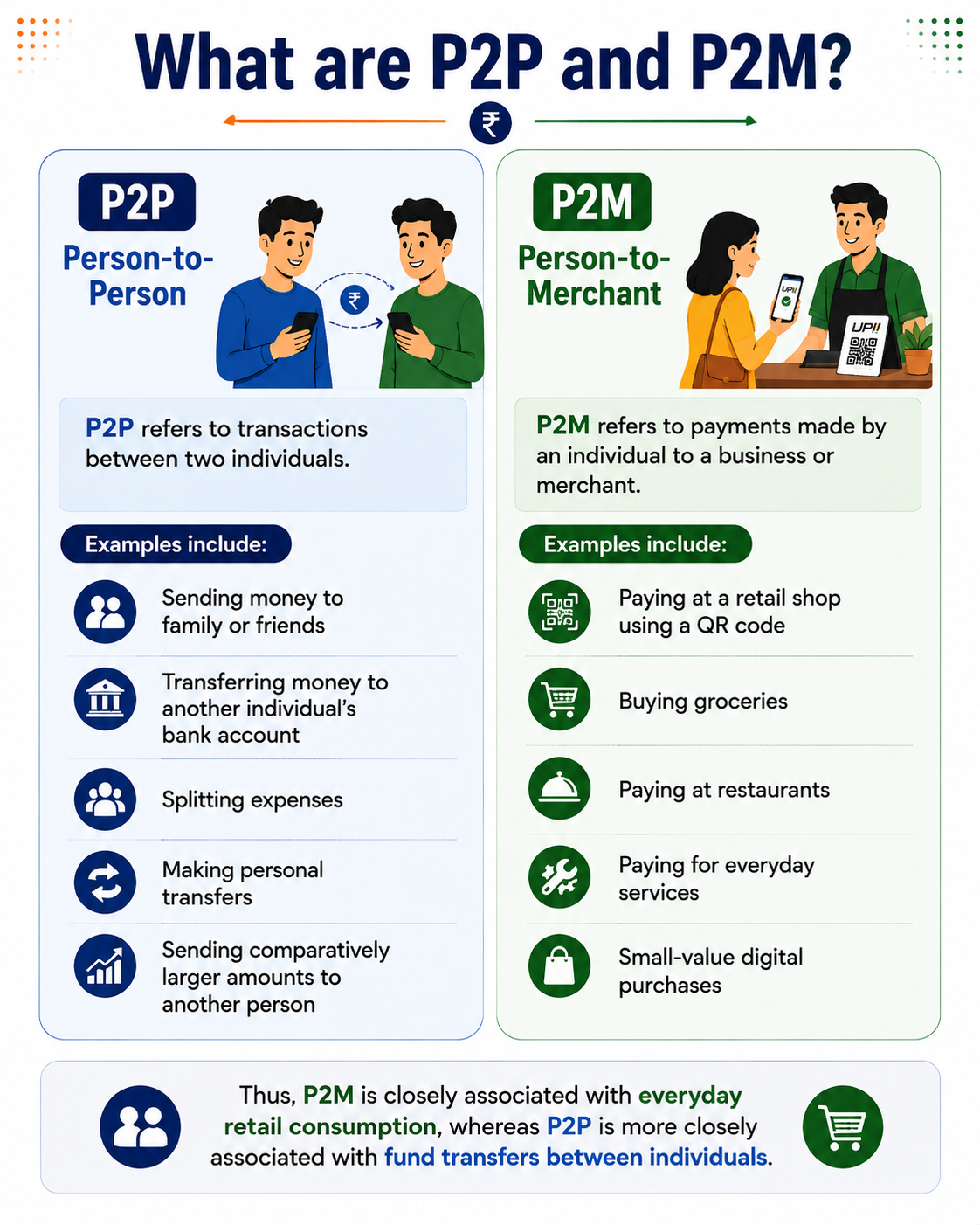
Supports both Person-to-Person (P2P) and Person-to-Merchant (P2M) payments.
-
Integrates fund transfers and merchant payments on a single platform.
-
Enables 24×7 digital payments.
-
Uses two-factor authentication and end-to-end encryption for transaction security.
-
Has become a key component of India's Digital Public Infrastructure (DPI).
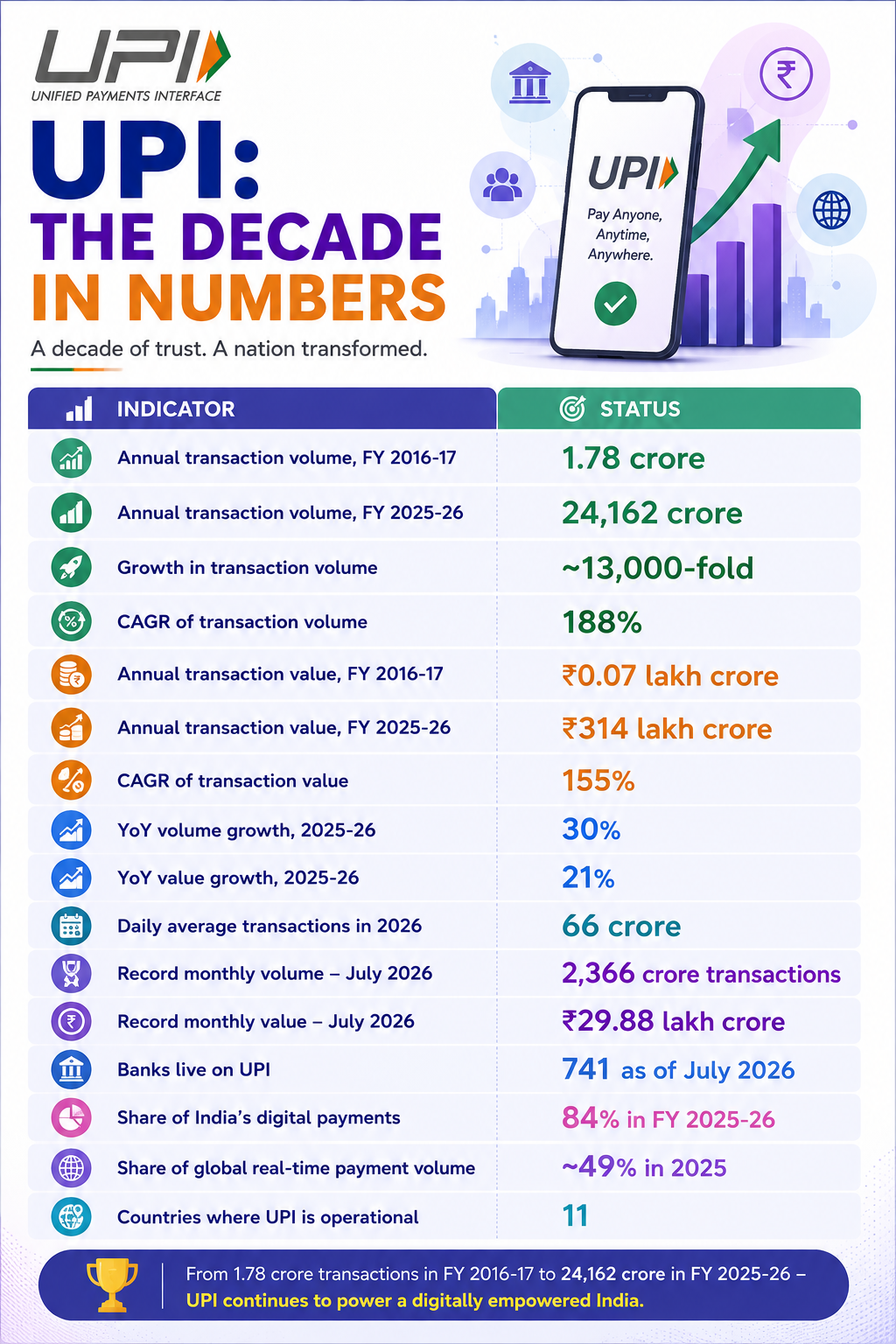
The Ministry of Finance release highlights the dramatic expansion from 1.78 crore annual transactions in FY 2016-17 to 24,162 crore in FY 2025-26, while transaction value increased from ₹0.07 lakh crore to around ₹314 lakh crore.
UPI and Financial Inclusion
UPI has helped expand access to digital financial services by providing an interoperable and relatively simple payment mechanism.
Contribution to inclusion
-
Brings digital payments to a wider geographical area.
-
Enables participation of different categories of banks.
-
Connects consumers, merchants and financial institutions.
-
Reduces dependence on cash for routine transactions.
-
Supports broader economic participation.
The number of banks live on UPI increased from 44 in FY 2016-17 to 703 in FY 2025-26, while the July 2026 figure stood at 741 banks
P2P vs P2M: Understanding UPI Usage
One of the most important insights from the UPI data is that transaction volume and transaction value tell two different stories. While P2M transactions dominate in number, P2P transactions dominate in monetary value.
Ticket Size: Micro-Payments Dominate
P2M transactions
-
86% of transaction volume is below ₹500.
-
Only 4% of transaction value comes from transactions below ₹500.
-
This demonstrates the extensive use of UPI for everyday, low-value merchant payments.
P2P transactions
-
86% of transaction volume is below ₹500.
-
Transactions above ₹2,000 account for 67% of P2P value.
Thus, UPI simultaneously serves as:
-
A mass retail payment system for micro-transactions.
-
A platform for larger person-to-person fund transfers.
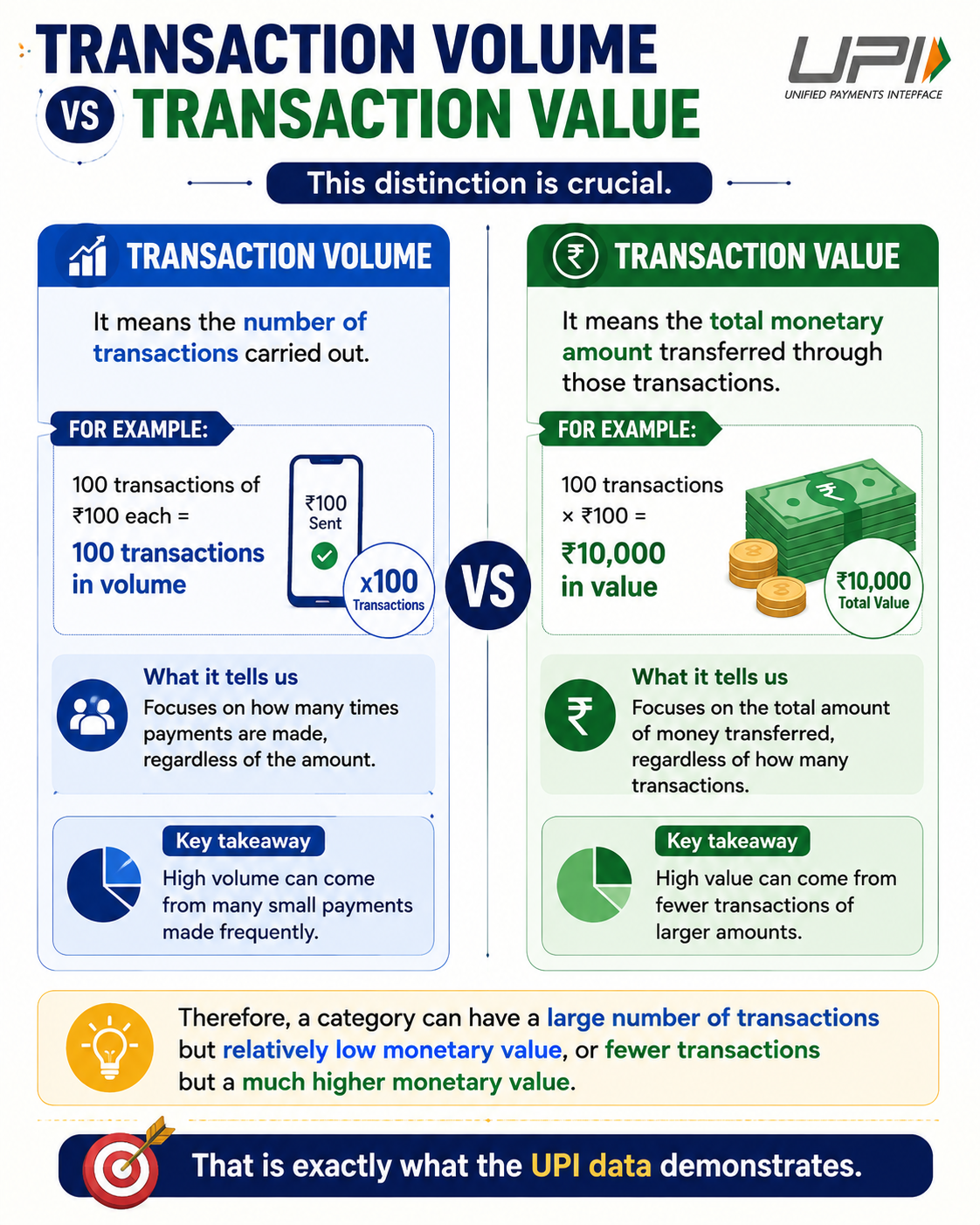
What does this show?
-
Financial inclusion: UPI enables individuals and small merchants to participate in the formal digital payment ecosystem.
-
Digital economy: The high P2M volume reflects the increasing digitisation of everyday commerce.
-
Formalisation: Digital payment trails can potentially support greater transparency and formal economic participation.
-
Fintech innovation: UPI demonstrates how interoperable digital infrastructure can support multiple payment use cases at enormous scale.
-
Digital Public Infrastructure: The P2P–P2M ecosystem illustrates how a common interoperable infrastructure can serve citizens, merchants and financial institutions simultaneously.
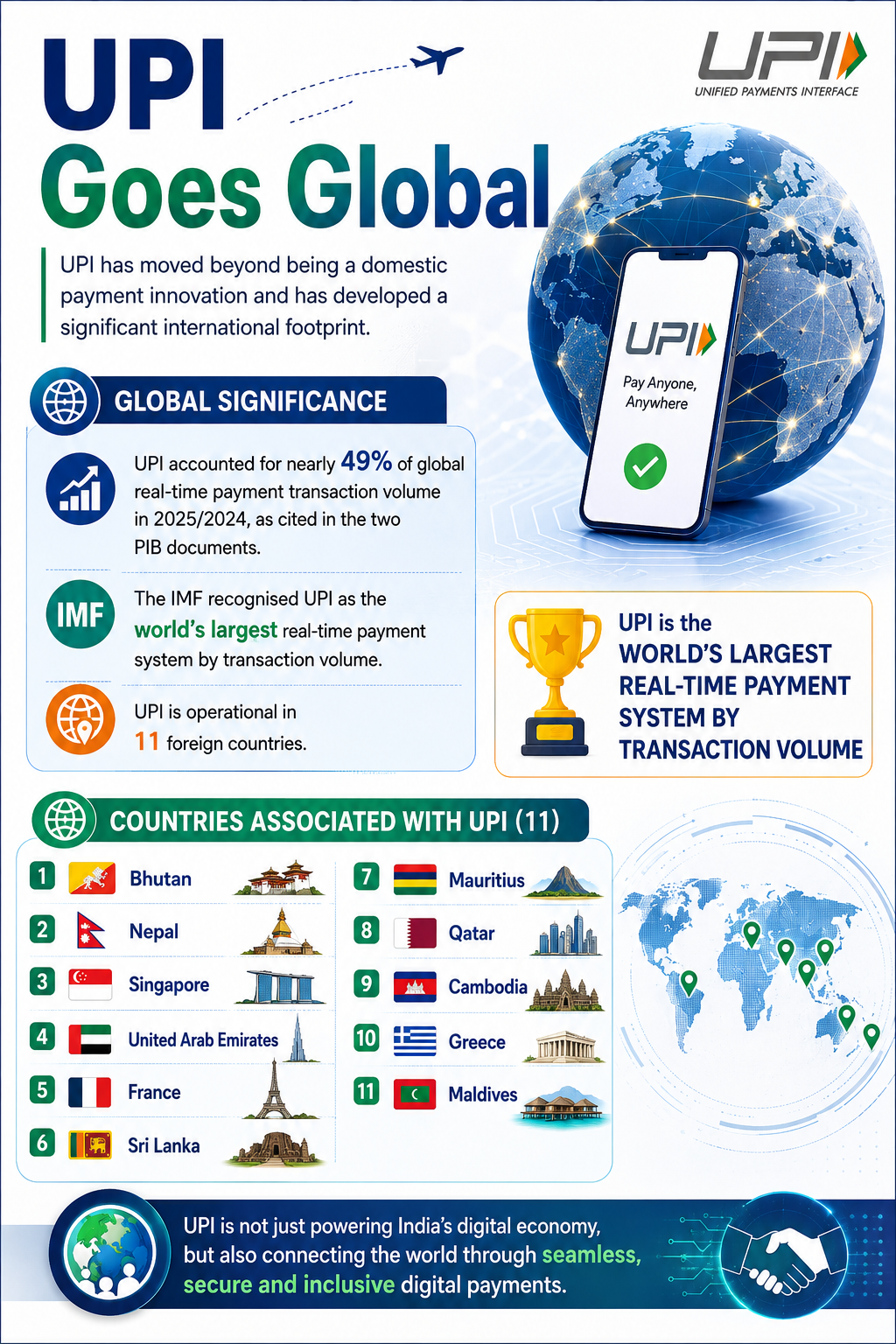
The latest developments include:
-
Cambodia: UPI acceptance launched through partnership with ACLEDA Bank.
-
Greece: UPI went live for cross-border remittances in June 2026.
-
Maldives: Cross-border remittances through the Maldives Instant Payment System, Favara, went live in July 2026.
UPI as Digital Public Infrastructure
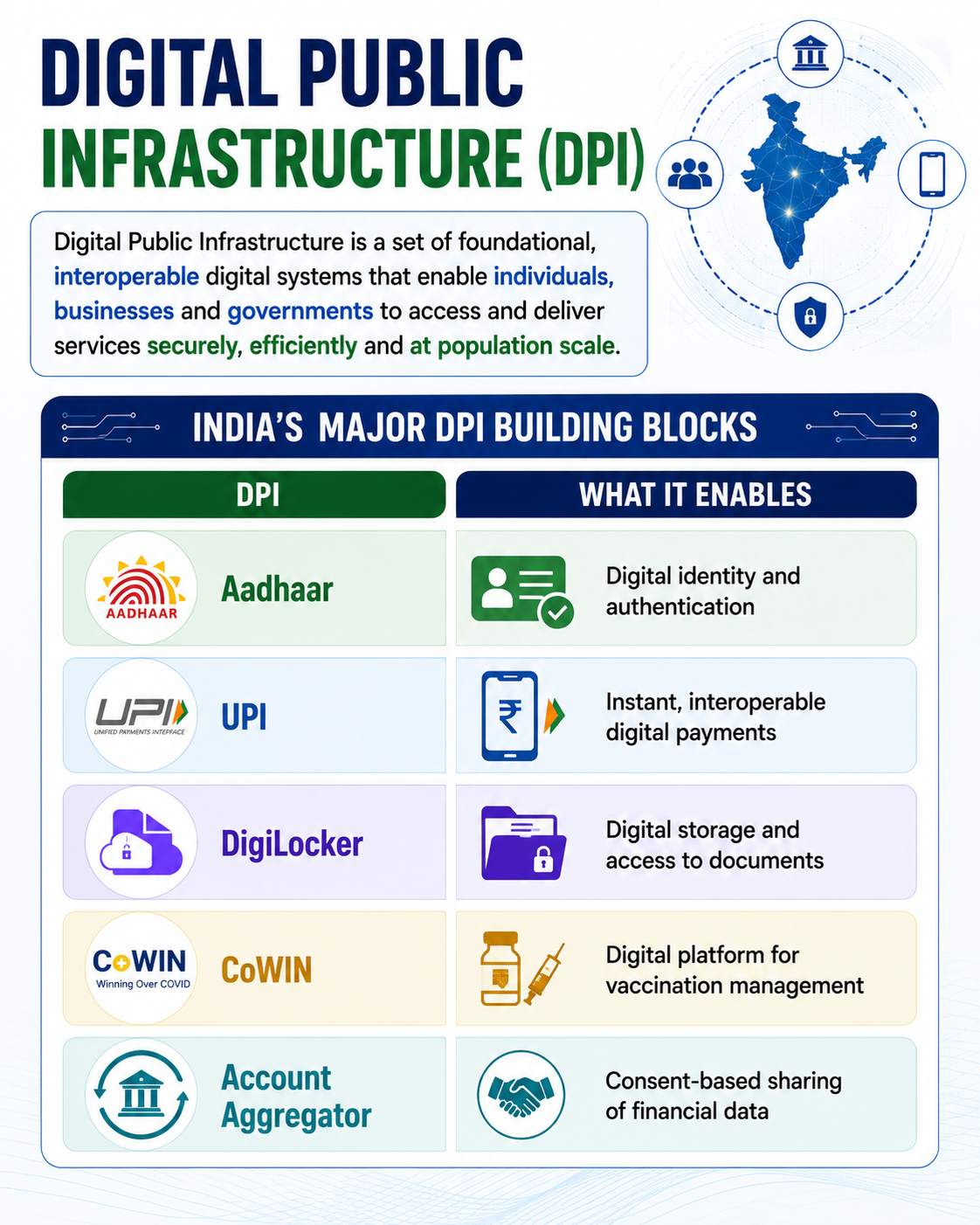
The larger significance of UPI lies beyond payments. It demonstrates the DPI model based on:
Interoperability + Scale + Accessibility + Innovation + Public infrastructure
UPI allows multiple banks and payment applications to operate within an interoperable ecosystem rather than functioning as isolated payment networks.
This has helped create a digital payment ecosystem capable of serving Individuals, Merchants, Banks, Government entities, Cross-border payment users.
Why is UPI Important for India?
1. Economic Significance
UPI enables faster and cheaper digital transactions, supporting the growth of digital commerce. It also contributes to the formalisation of economic activity and strengthens India's digital financial ecosystem.
2. Social Significance
UPI improves access to digital payments and promotes financial inclusion. Its ability to handle low-value transactions reduces dependence on cash, making digital payments accessible to a wider population.
3. Technological Significance
UPI demonstrates the power of interoperable digital infrastructure, integrating banking, mobile technology and digital authentication. It provides a scalable model for Digital Public Infrastructure (DPI).
4. Global Significance
UPI showcases India's ability to build large-scale, inclusive and interoperable digital infrastructure. Its international expansion also demonstrates India's potential to export its digital-payment capabilities globally.
UPI's decade-long journey illustrates India's transition from a fragmented payment ecosystem to a scalable, interoperable and globally recognised digital payments architecture.