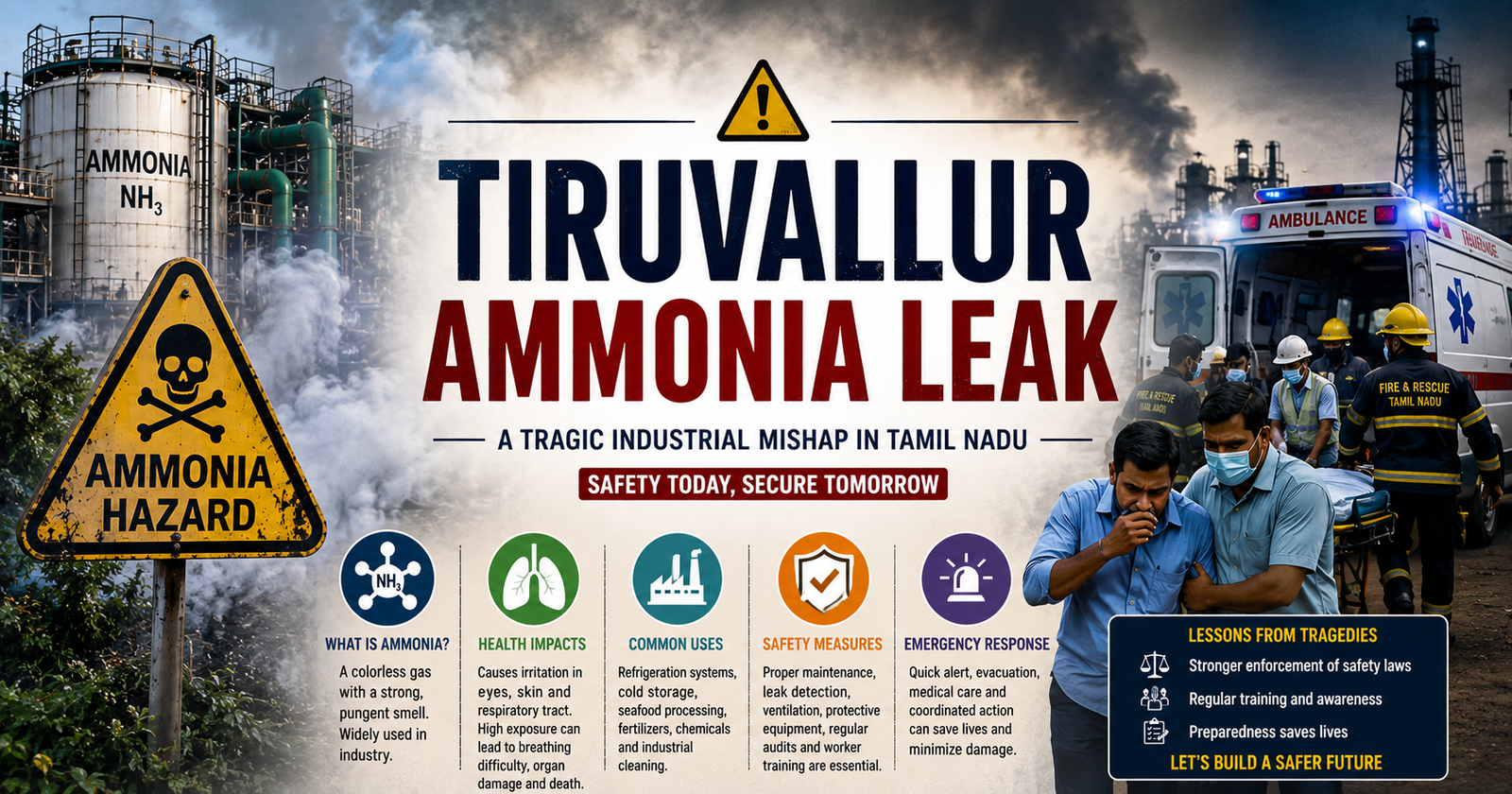
Tiruvallur Ammonia Leak highlights the dangers of hazardous industrial chemicals, raising concerns about worker safety, emergency preparedness, environmental governance, and the need for stronger industrial safety regulations in India.
Syllabus Areas:
GS II - Governance
GS III - Environment and Disaster Management
A tragic ammonia gas leak in Tiruvallur district, Tamil Nadu. The incident occurred at a private seafood/prawn processing unit near Periyapalayam in Tiruvallur district. Ammonia gas leaked from the industrial facility, affecting workers inside the plant.
What is Ammonia?
-
A colorless gas with a sharp, pungent smell.
-
Chemical formula: NH₃.
-
Composed of one nitrogen atom and three hydrogen atoms.
-
Highly soluble in water, forming ammonium hydroxide.
Where is Ammonia Used?
1. Fertilizer Industry: About 80% of the world's ammonia production is used to manufacture fertilizers such as: Urea, Ammonium nitrate, Ammonium sulfate
2. Refrigeration Systems: Used as a refrigerant (R-717) in Cold storage facilities, Ice plants, Food processing units, Seafood and dairy industries
- The Tiruvallur incident occurred in a seafood processing facility where ammonia is commonly used in refrigeration systems.
3. Chemical Industry: Used in the manufacture of Nitric acid, Dyes, Plastics, Synthetic fibers, Pharmaceuticals
4. Explosives: Used in producing ammonium nitrate. Important for mining and civil engineering activities.
5. Cleaning Products: Glass cleaners, Household cleaners, Industrial cleaning agents
Why is Ammonia Dangerous?
1. Highly Irritating Gas
-
Ammonia attacks moist tissues such as Eyes, Nose, Throat, Lungs
-
Even low concentrations can cause Burning sensation, Coughing, Watering of eyes
2. Respiratory Damage
-
High exposure can lead to Severe breathing difficulties, Lung inflammation, Pulmonary edema (fluid accumulation in lungs), Suffocation
3. Corrosive Nature
-
Liquid ammonia can cause Skin burns, Frostbite-like injuries, Eye damage, potentially leading to blindness
4. Toxic at High Concentrations
-
Very high concentrations may cause Loss of consciousness, Respiratory failure, Death
Major Industrial Disasters in India:
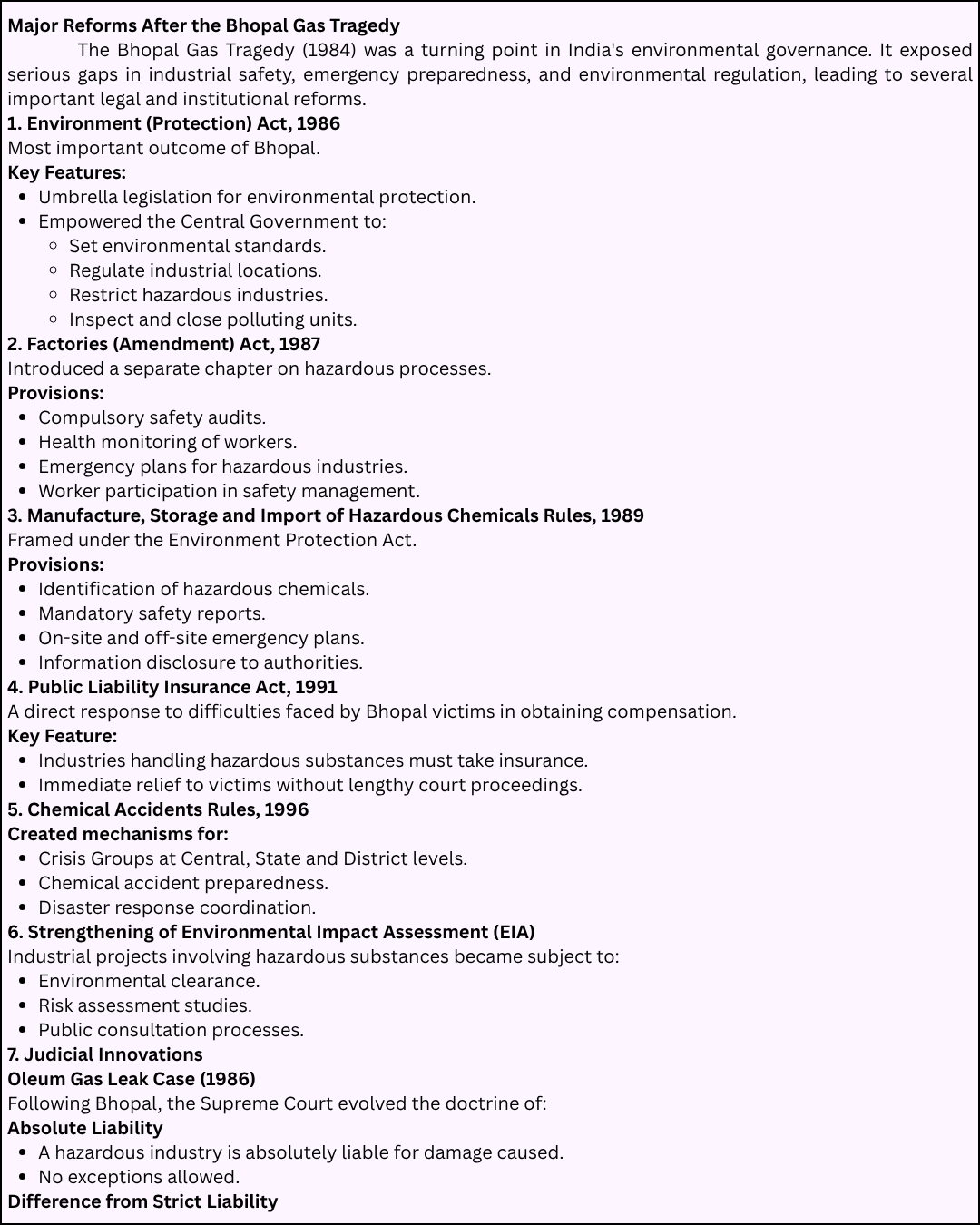
1. Bhopal (1984) – The Most Important
-
Toxic Methyl Isocyanate (MIC) gas leaked from the Union Carbide pesticide plant.
-
Considered the world's worst industrial disaster.
-
Thousands died immediately; long-term deaths and injuries ran into tens of thousands.
-
More than 5 lakh people were exposed to toxic gas.
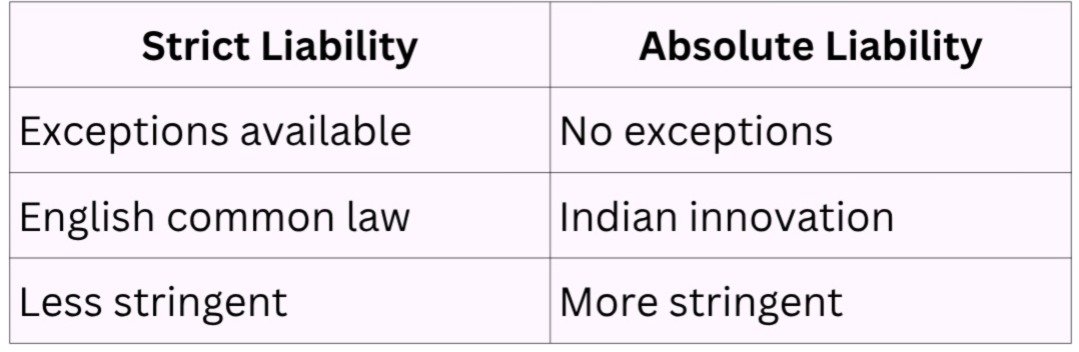
2. Visakhapatnam (2020)
-
Styrene gas leaked from the LG Polymers plant.
-
13 people died and more than 1,000 were affected.
-
The leak occurred when the plant was being restarted after the COVID-19 lockdown.
3. Surat
-
Toxic gas leak from an industrial tanker in Gujarat.
-
Several workers lost their lives.
-
Highlighted risks associated with transportation and handling of hazardous chemicals.
Prelims Questions:
1. Which one of the following is synthesised in the human body that dilates blood vessels and increases blood flow? [UPSC CSE Prelims 2024]
(a) Nitric oxide
(b) Nitrous oxide
(c) Nitrogen dioxide
(d) Nitrogen pentoxide
Correct Answer: (a) Nitric oxide
Explanation: Nitric oxide (NO) is a signaling molecule produced naturally by the endothelial cells lining the blood vessels in the human body. It functions as a potent vasodilator, meaning it relaxes vascular smooth muscle, causing the blood vessels to widen (dilate), which increases blood flow and helps regulate blood pressure.
2. Consider the following statements regarding the No-Fault Liability Principle:
-
Victims need not prove negligence to receive compensation.
-
It is reflected in the Public Liability Insurance Act, 1991.
-
It is identical to the doctrine of Absolute Liability.
Which of the statements given above are correct?
(a) 1 and 2 only
(b) 2 and 3 only
(c) 1 and 3 only
(d) 1, 2 and 3
Answer: (a) 1 and 2 only
Explanation:
No-fault liability principle:
If harm occurs due to a hazardous activity, compensation can be provided even before determining who was responsible.