Explore Ethanol Blending Program, its scientific validation, economic and environmental benefits, challenges, and crucial role in strengthening energy security and reducing imports.
Syllabus Areas:
GS III - Environment, Science and Technology
The Ministry of Petroleum and Natural Gas recently clarified that several misleading claims and old videos regarding Ethanol Blended Petrol (EBP) are being circulated on social media. The Government has reiterated that the Ethanol Blending Programme is scientifically validated, rigorously tested, and continuously monitored by various stakeholders. The clarification comes amid concerns relating to vehicle safety, engine performance, water absorption, and fuel quality.
India is one of the world's largest importers of crude oil, making energy security a critical national priority. To reduce dependence on imported fossil fuels, improve environmental sustainability, and support the agricultural sector, the Government of India launched the Ethanol Blended Petrol (EBP) Programme.
What is Ethanol?
Ethanol (C₂H₅OH) is a renewable biofuel produced from biomass containing sugars and starches. It is a colourless, biodegradable alcohol that can be blended with petrol and used as transportation fuel.
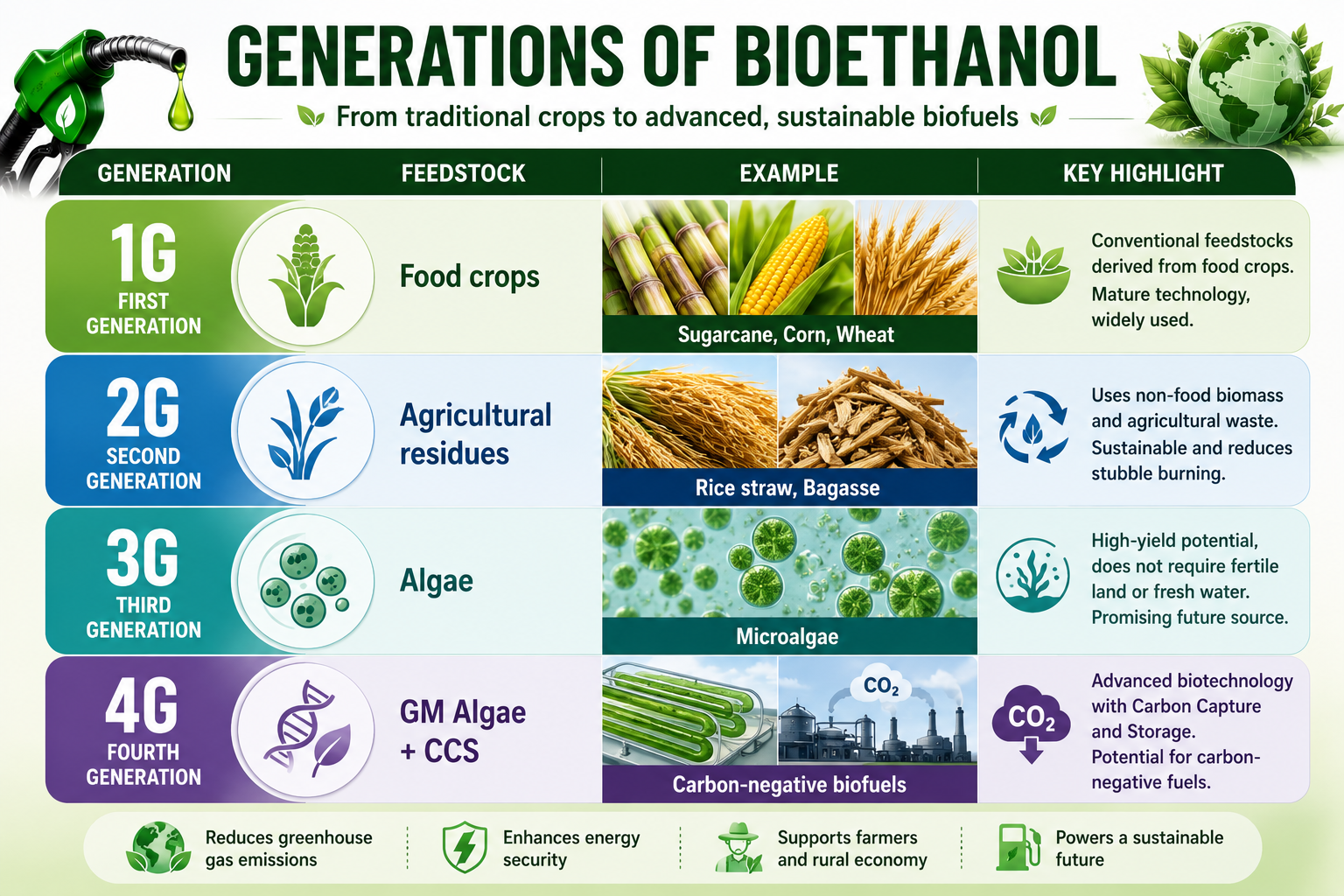
Major Feedstocks Used for Ethanol Production
-
Sugarcane juice, Sugar syrup, B-heavy molasses, C-heavy molasses, Broken rice, Maize, Damaged food grains, Agricultural residues
Unlike fossil fuels, ethanol is renewable and contributes significantly to reducing greenhouse gas emissions.
What is Ethanol Blending?
Ethanol blending is the process of mixing plant-derived ethyl alcohol (bioethanol) with conventional petrol (gasoline) to create a cleaner, more sustainable transportation fuel. It reduces fossil fuel dependence, lowers carbon emissions, and supports the agricultural economy.
Common Ethanol Blends
-
E5 – 5% Ethanol + 95% Petrol
-
E10 – 10% Ethanol + 90% Petrol
-
E20 – 20% Ethanol + 80% Petrol
-
E27 – 27% Ethanol + 73% Petrol
-
E85 – 85% Ethanol + 15% Petrol
India has currently adopted E20 petrol, which contains 20% ethanol and 80% petrol.
Evolution of Ethanol Blending Programme in India
The Ethanol Blended Petrol Programme was launched in 2003 by the Government of India.
Objectives of the Programme
-
Reduce crude oil imports
-
Enhance energy security
-
Lower greenhouse gas emissions
-
Promote cleaner transportation
-
Support farmers and rural economy
-
Encourage domestic biofuel production
The programme has been implemented gradually after extensive technical evaluations and stakeholder consultations.
Government's Clarification on Misleading Claims
1. Ethanol Blending is Scientifically Tested
The Ministry of Petroleum and Natural Gas has clarified that the Ethanol Blending Programme is scientifically validated and continuously monitored.
The programme is implemented in consultation with:
-
Oil Marketing Companies (OMCs)
-
Automobile Manufacturers
-
Fuel Testing Agencies
-
Research Institutions
-
Technical Experts
Higher blending levels have been introduced only after detailed technical assessments.
2. No Evidence of Widespread Engine Failures
Certain social media posts have claimed that E20 fuel causes engine damage and vehicle breakdowns.
The Government has clarified that:
-
No widespread engine failures have been reported due to E20 fuel.
-
Vehicle manufacturers have tested and approved E20-compatible vehicles.
-
The programme has undergone extensive evaluation before implementation.
Thus, claims linking E20 fuel to widespread vehicle failures are unsupported by evidence.
3. Understanding the Hygroscopic Nature of Ethanol
One frequently circulated concern is that ethanol absorbs water.
What is Hygroscopicity?
A hygroscopic substance has the ability to absorb moisture from the surrounding atmosphere.
Ethanol possesses this property. However, this does not mean that ethanol-blended petrol automatically damages vehicles.
Government's Clarification
-
Water contamination is undesirable for all fuels.
-
Modern vehicles are equipped with safeguards that prevent water ingress into fuel systems.
-
Fuel storage and transportation systems follow strict quality standards.
Therefore, the hygroscopic nature of ethanol is a known characteristic that has already been factored into vehicle and fuel system design.
4. Sugarcane Juice is Not Directly Mixed with Petrol
Some viral videos falsely portray sugarcane juice being directly mixed into petrol.
This claim is scientifically incorrect.
5. Myth Regarding Ants and E20 Fuel
A widely circulated video showed ants gathering near a vehicle fuel tank and attributed it to E20 fuel.
Bharat Petroleum Corporation Limited (BPCL) clarified that:
-
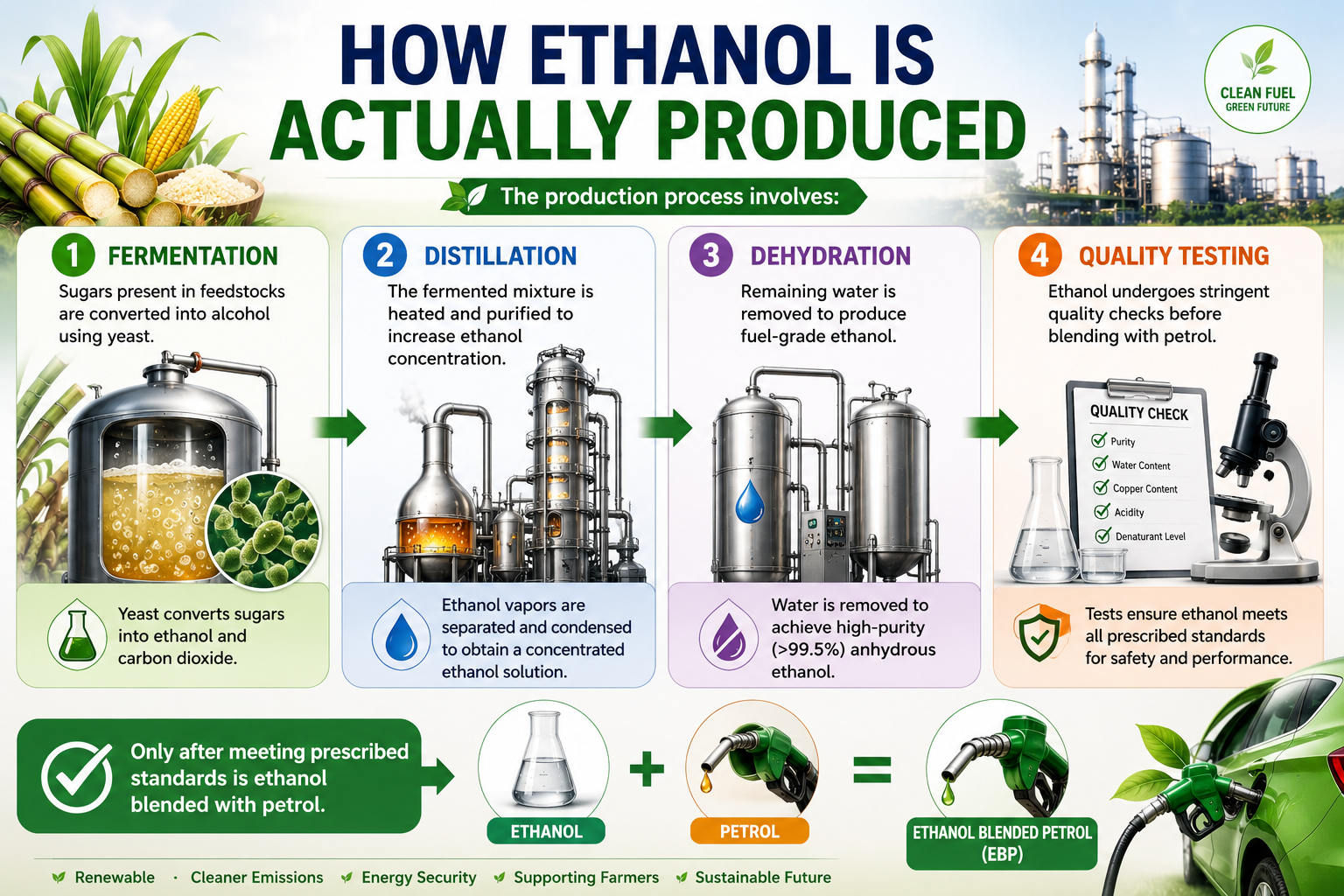
Fuel ethanol contains no residual sugar.
-
Fermentation and distillation eliminate sugars.
-
Fuel ethanol contains denaturants that repel insects.
Therefore, E20 fuel does not attract ants or insects.
The claim lacks scientific basis.
6. Insurance Validity Concerns are Baseless
-
Some reports suggested that using E20 fuel could affect vehicle insurance coverage.
-
After consultations with relevant stakeholders, the Government found these claims to be incorrect.
-
Vehicles designed and approved for E20 fuel remain covered under applicable insurance policies.
Economic Benefits of Ethanol Blending
1. Reduction in Crude Oil Imports
India imports a significant portion of its crude oil requirements from abroad.
By substituting a part of petrol consumption with ethanol:
-
Import dependence decreases.
-
Energy security improves.
-
Foreign exchange expenditure reduces.
According to the Government, the Ethanol Blending Programme has saved India more than ₹1.4 lakh crore in foreign exchange through reduced crude oil imports.
2. Support to Farmers
Ethanol production creates demand for agricultural feedstocks such as Sugarcane, Molasses, Maize, Broken rice
This provides:
-
Additional income opportunities
-
Stable market demand
-
Diversification of agricultural revenue
As a result, ethanol blending contributes to strengthening the rural economy.
Environmental Benefits
Reduction in Carbon Emissions
Ethanol burns cleaner than conventional petrol.
Benefits include:
-
Lower greenhouse gas emissions
-
Reduced carbon monoxide emissions
-
Improved air quality
-
Lower dependence on fossil fuels
This supports India's climate commitments and sustainable development goals.
Ethanol Blending Around the World
Ethanol blending is not unique to India.
Several countries have successfully adopted ethanol-based fuel systems.
Major Countries Using Ethanol Blends
-
United States
-
Brazil
-
Japan
-
Canada
-
Thailand
Brazil is a global leader in ethanol blending and uses E27 as its standard petrol blend.
The successful implementation of ethanol blending in multiple countries demonstrates its technical viability and environmental benefits.
National Policy on Biofuels, 2018
The National Policy on Biofuels, 2018 provides the framework for promoting biofuel production in India.
Key Features
-
Encourages domestic biofuel production
-
Supports advanced biofuels
-
Promotes use of surplus food grains
-
Strengthens energy security
-
Facilitates investments in biofuel infrastructure
Challenges Associated with Ethanol Blending
Despite its advantages, ethanol blending faces several challenges:
-
Feedstock Availability: Large-scale ethanol production requires adequate agricultural feedstocks.
-
Water Consumption: Sugarcane cultivation is water-intensive in several regions.
-
Infrastructure Requirements: Storage, transportation and blending infrastructure need continuous expansion.
-
Vehicle Compatibility: Older vehicles may require modifications for higher ethanol blends.
-
Food versus Fuel Debate: Use of food grains for fuel production can raise concerns regarding food security.
The Way Forward
India's ethanol blending programme represents an important step towards energy independence and sustainable mobility. Moving forward, the focus should be on:
-
Expanding second-generation (2G) ethanol production
-
Promoting agricultural residue-based biofuels
-
Strengthening fuel infrastructure
-
Encouraging E20-compatible vehicles
-
Enhancing public awareness through scientific information
-
Reducing misinformation related to biofuels
A balanced approach that ensures energy security, environmental sustainability and farmer welfare will be crucial for the long-term success of the programme.
The Ethanol Blended Petrol Programme has emerged as a strategic initiative that addresses multiple national priorities, including energy security, environmental protection and rural development. The Government's recent clarification highlights that ethanol blending is backed by scientific evidence, rigorous testing and continuous monitoring. With significant savings in foreign exchange, reduced carbon emissions and enhanced support to farmers, ethanol blending is expected to play a central role in India's transition towards a cleaner, greener and more self-reliant energy future.