
Explore rapidly expanding data-centre ecosystem of India, its digital infrastructure, policy support, energy and water challenges, sustainability measures, cybersecurity concerns, and role in building a resilient digital economy.
Syllabus Areas:
GS III - Science and Technology
India’s rapid digital transformation is driving growing demand for secure computing, data storage and high-speed connectivity. Data centres have emerged as critical digital infrastructure, supporting e-Governance, digital payments, cloud computing, AI and the wider digital economy.
Data Centre:
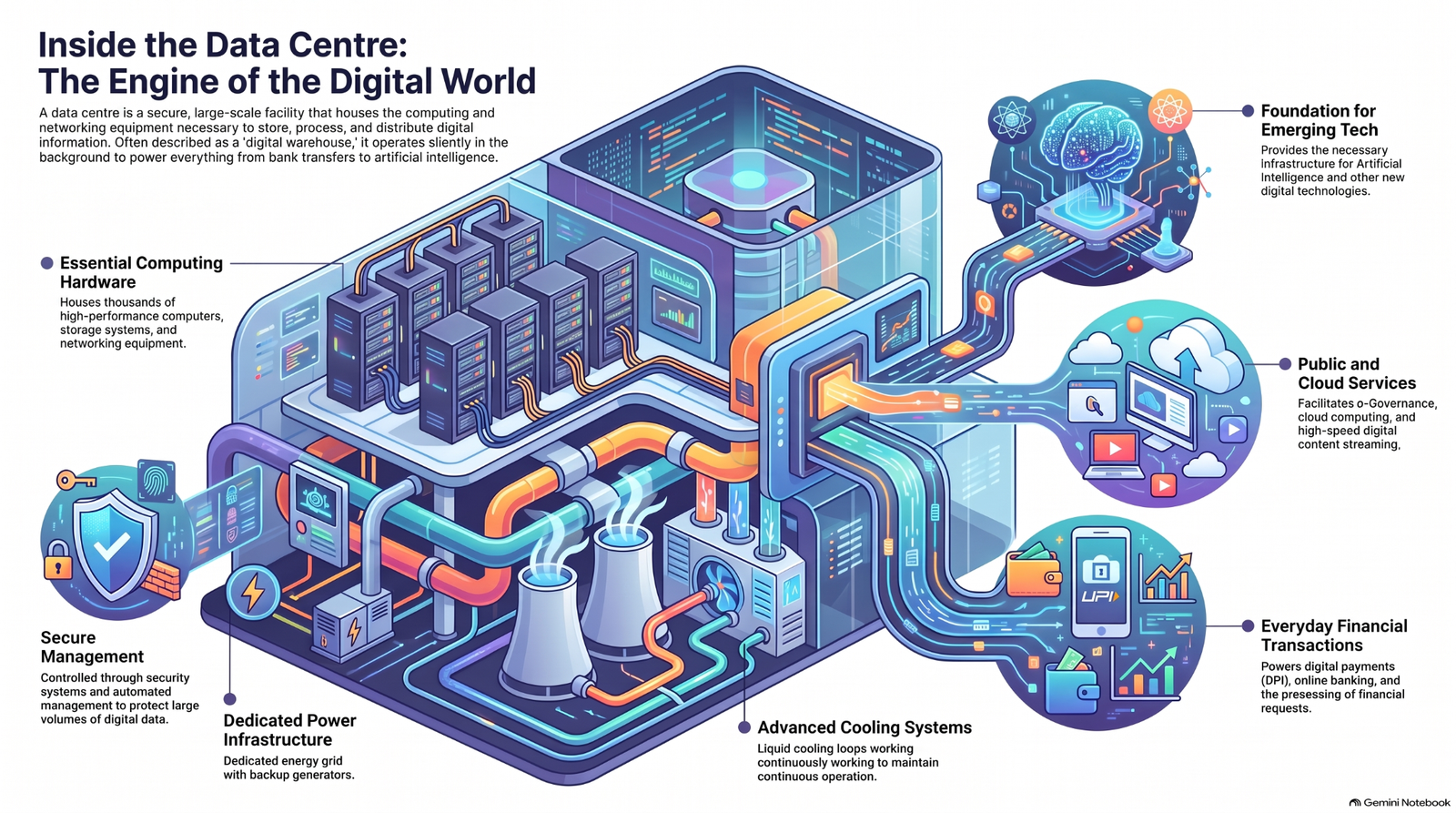
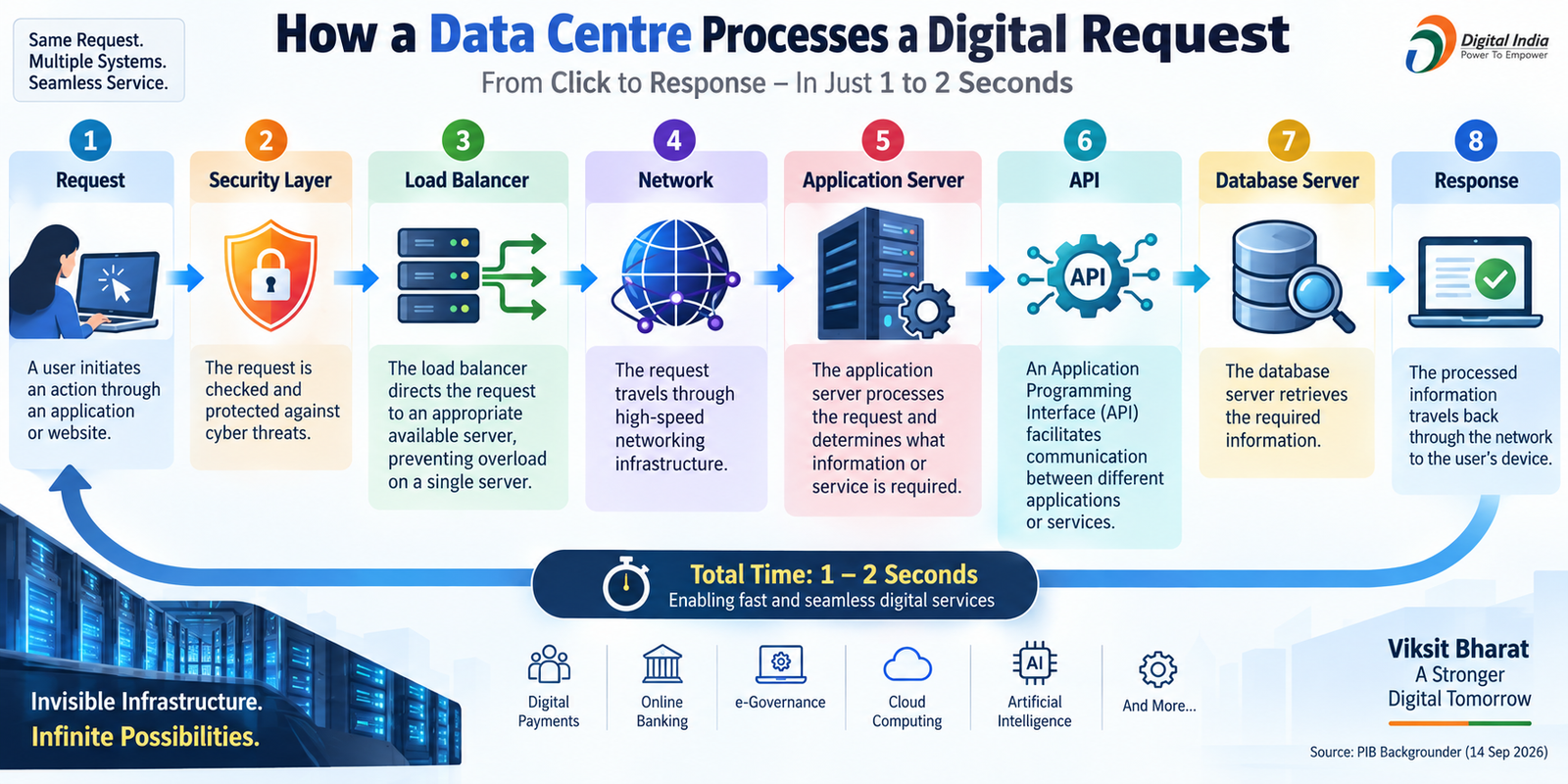
Think of a data centre as a massive digital warehouse full of thousands of super-fast computers. Just like a physical warehouse holds goods, a data centre holds digital information. Whenever you make a UPI payment, check your bank account, or stream a video, these computers work continuously in the background to fulfill your request.
Key significance
Digital Governance → Supports continuous delivery of e-Governance services.
Digital Economy → Provides infrastructure for online businesses and financial services.
AI Growth → Provides computing and storage infrastructure required by AI applications.
Cloud Infrastructure → Enables scalable digital services.
Data Sovereignty → Strengthens India's ability to maintain and process data within domestic infrastructure.
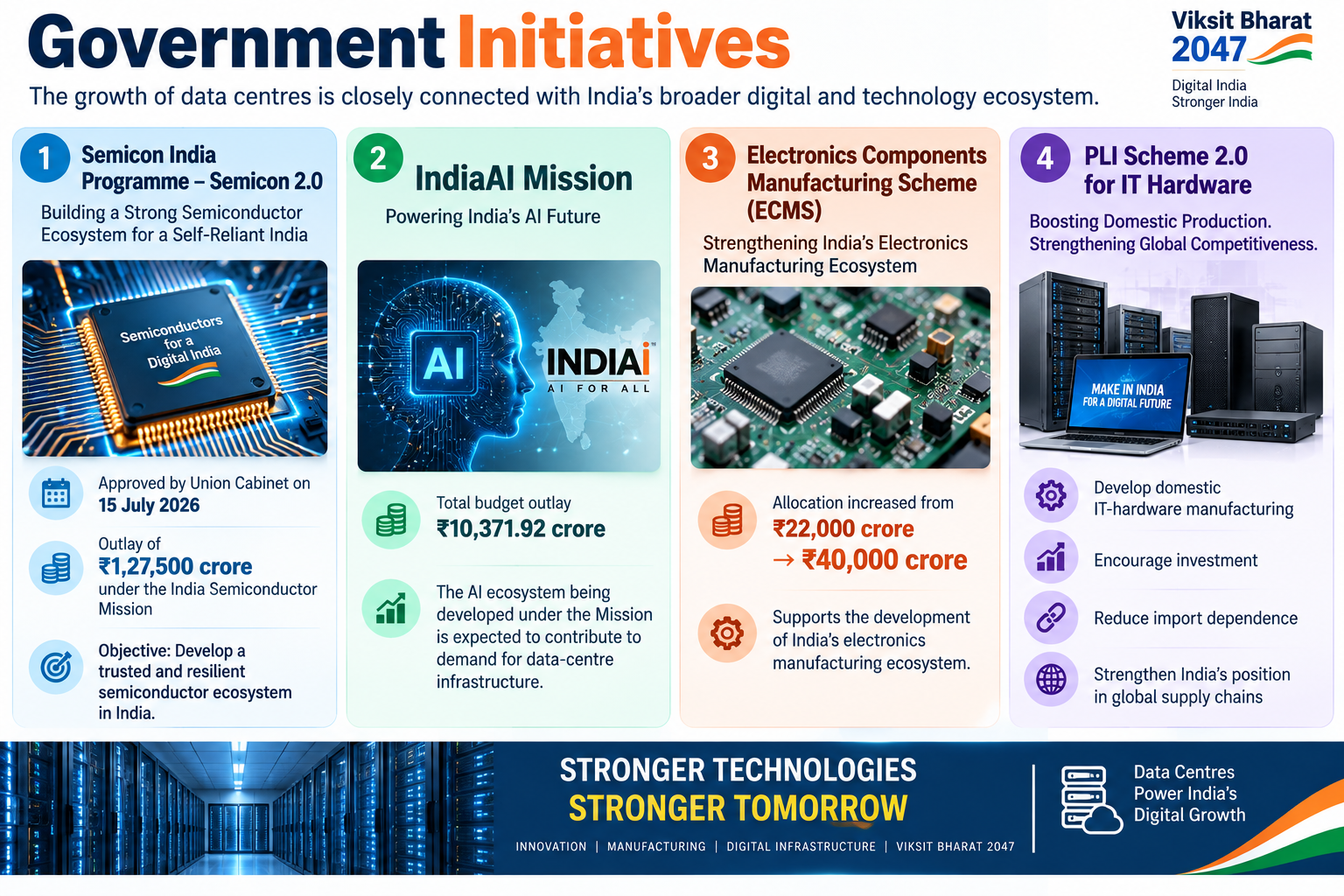
Technological Self-Reliance → Creates demand for domestic computing, semiconductor and IT hardware capabilities.
Tax Incentive for Foreign Cloud Service Providers
The Union Budget 2026–27 introduced a tax holiday for eligible foreign cloud service providers until 2047.
The incentive applies to eligible global operations using India-based data-centre infrastructure and covers notified foreign companies for Tax Years 2026–27 to 2046–47.
Significance
This policy is intended to strengthen India's investment environment for:
-
Data centres
-
Cloud infrastructure
-
Digital services
Tax holiday:
A tax holiday is a government-provided period during which eligible businesses receive complete or partial exemption from certain taxes, encouraging investment, expansion, employment and economic activity in targeted sectors.
SHANTI Act and Nuclear Power
The Sustainable Harnessing and Advancement of Nuclear Energy for Transforming India (SHANTI) Act strengthens the clean-power ecosystem.
The framework supports reliable nuclear power for emerging sectors, including:
-
Artificial Intelligence
-
Data centres
It also enables the future deployment of:
-
Micro Nuclear Reactors
Also Read the Background: Nuclear Fission and Fusion
BIS Standards for Data-Centre Efficiency
The Bureau of Indian Standards (BIS) has developed standards relating to data-centre efficiency.
Its technical committee LITD 31 covers:
-
Cloud Computing
-
Information Technology
-
Data Centres
BIS has published standards relating to:
Power Usage Effectiveness – PUE
Measures how efficiently electricity is used by a data centre.
Carbon Usage Effectiveness – CUE
Measures carbon emissions associated with electricity consumption.
Cooling Efficiency Ratio – CER
Measures the efficiency of cooling systems in removing heat relative to the electricity consumed.
Water Usage Effectiveness – WUE
Measures the efficiency of water use in data-centre operations.
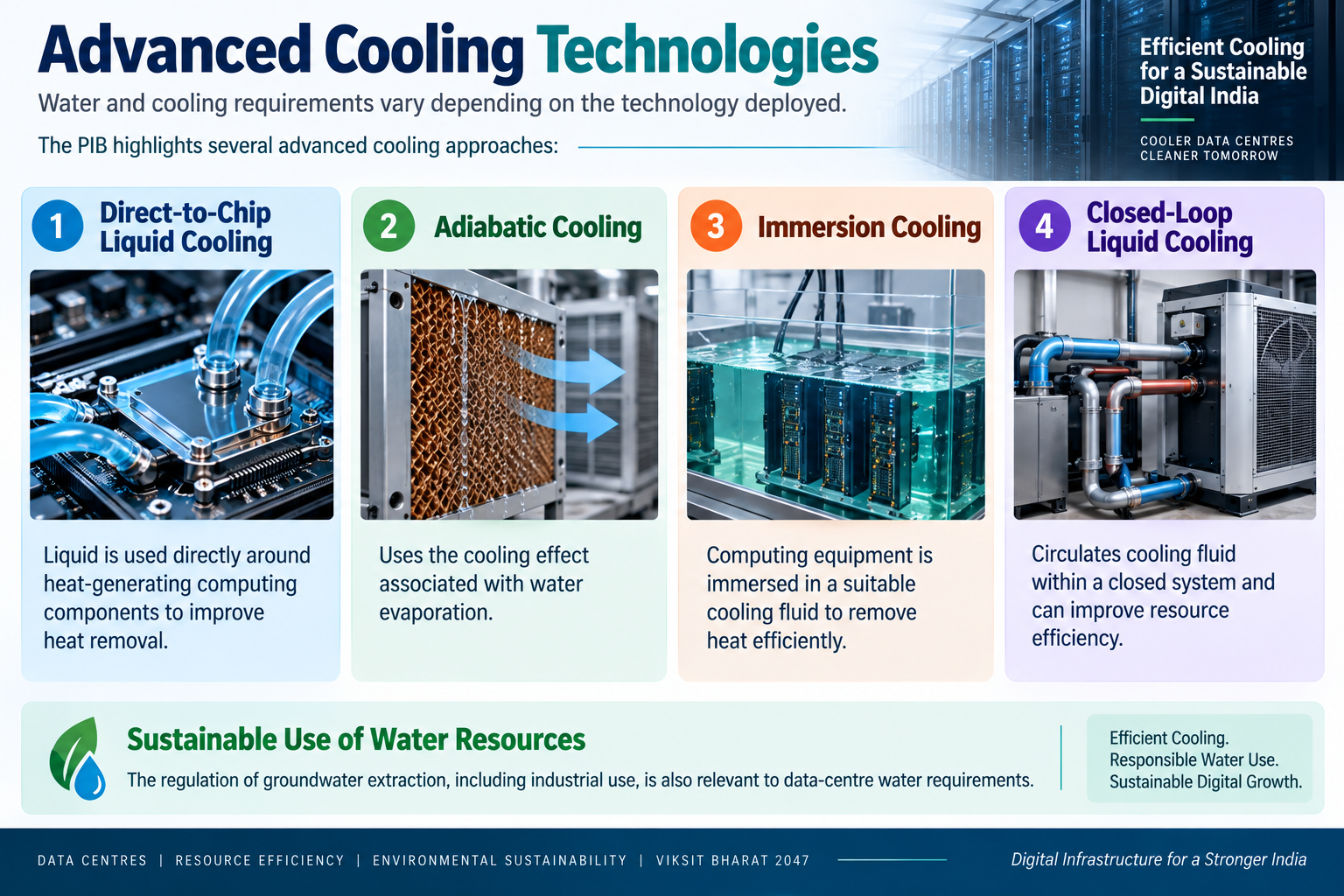
Major Challenges
-
High Energy Demand: Rising computing needs increase electricity consumption.
-
Water Stress: Cooling systems can require significant water resources.
-
Carbon Footprint: Fossil-fuel-based electricity can increase emissions.
-
Cybersecurity: Critical data infrastructure needs strong protection.
-
Resource Efficiency: Improve power, cooling, water and carbon efficiency.
-
Technology Dependence: Strengthen domestic capabilities in semiconductors, computing and IT hardware.
-
Data Governance: Ensure data security, privacy, accountability and responsible technology use.
Way Forward
-
Promote renewable energy and energy-efficient data centres.
-
Adopt water-efficient cooling technologies.
-
Strengthen cybersecurity and critical infrastructure protection.
-
Build domestic semiconductor and IT-hardware capabilities.
-
Ensure secure and responsible data governance.
-
Develop technology standards balancing innovation, sustainability and public interest.
-
Strengthen digital sovereignty through domestic technological capabilities.
India’s data-centre growth can strengthen digital sovereignty and economic competitiveness, provided expansion balances innovation with cybersecurity, energy efficiency, sustainability, responsible governance and public interest.