Explore how the CCPA’s action reinforces voluntary consent, transparent restaurant billing and consumer rights. Understand the service-charge debate through business interests, staff welfare and regulatory accountability.
UPSC relevance:
|
GS II – Governance |
Consumer rights, regulatory institutions and implementation of the Consumer Protection Act, 2019. |
|
GS III – Economy |
Fair market practices, transparent pricing and regulation of the service sector. |
|
GS IV – Ethics |
Informed consent, business accountability and ethical treatment of consumers. |
The Central Consumer Protection Authority (CCPA) imposed a ₹1 lakh penalty on New Delhi’s Shangri-La Eros for automatically adding a 10% service charge to restaurant bills. It held that describing the charge as “optional” did not establish voluntary consumer consent.
The case highlights the importance of transparent billing, informed consent and protection against unfair trade practices in the hospitality sector.
Understanding Service Charges
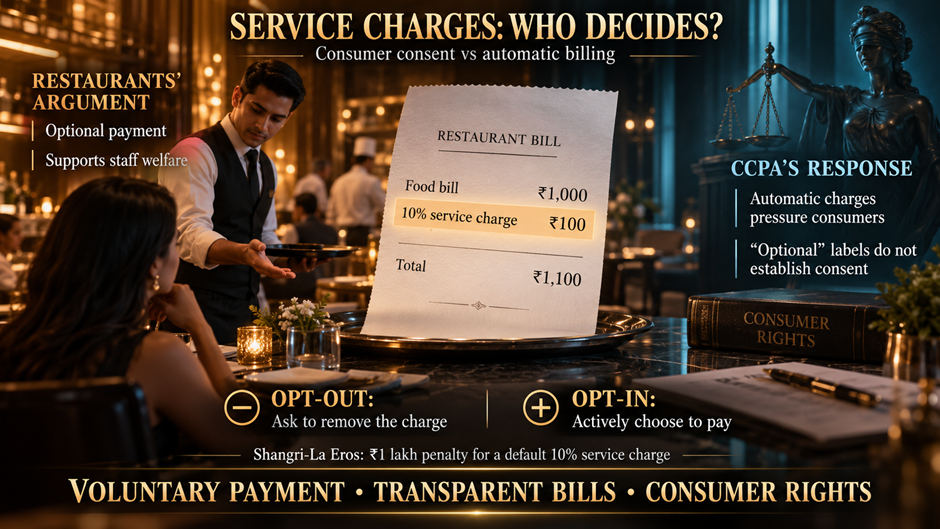
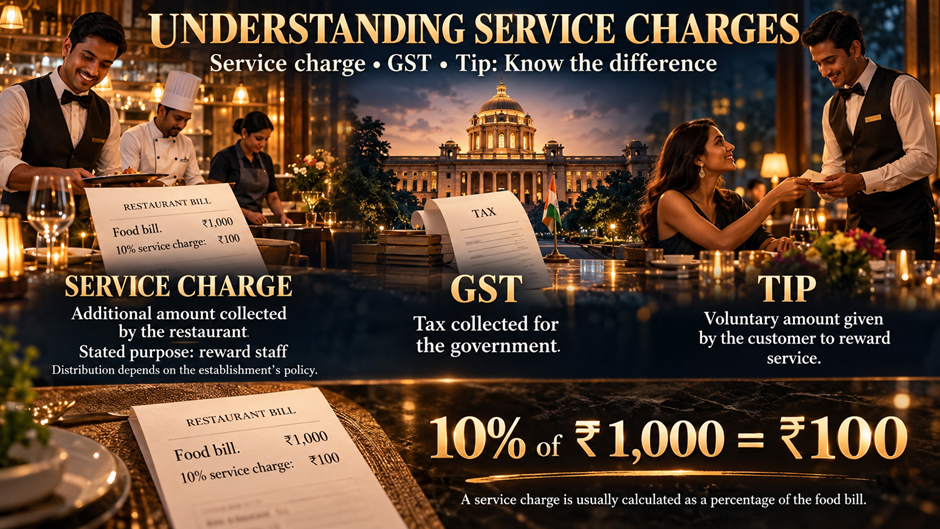
A service charge is an additional amount collected by a restaurant for serving customers, usually calculated as a percentage of the food bill.
Its stated purpose is to reward staff, including waiters, cooks and support workers. However, the actual distribution depends on the establishment’s policy.
For example, a 10% service charge on a ₹1,000 food bill adds ₹100.
Service Charge, GST and Tip: Key Differences
|
Component |
Purpose and nature |
|
Service charge |
An additional amount collected by the establishment, with the stated purpose of supporting or rewarding staff. |
|
GST |
A tax collected for the government. |
|
Tip |
An amount voluntarily given by a customer to reward service. |
The CCPA and Its Role
The Central Consumer Protection Authority (CCPA) is a statutory body established under the Consumer Protection Act, 2019. Its functions include:
-
Safeguarding consumer rights.
-
Preventing unfair trade practices.
-
Addressing false or misleading advertisements.
Its action on service charges centres on whether consumers freely choose to pay an additional amount.

Rules Governing Restaurant Service Charges
The CCPA guidelines issued on 4 July 2022 prescribe that hotels and restaurants:
-
Cannot automatically add service charges to bills.
-
Cannot collect service charges under another name.
-
Must clearly communicate that payment is voluntary and discretionary.
-
Cannot deny entry or services to customers who refuse to pay.
-
Cannot add service charges to the food bill and levy GST on the combined amount.
The Delhi High Court upheld the guidelines on 28 March 2025, affirming the CCPA’s authority to enforce them.
The Shangri-La Eros Case
The Hotel’s Practice and Defence
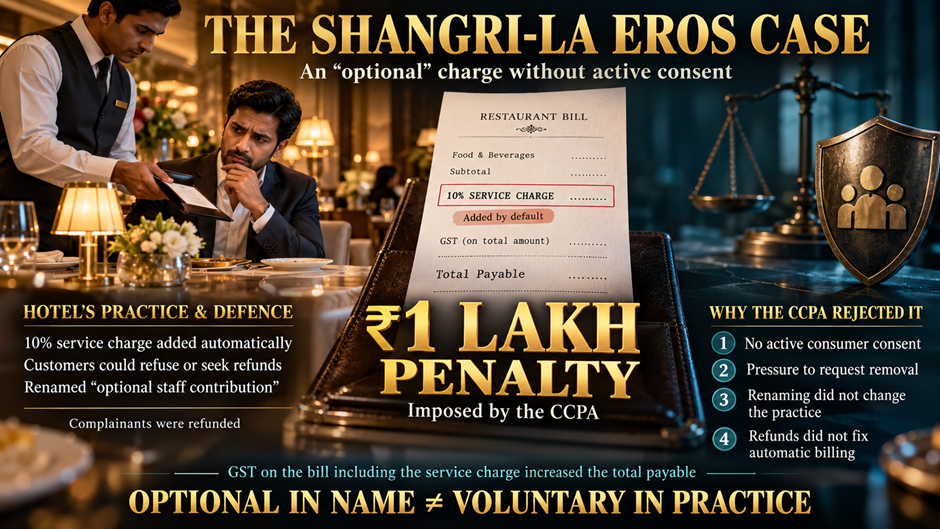
The hotel automatically added a 10% service charge to restaurant bills while describing it as optional. It argued that customers could refuse payment or request a refund.
The hotel also renamed the charge as an “optional staff contribution” and refunded the complainants.
The CCPA’s Findings
The CCPA rejected the hotel’s argument and imposed a ₹1 lakh penalty. Its reasoning focused on four concerns:
-
Absence of active consent: A charge included by default does not reflect a customer’s voluntary decision.
-
Pressure on consumers: Customers must object or negotiate to avoid paying.
-
Renaming without changing the practice: Calling the charge an optional contribution does not address its automatic inclusion.
-
Limited effect of refunds: Refunding individual complainants does not resolve the underlying billing practice.
The regulator also found that calculating GST on the amount inclusive of the service charge increased the total payable.
Opt-In and Opt-Out: Why the Distinction Matters
|
System |
Meaning |
Application to restaurant billing |
|
Opt-in |
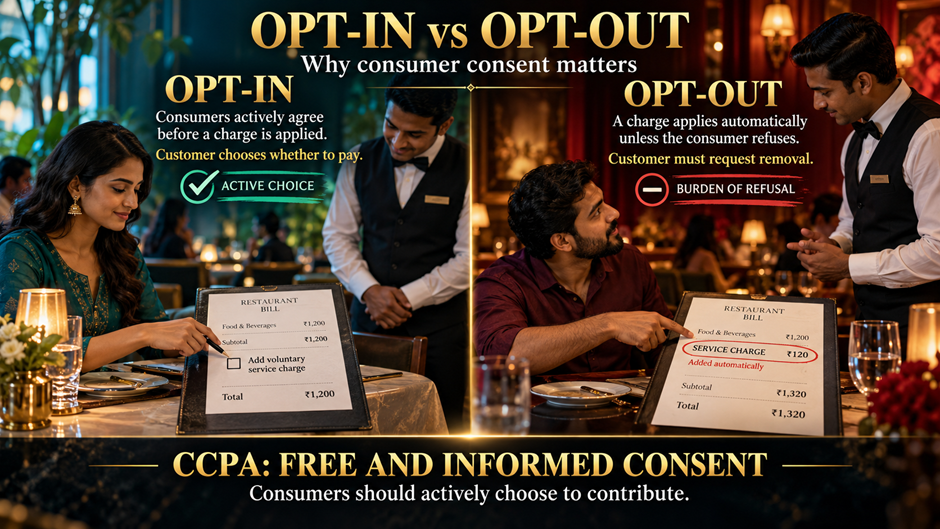
Consumers actively agree before a charge or service is applied. |
Customers choose whether to pay a service charge. |
|
Opt-out |
A charge or service applies automatically unless consumers refuse. |
Customers must request removal of an automatically added charge. |
The CCPA’s reasoning emphasises free and informed consent. Consumers should actively choose to contribute rather than bear the burden of refusing a default charge.
A Wider Enforcement Effort
The Shangri-La Eros case forms part of broader action against establishments automatically levying service charges.
-
Range of establishments: Enforcement has covered cafés, restaurant chains and luxury hotels.
-
Suo motu action: The CCPA initiated action against 27 restaurants in January and 41 in July, following complaints to the National Consumer Helpline (NCH).
-
Regulatory objective: These interventions reinforce voluntary payment, transparent billing and accountability.
Different Perspectives on Service Charges
|
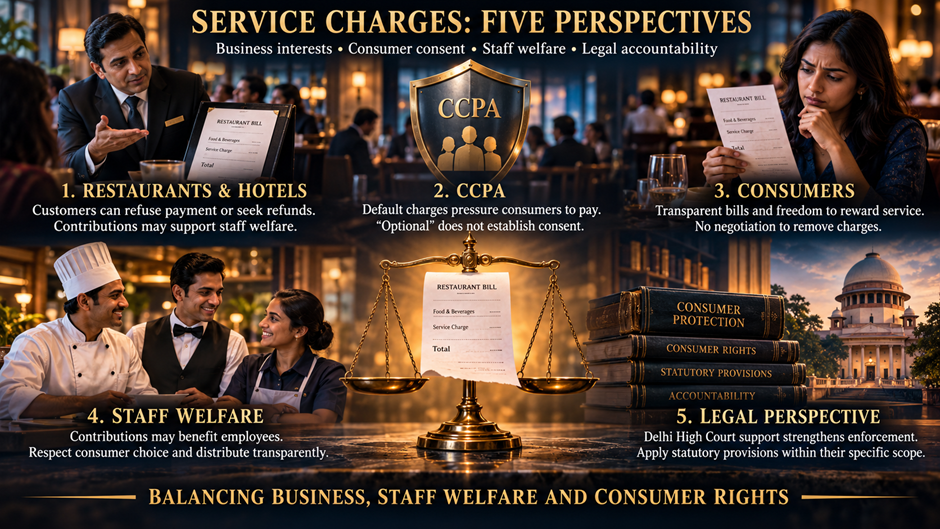
Perspective |
Main argument or concern |
|
Restaurants and hotels |
Charges are discretionary because customers can refuse payment or seek refunds. Contributions may support staff welfare. |
|
CCPA |
Automatically adding charges pressures consumers to pay. Describing them as optional does not establish consent. |
|
Consumers |
Bills should be transparent, and customers should freely decide whether to reward service without negotiating removal of charges. |
|
Staff welfare |
Contributions may benefit employees, but arrangements should respect consumer choice and ensure transparent distribution. |
|
Legal perspective |
The Delhi High Court’s support for the guidelines strengthens regulatory enforcement. Relevant statutory provisions must be understood within their specific scope. |
Section 21(7): A Legal Distinction
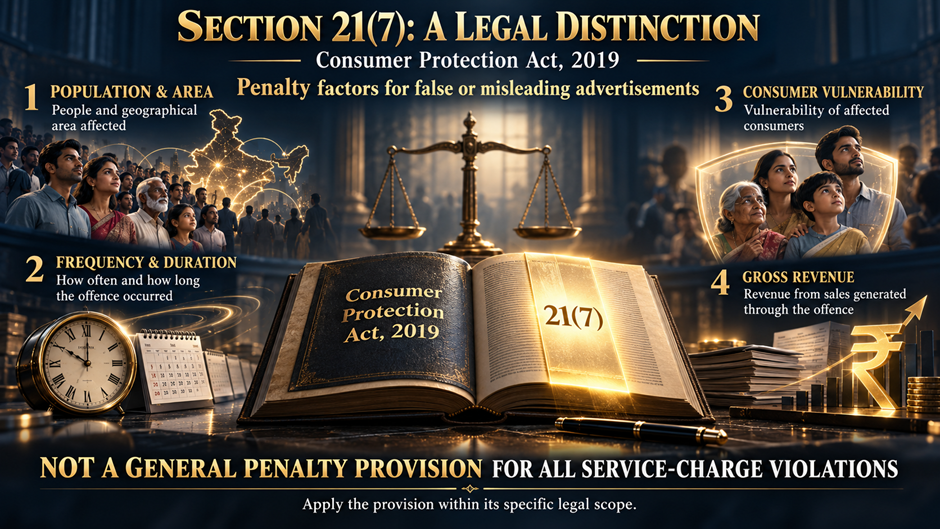
Section 21(7) of the Consumer Protection Act, 2019 specifies factors to consider when determining penalties under the section dealing with false or misleading advertisements:
-
The population and area affected.
-
The frequency and duration of the offence.
-
The vulnerability of affected consumers.
-
The gross revenue generated through the offence.
It should therefore not be presented as a general penalty provision for all service-charge violations.
Implications for Restaurants and Consumers
For Restaurants
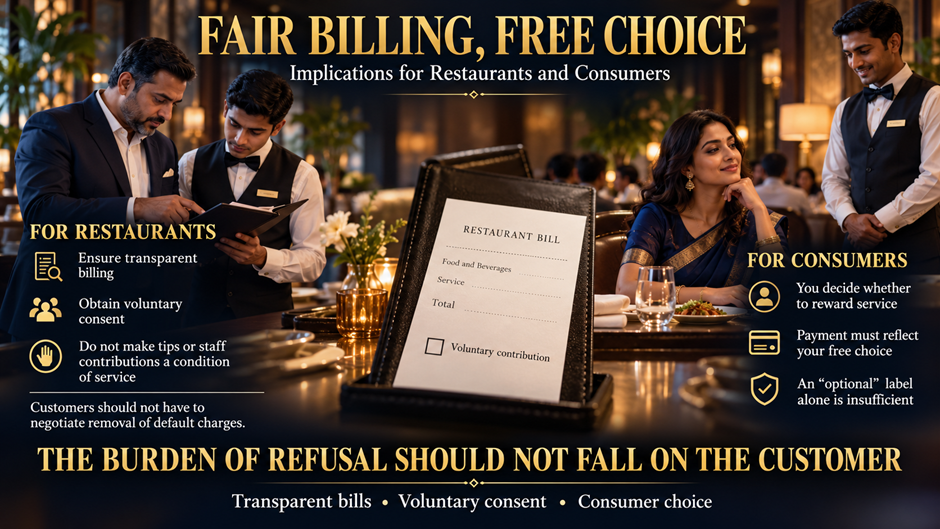
Billing practices must ensure transparency and voluntary consent. Establishments cannot make payment of a tip or staff contribution a condition for providing service or require customers to negotiate removal of automatically added charges.
For Consumers
Consumers retain the right to decide whether to reward service. Describing a charge as discretionary is insufficient when the billing process places the burden of refusal on the customer.