The article examines whether a dedicated Constitutional Court and regional Courts of Appeal could ease the Supreme Court’s caseload and bring justice closer to litigants.
UPSC relevance:
|
General Studies Paper II |
Indian Constitution and Judiciary · Structure and functioning of the Supreme Court, judicial pendency, access to justice, regional Benches, and separation of constitutional and appellate work |
In 2016, a three-judge Supreme Court Bench referred 11 questions to a larger Bench on whether the volume of ordinary appeals was crowding out the Court’s constitutional work. The reference remains unheard a decade later. The proposed reform would assign constitutional cases to a dedicated Constitutional Court and ordinary appeals to regional Courts of Appeal.
By the end of 2025, the Supreme Court had a record 92,318 pending cases, nearly 10,000 more than a year earlier. The proposed reform would create an 11-judge Constitutional Court in Delhi for constitutional cases and substantial questions of law, and four or five regional Courts of Appeal for ordinary appeals. The division would give constitutional cases a dedicated forum.
Why cases remain pending in the Supreme Court
A pending case is one that has been filed and is awaiting final disposal. The backlog grows when the Court receives more cases than it resolves. In 2025, the Supreme Court received 75,410 new cases and disposed of 65,615, a gap of 9,795 cases.
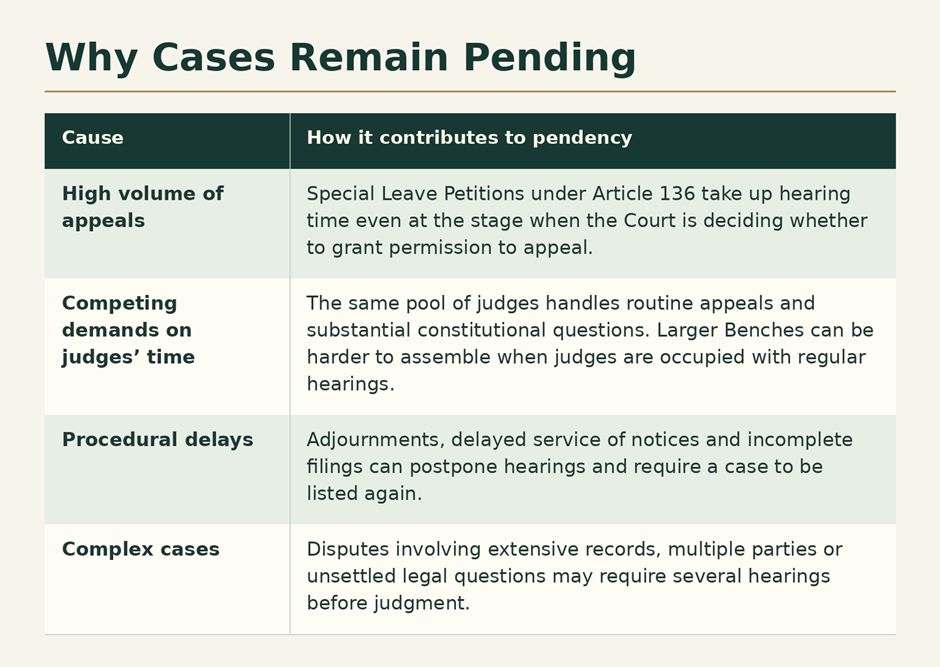
Pendency stood at about 60,000 cases in 2019, when the Court’s strength increased to 34 judges, and has since risen to nearly 93,000. Parliament raised the sanctioned strength to 38 in 2026. The growth in pendency despite an increase in judicial strength supports the case for assigning constitutional matters and ordinary appeals to separate forums.
Constitutional cases, ordinary appeals and special leave
The Supreme Court interprets the Constitution and hears appeals. The reform debate concerns two types of cases and one route for bringing a matter before the Court.
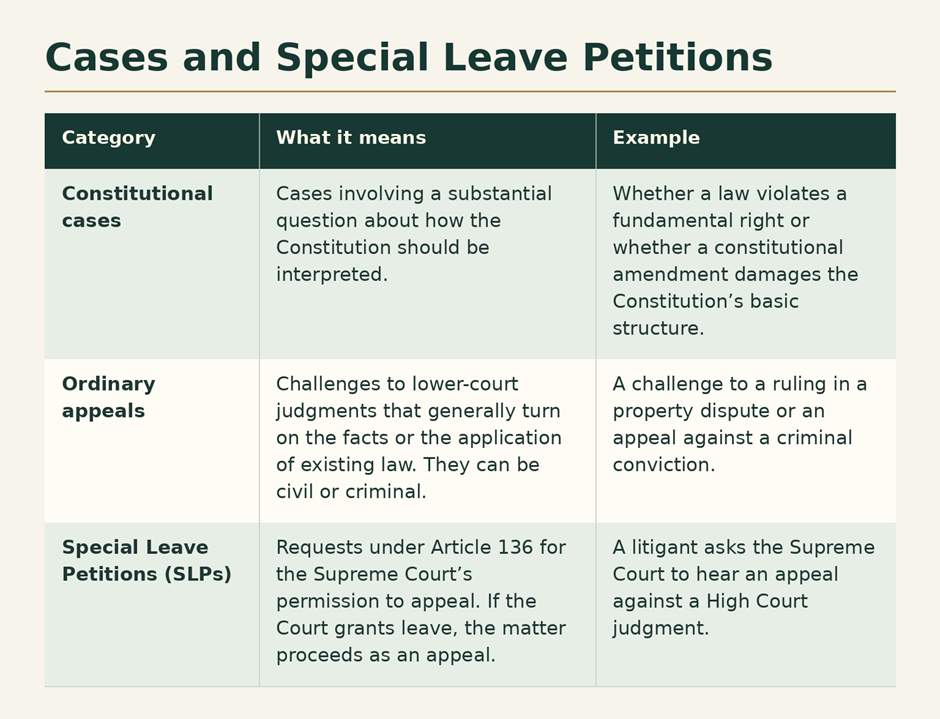
The Supreme Court’s Constitution Benches decided an average of 134 cases a year in the first half of the 1960s, compared with fewer than 10 a year over the past decade. By one estimate, SLPs accounted for 84.6% of the Court’s admission docket in 2011. In Bihar Legal Support Society (1986), a Constitution Bench reaffirmed that the Supreme Court was intended to exercise this appellate power in exceptional cases.
Constitutional provisions behind the reform debate
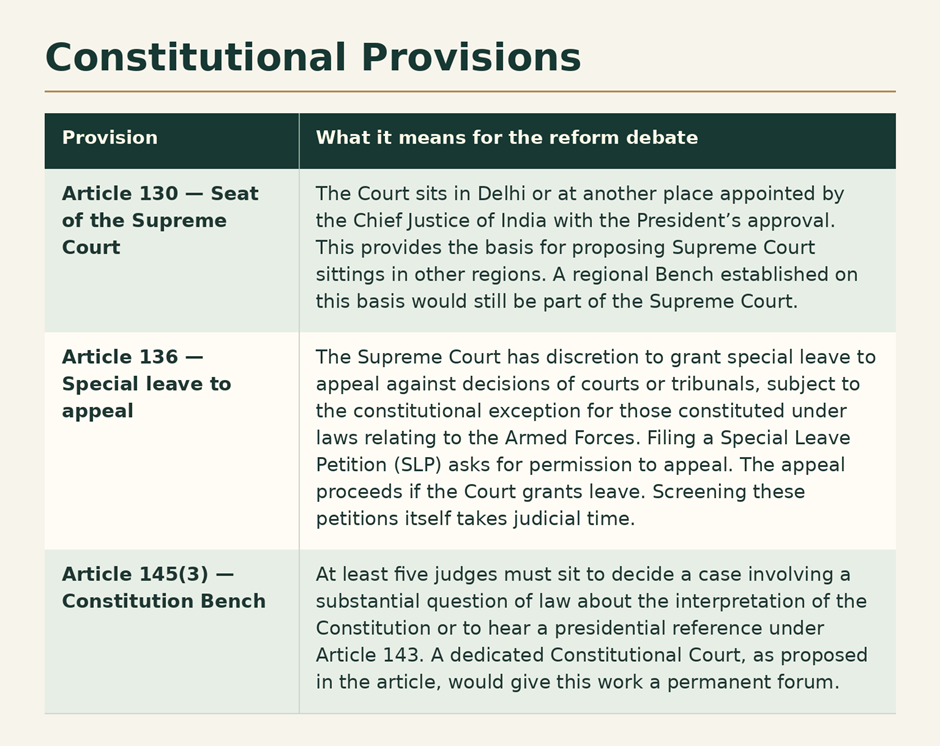
Regional Benches and the proposed two-tier structure
The 229th Law Commission Report (2009) proposed a Constitution Bench in Delhi and four regional Cassation Benches to hear appeals. It argued that Article 130 may allow regional Benches of the Supreme Court to be set up without a constitutional amendment. In 2023, a Parliamentary Standing Committee recommended regional Benches, a proposal the Union Law Ministry subsequently accepted.
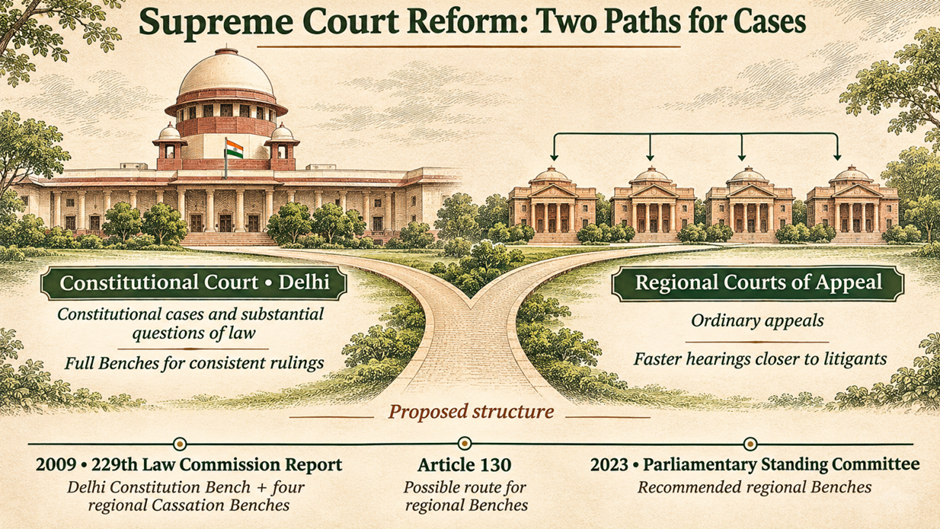
Under the proposed two-tier structure, a dedicated Constitutional Court would hear constitutional cases and substantial questions of law. It could hear selected cases in full Benches and deliver consistent rulings on constitutional questions. Regional Courts of Appeal could specialise in ordinary appeals, resolve them faster and bring the final appellate forum for these cases closer to litigants.
Judicial unity and the finality of appeals
Successive Chief Justices have argued that separating constitutional cases from ordinary appeals could weaken the Supreme Court’s authority as the single final court. Litigants may treat regional Courts of Appeal as intermediate forums and seek further review in Delhi, weakening the finality of regional rulings.
The heavy caseload has already pushed the Supreme Court to work through multiple small Benches, whose rulings can conflict. Only a handful of Constitution Benches sit each year to decide substantial constitutional questions. The Supreme Court, which evolved the basic structure doctrine, now hears relatively few cases through Constitution Benches amid a heavy appellate caseload. A dedicated Constitutional Court could give constitutional questions sustained attention, while regional Courts of Appeal could resolve ordinary appeals faster and closer to litigants.
International models and case screening
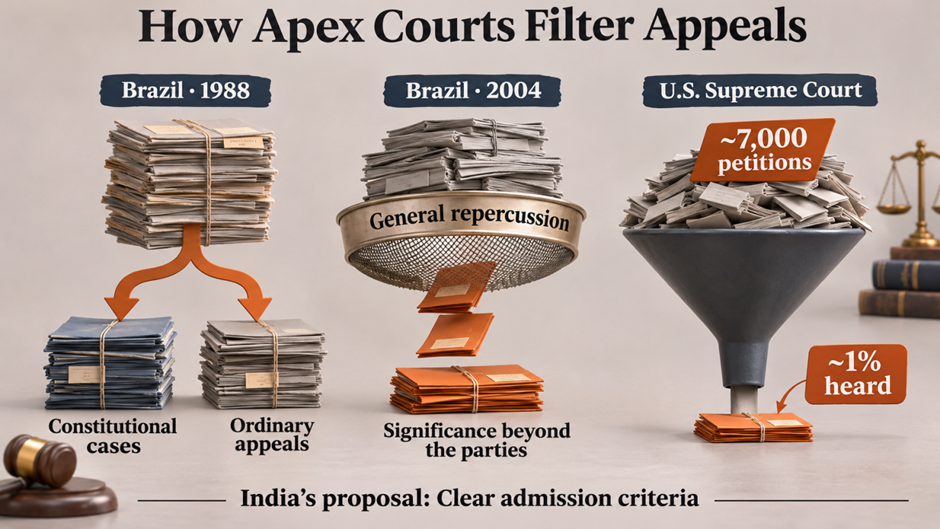
Brazil’s 1988 Constitution created a separate Superior Tribunal of Justice to take over ordinary federal appeals from the Supreme Federal Tribunal, allowing the latter to focus on constitutional matters. This offers a precedent for India’s proposed division of constitutional and appellate work.
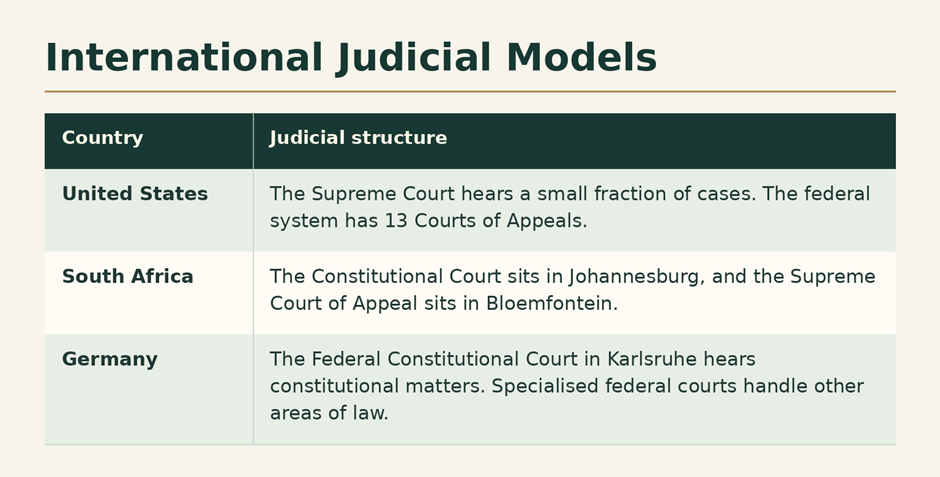
Brazil’s apex court backlog declined after a 2004 reform introduced a “general repercussion” filter for constitutional appeals. The filter requires the issue to have significance beyond the parties to the dispute. The U.S. Supreme Court similarly uses discretionary review, taking up roughly 1% of the 7,000 petitions it receives annually. India’s proposed Constitutional Court would need clear admission criteria to prevent a fresh backlog.