From linguistic statehood movements to protests over farm laws and citizenship, the article traces how the demands driving public mobilisation in India changed from 1947 to 2026.
UPSC relevance:
|
GS Paper I |
Post-Independence India and Indian Society · State reorganisation, regionalism, caste and reservation, communalism, and the role of women, students and farmers in social movements |
|
GS Paper II |
Constitution and Governance · Right to peaceful assembly, reasonable restrictions, public order, government responses to protests, and democratic accountability |
|
GS Paper III |
Internal Security · Agrarian grievances and the origins of Left-Wing Extremism, with the Naxalbari uprising as a case study |
Protests are a form of democratic participation. In India, they reflect economic change, shifts in political power, policy failures and the concerns of excluded groups. Government decisions and social change shape public demands, while protests can influence laws, institutions and even state boundaries. Eight decades of protests reveal how public demands have evolved and which grievances persist. The CJP and SIR agitations are recent examples.
What Brought People to the Streets?
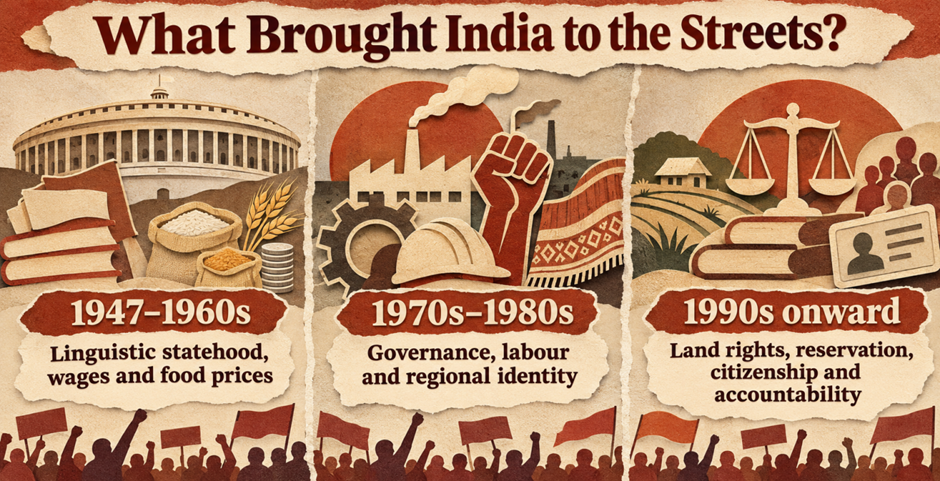
The chart shows the percentage share of protests by cause in each decade. It tracks how the issues that brought people onto the streets changed over time, including demands for linguistic states, better wages, land rights, reservation, accountable government and justice.
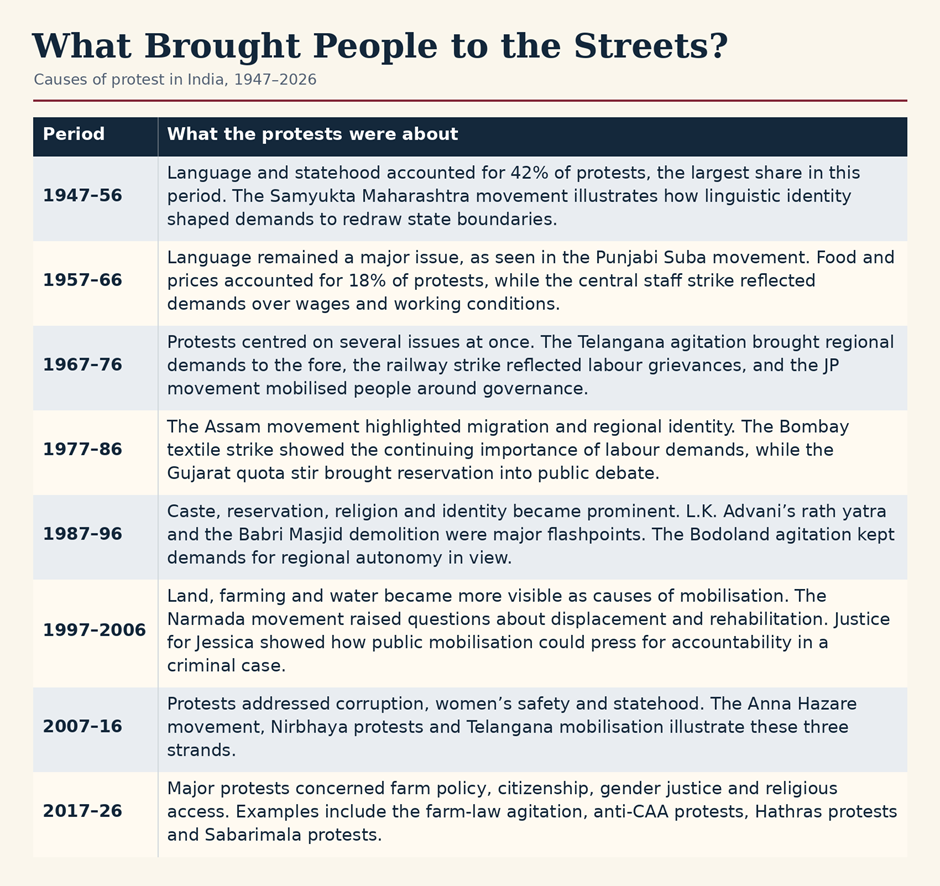
Early protests helped shape the territorial organisation of India through demands for linguistic states. Later movements increasingly challenged how governments made policies and how institutions protected citizens’ rights. Labour, land and identity remained recurring concerns across decades. A rising percentage share means an issue accounted for a larger proportion of protests in that period. The total number of protests would be needed to tell whether the number on that issue also rose.
From Statehood to Accountability
From 1947 to the 1960s, linguistic movements in Andhra, Maharashtra and Punjab demanded the reorganisation of state boundaries. Workers went on strike for higher wages and bonuses, while food shortages and rising prices sparked public protests.
Since the 1990s, protests have increasingly demanded institutional accountability. Singur farmers opposed land acquisition, Anna Hazare’s movement demanded action against corruption, and the Nirbhaya protests called for women’s safety. Farmers at Delhi’s borders sought repeal of the farm laws, while wrestlers protested against sexual harassment.
Landmark Movements
Kerala’s Liberation Struggle
Kerala’s Liberation Struggle (Vimochana Samaram) was a 1959 agitation against the elected Communist government led by E.M.S. Namboodiripad. Congress and community organisations mobilised opposition to reforms, including the Education Bill. The agitation culminated in the dismissal of the state government and imposition of President’s Rule under Article 356.
Anti-Hindi Agitation
The 1965 Anti-Hindi agitation in Madras State, now Tamil Nadu, opposed the prospect of Hindi becoming the Union’s sole official language. Students and the Dravida Munnetra Kazhagam mobilised protests. The Official Languages (Amendment) Act, 1967 ensured continued use of English alongside Hindi for Union purposes, accommodating concerns of non-Hindi-speaking states.
Naxalbari Uprising
The Naxalbari uprising began in 1967 in West Bengal’s Darjeeling district, where peasants and sharecroppers mobilised over land rights and landlord exploitation. Led locally by Kanu Sanyal and Jangal Santhal, it was suppressed by police. The uprising gave its name to the Naxalite movement and highlighted unresolved agrarian inequalities.
Telangana Agitation
The Telangana agitation sought a separate state, citing grievances over jobs, irrigation and public spending within Andhra Pradesh. A major student mobilisation in 1969 brought the demand to prominence. The movement revived in the 2000s, and Telangana became a state on 2 June 2014 under the Andhra Pradesh Reorganisation Act.
JP Movement
The JP Movement began in Bihar in 1974 as a student protest against corruption, rising prices and unemployment. Led by Jayaprakash Narayan, it expanded into a nationwide campaign for Total Revolution. It mobilised students and opposition parties, challenged the Congress government and shaped the political climate preceding the 1975 Emergency.
Anti-Mandal Agitation
The anti-Mandal agitation began in 1990 after Prime Minister V.P. Singh’s government announced 27% reservation for Other Backward Classes in central government jobs. Students led protests against the decision. The agitation brought caste and reservation to the centre of national politics, sharpening debates over social justice and access to employment.
Babri Masjid Demolition
On 6 December 1992, kar sevaks demolished the Babri Masjid in Ayodhya during the Ram Janmabhoomi movement. The demolition triggered communal violence across India. The episode illustrates how mobilisation around faith and identity can reshape national politics and raise questions about secularism, public order and the state’s responsibility to uphold law.
Anti-CAA Protests
The anti-CAA protests began in 2019 after Parliament passed the Citizenship (Amendment) Act. Protesters argued that its religion-based eligibility would undermine secularism and equality. Students and women played prominent roles, particularly at Delhi’s Shaheen Bagh sit-in. In Assam, protesters also raised concerns about migration and protection of local cultural identity.
Who Took Part?
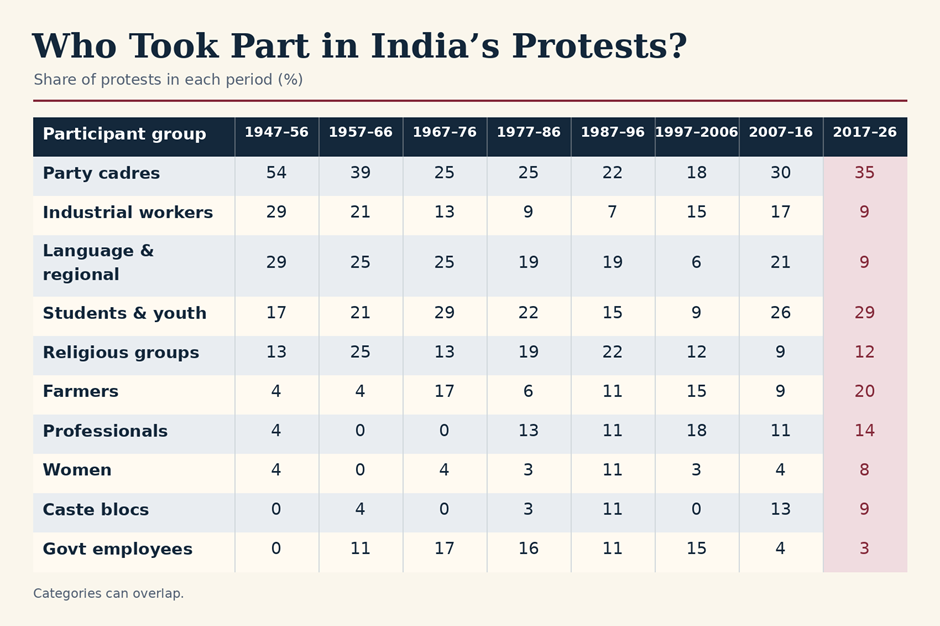
Political party cadres remained prominent, while students, youth and farmers gained a larger share in recent years. Party cadres featured in 54% of protests in 1947–56. Their share fell to 18% in 1997–2006 before rising to 35% in 2017–26. Industrial workers and language or regional campaigners each featured in 29% of protests in the first period. Both shares fell to 9% in the latest period.
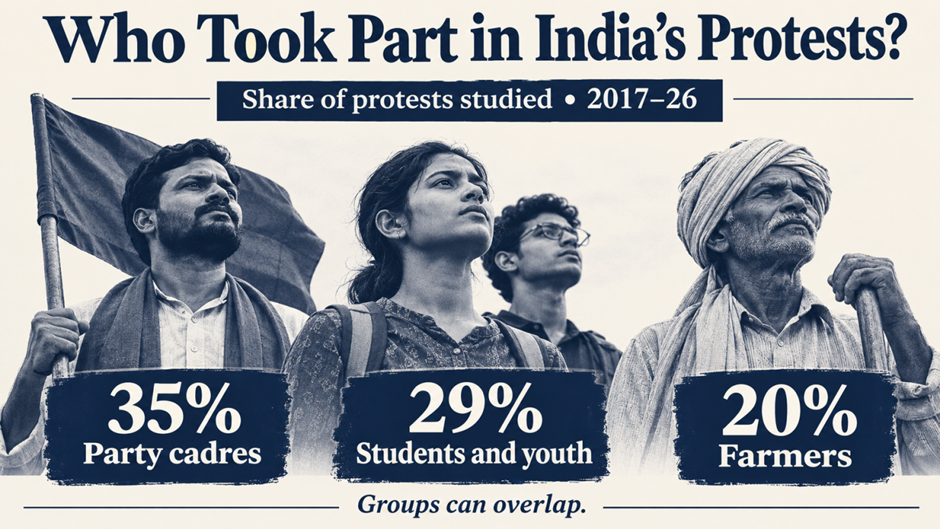
Students and youth were a recurring presence. Their share reached 29% in 1967–76, fell to 9% in 1997–2006, and returned to 29% in 2017–26. Recent mobilisations have also involved youth who were unaffiliated with political parties at the time. Farmers featured in 20% of protests in 2017–26, their highest share in the table, compared with 4% in each of the first two periods.
Other groups were more prominent at different times. Religious groups reached 25% in 1957–66, government employees reached 17% in 1967–76, women reached 11% in 1987–96, professionals reached 18% in 1997–2006, and caste blocs reached 13% in 2007–16.
How Did Governments Respond?
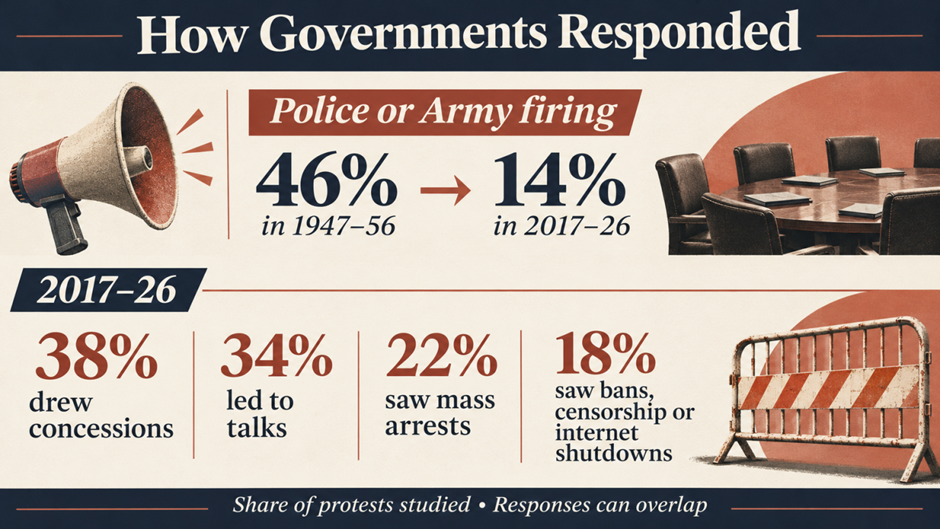
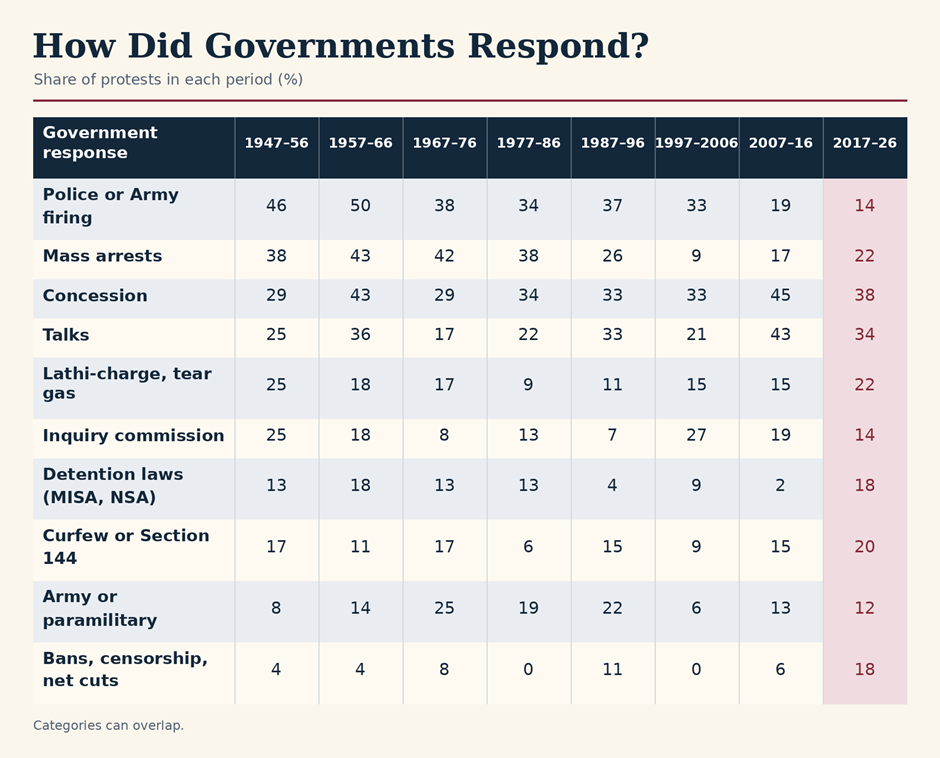
Police or Army firing became less common. It was recorded in 46% of protests studied in 1947–56, peaked at 50% in 1957–66, and fell to 14% in 2017–26. Mass arrests also fell from 43% in 1957–66 to 9% in 1997–2006, before rising to 22% in 2017–26.
Dialogue and concessions became more common in recent decades. Both peaked in 2007–16, when 45% of protests drew concessions and 43% led to talks. In 2017–26, 38% drew concessions and 34% led to talks.
Restrictions remained part of the government’s response. From 2007–16 to 2017–26, lathi-charge or tear gas rose from 15% to 22%, curfew or Section 144 measures from 15% to 20%, and use of detention laws from 2% to 18%. Bans, censorship or internet shutdowns rose from 6% to 18%.
When Did Protests Succeed?
Among the protests studied, 54% from the late 1960s to the mid-1970s were suppressed, called off or left unresolved. In the 1990s and after 2000, 60% achieved full or partial success.
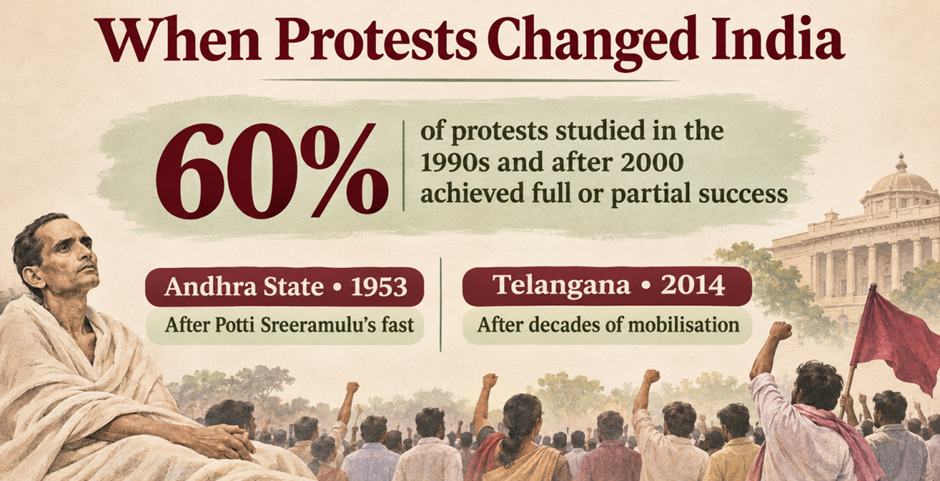
Some movements took years to achieve their goals. Telangana became a state in 2014 after decades of mobilisation. Andhra State was formed in 1953, a year after Potti Sreeramulu died during his fast for a separate Telugu-speaking state. Andhra Pradesh was formed in 1956.
1947 to 2026: Around 4,600 reports from 1947 to June 2026 and analysed 280 major protests by their causes, participants, government responses and outcomes. It selected protests based on media coverage, duration and reported toll, and cross-checked other sources for omissions.