
India fell from 23rd to 28th in the Climate Change Performance Index despite rapid solar and wind expansion. The article examines how coal dependence and limited grid capacity constrain the gains from renewable energy.
UPSC relevance:
|
GS Paper III (Primary) |
Environment: Climate change mitigation, emissions intensity and carbon markets. Economy and Infrastructure: Renewable energy, electricity grids and storage, energy efficiency, coal dependence, energy security and a just transition. |
|
GS Paper II |
Governance and Federalism: Climate policy implementation, State Action Plans on Climate Change, and coordination among the Centre, states and urban local bodies. |
|
Essay |
Balancing climate action, energy security and development. |
India fell from 23rd in the Climate Change Performance Index (CCPI) 2026 to 28th in CCPI 2027. Its score edged down from 61.31 to 60.85, and its overall rating remained medium. The figures show a modest decline in India’s score alongside a five-place drop relative to other countries. The report was released by Germanwatch and the New Climate Institute.
What the CCPI Measures
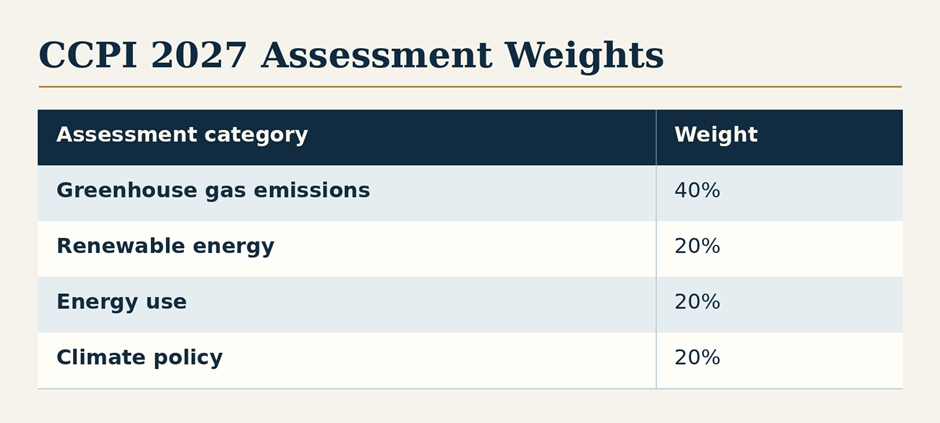
The CCPI is an annual index that compares countries’ performance on climate change mitigation. It helps identify progress and gaps in cutting emissions, expanding renewable energy, managing energy use and implementing climate policy. The 2027 edition covers 64 countries and the European Union, which together account for more than 90% of global greenhouse gas emissions.
The first three ranks remained vacant because no country earned a very high overall rating. Denmark ranked 4th, Lithuania 5th and Luxembourg 6th.
The 14 Indicators
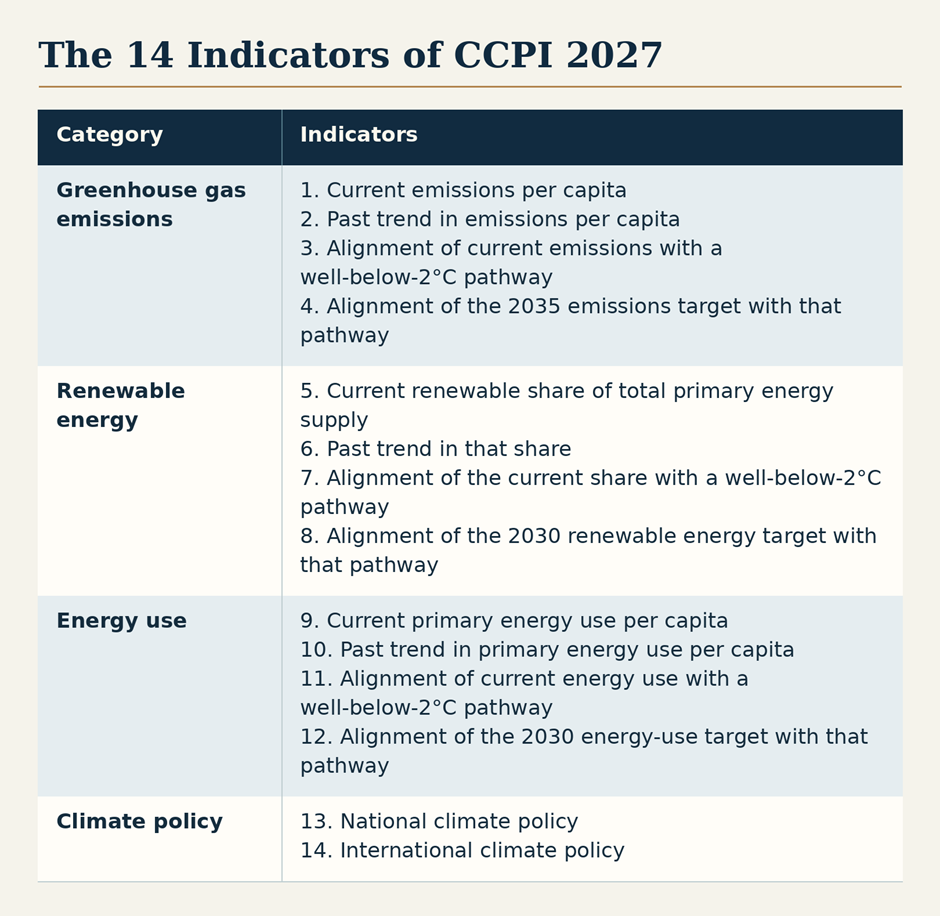
The index uses four indicators each for greenhouse gas emissions, renewable energy and energy use, and two for climate policy. For the first three categories, it examines the current level, past trend, and whether both the current level and the future target align with a pathway that keeps global warming well below 2°C.
Why India’s Rank Slipped
India received medium ratings for greenhouse gas emissions, energy use and climate policy. Renewable energy received a low overall rating, even though its trend indicator was rated high. The report recognised rapid solar and wind expansion, growth in non-fossil power capacity and gains in energy efficiency. It highlighted three persistent gaps: coal dependence, difficulty integrating renewables into the grid, and the lack of a comprehensive, time-bound national energy transition plan.
The ranking reflects performance across all four categories. The effect of additional clean power capacity on emissions depends on how much clean electricity the grid can use and how much fossil-fuel generation it displaces.
Clean Power and Grid Constraints
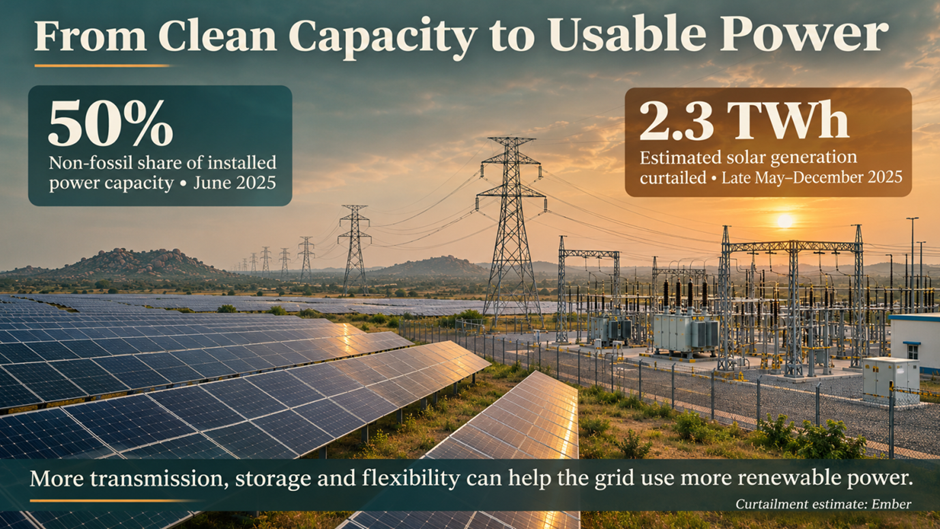
Non-fossil sources reached 50% of India’s installed electricity capacity in June 2025, ahead of the 2030 target. Limited transmission, storage and grid flexibility constrain actual renewable generation. Conventional power plants also face limits on how flexibly they can adjust their output as renewable generation varies.
Citing Ember, the report estimates that India curtailed 2.3 terawatt-hours (TWh) of solar generation between late May and December 2025 to maintain grid security. It recommends coordinated investment in transmission and energy storage, shifting electricity demand to periods of high renewable output, and making conventional power plant operations more flexible.
Progress in Efficiency and Transport
The report notes progress in electric vehicles, industrial efficiency programmes and appliance standards. Under the Carbon Credit Trading Scheme, India assigned emissions-intensity targets to 490 industrial entities from January 2026. Gaps remain in the coverage and enforcement of building energy codes and in compliance with appliance standards in informal markets.
By August 2026, urban rail covered 26 cities. The report also called for more affordable bus services, better service quality and greater support for walking and cycling.
Coal and the Transition Roadmap
Dependence on domestic coal remains a major barrier to India’s energy transition. Imports of crude oil, natural gas and some coal expose the country to global supply disruptions. The report recommends time-bound plans to reduce dependence on coal, oil and gas, along with tighter limits on new fossil-fuel infrastructure. Some experts call for avoiding new coal development this decade, while others emphasise India’s rising electricity demand and development needs.
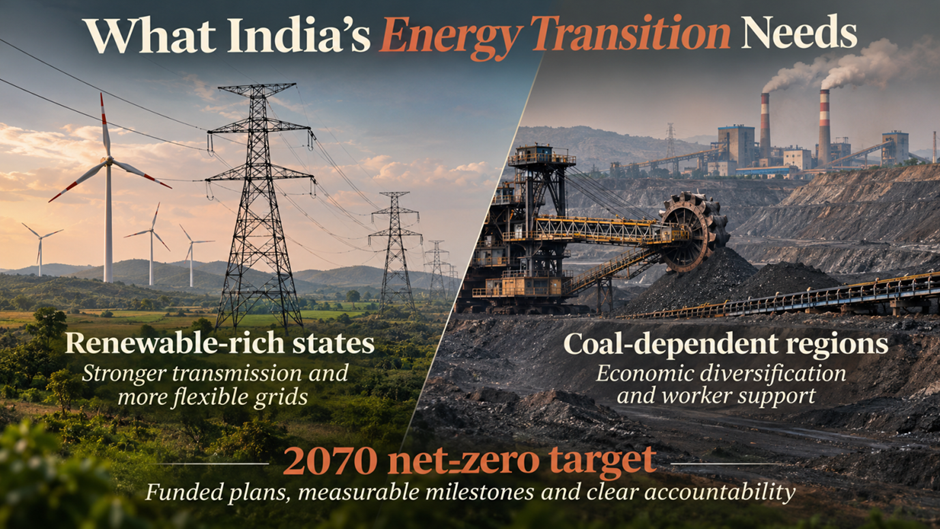
India’s 2070 net-zero target sets the long-term direction. Its existing climate framework includes national missions, State Action Plans on Climate Change and its 2035 Nationally Determined Contribution (NDC). Experts call for a funded roadmap to phase down fossil fuels, with measurable milestones beyond 2035 and clear accountability.
The report calls for coordination across ministries, states and municipalities. Renewable-rich states need stronger transmission networks and more flexible grids. Coal-dependent regions need economic diversification, support for workers and measures to manage the fiscal impact of the transition.
The Government’s Position
The Union Environment Ministry maintains that India’s climate policy is guided by its development priorities and energy needs. It sees coal as important for energy security and meeting electricity demand. The government told the Lok Sabha that national priorities and development needs guide domestic climate policy independently of external rankings.