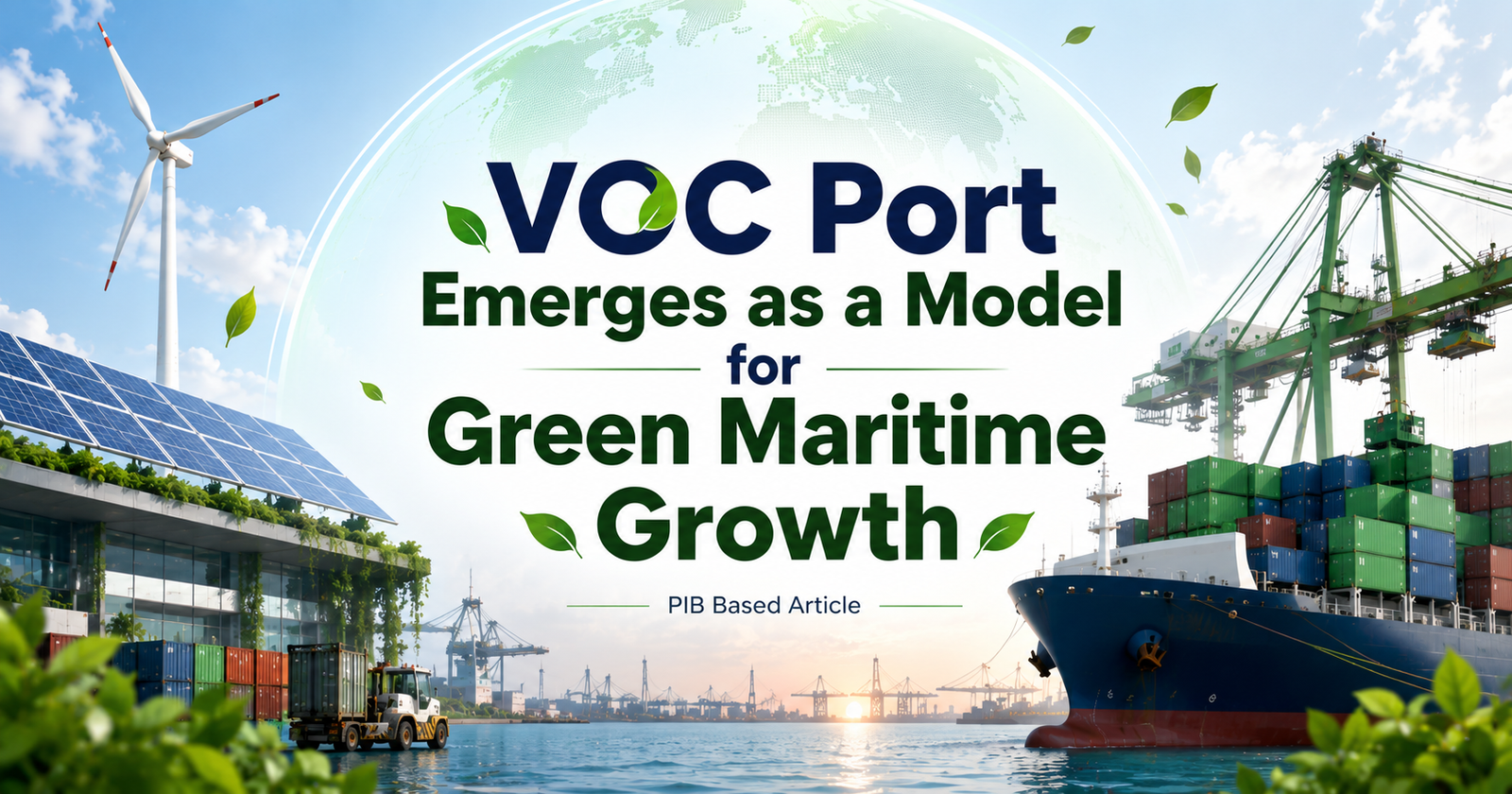
VOC Port achieves a 45% reduction in carbon emissions through renewable energy, green hydrogen, digital innovation, and sustainable infrastructure, emerging as a national model for India's green maritime transition.
Syllabus Areas:
GS III - Environment, S&T
Union Minister for Ports, Shipping and Waterways, Sarbananda Sonowal, stated that the V.O. Chidambaranar Port Authority (VOCPA) in Tamil Nadu has emerged as a leading model for sustainable maritime development in India. The port has achieved a remarkable 45% reduction in net carbon emissions, making it one of the country's foremost examples of green port transformation. The announcement was made during the dedication of several sustainability, education, innovation, and digital initiatives at the port.
India has committed itself to achieving Net Zero emissions by 2070, and the transformation of its ports forms an important pillar of this strategy. The achievements of V.O. Chidambaranar Port Authority demonstrate how ports can successfully combine economic growth with environmental sustainability.
Key Highlights of VOC Port's Green Transformation
1. Reduction in Carbon Emissions
The most significant achievement highlighted in the report is the substantial reduction in carbon emissions.
Major Achievements
-
Net carbon emissions reduced by approximately 45%.
-
Renewable energy offsets nearly 94% of the port's energy-consumption equivalent.
-
Carbon intensity per tonne of cargo handled has reduced by almost 50% over the past four years.
-
VOC Port has emerged as a frontrunner in India's green maritime transition.
These achievements indicate that ports can continue expanding cargo handling capacity while simultaneously reducing their environmental footprint. It serves as an example for other Indian ports seeking to balance economic growth with sustainability.
2. First Sustainability Report of VOC Port
VOC Port released its first-ever Sustainability Report, documenting its environmental performance and progress towards green growth.
Findings of the Report
-
Extensive adoption of renewable energy.
-
Significant decline in net carbon emissions.
-
Improved energy efficiency.
-
Reduction in carbon intensity of cargo operations.
-
Enhanced environmental management practices.
Importance of Sustainability Reports
A sustainability report helps stakeholders assess:
-
Environmental performance.
-
Social responsibility initiatives.
-
Governance standards.
-
Long-term sustainability goals.
-
Climate action commitments.
Such reports improve transparency and accountability while attracting environmentally conscious investors.
3. Green Hydrogen Transition
-
A major highlight of VOC Port's sustainability efforts is its transition towards green hydrogen-based energy systems.
-
The port has commissioned India's first Green Hydrogen Pilot Project at a major port.
Importance of Green Hydrogen
Green hydrogen is produced using renewable energy through the process of electrolysis and generates no carbon emissions during production.
Potential Applications
-
Port vehicles.
-
Cargo handling equipment.
-
Maritime fuel.
-
Industrial operations.
-
Backup power generation.
Benefits
-
Reduces dependence on fossil fuels.
-
Supports India's energy transition.
-
Helps achieve climate targets.
-
Encourages innovation in clean energy technologies.
4. Recognition as a Scope-2 Emission Free Port
VOC Port has been recognized as a Scope-2 Emission Free Port, validating its successful transition toward clean energy.
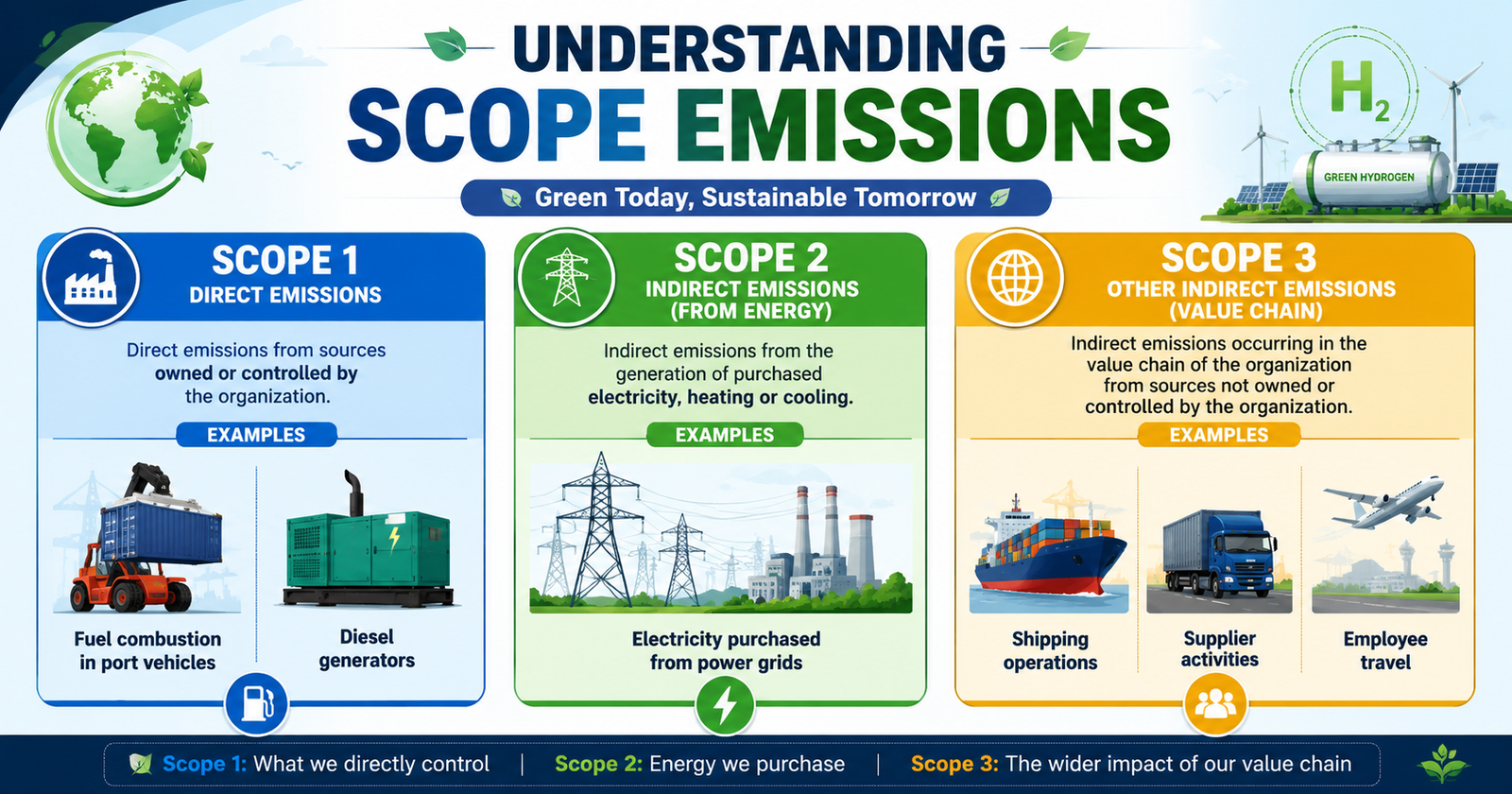
The Scope-2 certification indicates that VOC Port has significantly minimized emissions arising from electricity consumption through renewable energy adoption.
5. Renewable Energy Leadership
Renewable energy has become the backbone of VOC Port's decarbonisation strategy.
Achievements
-
Renewable energy offsets approximately 94% of energy requirements.
-
Reduced dependence on conventional power sources.
-
Enhanced energy security.
-
Lower operational carbon footprint.
Benefits
-
Reduced electricity costs.
-
Improved sustainability.
-
Long-term operational resilience.
-
Contribution to national renewable energy goals.
6. IIM Calcutta Case Study on VOC Port
During the event, the Minister released an important case study prepared by IIM Calcutta titled:
"The Hydrogen Pivot: Orchestrating the Green Transition at V.O. Chidambaranar Port Authority"
Major Themes
-
Renewable energy transition.
-
Electrification of operations.
-
Green hydrogen deployment.
-
Sustainable infrastructure development.
-
Decarbonisation strategies.
Significance
The case study documents how a traditional cargo port transformed into a green energy and sustainable maritime centre. It may serve as a model for other ports across India and abroad.
7. Partnership with Gati Shakti Vishwavidyalaya
VOC Port signed a Memorandum of Understanding (MoU) with Gati Shakti Vishwavidyalaya, Vadodara.
Objectives
-
Promote research and innovation.
-
Strengthen logistics education.
-
Enhance skill development.
-
Improve sustainable port operations.
-
Encourage industry-academia collaboration.
Expected Outcome
The partnership aims to establish a Centre of Excellence in Maritime Logistics and Port Management. This centre will support:
-
Advanced research.
-
Capacity building.
-
Professional training.
-
Logistics innovation.
8. Launch of PortGPT Mobile Application
VOC Port launched PortGPT, becoming the first major port in India to introduce an enterprise-grade Generative Artificial Intelligence platform through a dedicated mobile application.
Objectives
-
Improve operational efficiency.
-
Strengthen knowledge management.
-
Enable data-driven decision-making.
-
Accelerate digital transformation.
The initiative aligns with India's broader goal of integrating Artificial Intelligence into governance and infrastructure management.
9. Kendriya Vidyalaya at VOC Port
The Union Minister dedicated a new Kendriya Vidyalaya at VOC Port.
Features
-
Approved by Kendriya Vidyalaya Sangathan.
-
Initially operates from the Port School campus.
-
Provides CBSE education.
Beneficiaries
-
Children of port employees.
-
Children of Central Government personnel.
-
Students from local communities.
The initiative strengthens educational infrastructure and promotes inclusive development alongside economic growth.
About V.O. Chidambaranar Port Authority (VOCPA)
Location
-
Thoothukudi (Tuticorin), Tamil Nadu.
-
Located on the Coromandel Coast near the Gulf of Mannar.
Historical Background
-
The port is named after V.O. Chidambaram Pillai (1872–1936) Freedom fighter, Lawyer, Trade union leader, Founder of the Swadeshi Steam Navigation Company.
-
He is popularly known as "Kappalottiya Tamizhan" (The Tamil Helmsman) for challenging British shipping monopolies during the freedom movement.
Green Ports: Concept and Importance
What is a Green Port?
A Green Port is a port that minimizes environmental impacts through sustainable technologies and practices.
Key Features
-
Renewable energy adoption.
-
Electrified operations.
-
Green hydrogen utilization.
-
Energy efficiency measures.
-
Sustainable waste management.
-
Water conservation.
-
Pollution control systems.
Objectives
-
Reduce greenhouse gas emissions.
-
Improve environmental performance.
-
Promote sustainable trade and logistics.
-
Support climate action goals.
National Green Hydrogen Mission (NGHM)
The National Green Hydrogen Mission (NGHM) was approved by the Union Cabinet in January 2023 with the objective of making India a global hub for the production, utilization and export of Green Hydrogen and its derivatives. The mission is implemented by the Ministry of New and Renewable Energy (MNRE).
Key Targets by 2030
-
Production of 5 Million Metric Tonnes (MMT) of Green Hydrogen annually.
-
Creation of about 125 GW of additional renewable energy capacity.
-
Reduction in fossil fuel imports.
-
Development of a domestic green hydrogen ecosystem.
-
Position India as a major exporter of green hydrogen and green ammonia.
What is Green Hydrogen?
Hydrogen can be produced through different methods.
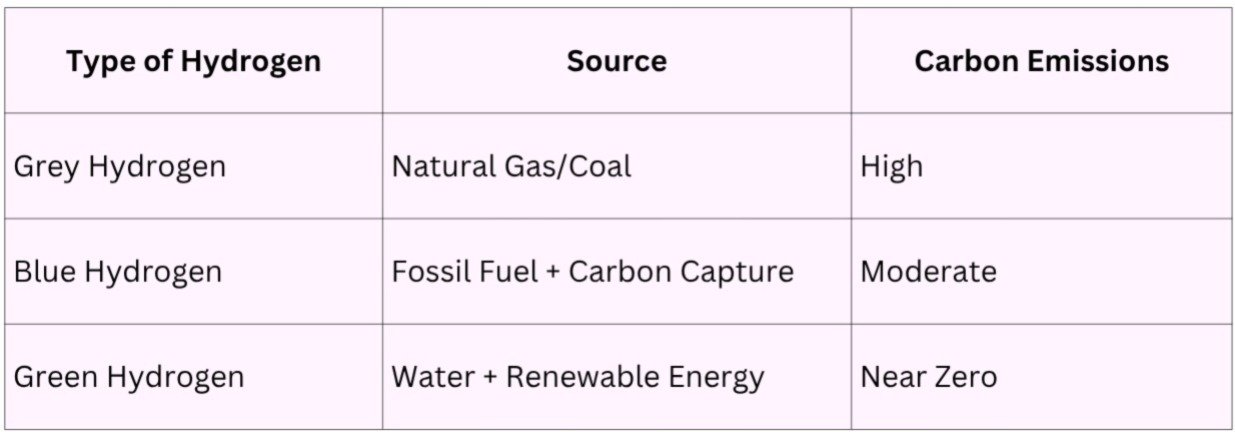
Green Hydrogen is produced by splitting water into hydrogen and oxygen using renewable electricity through a process called electrolysis. It is considered a clean fuel because no carbon dioxide is emitted during production.
Maritime India Vision 2030
Maritime India Vision 2030 is the Government of India's blueprint for comprehensive development of the maritime sector.
Key Objectives
-
Modernization of ports.
-
Promotion of green ports.
-
Adoption of smart technologies.
-
Improvement in logistics efficiency.
-
Expansion of port capacity.
-
Digital transformation.
-
Sustainable infrastructure development.
The initiatives undertaken by VOC Port closely align with Maritime India Vision 2030 and India's broader climate commitments.
Challenges in Green Maritime Transition
Despite significant progress, several challenges remain:
-
High cost of green hydrogen production.
-
Requirement of large renewable energy infrastructure.
-
Financing challenges for green projects.
-
Technology adoption barriers.
-
Need for skilled workforce.
-
Integration of digital and sustainable technologies.
Way Forward
To accelerate India's green maritime transition:
-
Expand renewable energy capacity at ports.
-
Promote shore power infrastructure.
-
Scale up green hydrogen production and usage.
-
Encourage public-private partnerships.
-
Strengthen research and innovation.
-
Develop green shipping corridors.
-
Enhance digitalization and AI integration.
-
Promote skill development in sustainable maritime operations.
The transformation of V.O. Chidambaranar Port Authority represents a landmark achievement in India's journey toward sustainable maritime development. With a 45% reduction in carbon emissions, large-scale renewable energy adoption, green hydrogen deployment, AI-driven digitalization, and investments in education and research, the port has emerged as a model for balancing economic growth with environmental responsibility. Its success provides a replicable blueprint for achieving the goals of Maritime India Vision 2030, the National Green Hydrogen Mission, and India's commitment to a Net Zero future by 2070.
UPSC Mains Practice Question
Q. "Green ports are essential for achieving sustainable maritime growth and climate resilience." Discuss with reference to the initiatives undertaken by V.O. Chidambaranar Port Authority. (250 Words).