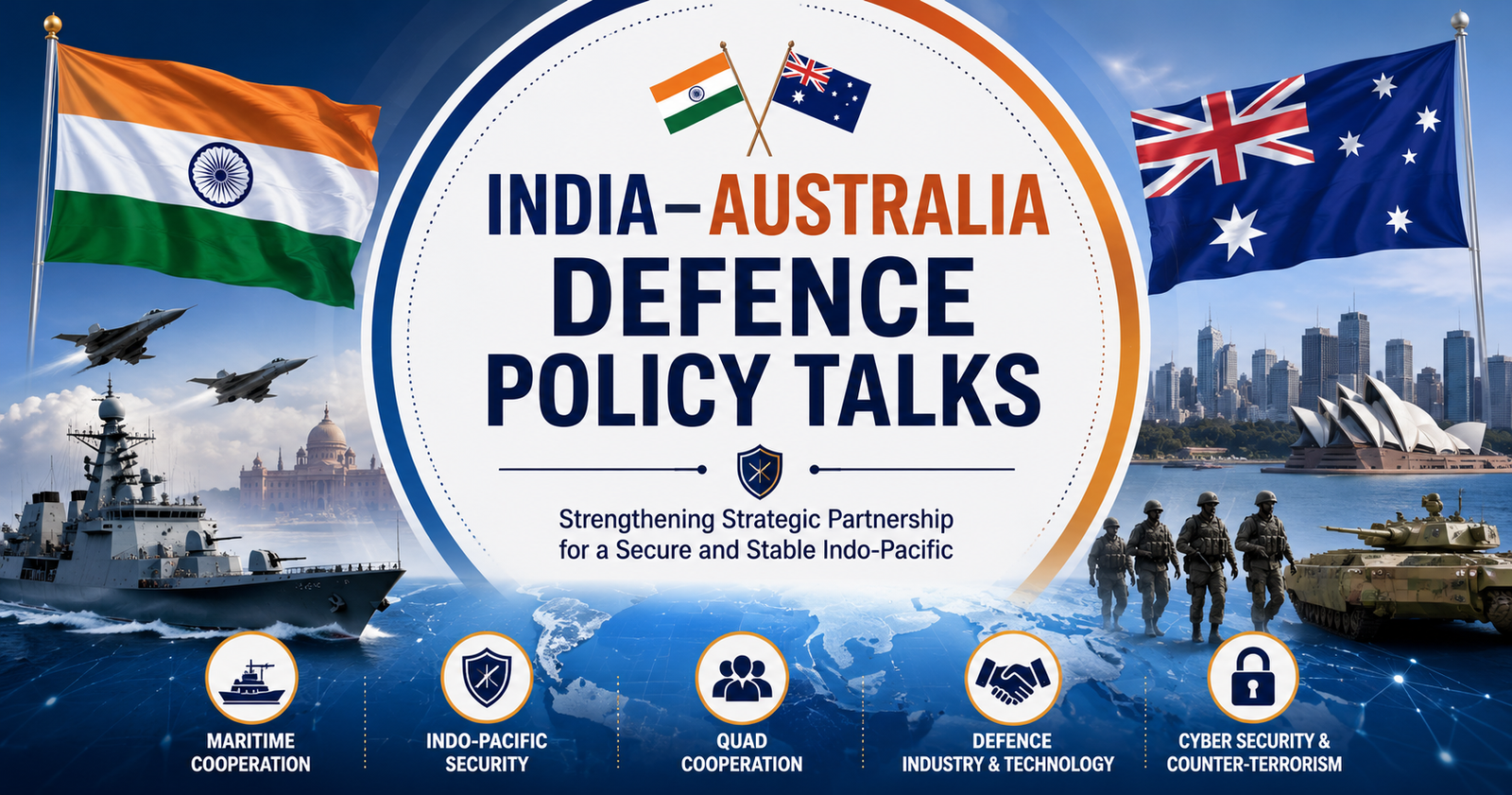
Explore India–Australia Defence Policy Talks 2026, covering Indo-Pacific security, QUAD cooperation, maritime strategy, defence technology partnerships, cyber security collaboration and evolving bilateral relations.
Syllabus Areas:GS II - International Relations GS III - Secutiry |
The 10th edition of the India–Australia Defence Policy Talks, recently held in New Delhi, marks another significant step in the rapidly expanding strategic partnership between the two countries. As geopolitical competition intensifies in the Indo-Pacific region, India and Australia are increasingly aligning their defence, security and maritime strategies to maintain regional stability, safeguard sea lanes and promote a rules-based international order.
The talks assume major significance in the context of:
-
China’s growing assertiveness in the Indo-Pacific
-
Expanding role of the QUAD grouping
-
Maritime security concerns
-
Supply chain resilience
-
Defence interoperability among like-minded democracies
The meeting reflects how India and Australia have transformed their relationship from a limited bilateral engagement into a comprehensive strategic partnership with deep defence cooperation.
Background of India–Australia Relations
Historically, India and Australia maintained cordial but limited engagement for several decades. However, the relationship witnessed major transformation during the last decade due to shared strategic concerns in the Indo-Pacific region.
Key Reasons for Improved Relations
-
Rise of China’s influence
-
Need for secure maritime trade routes
-
Shared democratic values
-
Counter-terrorism cooperation
-
Economic and strategic diversification
Today, both countries view each other as important partners in maintaining regional balance and stability.
Evolution of Defence Cooperation
1. Comprehensive Strategic Partnership (CSP)
In 2020, India and Australia elevated their ties to a Comprehensive Strategic Partnership (CSP).
This expanded cooperation in:
-
Defence
-
Cyber security
-
Critical minerals
-
Technology
-
Maritime affairs
-
Supply chains
The CSP became a turning point in bilateral strategic engagement.
2. Mutual Logistics Support Agreement (MLSA)
India and Australia signed the Mutual Logistics Support Agreement in 2020.
Importance of the Agreement
It allows:
-
Reciprocal access to military bases
-
Refueling and replenishment
-
Enhanced naval coordination
-
Greater interoperability
This strengthens operational cooperation between the armed forces of both nations.
3. Participation in Malabar Naval Exercise
Australia’s inclusion in the Malabar naval exercises alongside:
-
India
-
United States
-
Japan
symbolized deeper strategic trust.
The exercise focuses on:
-
Naval warfare
-
Maritime surveillance
-
Anti-submarine operations
-
Humanitarian assistance and disaster relief
It also reflects growing defence coordination among QUAD nations.
Key Areas Discussed in the 10th Defence Policy Talks
1. Indo-Pacific Security
The Indo-Pacific has emerged as the world’s most strategically significant region due to:
-
Major sea trade routes
-
Energy transportation
-
Strategic chokepoints
-
Military competition
India and Australia emphasized the need for:
-
Freedom of navigation
-
Respect for international law
-
Peaceful resolution of disputes
-
Maritime stability
Both countries support a free, open and inclusive Indo-Pacific.
2. Maritime Cooperation
Maritime security remains central to India–Australia relations.
Focus Areas
-
Joint naval exercises
-
Maritime domain awareness
-
Anti-piracy operations
-
Information sharing
-
Surveillance cooperation
The Indian Ocean is becoming increasingly important due to:
-
Global trade movement
-
Strategic naval deployments
-
Energy security concerns
Both nations aim to prevent disruptions in maritime trade routes.
3. QUAD Cooperation
The QUAD consists of:
-
India
-
Australia
-
United States
-
Japan
It is not a formal military alliance but a strategic platform focused on:
-
Regional stability
-
Infrastructure
-
Cyber security
-
Maritime security
-
Emerging technologies
India and Australia discussed enhancing coordination within the QUAD framework.
Significance of QUADThe QUAD has become increasingly important due to:
Both countries support strengthening QUAD-based cooperation without converting it into an overt military bloc. |
4. Defence Technology and Industry Cooperation
India and Australia also discussed expanding collaboration in:
-
Defence manufacturing
-
Emerging technologies
-
Artificial Intelligence
-
Cyber security
-
Space cooperation
India’s emphasis on “Atmanirbhar Bharat” creates opportunities for:
-
Joint production
-
Defence innovation
-
Technology transfer
Australia’s expertise in critical minerals also complements India’s manufacturing ambitions.
5. Counter-Terrorism and Cyber Security
Both countries expressed concerns over Terrorism, Cyber attacks, Hybrid warfare, Disinformation campaigns
They agreed to improve:
-
Intelligence sharing
-
Cyber defence cooperation
-
Capacity-building mechanisms
Cyber security is emerging as a major pillar of modern strategic partnerships.
Strategic Importance of India–Australia Partnership
For India
1. Strengthening Indo-Pacific Presence: Australia supports India’s strategic role in the Indian Ocean Region.
2. Balancing China’s Influence: Closer ties help India counter strategic pressures in the region.
3. Maritime Security: Australia strengthens India’s naval coordination capabilities.
4. Access to Critical Minerals: Australia possesses large reserves of lithium and rare earth minerals essential for:
-
Electric vehicles
-
Electronics
-
Renewable energy technologies
For Australia
-
Diversification of Strategic Partnerships: Australia seeks to reduce excessive dependence on China.
-
Expanding Presence in the Indian Ocean: India provides strategic geographical advantages.
-
Economic and Security Cooperation: India is viewed as a long-term economic and strategic partner.
Challenges in the Relationship
Despite growing cooperation, some challenges remain.
-
Economic Differences: Trade potential remains underutilized.
-
Strategic Sensitivities: India maintains strategic autonomy and avoids alliance politics.
-
Different Regional Priorities: Australia’s alliance with the United States sometimes shapes its strategic outlook differently from India.
-
Defence Procurement Complexities: Technology sharing and industrial collaboration still face procedural challenges.
Importance for India’s Foreign Policy
The India–Australia partnership aligns with several major Indian foreign policy objectives.
- Act East Policy: Strengthening engagement with Indo-Pacific democracies.
- SAGAR Vision(Security and Growth for All in the Region): Promotes maritime cooperation and regional stability.
- Indo-Pacific Oceans Initiative (IPOI): Encourages collaborative maritime governance.
- Strategic Autonomy: India balances partnerships without entering military alliances.
Global Geopolitical Context
The defence talks occur amid:
-
US–China strategic rivalry
-
Militarization of the South China Sea
-
Taiwan tensions
-
Growing naval competition
Middle powers like India and Australia are increasingly coordinating to maintain strategic balance while avoiding direct confrontation.
The Way Forward
Areas for Future Cooperation
-
Defence Industrial Cooperation: Joint defence manufacturing projects.
-
Maritime Domain Awareness: Improved intelligence and surveillance systems.
-
Critical Technologies: Cooperation in semiconductors, AI and cyber systems.
-
Energy Security: Partnership in renewable energy and critical minerals.
-
Regional Diplomacy: Strengthening ASEAN-centred regional frameworks.
The 10th India–Australia Defence Policy Talks demonstrate the growing maturity and strategic depth of bilateral relations. What was once a limited diplomatic relationship has now evolved into a strong defence and security partnership shaped by shared geopolitical interests and democratic values.
As the Indo-Pacific becomes the central theatre of global geopolitics, India and Australia are expected to play increasingly important roles in ensuring maritime stability, promoting international law and maintaining a balanced regional order.
The partnership is likely to expand further in defence technology, maritime cooperation, cyber security and critical supply chains, making it one of the most important strategic relationships in the Indo-Pacific region.