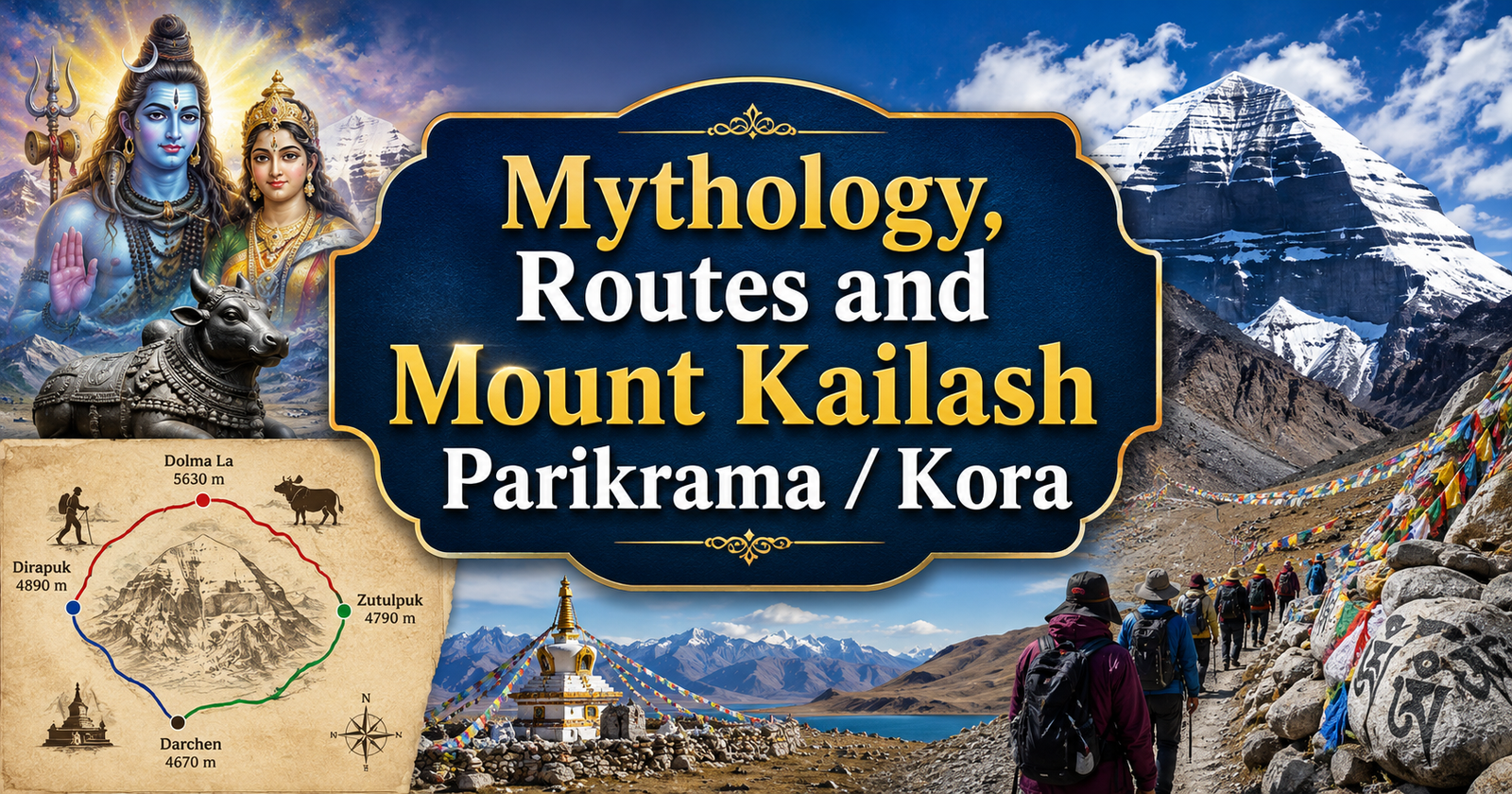
Explore the sacred mythology of Mount Kailash, pilgrimage routes, and the spiritual significance of Parikrama/Kora, highlighting key landmarks, high-altitude challenges, cultural traditions, and breathtaking Himalayan landscapes.
Syllabus Areas:
GS I - Geography
GS III - Environment and Disaster Management
Points To Be Covered:
- Why is it in News?
- Key Terminology Related to Manasasarovar Yatra
- The Topography of the Kailash Mansarovar Yatra, Plate Tectonics & Geographical Activity In This Area and Major Disasters in the Kailash–Mansarovar Region
- Mythological History of Kailash–Mansarovar and Travel route to reach the Kailash–Manasarovar Routes and Mount Kailash Parikrama / Kora
- From Salt & Wool to EVs: The Changing Face of Rasuwagadhi
Watch Video On Manasasarovar Major Disaster:

Kailash Mountain in Ancient Sanskrit Literature
Mount Kailash (कैलास) holds a highly sacred place in ancient Sanskrit literature:
-
Vedas: References to Kailash are limited; its later prominence is more evident in the epics and Puranas.
-
Ramayana: Kailash is described as a magnificent Himalayan mountain associated with Lord Shiva and his divine abode.
-
Mahabharata: Kailash appears as a sacred Himalayan region connected with Shiva, Kubera, and other divine beings.
-
Puranas: Texts such as the Shiva Purana, Skanda Purana and Vishnu Purana extensively portray Kailash as Shiva's abode, surrounded by divine landscapes.
-
Kalidasa: In Kumarasambhava, the Himalayan world is portrayed as the majestic realm associated with Shiva and Parvati.
-
Religious symbolism: Kailash represents spiritual transcendence, asceticism, purity and the cosmic presence of Shiva.
Ancient Sanskrit tradition transformed Kailash from a Himalayan peak into a sacred cosmic mountain — the abode of Lord Shiva and a symbol of divine consciousness.
-
Abode of Lord Shiva: In Hindu tradition, Mount Kailash is regarded as the sacred abode of Lord Shiva and Goddess Parvati. Shiva is believed to reside and meditate on the mountain.
-
Mount Meru connection: Kailash is often associated with Mount Meru, the cosmic mountain described in Hindu, Buddhist and Jain cosmological traditions as the centre of the universe.
-
Lake Mansarovar: According to Hindu tradition, the lake was created by Lord Brahma through his mind. The name Manas-sarovar is derived from manas (mind) and sarovar (lake), giving it the meaning “lake of the mind.”
-
Source-region of sacred rivers: The broader Kailash region is traditionally associated with the sources of four major Asian rivers: Indus, Sutlej, Brahmaputra (Yarlung Tsangpo) and Karnali, a major tributary of the Ganga.
-
Buddhism: In Tibetan Buddhism, Mount Kailash is known as Kang Rinpoche (“Precious Snow Jewel”) and is associated with Demchok (Chakrasamvara), representing supreme bliss and enlightenment.
-
Jainism: Jain tradition associates Mount Kailash, particularly Ashtapada, with Rishabhanatha (Adinath), the first Tirthankara, who is believed to have attained liberation there.
-
Bon tradition: In the indigenous Tibetan Bon tradition, Mount Kailash is a sacred mountain associated with Zhang Zhung cosmology and the deity Tönpa Shenrab.
-
Sacred circumambulation: Pilgrims traditionally perform kora/parikrama around Mount Kailash. The circuit is considered spiritually significant, with different traditions attaching different religious meanings to completing it.
Travel route to reach the Kailash–Manasarovar region
The Government of India currently organizes the Kailash Manasarovar Yatra through two routes: Lipulekh Pass (Uttarakhand) and Nathu La Pass (Sikkim). In 2026, the official durations are approximately 22 days via Lipulekh and 21 days via Nathu La.
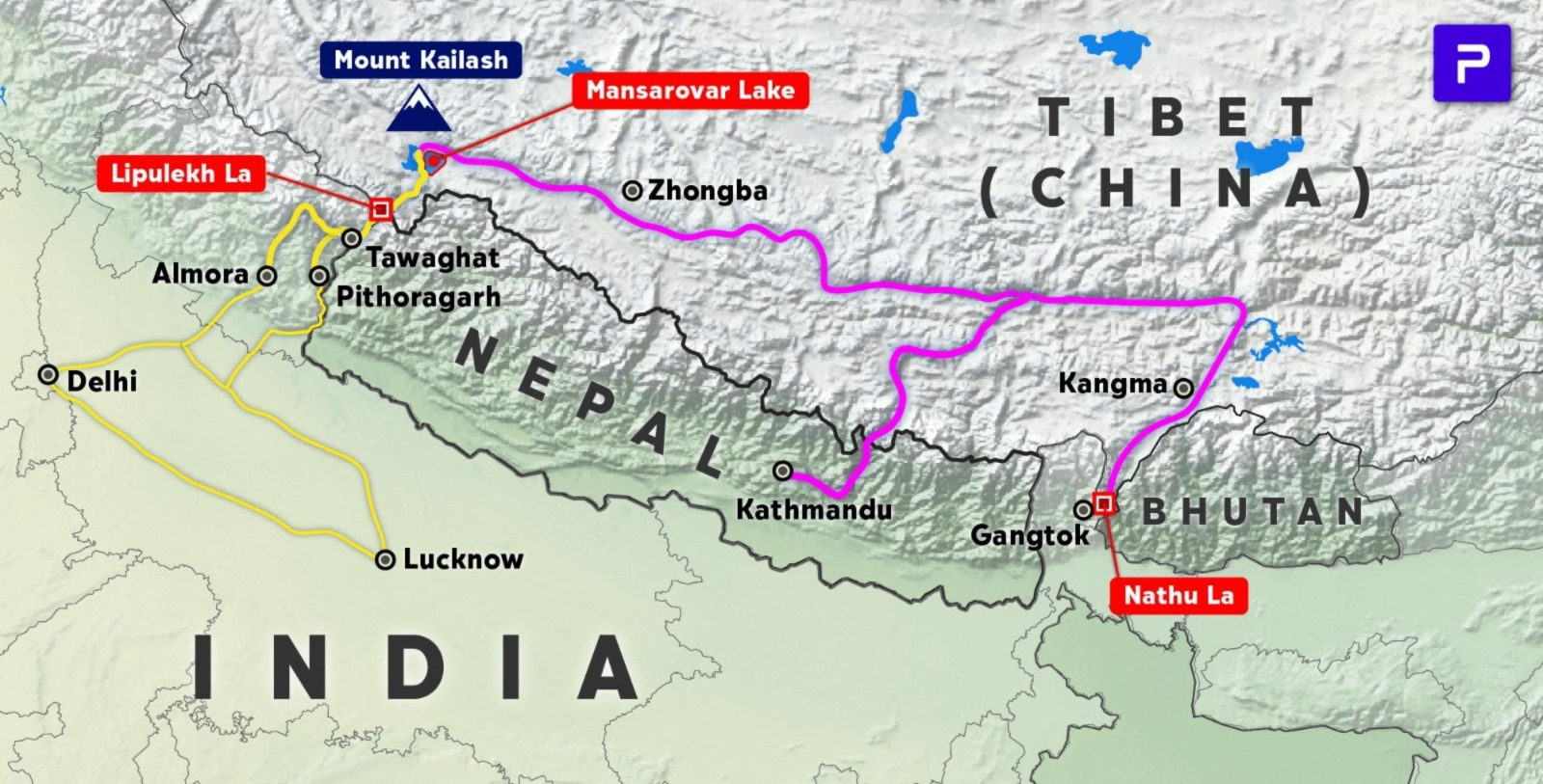
1. Lipulekh Pass Route — Uttarakhand
New Delhi → Tanakpur → Dharchula → Gunji → Kalapani → Nabhidhang → Lipulekh Pass → Purang/Taklakot → Manasarovar → Darchen → Kailash Parikrama
The 2026 itinerary records the Indian-side journey through Tanakpur, Dharchula, Gunji, Kalapani and Nabhidhang, followed by crossing Lipulekh Pass (≈5,050 m) into the Tibet region.
Key point: This is the more trekking-intensive route. The official FAQ estimates roughly 200 km of trekking over the entire Lipulekh pilgrimage.
2. Nathu La Route — Sikkim
New Delhi → Bagdogra → Gangtok → Nathu La → Tibet → Shigatse/Saga region → Manasarovar → Darchen → Kailash Parikrama
Nathu La is largely motorable, making this route considerably less trekking-intensive. The official FAQ estimates approximately 35–40 km of trekking, primarily for the Kailash Parikrama.
Mount Kailash Parikrama / Kora
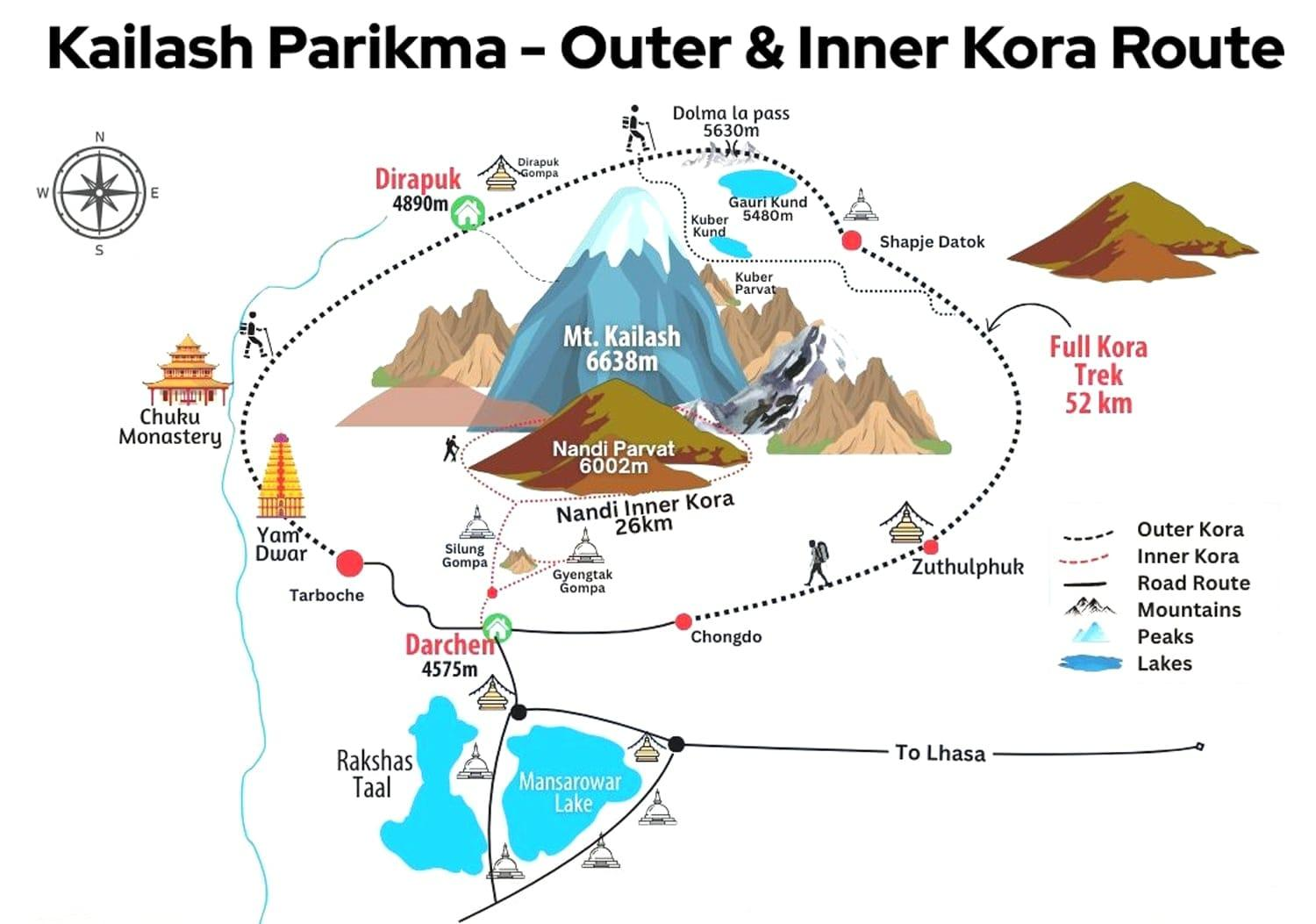
The Parikrama is the circumambulation of Mount Kailash.
Darchen → Yam Dwar → Dirapuk → Dolma La Pass → Zuthulphuk → Darchen
The official 2026 itinerary identifies:
-
Darchen – base for the Kailash Parikrama
-
Yam Dwar – starting point
-
Dirapuk – first major halt
-
Dolma La – highest point, about 5,590 m
-
Zuthulphuk – second major halt
-
Darchen – completion of the circuit
Manasarovar Parikrama
A separate circumambulation is undertaken around Lake Manasarovar. The official itinerary places Manasarovar Parikrama after completion of the Kailash Parikrama.
UPSC angle: The map can effectively illustrate the intersection of Himalayan geography + pilgrimage tourism + transboundary rivers + India–China relations + disaster vulnerability + climate change. The recent resumption of the Yatra also makes it a useful contemporary example