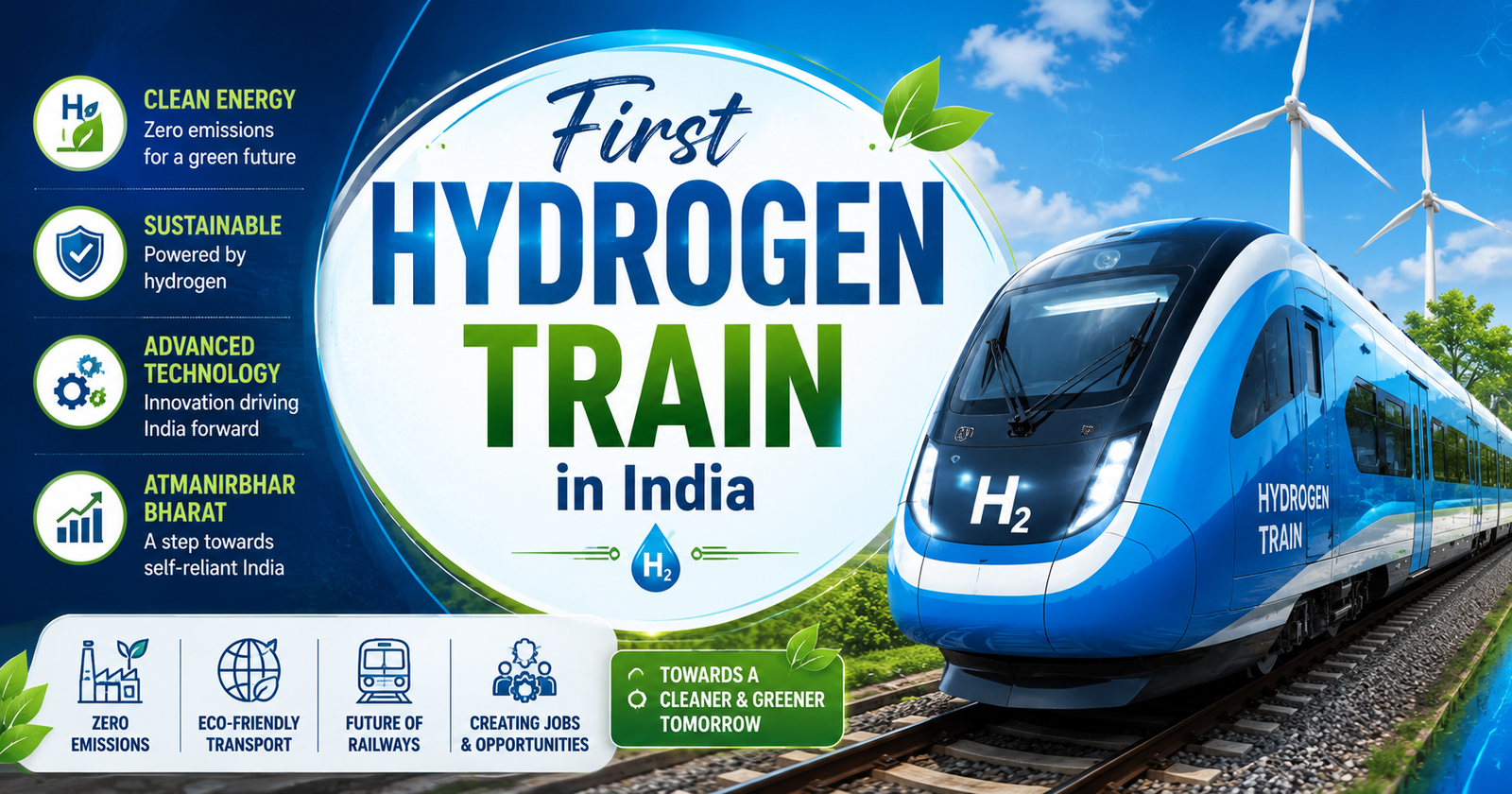
Explore first Hydrogen Train in India, its technology, environmental benefits, National Green Hydrogen Mission, technical features, UPSC relevance, and how it advances sustainable transportation and clean energy.
Syllabus Areas:
GS III - S & T, Environment
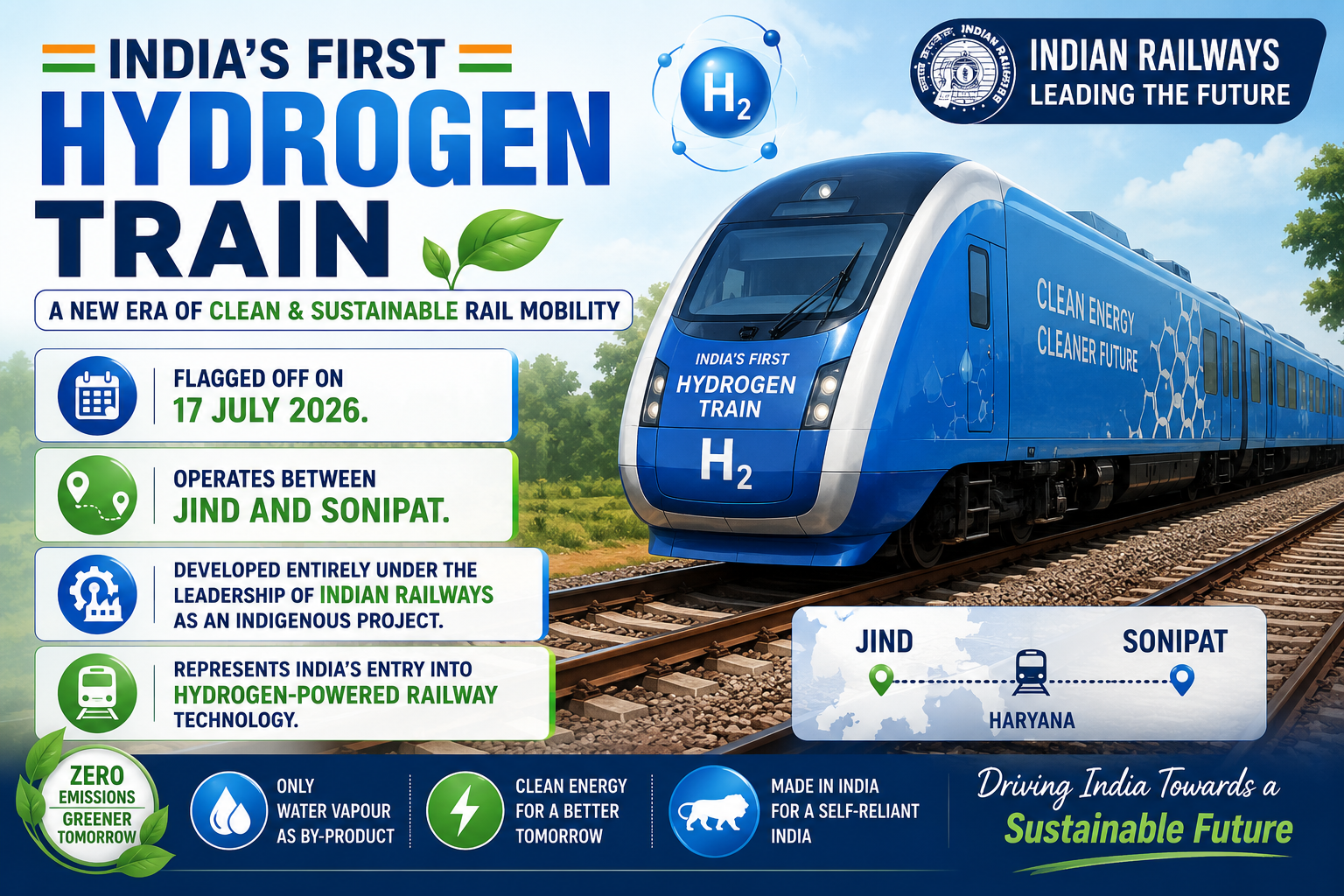
India's first Hydrogen Fuel Cell Train was flagged off between Jind and Sonipat (Haryana) on 17 July 2026. This comes three years after Rs.20,000 crore National Green Hydrogen Mission’s launch.
The train has successfully travelled over 1,200 km, replacing the consumption of more than 3,200 litres of diesel, marking a major milestone in India's green transportation initiative.
Features of First Hydrogen Train:
-
Features a 10-coach train, 2 Hydrogen Driving Power Cars, and 2,400 kW power output.
-
Uses Lithium Iron Phosphate (LiFePO₄) batteries and onboard hydrogen cylinders.
-
Stores hydrogen up to 500 bar, dispensed at 350 bar, with 3,000 kg storage capacity at Jind.
-
Equipped with leak, heat, flame, and smoke detection, automatic shut-off, ventilation, and international-standard safety systems.
-
Successful trials pave the way for Delhi operations and a future nationwide hydrogen rail network.
Significance
Environmental Significance
-
Supports India's Net Zero emissions goal.
-
Promotes clean and sustainable mobility.
-
Reduces greenhouse gas emissions.
-
Improves urban air quality.
Economic Significance
-
Lowers diesel consumption.
-
Reduces fuel import dependence.
-
Encourages indigenous manufacturing and innovation.
-
Creates opportunities in the green hydrogen sector.
Technological Significance
-
Demonstrates India's capability in advanced hydrogen technologies.
-
Establishes a domestic hydrogen rail ecosystem.
-
Strengthens India's leadership in clean transportation technologies.
National Green Hydrogen Mission (NGHM)
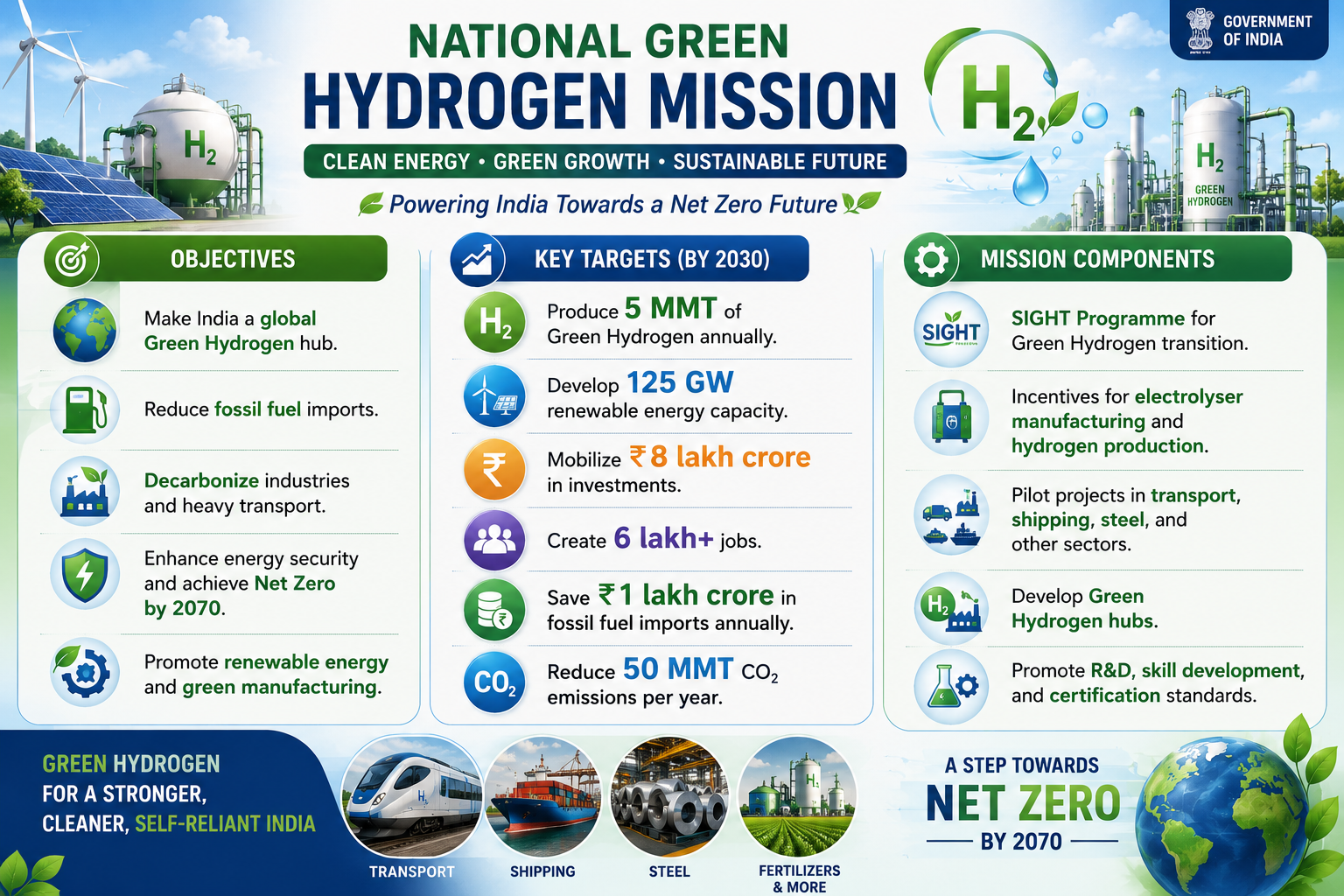
The National Green Hydrogen Mission (NGHM) is a flagship initiative launched by the Government of India on 4 January 2023 to make India a global hub for the production, use, and export of Green Hydrogen.
What is Green Hydrogen?
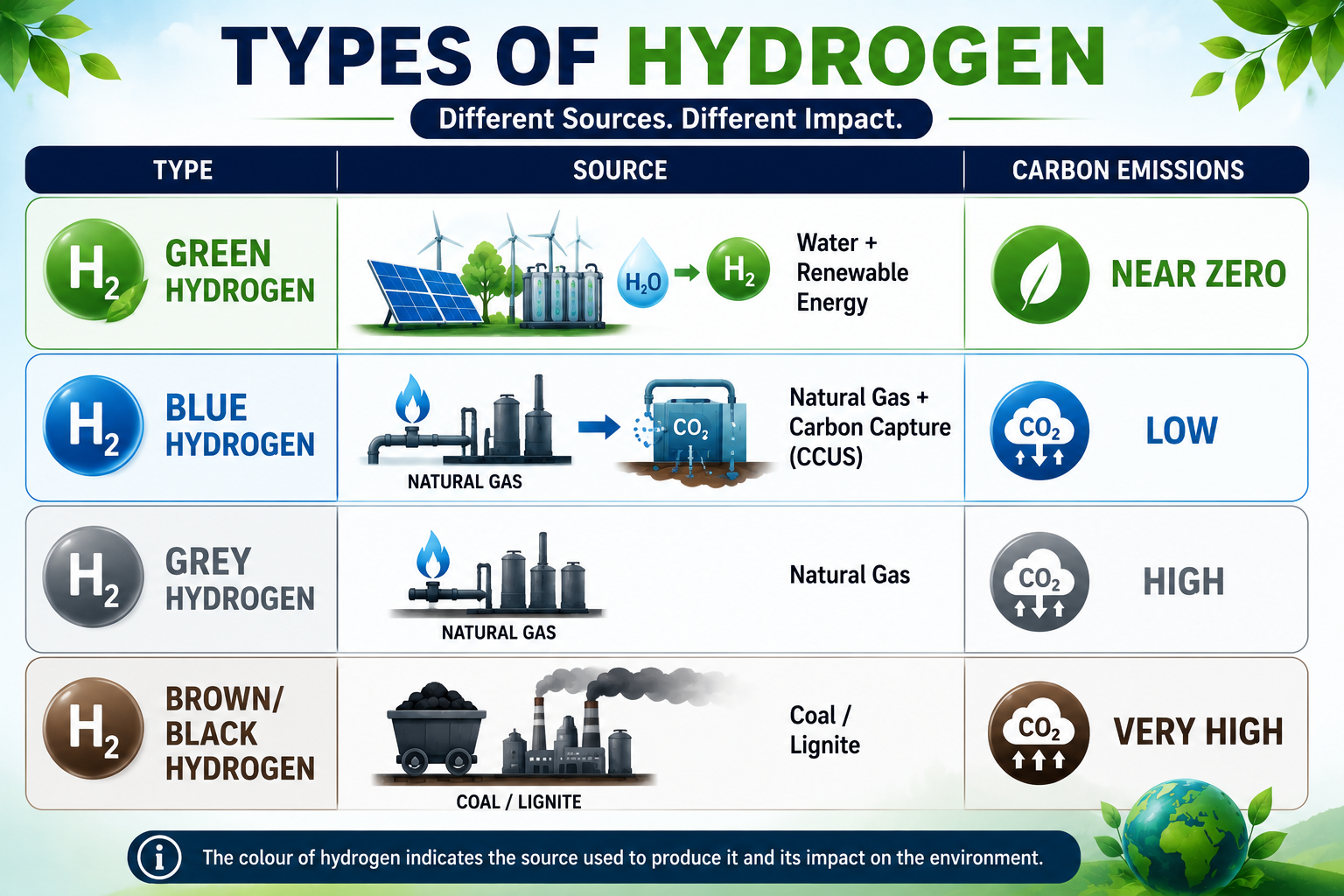
Green Hydrogen is hydrogen gas produced by splitting water (H₂O) into hydrogen (H₂) and oxygen (O₂) using electricity generated entirely from renewable energy sources, such as solar, wind, or hydropower. Since no fossil fuels are used in the process, it produces almost zero greenhouse gas emissions.
Why does green hydrogen matter?
-
In April-June, its crude oil import bill jumped 61% year-on-year to $49.8 billion, despite lower volumes, as geopolitical tensions spiked prices.
-
And then, there are electric vehicles (EVs), that rely on battery and critical mineral supply chains dominated by countries such as China.
-
Green hydrogen can cut reliance on these supply chains while helping decarbonize refineries, fertilizers, steel, shipping and heavy transport.
How has our hydrogen mission fared?
-
Since 2023, India's ₹19,744-crore National Green Hydrogen Mission has launched the country's hydrogen economy, but commercial use is limited.
-
It targets 5 million tonne green hydrogen annual output by 2030, of which only about 8,000 tonnes was commissioned by February.
-
Under Strategic Interventions for Green Hydrogen Transition plan, 862,000-tonne annual hydrogen output and 3,000 MW electrolyser capacity got sops.
-
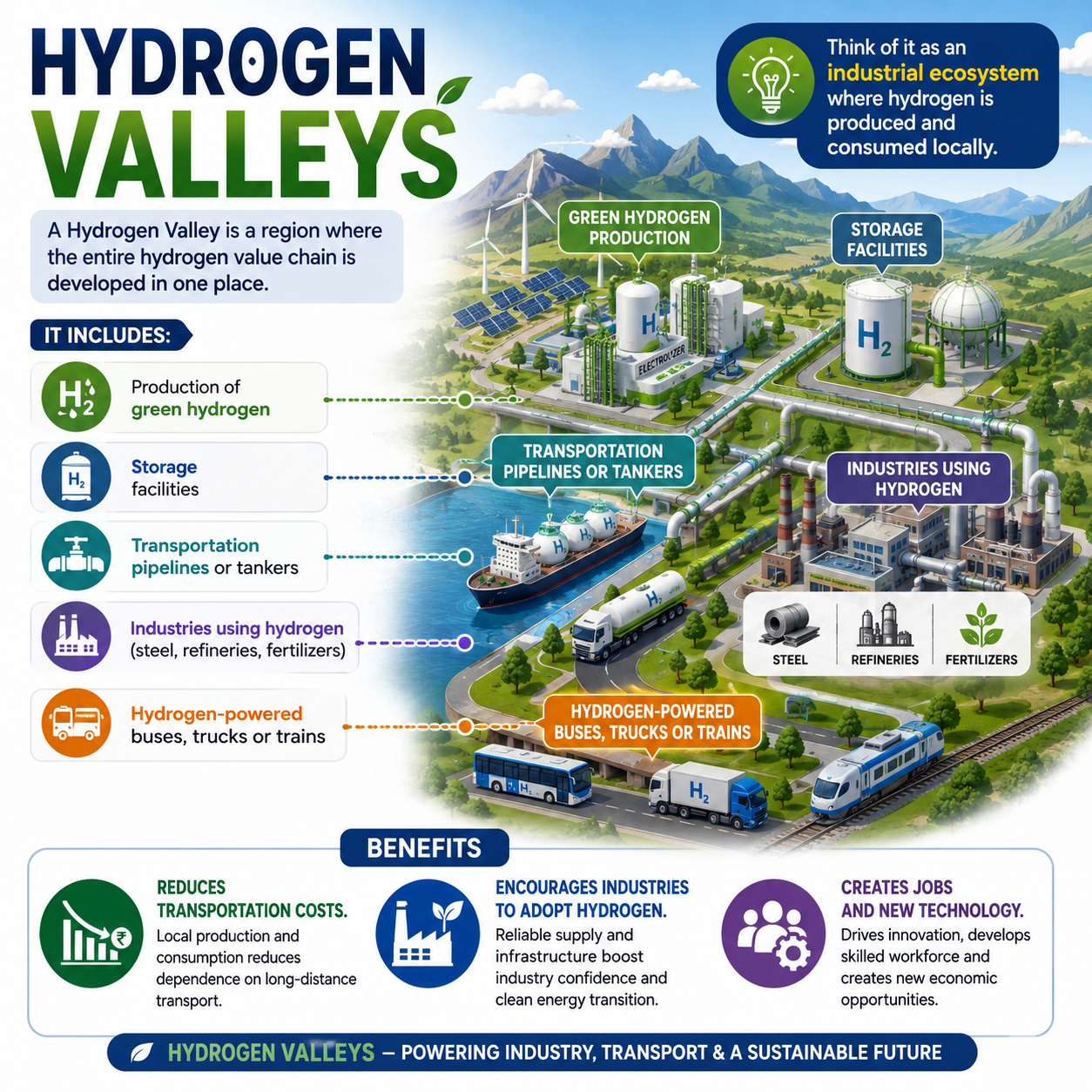
Long-term green ammonia supply pacts were signed for fertilizer units, and hydrogen valleys, ports and mobility plans backed. Firms such as JSW Energy and IOC are also starting projects.
So, what's dragging the hydrogen economy?
-
Simple reason : The cost. Green hydrogen costs ₹400-560 a kg as against ₹150-225 for conventional grey hydrogen, making large-scale use unviable without policy support.
-
Renewable power makes for 60-70% of output cost, with electrolysers, storage, transport and financing adding up.
-
India also needs local manufacturing for electrolysers and other hydrogen technologies.
-
Without this, it risks swapping reliance on imported oil with that on imported hydrogen equipment. Developing this supply chain is key to making India competitive.
And, where will the demand come from?
-
Firstly, it is the incumbent hydrogen users: refineries, fertilizer units, etc. Then comes steel, shipping and heavy transport.
-
The Centre is already in long-term green ammonia supply pacts with fertilizer firms and is working on Green Hydrogen Consumption Obligations that will push industries to swap grey hydrogen with greener options.
India's Hydrogen Train marks a transformative step towards sustainable transportation, showcasing indigenous innovation, clean energy adoption, reduced carbon emissions, and advancing the National Green Hydrogen Mission for a greener, self-reliant future.
Prelims Questions:
Q1. With reference to Hydrogen Fuel Cell Trains, consider the following statements:
-
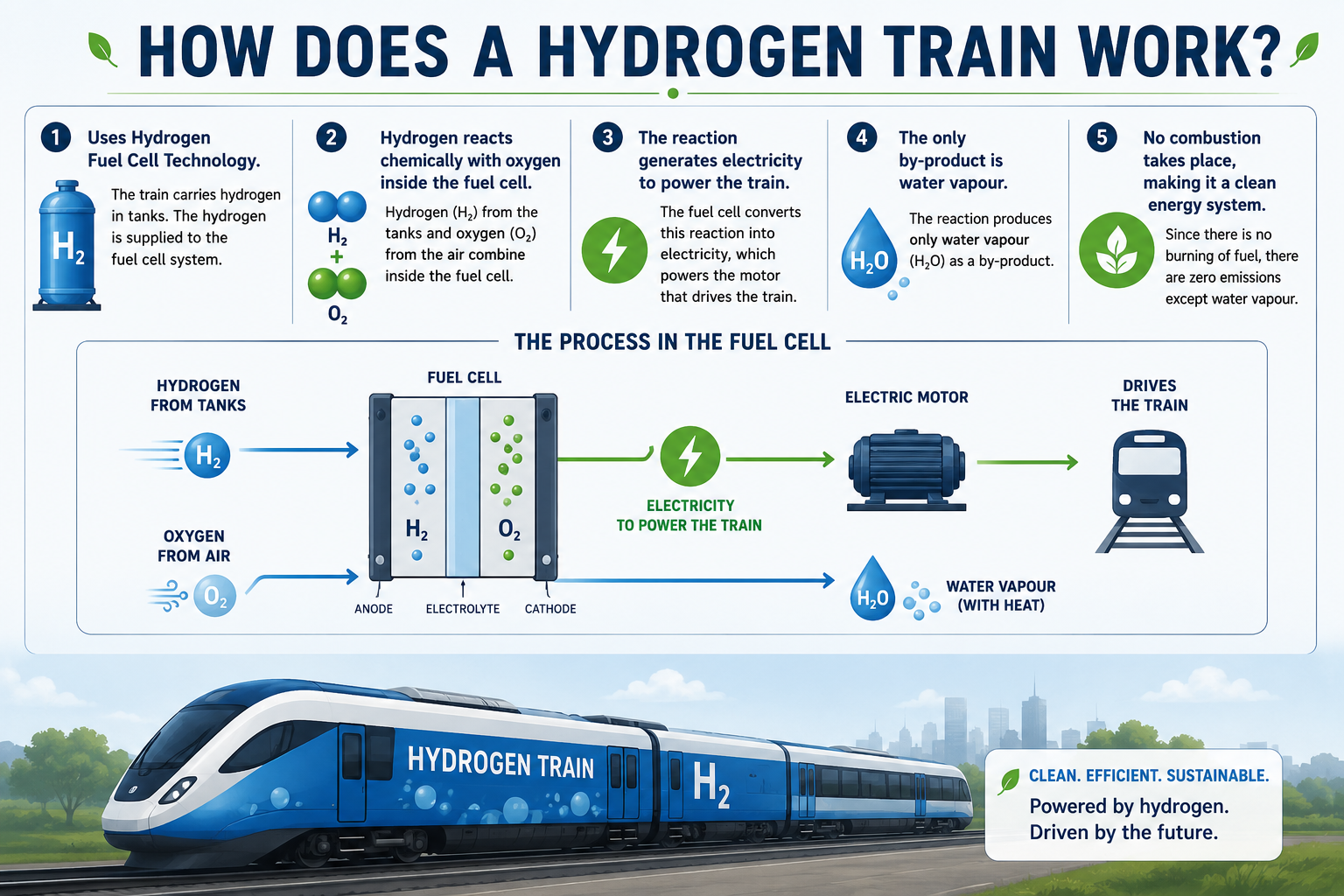
Electricity is generated onboard through a chemical reaction between hydrogen and oxygen.
-
The only tailpipe emission from the train is water vapour.
-
Hydrogen is burned directly inside an internal combustion engine to propel the train.
Which of the statements given above is/are correct?
A. 1 and 2 only
B. 2 and 3 only
C. 1 and 3 only
D. 1, 2 and 3
Answer: A
Explanation:
Hydrogen fuel cell trains generate electricity through an electrochemical reaction between hydrogen and oxygen. The only by-product is water vapour. Hydrogen is not burned in an internal combustion engine.
Q2. With reference to the National Green Hydrogen Mission, consider the following statements:
-
It aims to produce at least 5 million metric tonnes of Green Hydrogen annually by 2030.
-
It seeks to develop about 125 GW of renewable energy capacity.
-
One of its objectives is to reduce India's dependence on imported fossil fuels.
Which of the statements given above are correct?
A. 1 only
B. 1 and 2 only
C. 1, 2 and 3
D. 2 and 3 only
Answer: C
Explanation:
All three statements are correct and constitute the major objectives and targets of the National Green Hydrogen Mission.
Q3. Which of the following are components of the National Green Hydrogen Mission?
-
SIGHT Programme
-
Incentives for domestic electrolyser manufacturing
-
Development of Green Hydrogen hubs
-
Research & Development and skill development
Select the correct answer using the code below:
A. 1 and 2 only
B. 2 and 3 only
C. 1, 3 and 4 only
D. 1, 2, 3 and 4
Answer: D
Explanation:
All the listed initiatives are key components of the National Green Hydrogen Mission aimed at creating a complete Green Hydrogen ecosystem