This article examines India’s transition from high fertility to declining fertility and the emerging challenge of population ageing.
Syllabus Areas:
GS Paper I – Indian Society
GS Paper II – Governance
Essay
Economic Advisory Council to Prime Minister (EAC-PM) Report
The Economic Advisory Council to the Prime Minister (EAC-PM) is an independent body that advises the Prime Minister on economic and related policy matters through research and analysis.
India should move away from treating population control as an objective of state policy and recalibrate its family planning framework to reflect country’s rapidly changing demographic profile.
The report argues that India’s demographic challenge is shifting from concerns over rapid population growth towards declining fertility and population ageing.
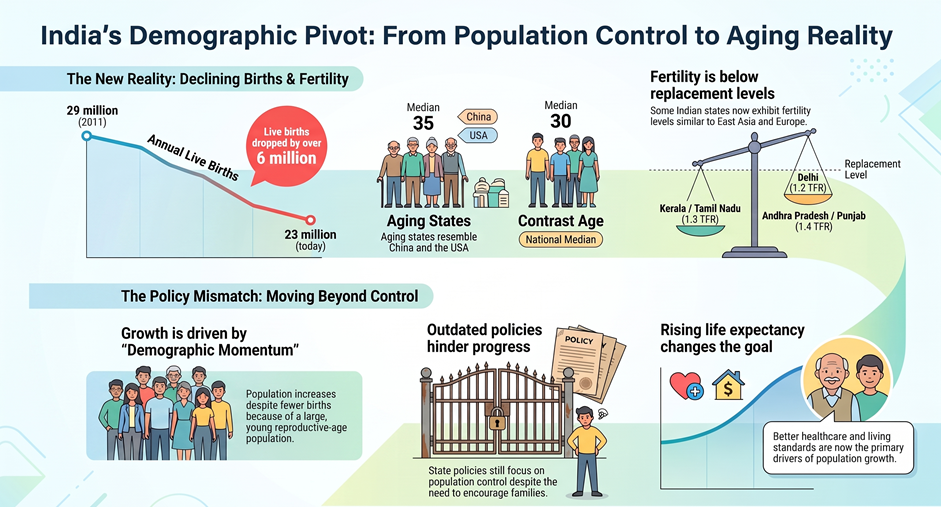
India’s fertility rate is well below replacement rate and some parts of the country now have East Asian and European fertility levels.
Fertility rate is the average number of children a woman is expected to have during her reproductive years, based on current age-specific fertility rates.
Replacement-level fertility is the fertility rate at which a population exactly replaces itself from one generation to the next, without migration, usually around 2.1 children per woman.
Live births in India peaked at 29 million in 2011 but have since declined to fewer than 23 million. Despite the fall in births, the country’s population continues to increase, largely because of demographic momentum — the effect of relatively young population that continues to have children even as average family size declines.
Live births in India refer to babies born showing signs of life, such as breathing, heartbeat, or movement, regardless of gestational age or birth weight.
Longer life expectancy, falling infant mortality and better health care and living standards have also contributed to population growth. Population control measures remain embedded in several government policies, including some states that are now beginning to confront possibility of low fertility and seek ways to encourage larger families.
Life expectancy in India is the average number of years a new born is expected to live, based on prevailing mortality rates and health conditions in the population.
Infant mortality in India refers to the number of deaths of infants before their first birthday, usually measured per 1,000 live births in a given year.
This creates mismatch between policies developed during India’s high fertility period and the demographic conditions emerging today.
India’s high-fertility period refers to the earlier decades when Indian women had larger families, resulting in rapid population growth and higher fertility rates before the subsequent demographic transition.
Total Fertility Rate (TFR) is the average number of children a woman would have during her reproductive years if current age-specific fertility rates remain constant.
Total Fertility Rate -
|
Total Fertility Rate |
State |
|
1.4 |
Andhra Pradesh, Punjab, Maharashtra |
|
1.5 |
Himachal Pradesh, Karnataka |
|
1.3 |
Kerala, Tamil Nadu, West Bengal |
|
1.6 |
Goa |
|
1.2 |
Delhi |
These low fertility states together have a median age of 35 years and average TFR 1.4. Their demographic profile increasingly resembles ageing economies such as China and USA rather than India’s national median age 30.
In China, population control policies remained in place for years even after their longer-term demographic consequences became apparent. India could face similar pressures if policies designed for an earlier phase of population growth continue unchanged.
Case Study: Andhra Pradesh
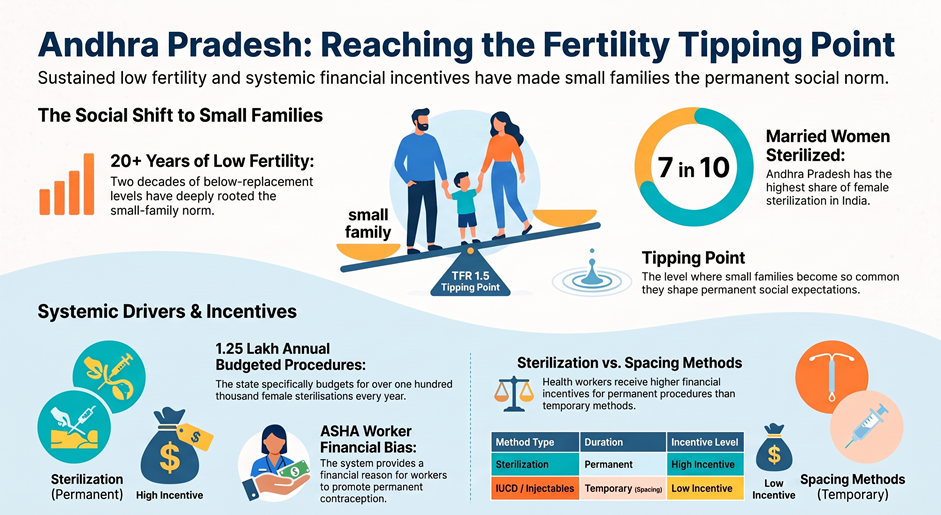
Andhra Pradesh’s experience shows how difficult it can be to reverse fertility decline once having fewer children becomes a social norm. AP has had below replacement fertility level for more than two decades.
This report says the state now faces what it calls a “behavioural tipping point”. This is a state at which fewer children becomes so common that it begins to shape people’s expectations about what a normal family should look like.
Behavioural tipping point is a stage when a behaviour becomes widely accepted as a social norm, making it increasingly difficult to reverse or change that behaviour.
In fact, possible tipping point could be at around Total Fertility Rate of 1.5. But it is not fixed cut-off. What matters is that fertility stays very low for long period, allowing smaller families to become deeply rooted as a social norm. Once this happens, encouraging people to have more children can become much harder.
In Andhra Pradesh, seven in 10 married women are sterilised, the highest share in India (NFHS-6). AP had also budget incentives for 1.25 lakh female sterilisation procedures every year.
Sterilisation is a permanent method of preventing pregnancy. Spacing methods such as IUCD and injectable contraceptives are temporary methods that allow couples to delay or space another pregnancy. AP’s system also gave health workers a financial reason to promote sterilisation. ASHA workers and health providers received higher incentives for sterilisation than for spacing methods.
In simple terms, a health worker could earn more for motivating a couple to choose permanent contraception than for helping them use a temporary method.