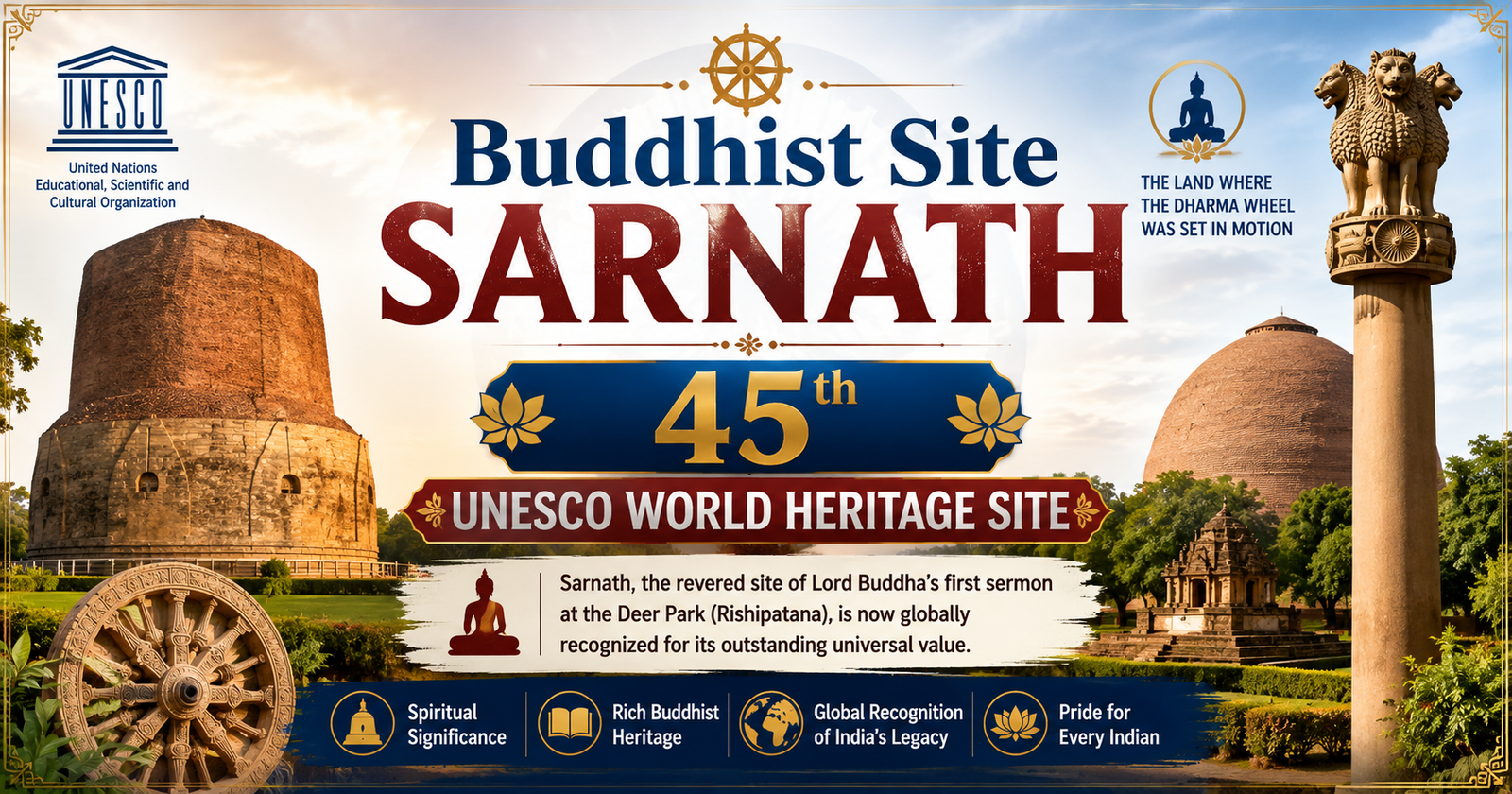
Sarnath, where Buddha delivered his first sermon, became India's 45th UNESCO World Heritage Site, highlighting its immense Buddhist heritage, global cultural significance, and historical importance.
Syllabus Areas:
GS I - Culture
The Ancient Buddhist Site of Sarnath (Uttar Pradesh) has been inscribed on the UNESCO World Heritage List during the 48th Session of the World Heritage Committee held at Busan, South Korea.
-
It has become India's 45th UNESCO World Heritage Site, reflecting India's rich civilizational and cultural heritage.
About Sarnath
-
Located near Varanasi, Uttar Pradesh.
-
Known by ancient names:
-
Rishipatana
-
Isipatana
-
Mrigadava (Deer Park)
Click Here to Read More About Buddhism and Sarnath:
Components of the UNESCO Property
The serial property comprises:
Chaukhandi Stupa
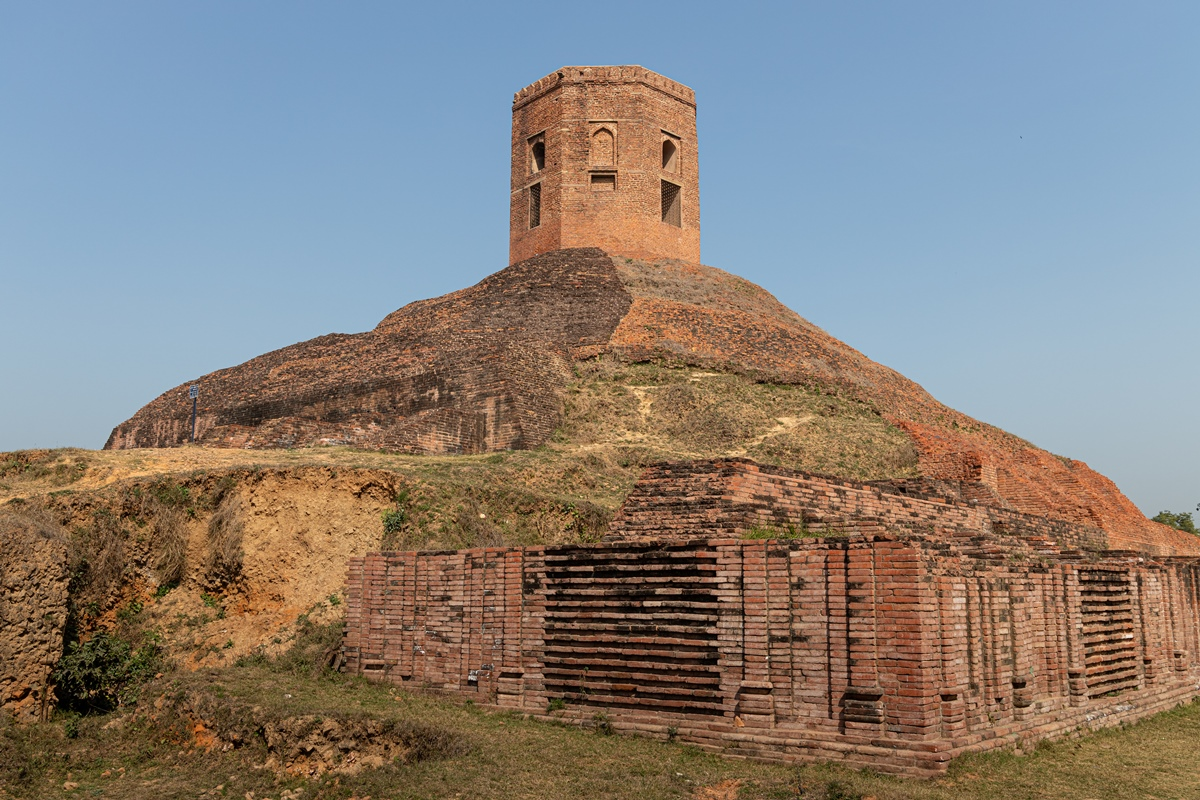
The Chaukhandi Stupa is an ancient Buddhist monument located at Sarnath, about 8 km from Varanasi, Uttar Pradesh. It marks the place where Gautama Buddha first met his five ascetic disciples after attaining enlightenment at Bodh Gaya. This meeting eventually led to Buddha's first sermon (Dharmachakra Pravartana) at nearby Sarnath.
Historical Background of Chaukhandi Stupa:
-
Originally built as a terraced brick stupa during the Gupta period (4th–6th century CE).
-
The octagonal tower on top was added later by Govardhan, son of Raja Todar Mal, in 1588 CE.
-
It was constructed to commemorate the visit of the Mughal emperor Humayun to Sarnath.
Historical Importance
-
One of the four principal Buddhist pilgrimage sites identified by the Buddha.
-
Continuous occupation from the Pre-Mauryan period (5th–4th century BCE) to the 12th century CE.
-
Rediscovered and scientifically excavated by the Archaeological Survey of India (ASI) after centuries of decline.
UNESCO Inscription Criteria of Sarnath
-
Criterion (iii): Sarnath bears exceptional testimony to the Buddhist tradition as one of the four principal Buddhist pilgrimage sites, reflected in its numerous stupas, monasteries, temples, and other monuments built over many centuries.
-
Criterion (vi): Sarnath is directly associated with Buddha's first sermon (Dharmachakra Pravartana) and his first meeting with the five disciples, marking the beginning of the Buddhist Sangha. Its monuments embody Buddha's teachings and the ideals of the Triratna (Three Jewels).
Major Buddhist Pilgrimage Sites Recognized by UNESCO
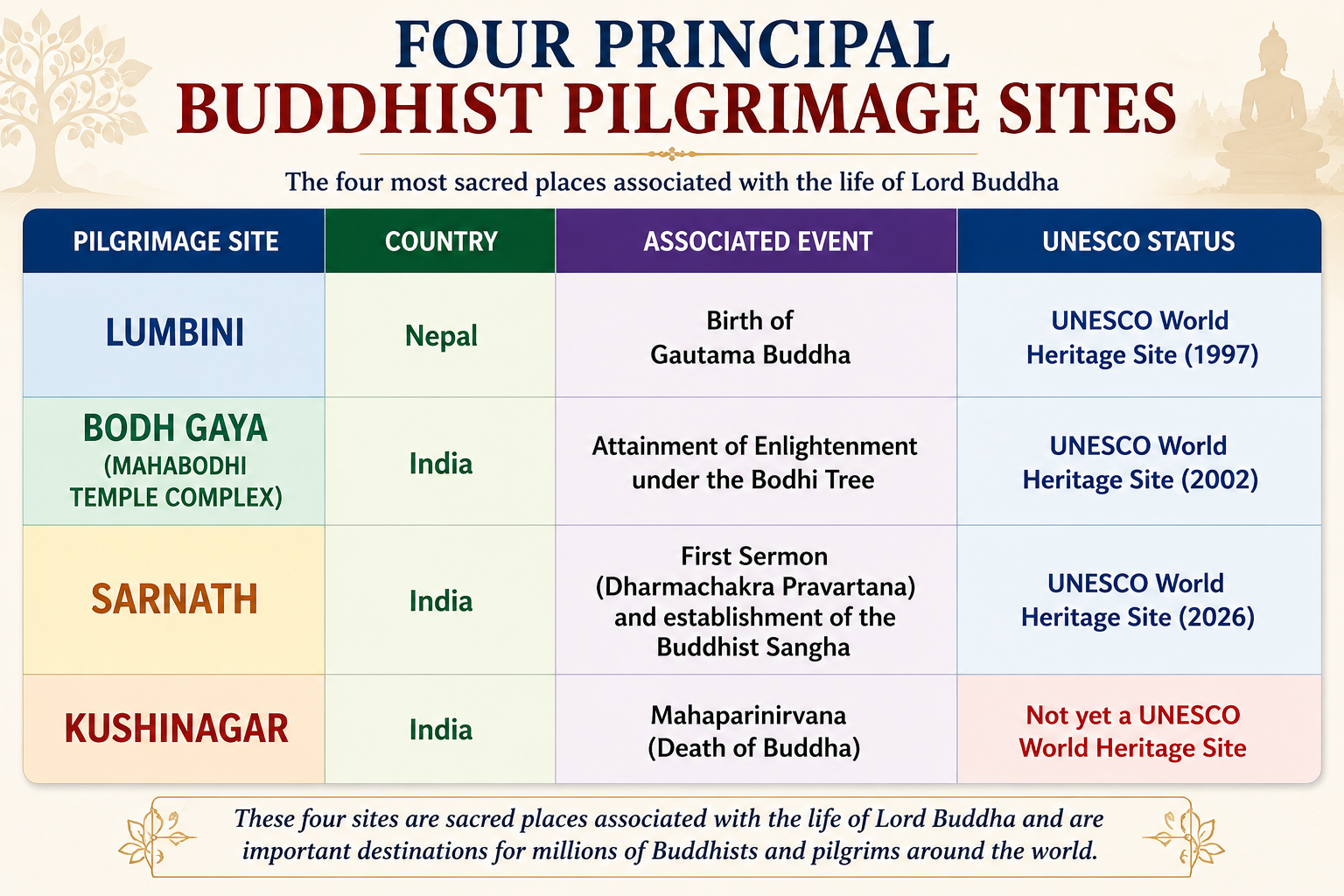
With the inscription of Sarnath as a UNESCO World Heritage Site, three of the four holiest Buddhist pilgrimage sites associated with the life of Gautama Buddha are now included in the UNESCO World Heritage List. This recognition highlights the global significance of Buddhist heritage and promotes its conservation.
The Four Principal Buddhist Pilgrimage Sites
According to the Mahaparinibbana Sutta, Lord Buddha advised his followers to visit four places connected with the major events of his life.
Click Here to Read Other UNESCO WHS related to Buddhism
Significance for India
-
Strengthens India's status as the birthplace of Buddhism.
-
Enhances:
-
Religious tourism
-
Cultural diplomacy
-
Heritage conservation
-
Global recognition of India's Buddhist legacy.
-
Supports stronger ties with Buddhist-majority countries such as Sri Lanka, Thailand, Myanmar, Cambodia, Vietnam, Japan, Mongolia, and South Korea.
Ashokan Legacy
-
The Ashokan Lion Capital, discovered at Sarnath, later became the National Emblem of India.
-
The famous Dharmachakra (Ashoka Chakra) is also associated with Sarnath.