Explore the Ken–Betwa Link Project, its water, irrigation and energy benefits, environmental safeguards, rehabilitation measures, regional development impacts, and significance for river interlinking programme of India.
Syllabus Areas:
GS I - Geography
GS II - Governance
GS III - Environment
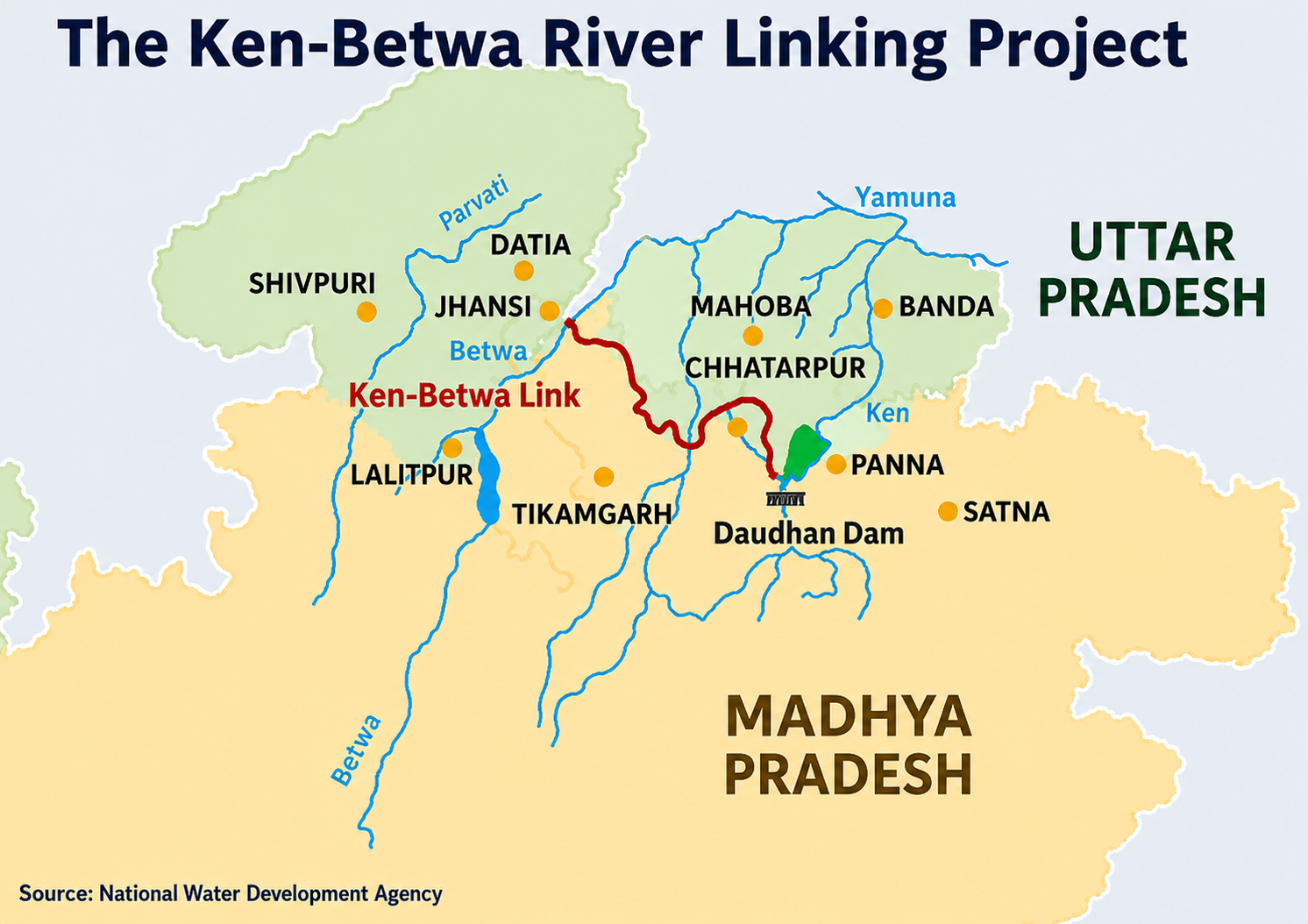
The Ken–Betwa Link Project (KBLP) is a major water-resources development project aimed at addressing the long-standing water scarcity and irrigation challenges of the Bundelkhand region of Madhya Pradesh and Uttar Pradesh.
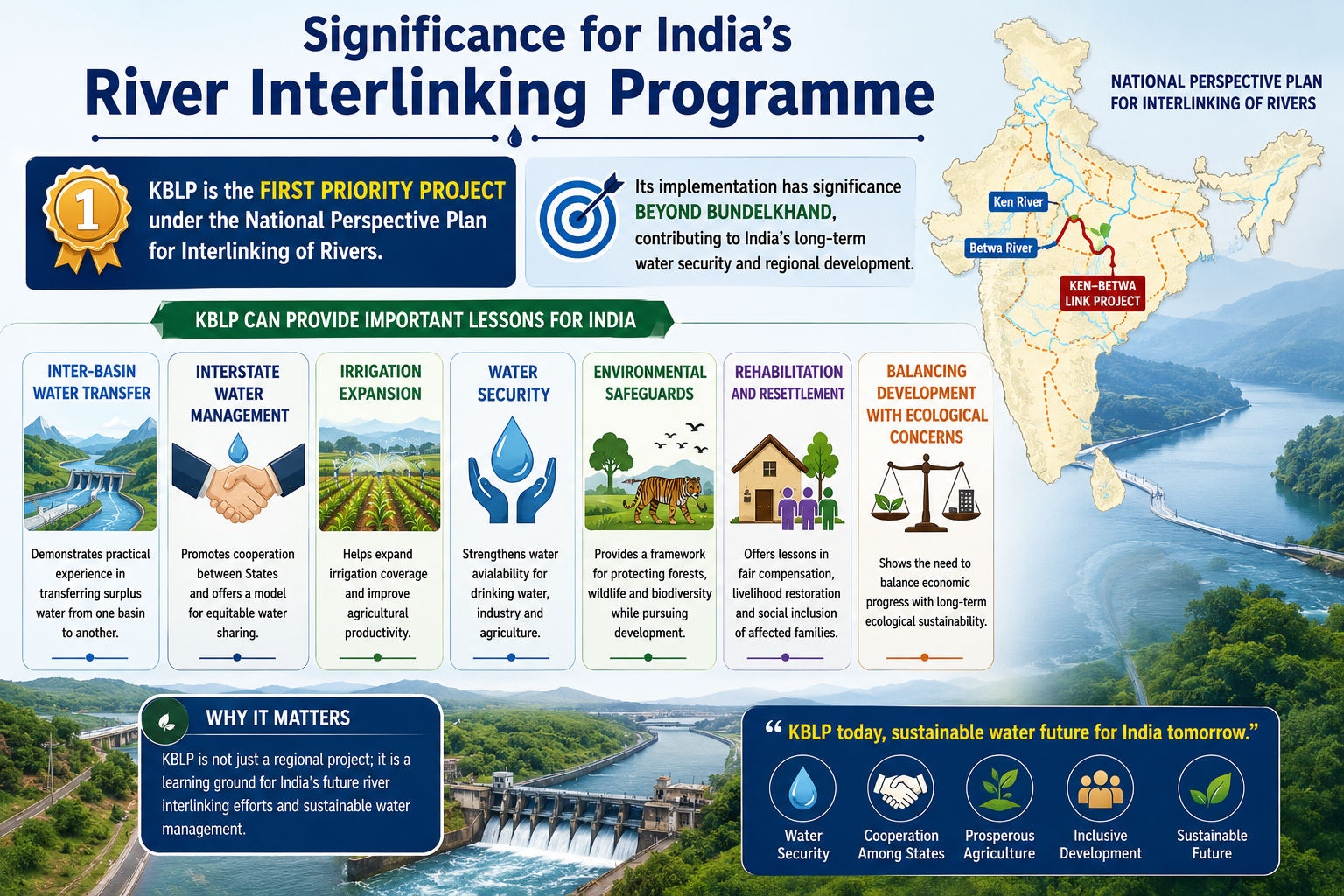
The project envisages transfer of water from the Ken River basin to the Betwa River basin through the construction of the Daudhan Dam, a link canal and associated works. It is the first priority project under the National Perspective Plan for Interlinking of Rivers (ILR).
Why is the Ken–Betwa Project Needed?
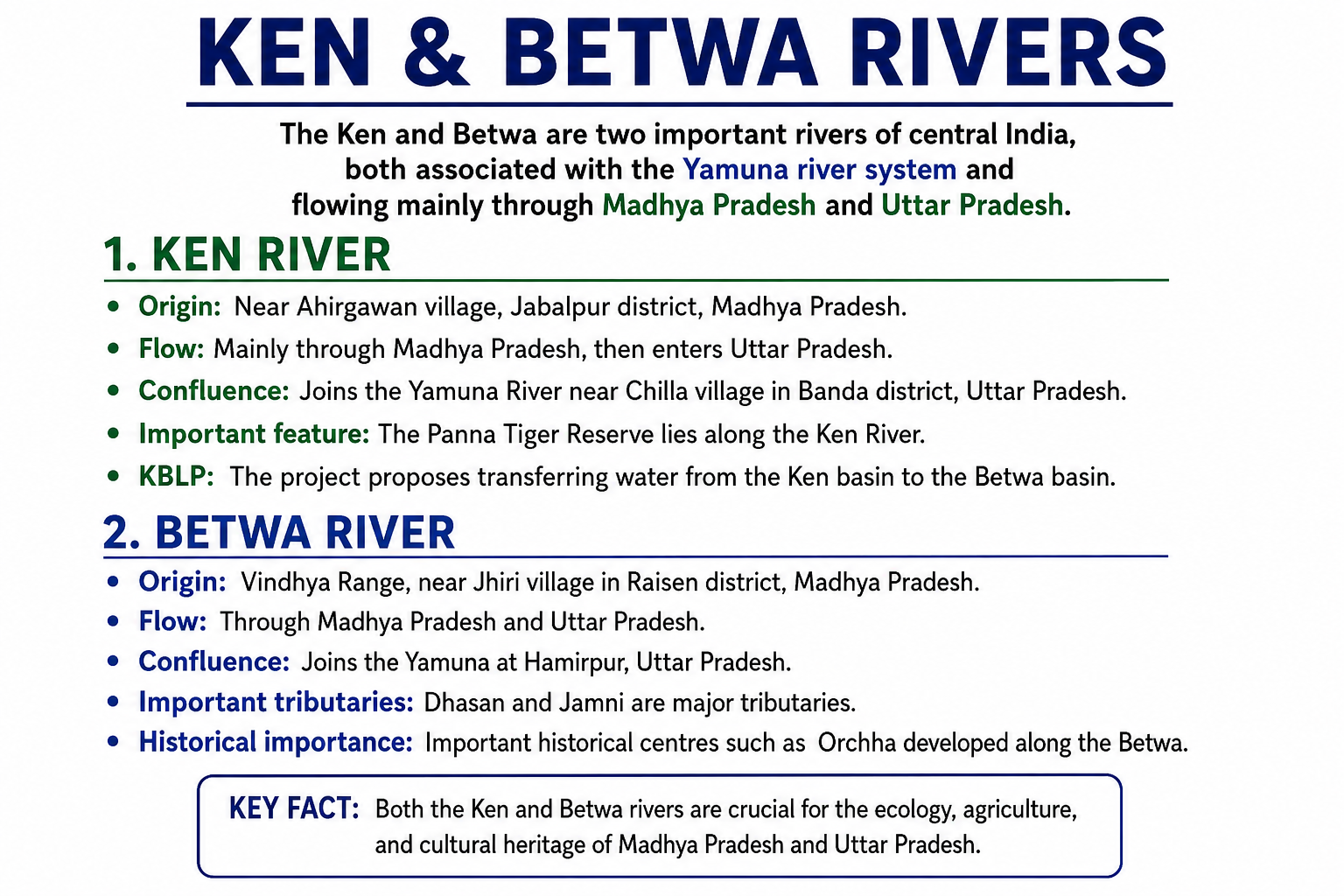
The Bundelkhand region has historically faced:
-
Recurrent water scarcity
-
Dependence on rainfall
-
Groundwater depletion in several areas
-
Inadequate irrigation facilities
-
Agricultural vulnerability
-
Water insecurity for rural communities
The project seeks to provide more dependable water availability for irrigation and drinking purposes, thereby strengthening regional water security and reducing vulnerability to drought.
Major Benefits
-
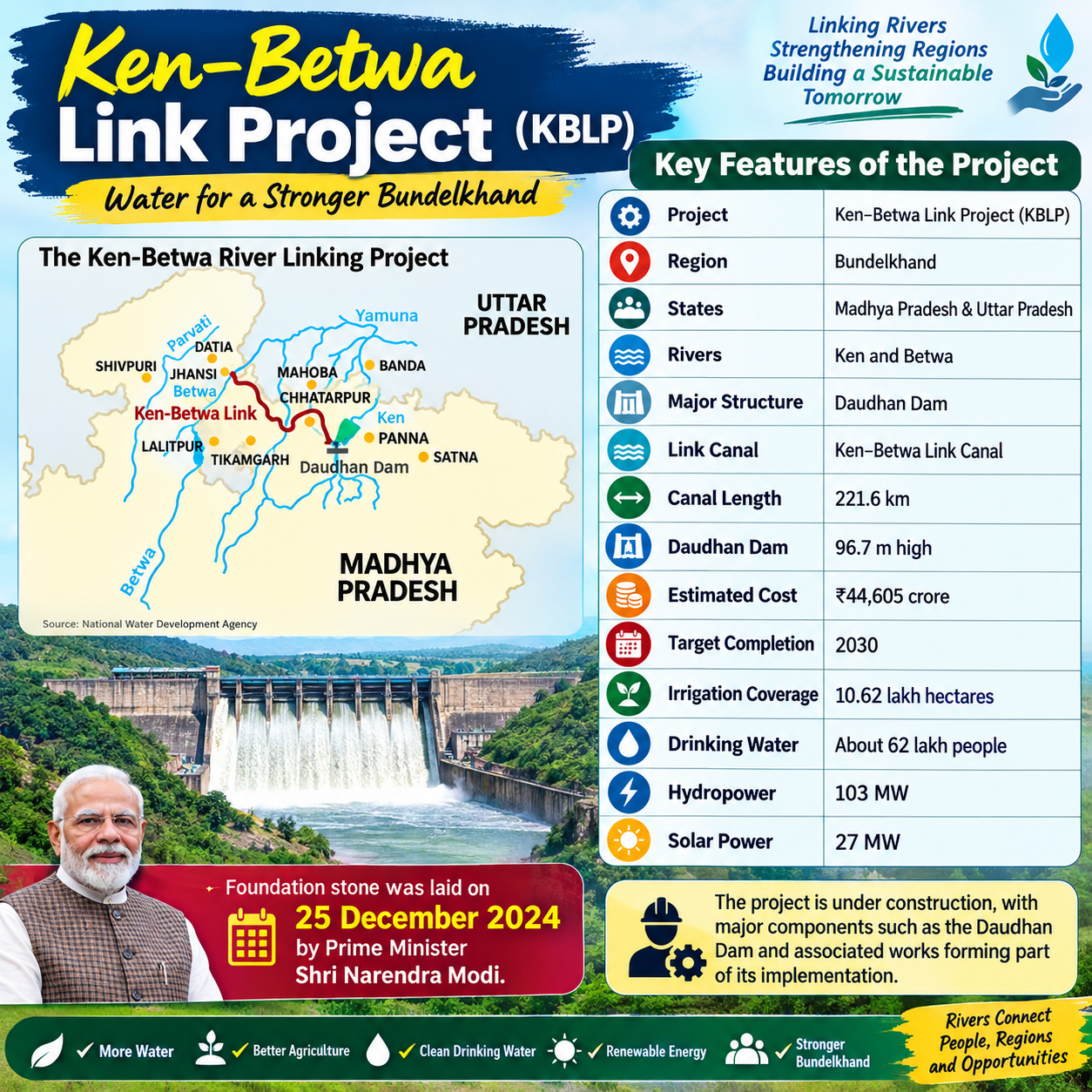
Irrigation: Provides irrigation to approximately 10.62 lakh hectares, improving water reliability, cropping intensity, productivity and farm incomes while reducing drought vulnerability.
-
Drinking Water: Supplies drinking water to around 62 lakh people, strengthening household water security, public health, sanitation and rural livelihoods, while reducing women's time burden.
-
Renewable Energy: Generates 103 MW of hydropower and 27 MW of solar power, integrating water infrastructure with clean-energy generation.
Areas Benefited
The project will benefit water-stressed areas of Madhya Pradesh and Uttar Pradesh.
Impact on Agriculture
-
Reliable irrigation → Higher cropping intensity & productivity.
-
Crop diversification → Higher-value crops & farm incomes.
-
Greater drought resilience → Improved rural livelihoods.
Can KBLP Eliminate Drought?
-
No, it cannot completely eliminate drought.
-
Improves water security, irrigation & drinking-water availability.
-
Reduces vulnerability to rainfall variability.
-
Outcomes depend on local hydrogeology & sustainable groundwater use.
Wider Regional Development
-
Boosts agriculture & employment.
-
Improves infrastructure, markets, schools & healthcare access.
-
Promotes commercial and agro-industrial development.
Transportation: Key Clarification
-
KBLP is primarily a water-resource & energy project, not a transport corridor.
-
Project roads, bridges & access infrastructure can improve local connectivity.
-
Supports movement of people, goods and agricultural produce and access to markets/services.
Land Acquisition and Rehabilitation & Resettlement
Land is required for the Daudhan Dam, Ken–Betwa Link Canal, powerhouses, roads and related infrastructure. Acquisition follows the RFCTLARR Act, 2013 and state laws, covering affected landowners, livelihood-dependent persons and forest communities.
-
Compensation & Special R&R Package: A special R&R package was announced in 2023. ₹629.87 crore was awarded, ₹604.745 crore paid, covering 5,039 affected families, with approximately 96% disbursed.
-
Livelihood Restoration: Rehabilitation extends beyond compensation, providing affected families vocational training, skill development, financial assistance, SHG support and small-business assistance to restore livelihoods and improve economic opportunities.
-
Special Provisions for Vulnerable Communities: Eligible SC/ST families and families in Scheduled Areas receive additional assistance. Rights of tribal and forest-dependent communities are protected under the Forest Rights Act, 2006.
-
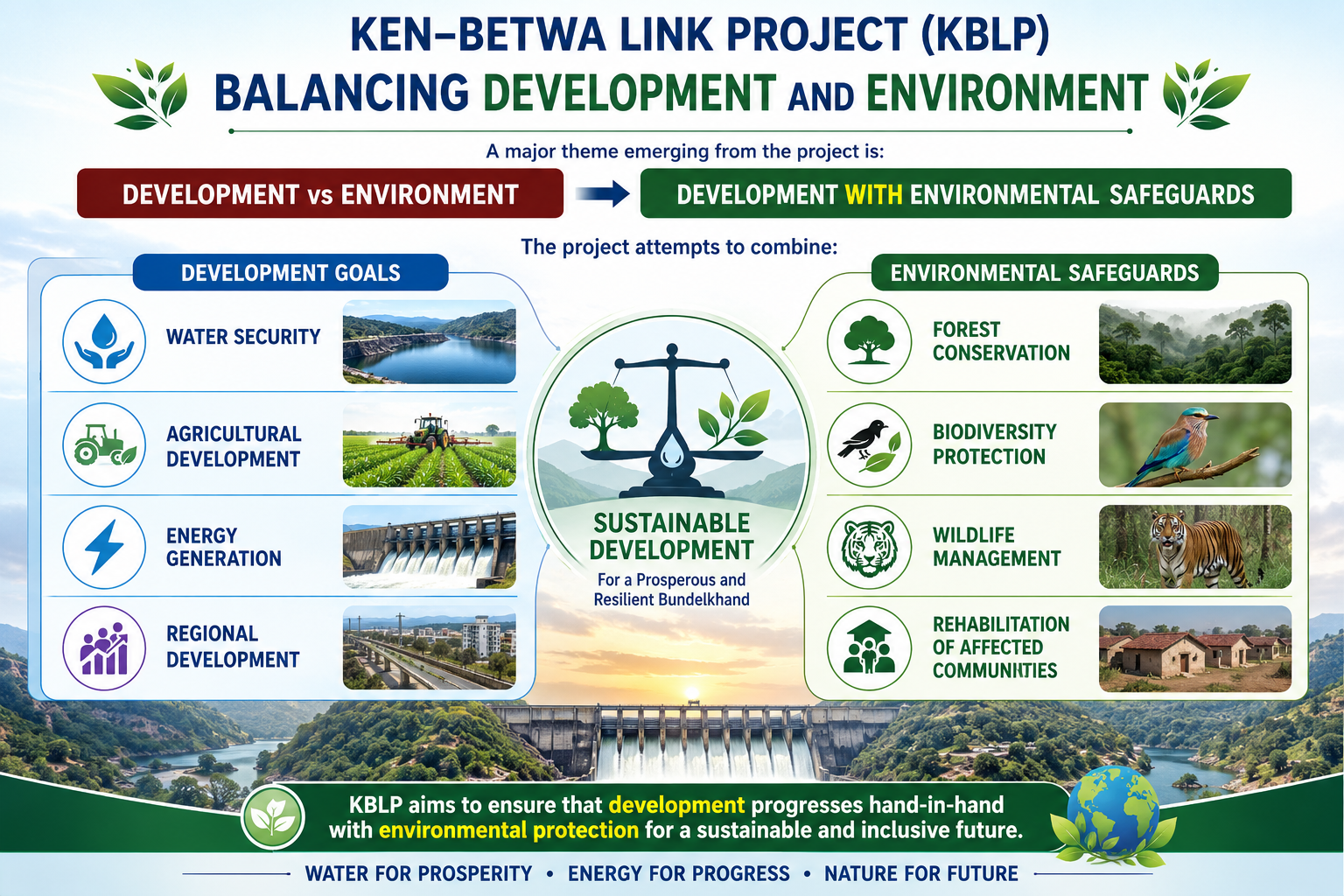
Environmental Concerns: KBLP incorporates EIA, Environmental Management Plans, wildlife and forest safeguards, compensatory afforestation, biodiversity conservation and landscape planning, supported by required environmental, wildlife and forest clearances.
Panna Tiger Reserve: Major Environmental Dimension
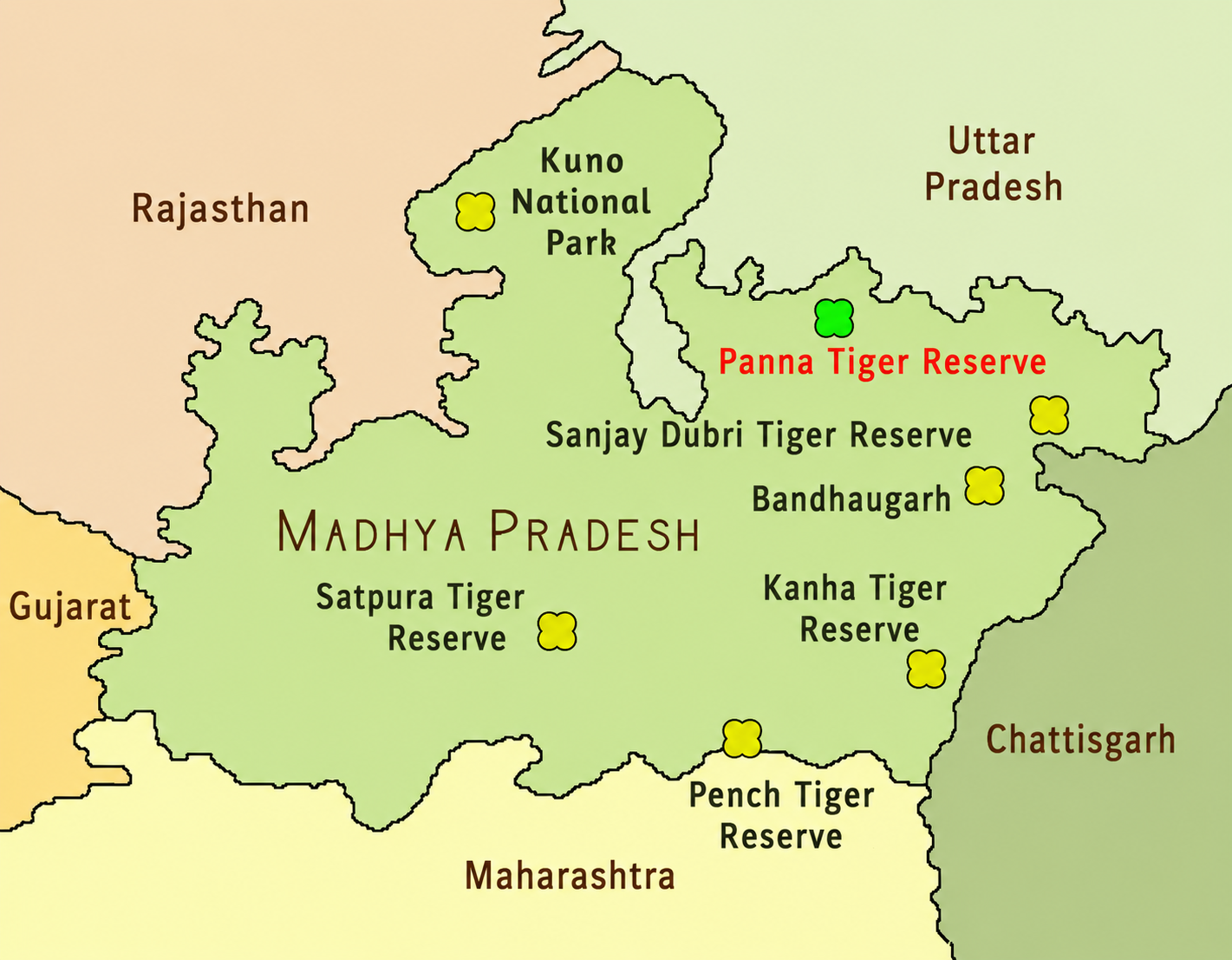
One of the most important environmental issues associated with KBLP is its proximity to the Panna Tiger Reserve (PTR) and the associated forest and biodiversity impacts.
The project has addressed these concerns through landscape-level planning and conservation measures.
Measures mentioned in the document
-
Integrated Landscape Management Plan (ILMP) by the Wildlife Institute of India
-
Greater Panna Landscape Management Plan
-
Safeguarding species such as:
-
Tiger
-
Vulture
-
Gharial
These measures seek to address impacts on forest ecosystems and biodiversity while ensuring long-term conservation.
-
Compensatory Afforestation: Where forest land is diverted for approved project purposes, compensatory afforestation and other prescribed measures are undertaken in accordance with applicable forest legislation.
The objective is to compensate for unavoidable forest loss and contribute to long-term ecological restoration
Downstream Water Security
The project is also designed to maintain environmental and downstream water requirements.
According to the document, continuous minimum environmental water release is to be maintained around the year so that:
-
Downstream farming is supported
-
Drinking-water needs are met
-
Aquatic ecosystems remain undisturbed
-
Regional groundwater recharge is supported
Thus, downstream ecological and livelihood concerns are incorporated into the project's water-management framework.
KBLP illustrates India's effort to convert water-stressed regions into more resilient development zones while demonstrating the need to integrate environmental safeguards, community rights and rehabilitation into large infrastructure projects.