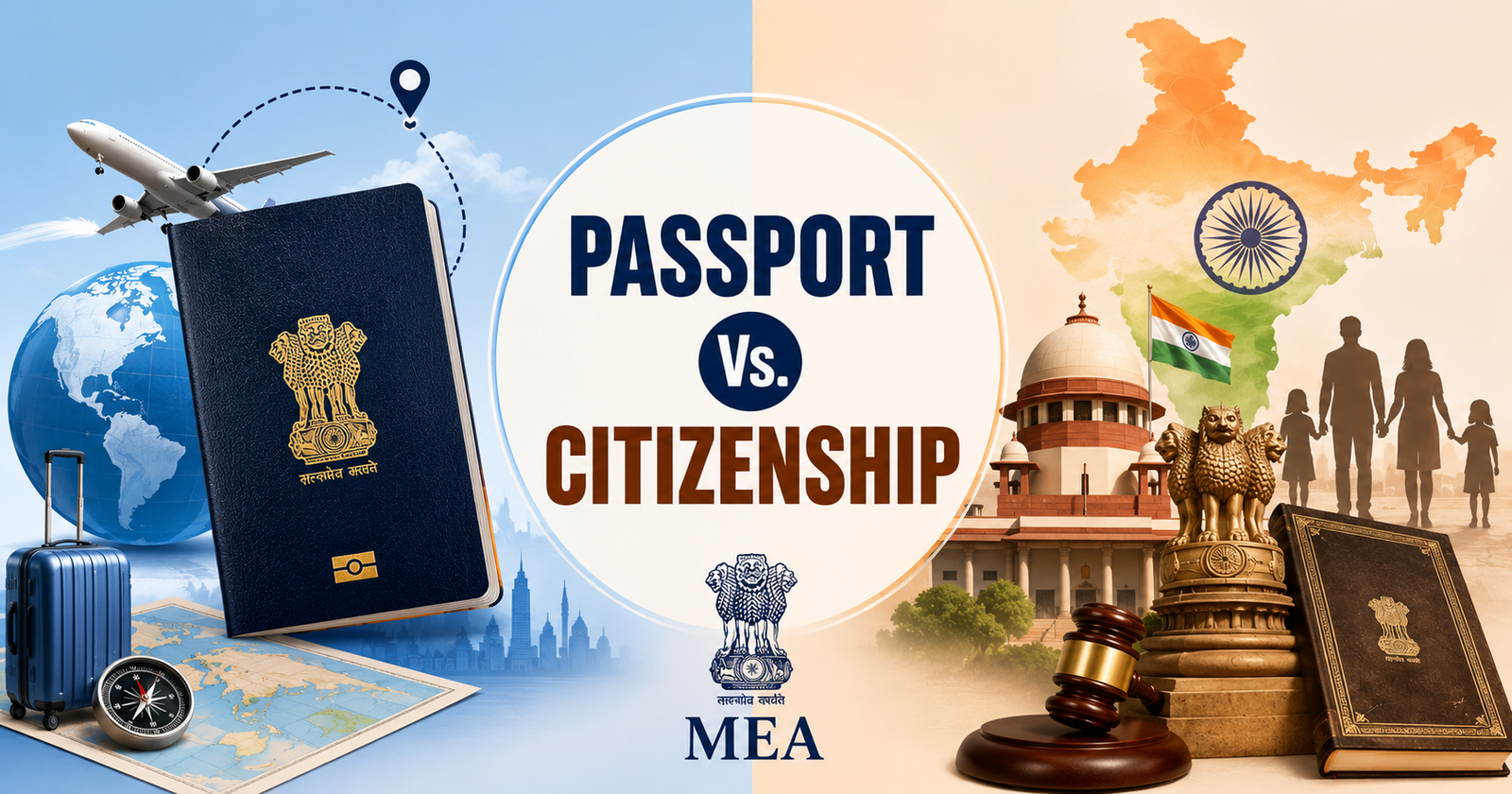
The MEA clarified that an Indian passport is primarily a travel document reflecting nationality, not conclusive proof of citizenship. Understand the legal distinction between passport, nationality, and citizenship in India.
Syllabus Areas:
GS II - Polity and Governance
The Ministry of External Affairs (MEA) recently clarified that an Indian Passport is primarily a travel document and not a conclusive proof of Indian citizenship. The clarification came during the 14th Passport Seva Divas (24 June 2026) and has sparked widespread public discussion, especially in the context of electoral roll revisions and citizenship-related debates.
The MEA emphasized that while passports are issued only after rigorous verification, their legal purpose is to facilitate international travel and establish the holder's nationality abroad, rather than serve as a definitive legal document for citizenship disputes within India.
Key Points To Understand:
-
The Indian Passport is primarily a travel document.
-
It certifies the nationality of an Indian while travelling abroad.
-
It is not a conclusive legal proof of citizenship in all circumstances.
-
Passports are issued only after detailed verification under the Passport Act, 1967.
-
Citizenship in India is governed by the Constitution of India (Articles 5–11) and the Citizenship Act, 1955.
What is a Passport?
A passport is an official document issued by the Government of India that enables its holder to travel internationally. It serves as an internationally recognized identity document and requests foreign governments to permit the holder to enter or transit through their territories.
Nationality vs Citizenship: Understanding the Difference
One of the most important concepts behind the MEA's clarification is the distinction between Nationality and Citizenship.
Nationality
Nationality refers to the legal relationship between an individual and a sovereign state under international law.
It primarily:
-
Identifies the country to which a person belongs internationally.
-
Determines diplomatic protection abroad.
-
Is reflected in an Indian Passport.
For example, an Indian passport identifies the holder's nationality as Indian.
Citizenship
Citizenship is a constitutional and legal status that determines an individual's rights and obligations within a country. Part III of the Constitution from Article 5 to Article 11 talks about Citizenship.
Citizenship provides rights such as:
-
Right to vote
-
Right to contest elections
-
Eligibility for constitutional offices
-
Access to certain government benefits
-
Political participation
Citizenship in India is determined according to the Constitution and the Citizenship Act, 1955.
If Passports Are Issued Only to Citizens, Why Are They Not Conclusive Proof of Citizenship?
-
Before issuing a passport, authorities verify Identity, Address, Police records, Birth details, Aadhaar and other government records
-
However, legal disputes regarding citizenship may involve additional constitutional and statutory considerations.
-
Therefore, while passport issuance presumes citizenship after due verification, the passport itself does not become a legally conclusive citizenship certificate for every purpose.
Passport Act, 1967
The Passport Act, 1967 governs the issuance of passports in India.
Section 6(2)(a): The Passport Authority shall refuse to issue a passport if the applicant is not a citizen of India.
Thus:
-
Only Indian citizens are eligible for Indian passports.
-
The Act, however, does not declare that the passport itself is the final legal proof of citizenship.
Constitutional Provisions on Citizenship (Articles 5–11)
-
Article 5 – Citizenship at the Commencement of the Constitution: Grants citizenship to persons domiciled in India who satisfy conditions relating to birth, parentage, or residence.
-
Article 6 – Migrants from Pakistan to India: Grants citizenship to persons who migrated from Pakistan to India before or after 19 July 1948, subject to prescribed conditions and registration.
-
Article 7 – Migrants to Pakistan: Persons who migrated to Pakistan after 1 March 1947 were not considered Indian citizens, unless they returned to India under a Permit for Resettlement or Permanent Return.
-
Article 8 – Indians Residing Abroad: Persons of Indian origin living outside India could acquire Indian citizenship by registering at an Indian diplomatic or consular mission.
-
Article 9 – Voluntary Acquisition of Foreign Citizenship: A person who voluntarily acquires the citizenship of another country ceases to be an Indian citizen. India does not permit dual citizenship.
-
Article 10 – Continuance of Citizenship: Persons recognized as Indian citizens under Articles 5–9 continue as citizens, subject to laws made by Parliament.
-
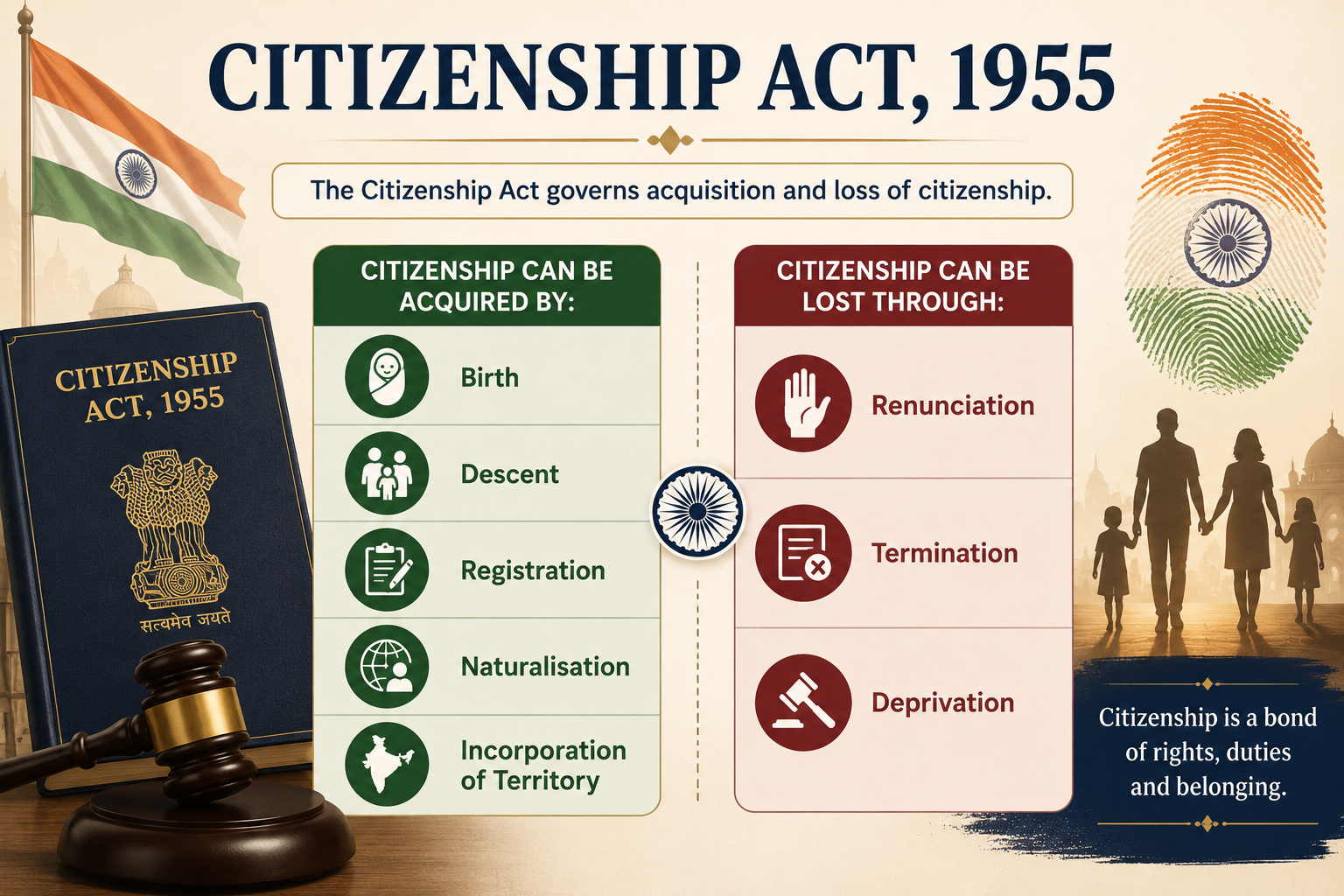
Article 11 – Parliament's Power to Regulate Citizenship: Empowers Parliament to make laws regarding the acquisition, termination, renunciation, and all other matters relating to citizenship. The Citizenship Act, 1955 was enacted under this Article.
Why Has This Issue Become Significant?
The clarification gained importance due to discussions surrounding:
-
Revision of electoral rolls
-
Citizenship-related debates
-
Identity verification
-
Documentation requirements for government processes
The MEA clarified that electoral authorities operate under separate legal provisions and that a passport alone cannot determine electoral eligibility.
e-Passports: India's Next Generation Travel Document
The Government is gradually introducing chip-enabled e-Passports across the country.
Features
-
Embedded RFID chip
-
Stores biometric and demographic information securely
-
Strong protection against tampering
-
Faster immigration clearance
-
Compliance with ICAO international standards
-
Improved anti-forgery features
According to the MEA, around 10% of Indian passport holders currently possess e-Passports, and the rollout is expanding under the revamped Passport Seva Programme.
Passport Seva Programme
The Passport Seva Programme aims to provide efficient, transparent and citizen-friendly passport services.
Important Features
-
Online application system
-
Appointment scheduling
-
Faster processing
-
Police verification integration
-
Digital tracking
-
Improved accessibility across India
India presently has 545 Passport Seva Kendras, covering nearly every Lok Sabha constituency.
Passport Seva Divas
Observed: 24 June every year
Objectives
-
Commemorate the Passport Act, 1967
-
Improve passport delivery systems
-
Recognise the contribution of passport officials
-
Promote citizen-centric governance
Visa Facilitation for Indian Passport Holders
According to the MEA:
-
27 countries provide visa-free entry to Indian passport holders.
-
47 countries offer Visa-on-Arrival facilities.
-
66 countries provide e-Visa facilities.
These measures enhance global mobility for Indian citizens.
The recent clarification by the Ministry of External Affairs reinforces an important legal distinction between nationality and citizenship. While an Indian passport is issued only after comprehensive verification and serves as proof of nationality during international travel, it is not intended to function as a universal legal certificate of citizenship in all domestic legal contexts.
Prelims Practice Question
Q. Consider the following statements regarding Indian Passports:
-
An Indian Passport is issued under the Passport Act, 1967.
-
Possession of an Indian Passport is conclusive legal proof of Indian citizenship.
-
e-Passports contain an embedded RFID chip.
Which of the statements given above is/are correct?
A. 1 only
B. 1 and 3 only
C. 2 and 3 only
D. 1, 2 and 3
Answer: B. 1 and 3 only
Q. Consider the following statements regarding the constitutional provisions on citizenship:
-
Article 5 deals with citizenship at the commencement of the Constitution.
-
Article 9 permits dual citizenship under certain conditions.
-
Article 11 empowers Parliament to make laws relating to citizenship.
Which of the statements given above is/are correct?
A. 1 only
B. 1 and 3 only
C. 2 and 3 only
D. 1, 2 and 3
Answer: B. 1 and 3 only