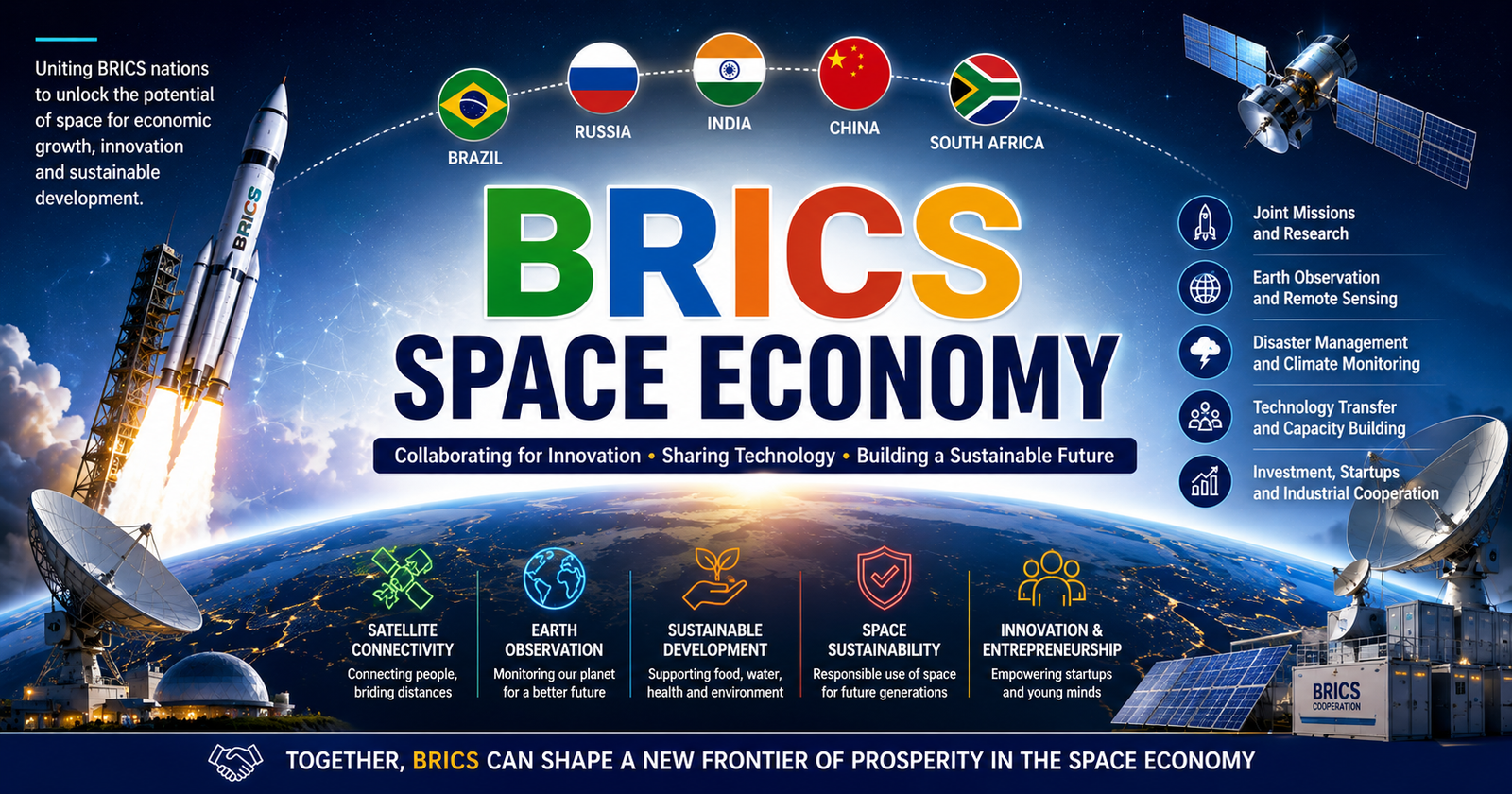
India proposed the BRICS Space Economy to promote innovation, technology sharing, investment, sustainability, and collaborative space research, strengthening economic growth and global space cooperation among BRICS nations.
Syllabus Areas:
GS II - International Relations
GS III - Economy, Science and Technology
India proposed the concept of a BRICS Space Economy during the BRICS Heads of Space Agencies (HOSA) Meeting in Bengaluru. The idea is to create an integrated space ecosystem among BRICS countries through Joint innovation, Investment, Technology transfer, Entrepreneurship, Industrial collaboration. It aims to make space a major contributor to economic growth and sustainable development.
What is the BRICS Space Economy?
The BRICS Space Economy is India's proposal to build a collaborative space ecosystem among BRICS countries by integrating their scientific expertise, technological capabilities, industries, and investments. The initiative aims to transform space technology into a major driver of economic growth, innovation, and sustainable development.
Rather than working independently, BRICS nations seek to develop joint solutions for common developmental and global challenges through enhanced cooperation in the space sector.
What is the Space Economy?
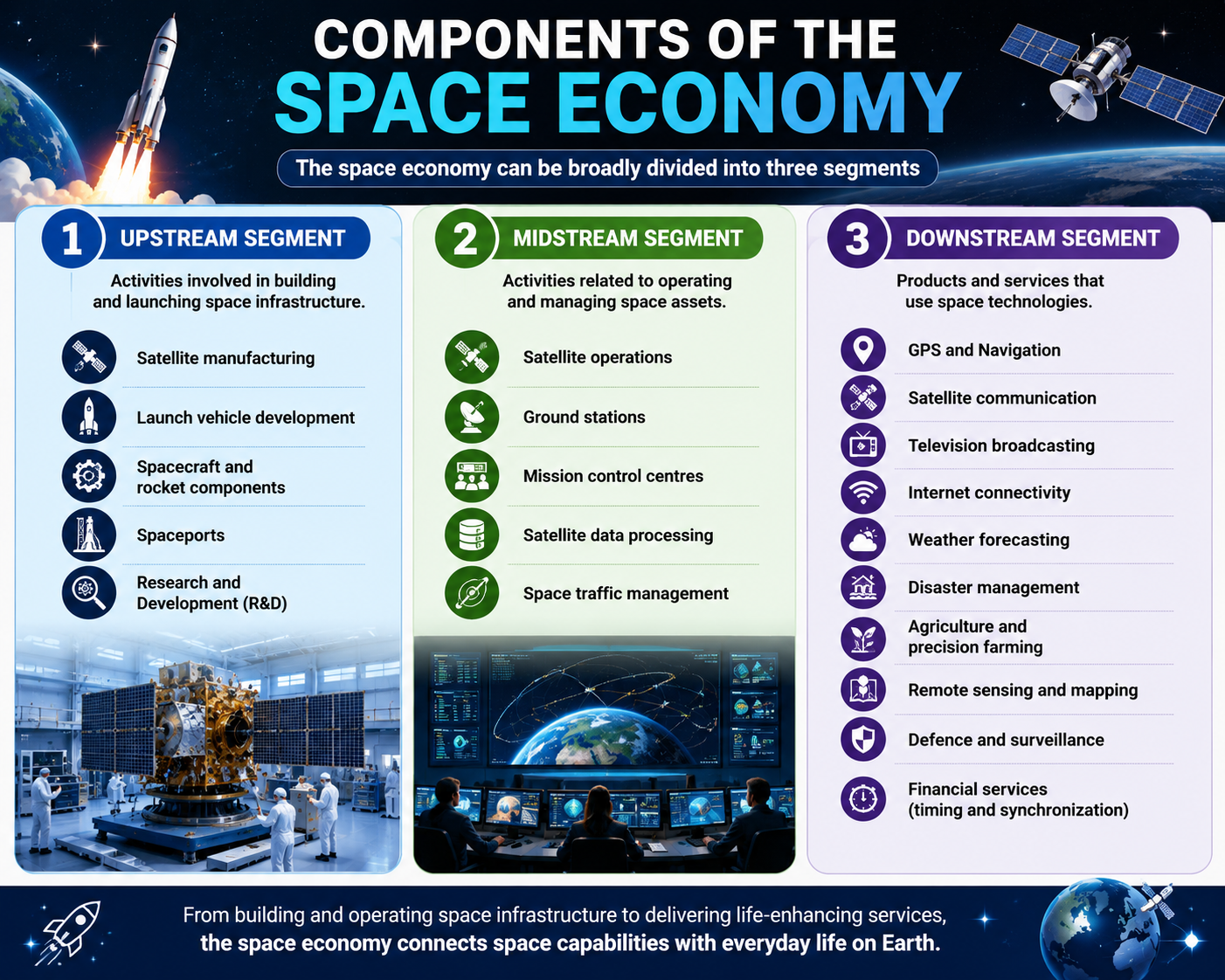
The Space Economy refers to the entire range of economic activities related to the exploration, development, utilization, and commercialization of outer space, including the production of goods and services that use space-based technologies to generate economic and societal benefits.
According to the OECD, the space economy encompasses all public and private activities involved in developing, providing, and using space-enabled products, services, and knowledge to create value for individuals, businesses, and governments.
Objectives of the BRICS Space Economy
The proposed initiative seeks to:
-
Promote innovation and advanced space research.
-
Encourage investments in the space sector.
-
Strengthen technology transfer among BRICS countries.
-
Support entrepreneurship and private space industries.
-
Develop resilient space-based infrastructure.
-
Enhance international cooperation for peaceful uses of outer space.
-
Generate new economic opportunities through collaborative space missions.
Key Outcomes of the BRICS Heads of Space Agencies (HOSA) Meeting
The participating countries reviewed existing cooperation and discussed several important initiatives:
1. Space Sustainability
-
Promoting responsible use of outer space.
-
Addressing increasing orbital debris.
-
Encouraging debris-free space missions.
- Developing sustainable space operations.
2. Strengthening the BRICS Remote Sensing Satellite Constellation (RSSC)
-
Improving satellite data sharing.
-
Expanding Earth observation capabilities.
-
Enhancing disaster management and environmental monitoring.
3. Proposal for a BRICS Space Council
-
Discussions on creating an institutional mechanism for long-term cooperation.
-
Providing continuity and strategic direction for future joint projects.
4. Capacity Building
-
Knowledge sharing among member nations.
-
Technical cooperation.
-
Human resource development.
-
Joint scientific research.
5. Inclusion of New BRICS Members
-
Expanding participation of recently admitted BRICS countries in existing space cooperation mechanisms.
How Space Technology Supports Economic Development
Space technology is no longer confined to scientific exploration but has become an essential component of economic transformation.
Its applications include:
-
Satellite communication
-
Navigation systems
-
Precision agriculture
-
Healthcare services
-
Education
-
Climate monitoring
-
Disaster preparedness
-
Environmental protection
-
Food and water security
-
Urban planning
These technologies help governments improve service delivery while creating new opportunities for businesses and startups.
India's Growing Leadership in the Space Sector
India showcased its rapidly expanding space ecosystem and highlighted:
-
Successful missions like Chandrayaan-3 and Aditya-L1.
-
Progress of the Gaganyaan Human Spaceflight Mission.
-
Major reforms opening the space sector to:
-
Private companies
-
Startups
-
Academia
-
International partnerships
-
Growing role of India's NewSpace ecosystem in driving innovation.
Importance of Space Sustainability
The long-term success of the global space economy depends upon preserving outer space as a safe and sustainable domain.
India stressed the need for:
-
International cooperation.
-
Responsible behaviour in space activities.
-
Transparency among space-faring nations.
-
Reduction of orbital debris.
-
Sustainable utilization of outer space resources.
These efforts are essential for protecting the space environment for future generations.
Why is the BRICS Space Economy Significant?
The proposed initiative has the potential to:
-
Position BRICS as a major force in the global space economy.
-
Strengthen South-South cooperation.
-
Accelerate scientific innovation.
-
Promote private sector participation.
-
Expand commercial space opportunities.
-
Improve disaster resilience through satellite technologies.
-
Support sustainable development goals.
-
Enhance strategic cooperation among emerging economies.
The proposed BRICS Space Economy reflects India's vision of making space technology a catalyst for innovation, economic growth, and sustainable development. By encouraging joint research, technology sharing, institutional cooperation, and private sector participation, the initiative aims to transform BRICS into a leading force in the evolving global space ecosystem. If implemented effectively, it can significantly strengthen international space governance while unlocking new opportunities for science, industry, and society.
Prelims Questions:
Q. Which of the following are examples of the Downstream Segment of the Space Economy?
- GPS navigation
- Satellite communication
- Weather forecasting
- Precision agriculture
- Remote sensing
Select the correct answer.
A. 1, 2 and 5 only
B. 3, 4 and 5 only
C. 1, 2, 3, 4 and 5
D. 2 and 4 only
Answer: C