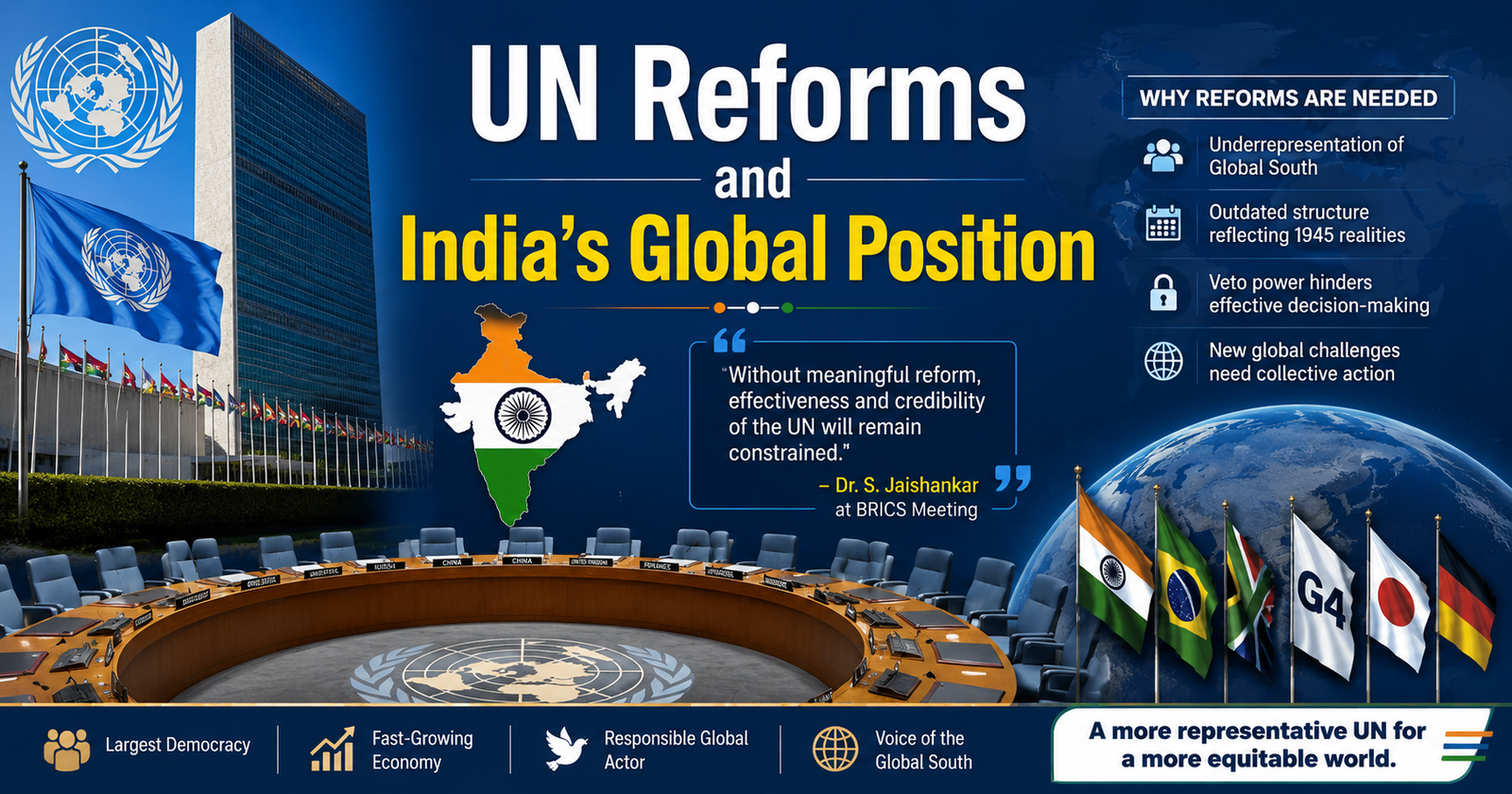
India’s push for UN reforms highlights the need for a more democratic and representative global order. Learn why India seeks permanent UNSC membership and how changing geopolitics shape global governance debates.
Syllabus Areas:GS II - International Relations |
The debate over reforming the United Nations (UN), especially the United Nations Security Council (UNSC), has once again gained attention after India strongly raised the issue during the recent BRICS meeting. India argued that global institutions created after the Second World War no longer reflect present-day geopolitical realities. According to India, without meaningful reforms, the effectiveness and credibility of the UN system will continue to weaken.
Why UN Reforms Are Being Discussed Again
The current structure of the UN Security Council was designed in 1945 after World War II. At that time, the global balance of power was very different from today. The permanent members of the UNSC — the United States, Russia, China, the United Kingdom, and France — were considered the major powers of that period.
However, over the decades, the world has changed significantly:
-
Many new countries emerged after decolonization.
-
Economic and political power shifted toward Asia, Africa, and Latin America.
-
Countries like India, Brazil, Germany, Japan, and South Africa gained major global influence.
-
New challenges such as climate change, cyber security, terrorism, pandemics, and energy crises emerged.
Despite these changes, the structure of the UNSC remains largely unchanged. As a result, many countries believe that the UN no longer adequately represents contemporary global realities.
India’s Main Argument
India argues that the present UN system suffers from a “representation deficit.” In simple terms, decision-making power is concentrated in a few countries while large parts of the world remain underrepresented.
India highlighted several concerns:
1. Global South Lacks Representation
Africa, Latin America, and much of Asia do not have permanent representation in the UNSC. This creates dissatisfaction among developing countries.
India believes that countries representing the Global South should have a greater voice in international decision-making.
2. Current Structure Reflects 1945, Not 2026
The UNSC structure still reflects the post-World War II order. At that time:
-
India was not independent.
-
Many African countries did not exist as sovereign nations.
-
China’s economy was not globally dominant.
-
Europe was the center of global politics.
Today, economic and demographic realities are entirely different. India argues that institutions must evolve with changing realities.
3. Inefficiency in Handling Global Crises
Critics argue that the UNSC has often failed to respond effectively to major crises because of political divisions among permanent members.
Examples include:
-
Russia-Ukraine conflict
-
Israel-Palestine tensions
-
Syria conflict
-
humanitarian crises in Africa
The veto power frequently blocks collective action. India argues that excessive concentration of power reduces the credibility of global governance.
What Is the Veto Power Debate?
The five permanent members of the UNSC possess veto power. This means any one of them can block a resolution even if most countries support it.
Many countries criticize this arrangement because:
-
it creates inequality among nations,
-
allows geopolitical interests to dominate,
-
and weakens democratic functioning within the UN.
India has not only demanded expansion of permanent membership but also called for serious discussions on the future of veto powers.
However, removing veto power is politically difficult because existing permanent members are unlikely to surrender their privileges voluntarily.
India’s Claim for Permanent Membership
India has consistently argued that it deserves permanent membership in the UNSC due to its growing global role.
India highlights several strengths:
1. Largest Democracy
India is the world’s largest democracy with a massive population and strong constitutional institutions.
2. Major Economic Power
India is among the world’s fastest-growing major economies and plays a crucial role in global trade, technology, and markets.
3. Responsible Global Actor
India has contributed significantly to:
-
UN peacekeeping missions,
-
climate negotiations,
-
humanitarian assistance,
-
disaster relief operations,
-
and development partnerships.
India projects itself as a responsible and constructive power rather than an aggressive geopolitical actor.
4. Voice of the Global South
India increasingly positions itself as the representative of developing nations. Through forums like:
-
BRICS,
-
G20,
-
International Solar Alliance,
-
and Global South Summits,
India seeks to amplify concerns of developing countries regarding inequality, debt, climate finance, and technology access.
What Is the G4 Group?
India is part of the G4 grouping along with:
-
Japan,
-
Germany,
-
and Brazil.
These countries support each other’s bids for permanent UNSC membership.
Their common argument is that countries with significant economic, political, and demographic influence must be included in permanent decision-making structures.
However, opposition also exists.
Why Some Countries Oppose UNSC Expansion
Several countries oppose expansion proposals due to regional rivalries and geopolitical concerns.
Examples:
-
Pakistan opposes India’s permanent membership.
-
China has shown reluctance regarding India and Japan.
-
Some countries argue that expanding permanent membership may create new inequalities instead of solving old ones.
Another group called “Uniting for Consensus” prefers increasing only non-permanent seats rather than adding new permanent members.
Why BRICS Support Matters
At recent BRICS meetings, discussions on multipolarity and global governance reforms became more prominent.
BRICS nations generally argue that:
-
Western dominance in international institutions should reduce,
-
emerging economies deserve larger roles,
-
and global governance must become more democratic and inclusive.
For India, BRICS provides a major diplomatic platform to build support for UN reforms.
However, India also balances its relations carefully because BRICS includes China and Russia, while India simultaneously strengthens ties with Western powers like the US, France, and Australia.
Challenges Before UN Reform
1. Charter Amendment Process
Any reform requires amendments to the UN Charter, which must be approved by:
-
two-thirds of UN member states,
-
and all five permanent members.
This gives permanent members enormous control over reforms.
2. Geopolitical Competition
Global politics is increasingly polarized due to:
-
US-China rivalry,
-
Russia-West tensions,
-
regional conflicts,
-
and strategic competition.
This reduces consensus on institutional reforms.
3. Competing Reform Models
Different countries support different models of reform:
-
expansion of permanent seats,
-
expansion of non-permanent seats,
-
regional representation systems,
-
or veto reform.
Lack of agreement slows progress.
Why This Issue Matters for India
UN reforms are not only about prestige for India. They are linked to broader strategic goals:
-
increasing India’s global influence,
-
shaping international rules,
-
protecting national interests,
-
securing representation for developing countries,
-
and strengthening multipolar global order.
India believes that without reform, global institutions may lose legitimacy and countries may increasingly rely on alternative platforms outside the UN system.
The demand for UN reforms reflects a larger transition in global politics. The world is moving from a Western-dominated post-World War II order toward a more multipolar system where emerging powers seek greater representation.
India argues that institutions created in 1945 cannot effectively govern the realities of 2026 without structural change. Through diplomatic engagement, BRICS cooperation, and Global South leadership, India continues to push for a more representative, democratic, and credible international system.
However, meaningful reform remains difficult because powerful nations rarely give up influence voluntarily. The future of UN reforms will therefore depend not only on moral arguments but also on geopolitical bargaining and evolving power balances in the international system.