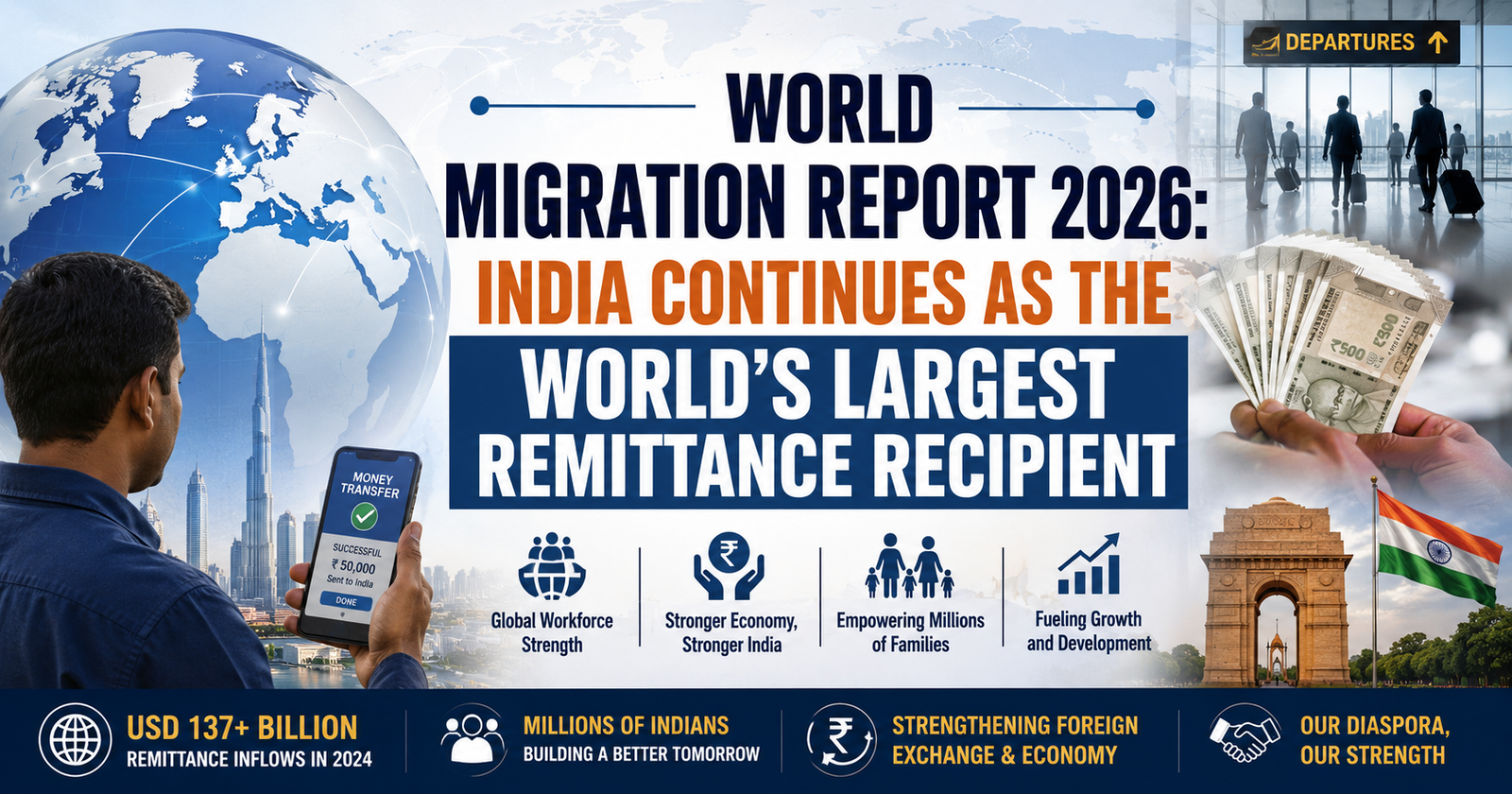
Explore World Migration Report 2026 and understand why India remains the world’s largest remittance recipient, its economic impact, diaspora contribution, migration trends, challenges, and importance for UPSC preparation.
Syllabus Areas:GS II - Governance GS III - Economy (Balance of Payment) |
According to the International Organization for Migration (IOM) – World Migration Report 2026, India has once again emerged as the largest recipient of remittances globally, receiving more than USD 137 billion in 2024.
This highlights:
-
the growing contribution of the Indian diaspora,
-
India’s strong global workforce presence,
-
and the increasing importance of migration-driven economic flows.
The report once again underlines the strategic role played by overseas Indians in supporting India’s economy, households, and foreign exchange reserves.
What are Remittances?
-
Remittances refer to “Money transferred by migrant workers living abroad to their families or relatives in their home country”.
-
These transfers are usually sent through banks, digital payment platforms, money transfer agencies or informal channels.
-
For millions of Indian families, remittances act as household income, social security, education funding, healthcare support and investment capital.
India’s Position in Global Remittances
India has remained the top remittance recipient country for several years.
- Major Remittance Receiving Countries (Approximate)
- India (USD 137+ Billion) > Mexico > China > Philippines > Pakistan
- India’s remittance inflow is now larger than the GDP of several smaller countries.
- Major Sources of Indian Remittances
- Indian migrants working across the world contribute significantly to remittance inflows.
- Top Contributing Countries
-
United States
-
Saudi Arabia
-
United Arab Emirates
-
United Kingdom
-
Canada
-
Switzerland
-
Qatar
-
Kuwait
-
Why are Remittances Increasing?
1. Expansion of Skilled Indian Workforce Abroad
Indian professionals dominate sectors such as:
-
Information Technology, Healthcare, Finance, Engineering, Research, Artificial Intelligence and Education.
Highly skilled migration has increased India’s earnings abroad.
2. Strong Presence in Gulf Countries
-
Millions of Indian workers continue to work in: UAE > Saudi Arabia > Qatar > Oman > Kuwait > Bahrain.
-
These countries remain crucial sources of remittance income.
3. Growth of Digital Banking
-
Technological improvements have made remittance transfers faster, cheaper and more secure.
-
Digital payment systems and fintech platforms have increased formal transfers.
4. Rise in Global Demand for Indian Talent
India’s demographic advantage and skilled manpower have increased global dependence on Indian workers, especially in technology, healthcare, construction, logistics and financial services.
Importance of Remittances for India
1. Strengthening Foreign Exchange Reserves
Remittances provide a stable source of foreign currency inflow.
This helps:
-
strengthen India’s Balance of Payments,
-
support rupee stability,
-
and improve external sector resilience.
Unlike foreign investments, remittances are generally more stable during global crises.
2. Poverty Reduction
-
Remittances directly support millions of households.
-
Families use remittances for food, education, healthcare, housing and small businesses.
-
Thus, remittances contribute significantly to poverty alleviation.
3. Rural Economic Development
-
In many Indian states, remittances support village economies, local employment and real estate development.
-
States like Kerala, Punjab, Uttar Pradesh, Bihar, Andhra Pradesh and Telangana benefit heavily from overseas earnings.
4. Increase in Consumption and Investments
-
Remittance income boosts domestic consumption, savings, insurance, education spending and entrepreneurship. This indirectly stimulates economic growth.
Indian Diaspora: A Strategic Asset
India has one of the world’s largest diaspora populations.
Estimated Indian Diaspora
-
Over 35 million people of Indian origin live abroad.
-
The Indian diaspora contributes not only through remittances but also through investments, technology transfer, diplomacy, lobbying and cultural influence.
Challenges Associated with Migration and Remittances
1. Dependence on External Economies
Heavy reliance on remittances can create vulnerability if:
-
oil prices fall,
-
Gulf economies slow down,
-
or immigration policies tighten.
2. Brain Drain
-
Migration of highly skilled professionals may sometimes reduce domestic talent availability. India faces debates regarding: “brain drain” vs “brain gain.”
3. Exploitation of Migrant Workers
Low-skilled workers abroad often face:
-
poor working conditions,
-
low wages,
-
contract violations,
-
and lack of legal protections.
This remains a major humanitarian concern.
4. Regional Imbalances
-
Certain states benefit disproportionately from remittances while others receive comparatively lower inflows.
Government Initiatives for Overseas Indians
-
Pravasi Bharatiya Divas: Celebrates contributions of overseas Indians.
-
e-Migrate Portal: Protects emigrant workers and regulates overseas employment processes.
-
MADAD Portal: Helps resolve grievances of Indians abroad.
-
Overseas Citizenship of India (OCI): Provides special privileges to persons of Indian origin.
Global Migration Trends
The World Migration Report highlights:
-
rising international migration,
-
demographic shifts,
-
labour shortages in developed countries,
-
and increasing mobility of skilled workers.
India is expected to remain a major supplier of global talent in coming decades.
Remittances vs Foreign Direct Investment (FDI)
|
Aspect |
Remittances |
FDI (Foreign Direct Investment) |
|
Nature |
Personal money transfers by migrants |
Investment made by foreign companies/businesses |
|
Stability |
Relatively stable during crises |
Depends on market and investor confidence |
|
Purpose |
Household welfare and family support |
Profit generation and business expansion |
|
Main Beneficiaries |
Families and local communities |
Industries and corporate sector |
|
Economic Role |
Supports consumption and poverty reduction |
Enhances production and infrastructure |
|
Source |
Overseas workers and diaspora |
Foreign corporations and investors |
|
Impact |
Social and household-level development |
Industrial growth and employment generation |
|
Risk Level |
Comparatively low volatility |
More sensitive to global economic conditions |
|
Examples |
Money sent by Indians working abroad |
Foreign company setting up factories in India |
Both are important, but remittances directly support household-level economic security.
Way Forward
India should:
-
strengthen diaspora engagement,
-
improve migrant worker protection,
-
reduce remittance transfer costs,
-
enhance skill development,
-
and channel remittances into productive investments.
The country must also balance outward migration with domestic employment generation.
India becoming the world’s largest remittance recipient reflects the global success of Indian workers and professionals. Remittances have become a lifeline for millions of households and a pillar of India’s external economic stability.
However, sustainable development requires moving beyond remittance dependence toward:
-
higher domestic productivity,
-
skilled employment,
-
and inclusive economic growth.
India’s diaspora is not merely an overseas population—it is one of the nation’s greatest strategic strengths in the 21st century.