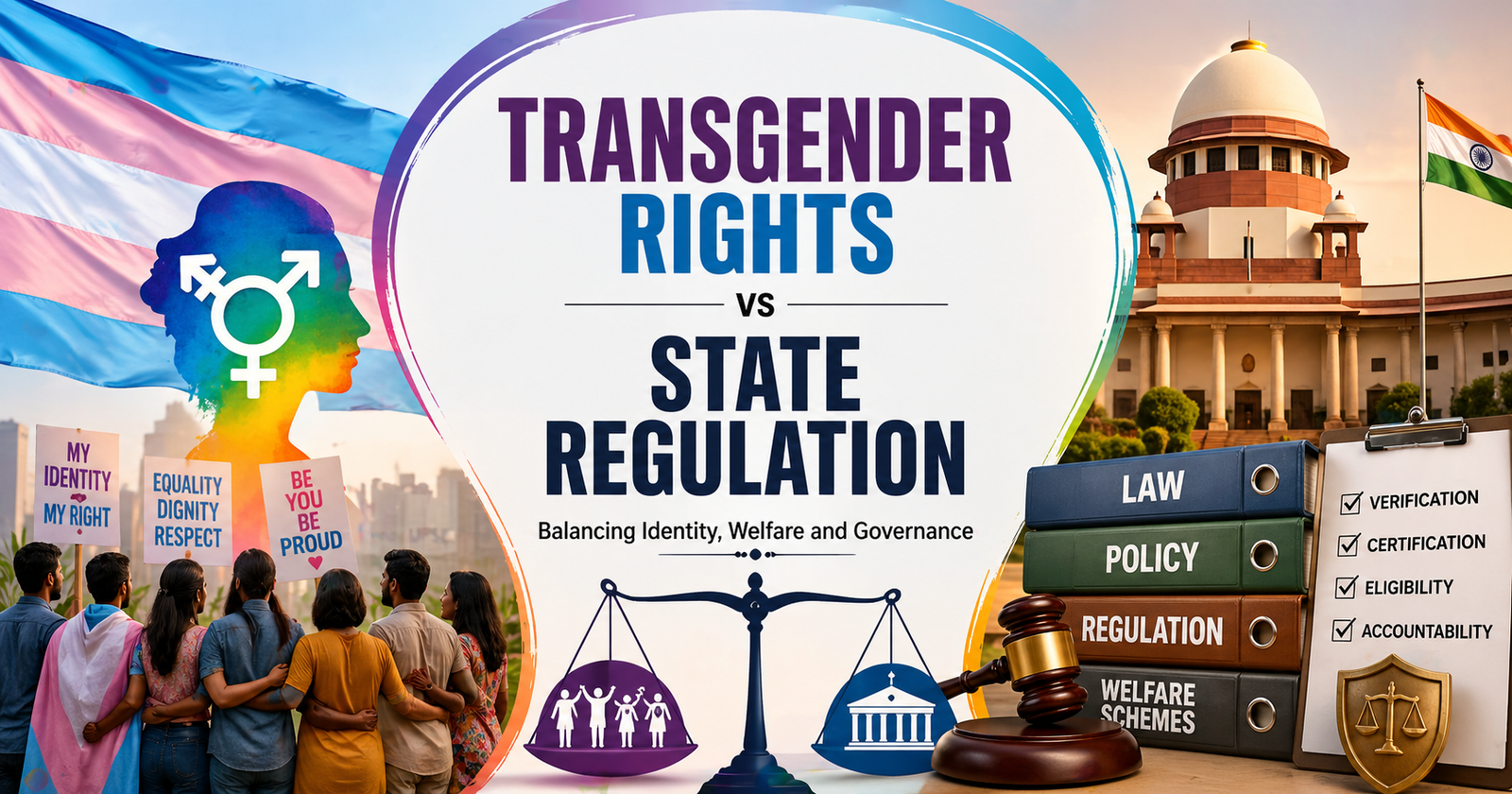
Should gender identity be self-declared or state-regulated? Explore India’s transgender rights debate, key issues, challenges, and future direction.
Syllabus Areas:GS I - Society GS II - Governance |
The question of transgender rights has increasingly emerged as a significant issue in contemporary governance and social justice discourse. In India, the recognition of transgender persons as a “third gender” marked a progressive step toward inclusivity. However, recent policy developments, including amendments to transgender-related laws, have reignited debates on the balance between individual self-identification and state regulation.
Background and Legal Evolution
The journey of transgender rights in India has been shaped by judicial activism and legislative intervention. A landmark moment came with the Supreme Court’s judgment in the NALSA v. Union of India case, which recognised transgender persons as a third gender and affirmed their fundamental rights under the Constitution. The Court upheld the principle of self-identification, allowing individuals to determine their gender identity without invasive procedures.
Following this, the government enacted the Transgender Persons (Protection of Rights) Act, 2019 to provide a legal framework for protecting the rights of transgender individuals. However, recent amendments and policy discussions have shifted focus toward introducing regulatory mechanisms, particularly in areas related to certification, welfare eligibility, and verification processes.
Core Issue: Self-Identification vs State Regulation
The central issue in the current debate is the tension between two competing priorities:
-
Right to Self-Identification:
Transgender individuals argue that gender identity is deeply personal and should not be subject to external validation. Any requirement for certification or verification may violate dignity and privacy. -
Need for State Regulation:
The government emphasizes the need to regulate access to welfare schemes and benefits to prevent misuse and ensure that resources reach genuinely deserving individuals.
This creates a complex policy challenge where both sides present legitimate concerns.
Arguments in Favour of Self-Identification
1. Protection of Dignity and Autonomy
Self-identification respects the fundamental rights to dignity, privacy, and personal liberty under Article 21 of the Constitution. Forcing individuals to undergo verification processes can be intrusive and humiliating.
2. Alignment with Constitutional Morality
The principle of self-identification aligns with constitutional values of equality and non-discrimination. It ensures that transgender persons are not subjected to additional barriers compared to others.
3. Avoidance of Bureaucratic Harassment
Requiring certification from authorities may expose individuals to delays, discrimination, and corruption within administrative systems.
4. International Best Practices
Many progressive countries have adopted self-identification models, recognising gender identity as a personal choice rather than a state-determined category.
Arguments in Favour of State Regulation
-
Prevention of Welfare Misuse: Governments argue that completely unrestricted self-identification may lead to misuse of welfare schemes intended for transgender individuals.
-
Administrative Feasibility: Verification mechanisms help the state maintain accurate records, ensuring effective policy implementation and targeted delivery of benefits.
-
Safeguarding Policy Integrity: Without some form of regulation, there is a risk that policies may lose credibility and public support.
-
Balancing Competing Interests: The state must ensure fairness not only to transgender individuals but also to other disadvantaged groups competing for limited resources.
Challenges in the Current Framework
-
Ambiguity in Certification Procedures: Lack of clarity on how identity verification should be conducted creates confusion and inconsistency.
-
Social Stigma and Discrimination: Even with legal recognition, transgender individuals continue to face marginalisation in society.
-
Limited Access to Welfare Benefits: Many transgender persons remain outside the reach of government schemes due to procedural barriers.
-
Trust Deficit Between Community and State: Perceived overregulation may lead to distrust, reducing the effectiveness of policies.
Broader Social Implications
The debate extends beyond legal frameworks and touches upon deeper societal issues. It reflects the ongoing struggle between traditional norms and evolving identities, as well as the state’s role in shaping social inclusion.
A rigid regulatory approach risks reinforcing exclusion, while an entirely unregulated system may create administrative challenges. Therefore, the issue must be viewed through a lens of inclusive governance, where policies are both empathetic and practical.
Way Forward
-
Adopt a Hybrid Approach: A balanced model that respects self-identification while incorporating minimal, non-intrusive verification mechanisms can address both concerns.
-
Simplify Administrative Procedures: Certification processes, if required, should be transparent, time-bound, and free from harassment.
-
Strengthen Awareness and Sensitisation: Government officials and society at large must be sensitised to transgender issues to reduce discrimination.
-
Enhance Targeted Welfare Delivery: Policies should focus on improving access to education, healthcare, and employment for transgender individuals.
-
Engage with the Community: Continuous dialogue with transgender communities is essential to design policies that are both effective and respectful.
The debate on transgender rights versus state regulation is not a binary conflict but a nuanced policy challenge. While the state has a legitimate interest in ensuring accountability and preventing misuse, it must not do so at the cost of individual dignity and autonomy.
The ultimate goal should be to create a framework that upholds constitutional values, ensures social justice, and fosters inclusive development. Striking this balance will be crucial in determining the success of India’s approach to transgender rights in the years to come.
Mains Question:
“Discuss the tension between self-identification and state regulation in the context of transgender rights in India.” 250 words