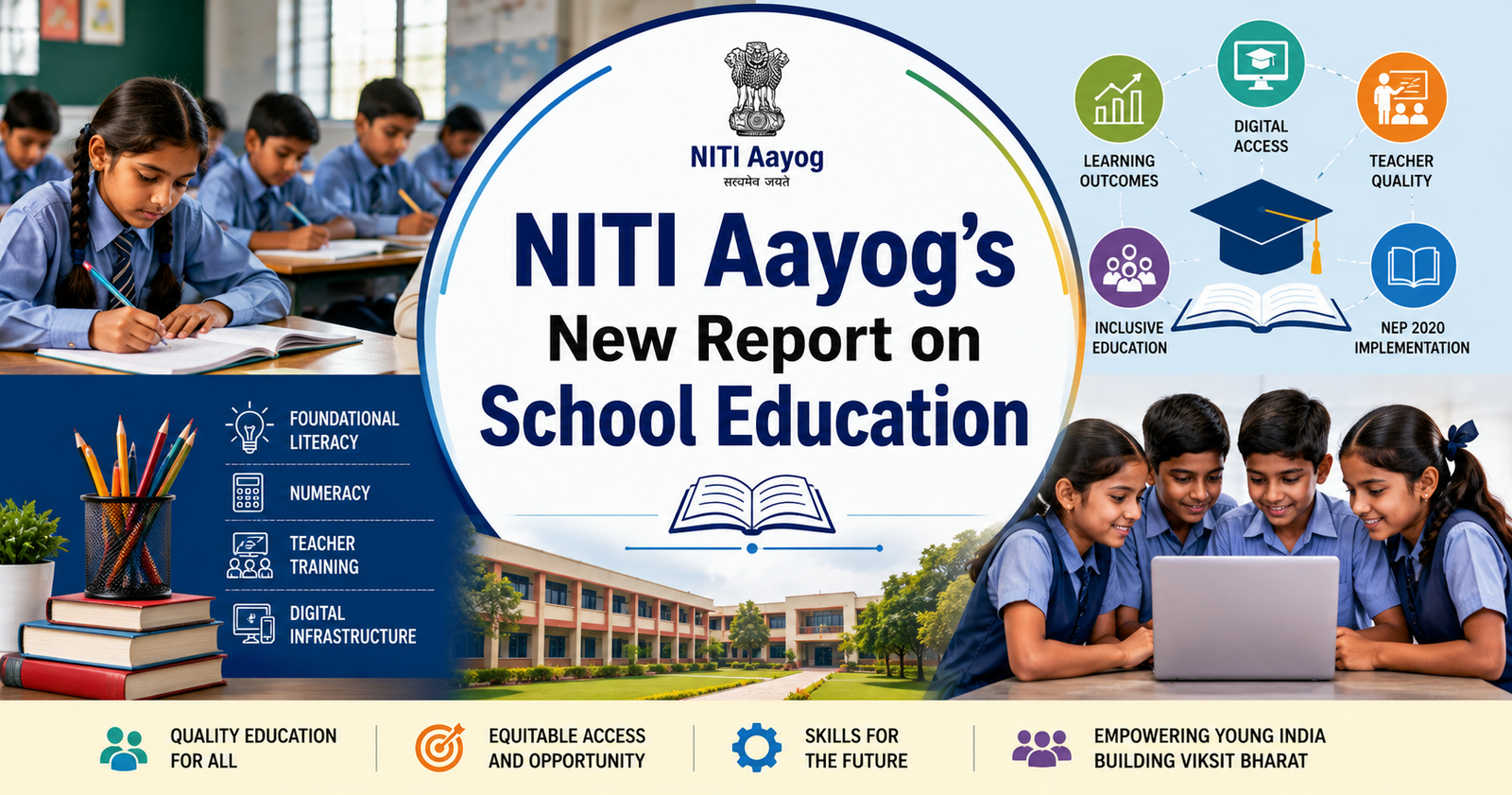
Explore NITI Aayog’s latest report on school education covering learning outcomes, digital divide, teacher quality, NEP 2020 implementation, challenges, reforms, and the future roadmap for India’s education system.
Syllabus Areas:GS II - Polity and Governance |
India’s education sector is once again at the centre of policy discussions after NITI Aayog released a comprehensive report evaluating the condition of school education across the country. The report assumes significance at a time when India is implementing the National Education Policy (NEP) 2020 while simultaneously attempting to improve foundational literacy, digital learning access and teacher quality.
The report provides a realistic assessment of India’s schooling ecosystem and highlights both achievements and persistent structural challenges. It examines the status of learning outcomes, digital infrastructure, teacher training, governance mechanisms and implementation of NEP reforms across states.
Why is the Report in News?
The latest report by NITI Aayog has gained attention because it presents a detailed evaluation of school education reforms after the disruptions caused by the COVID-19 pandemic and during the ongoing implementation phase of NEP 2020.
The report emphasizes:
-
Uneven learning outcomes among states
-
Growing digital divide
-
Shortage of trained teachers
-
Need for foundational literacy reforms
-
Better monitoring of NEP implementation
The findings are important for policymakers, civil services aspirants, education administrators and state governments.
Background: Evolution of School Education Reforms in India
India’s school education system has undergone several reforms over the decades:
-
Right to Education (RTE) Act, 2009
-
Samagra Shiksha Abhiyan
-
Mid-Day Meal Scheme
-
Digital learning initiatives
-
National Education Policy (NEP) 2020
Despite increased enrollment levels, concerns regarding quality of education and employability skills have remained persistent.
NEP 2020 attempted to address these structural concerns through:
-
Foundational literacy and numeracy
-
Holistic learning
-
Flexible curriculum
-
Skill-based education
-
Mother tongue instruction
-
Digital integration
-
Teacher capacity building
The recent NITI Aayog report evaluates how far these goals are being achieved.
Major Findings of the Report
1. Learning Outcomes Continue to Remain a Concern
One of the most important observations in the report is the weak learning levels among school students, especially in foundational literacy and numeracy.
Many students in primary schools continue to face difficulties in:
-
Reading basic texts
-
Understanding comprehension
-
Performing simple arithmetic operations
The report highlights that enrollment alone cannot be treated as educational success unless students actually acquire meaningful learning skills.
Reasons for Poor Learning Outcomes
-
Learning gaps after the pandemic
-
Teacher shortages
-
Outdated teaching methods
-
Examination-oriented learning
-
Poor student-teacher ratio in some regions
Importance for India
Weak foundational learning directly affects:
-
Human capital formation
-
Productivity
-
Innovation capacity
-
Future employability
The report strongly recommends strengthening foundational learning programmes in early childhood and primary education.
2. Digital Divide Remains a Serious Challenge
The report notes that digital education expanded rapidly during and after the pandemic, but unequal access remains a major obstacle.
Key Issues Identified
-
Lack of internet access in rural areas
-
Poor electricity connectivity
-
Shortage of digital devices
-
Limited digital literacy among teachers and students
Urban schools benefited more from online education, while many rural and economically weaker students were left behind.
Impact of Digital Inequality
Digital exclusion creates:
-
Educational inequality
-
Higher dropout risks
-
Reduced access to competitive learning resources
The report recommends:
-
Affordable internet connectivity
-
Digital infrastructure in government schools
-
Community digital centres
-
Teacher training in educational technology
3. Teacher Quality and Capacity Need Major Improvement
Teachers remain the backbone of the education system. However, the report identifies multiple concerns regarding teacher quality.
Major Problems
-
Inadequate teacher training
-
Outdated pedagogical practices
-
Administrative burden on teachers
-
Vacancies in government schools
The report stresses that successful implementation of NEP 2020 depends heavily on teacher preparedness.
Suggested Reforms
-
Continuous professional development
-
Modern teaching methodologies
-
Performance-based support systems
-
Better recruitment mechanisms
-
Technology-enabled teacher training
The report also highlights the need to restore social respect and institutional support for teachers.
4. Implementation of NEP 2020 is Uneven Across States
Although NEP 2020 provides a broad national framework, implementation levels vary significantly across states.
Areas with Slow Progress
-
Multidisciplinary learning
-
Vocational integration
-
Foundational literacy missions
-
Mother tongue instruction
-
Curriculum restructuring
Some states have moved quickly with reforms, while others face:
-
Financial constraints
-
Administrative limitations
-
Infrastructure gaps
The report calls for stronger Centre-State coordination and better monitoring systems.
5. Early Childhood Care and Education (ECCE) Requires Greater Attention
The report underlines the importance of pre-primary education in improving long-term learning outcomes.
It recommends:
-
Strengthening Anganwadi systems
-
Better integration between ECCE and primary schools
-
Training ECCE educators
-
Nutrition and cognitive development support
Research globally shows that investments in early childhood education generate high social and economic returns.
6. Focus on Skill Development and Employability
The report recognizes that India’s education system must move beyond rote memorization toward skill-oriented learning.
Key Recommendations
-
Vocational education from school level
-
Coding and digital literacy
-
Critical thinking skills
-
Communication abilities
-
Problem-solving orientation
The objective is to prepare students for:
-
Future employment markets
-
Technological transformation
-
Innovation-driven economies
Significance of the Report
The report is important because it aligns education reform with India’s long-term developmental goals.
Educational Importance
-
Improves quality of learning
-
Strengthens foundational literacy
-
Encourages inclusive education
Economic Importance
Education directly contributes to:
-
Workforce productivity
-
Economic growth
-
Demographic dividend utilization
Social Importance
Better education promotes:
-
Social mobility
-
Gender empowerment
-
Reduced inequality
-
Democratic participation
Challenges Before India’s Education System
Despite reforms, several structural challenges continue to exist.
1. Funding Constraints: Public expenditure on education remains relatively low compared to global standards.
2. Rural-Urban Disparities: Infrastructure and teacher quality differ sharply between urban and rural schools.
3. Learning Poverty: Many students complete schooling without acquiring essential skills.
4. Teacher Vacancies: Large numbers of teaching positions remain unfilled in many states.
5. Digital Infrastructure Gap: Technology access remains unequal across regions and socio-economic groups.
Government Initiatives Supporting School Education
Several initiatives are already being implemented to improve school education.
Major Programmes
-
Samagra Shiksha Scheme
-
PM eVIDYA
-
DIKSHA Platform
-
NIPUN Bharat Mission
-
National Digital Education Architecture (NDEAR)
These initiatives aim to:
-
Improve foundational literacy
-
Expand digital learning
-
Enhance teacher training
-
Promote inclusive education
The Way Forward
The report suggests that India must now focus on “learning quality” rather than only “school enrollment.”
-
Strengthening Foundational Literacy: Primary education must become the core focus area.
-
Investing in Teachers: Teacher training institutions require modernization.
-
Bridging the Digital Divide: Affordable digital access must be treated as an educational necessity.
-
Increasing Public Investment: Higher spending on education is essential for sustainable reforms.
-
Data-Driven Governance: Regular assessment and monitoring systems must guide policymaking.
- Cooperative Federalism: Centre and states must work together for effective NEP implementation.
The latest report by NITI Aayog provides a critical roadmap for improving India’s school education system. While enrollment rates have improved significantly over the years, the real challenge now lies in ensuring quality education, meaningful learning outcomes and equitable access.
India’s aspiration to become a developed nation by 2047 depends heavily on how effectively it transforms its education system today. The report serves as both a warning and an opportunity — a warning against complacency and an opportunity to build a future-ready education ecosystem capable of empowering millions of young Indians.
Mains Question:
Q. “India’s education reforms must shift focus from schooling to learning outcomes.” Discuss in the context of recent educational reforms and the latest NITI Aayog report. 250 Words.