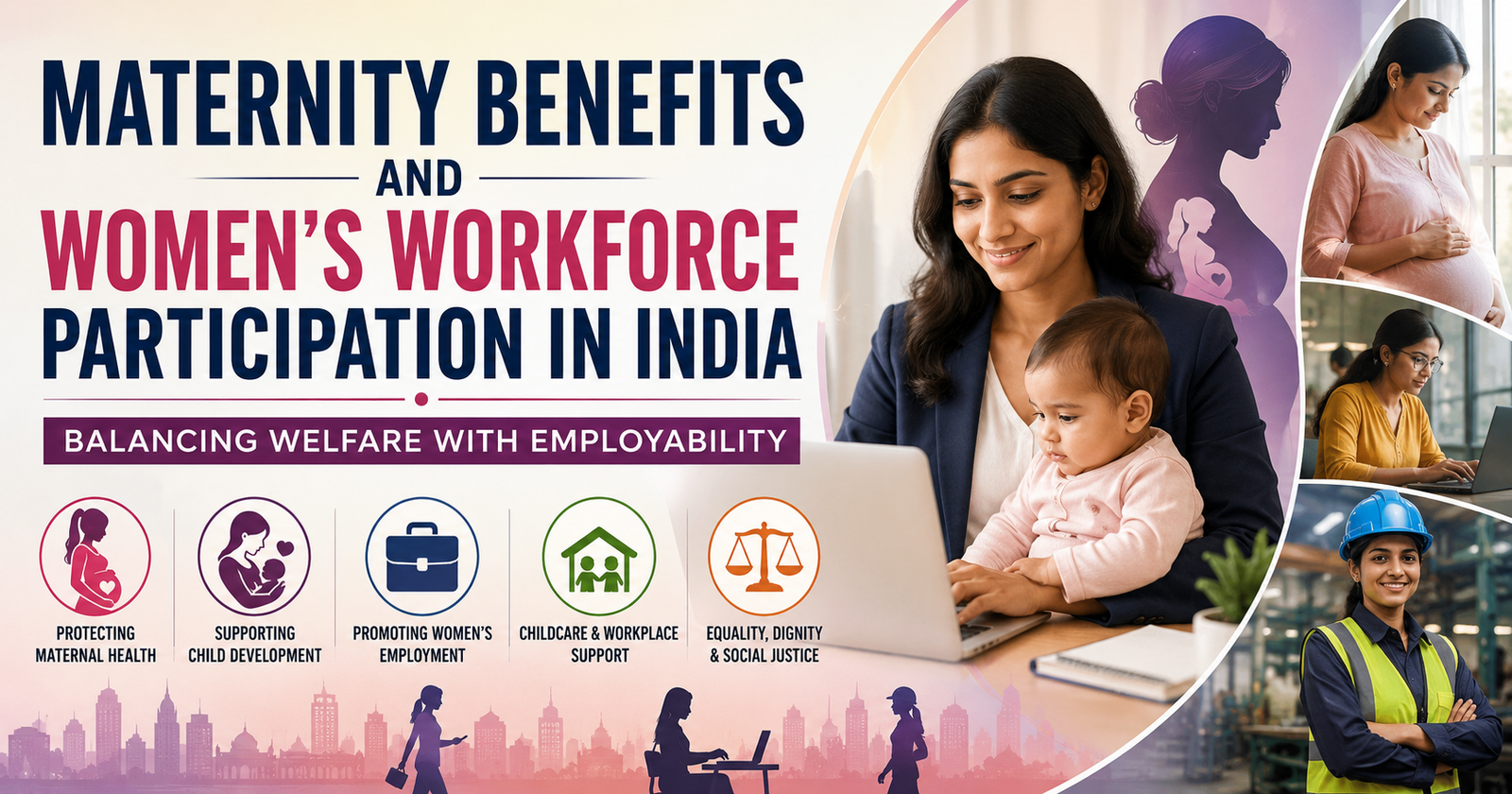
Explore India’s maternity benefit framework, women’s workforce participation, childcare challenges, labour reforms, gender equality, and policy solutions for balancing welfare with employability and economic growth.
Syllabus Areas:GS I - Society GS III - Economy |
India’s economic growth story cannot become sustainable unless women participate equally in the workforce. While the country has made progress in education, entrepreneurship, and political representation, female labour force participation still remains one of India’s biggest structural challenges. In this context, maternity benefits and workplace support systems have become central to the debate on gender equality, economic productivity, and social justice.
The issue is not merely about granting leave to women after childbirth. It is about creating an ecosystem where motherhood does not become a barrier to employment, career progression, or financial independence.
Understanding Maternity Benefit
Maternity benefit refers to the paid leave and employment protection provided to women during pregnancy and after childbirth.
Its objectives are:
-
Protect maternal health,
-
Ensure child welfare,
-
Prevent discrimination against women workers,
-
Support work-life balance,
-
Promote gender equality in employment.
Maternity Benefit Act, 1961
India regulates maternity leave primarily through the Maternity Benefit Act, 1961.
The Act applies to:
-
Factories,
-
Mines,
-
Shops and establishments,
-
Organizations employing a specified number of workers.
Major Provisions of the Act
1. Paid Maternity Leave
Initially, the Act provided:
-
12 weeks of paid maternity leave.
After the 2017 amendment:
-
Leave was increased to 26 weeks for women with up to two children.
For women with more than two children:
-
12 weeks leave is applicable.
2. Adoption and Surrogacy
The law also provides:
-
12 weeks maternity leave for adoptive mothers,
-
Leave for commissioning mothers through surrogacy.
This reflected a broader understanding of motherhood and childcare.
3. Crèche Facilities
Organizations with 50 or more employees must provide:
-
Crèche facilities,
-
Multiple visits to the crèche during work hours.
This provision aimed to improve post-maternity workforce continuity.
4. Work from Home Provision
The amendment introduced flexibility allowing:
-
Work-from-home arrangements wherever feasible.
This became especially relevant after the digital workplace transformation during the pandemic years.
Importance of Maternity Benefits
1. Protection of Maternal Health
Pregnancy and childbirth require physical recovery and emotional support. Paid leave ensures:
-
Reduced health risks,
-
Better recovery,
-
Lower maternal mortality,
-
Improved mental well-being.
Healthy mothers contribute to healthier families and healthier societies.
2. Child Development
The first six months are critical for:
-
Breastfeeding,
-
Nutrition,
-
Emotional bonding,
-
Early childhood care.
Scientific studies consistently show that maternal presence during infancy positively affects cognitive and emotional development.
3. Women’s Dignity and Equality
Maternity benefits recognize that:
-
Reproduction is a social function, not merely a personal burden.
Without institutional protection:
-
Women may face dismissal,
-
Wage discrimination,
-
Career setbacks.
Thus, maternity protection is linked to constitutional ideals of equality and dignity.
Constitutional Basis
The Indian Constitution indirectly supports maternity welfare through several provisions:
Article 14: Equality before law.
Article 15(3): Allows special provisions for women and children.
Article 21: Protection of life and dignity.
Article 42: Directive Principle directing the State to ensure:
-
Just and humane working conditions,
-
Maternity relief.
Thus, maternity benefits are not merely welfare schemes but part of India’s constitutional vision of social justice.
The Reality: India’s Female Labour Force Participation Crisis
Despite policy measures, India’s female labour force participation remains comparatively low.
Major concerns include:
-
Women dropping out after marriage,
-
Career breaks after childbirth,
-
Informal employment dominance,
-
Safety concerns,
-
Lack of workplace flexibility.
Many educated women leave jobs permanently due to:
-
Caregiving responsibilities,
-
Absence of childcare support,
-
Workplace discrimination.
This creates a paradox:
-
Educational gains are not translating into workforce participation.
The Structural Problems in India’s Maternity Benefit System
1. Entire Cost is Largely Borne by Employers
One of the biggest criticisms of India’s framework is:
-
The employer bears the salary cost during maternity leave.
This creates unintended consequences:
-
Firms may hesitate to hire women,
-
Women may face hidden discrimination,
-
Smaller companies may avoid long-term female recruitment.
Many economists argue:
Welfare responsibilities should be socially shared, not privately penalized.
Countries with better gender participation often use:
-
Social insurance models,
-
Government-funded maternity support,
-
Shared parental leave systems.
2. Informal Sector Exclusion
India’s workforce is dominated by:
-
Informal labour,
-
Domestic workers,
-
Agricultural workers,
-
Gig workers.
Most women in these sectors:
-
Receive no paid maternity leave,
-
Lack health insurance,
-
Continue working during pregnancy.
Thus, legal protection largely benefits:
-
Formal urban employees,
while millions remain excluded.
This is one of the biggest gaps in India’s labour welfare architecture.
International Models India Can Learn From
Nordic Countries
Countries like:
-
Sweden,
-
Norway,
-
Finland
provide:
-
Shared parental leave,
-
Government-supported childcare,
-
Flexible work systems.
This reduces discrimination against women in hiring.
Economic Importance of Women’s Workforce Participation
Increasing female labour participation can:
-
Boost GDP,
-
Increase household incomes,
-
Improve savings,
-
Reduce poverty,
-
Enhance human capital.
Many economic studies suggest:
-
India could significantly increase economic output through greater women participation alone.
Thus, maternity support is not just social welfare — it is also an economic growth strategy.
Way Forward
1. Shared Financing Model
The government, employers, and social insurance systems should collectively finance maternity benefits.
This reduces:
-
Hiring bias,
-
Employer burden.
2. Expand Coverage to Informal Sector
India needs:
-
Universal maternity income support,
-
Portable social security,
-
Inclusion of gig and platform workers.
3. Strengthen Childcare Infrastructure
Investment is needed in:
-
Community childcare centres,
-
Workplace crèches,
-
Urban childcare support systems.
4. Encourage Paternity Leave
Caregiving must become gender-neutral.
This promotes:
-
Shared parenting,
-
Reduced workplace discrimination against women.
5. Flexible Work Ecosystem
Hybrid work, flexible timing, and remote work can significantly improve retention of women employees.
India’s maternity benefit framework reflects a progressive commitment toward women’s welfare and social justice. However, legislation alone cannot guarantee workforce equality. Real empowerment requires institutional support, childcare infrastructure, flexible workplaces, and social transformation.
The larger question is not whether women should receive maternity benefits. The real question is whether India is willing to build an economy where motherhood and professional ambition can coexist without penalty.
A developed India cannot emerge while half its talent pool remains structurally constrained. Strengthening women’s workforce participation is therefore not merely a gender issue — it is a national development imperative.