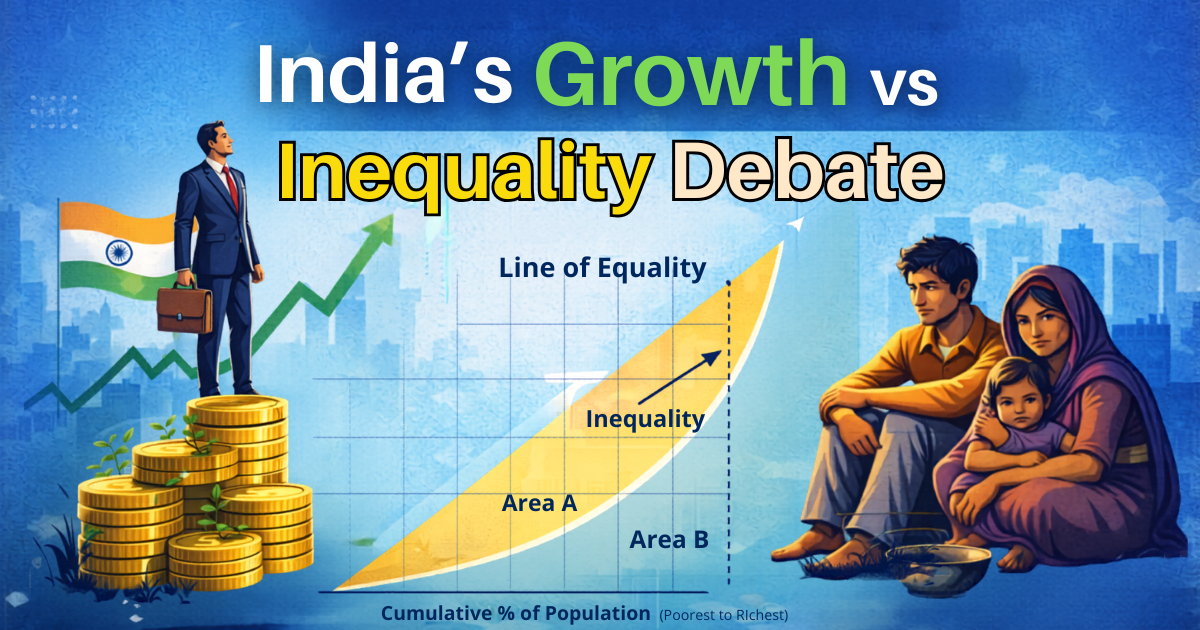
Explore India’s growth vs inequality debate, covering jobless growth, informal sector challenges, Lorenz Curve, Gini coefficient, and policy measures for inclusive development—essential insights for UPSC aspirants.
Syllabus Areas:GS III - Economy |
India continues to be one of the fastest-growing major economies in the world, with strong GDP projections and increasing global recognition. However, recent reports and analyses have highlighted a growing concern: the benefits of this economic growth are not being distributed evenly across society. Rising income and wealth inequality, coupled with concerns about jobless growth and stress in the informal sector, have brought the issue of “growth without equity” back into public discourse. This has made the debate highly relevant in current policy and academic discussions.
Understanding the Growth–Inequality Paradox
Economic growth is traditionally seen as a means to improve living standards, reduce poverty, and create opportunities. However, in India’s case, rapid GDP expansion has not translated proportionately into widespread socio-economic gains. While a segment of the population has witnessed significant income increases, a large section continues to struggle with stagnant wages, limited job opportunities, and economic vulnerability.
This divergence highlights a fundamental paradox: high growth rates coexist with persistent inequality.
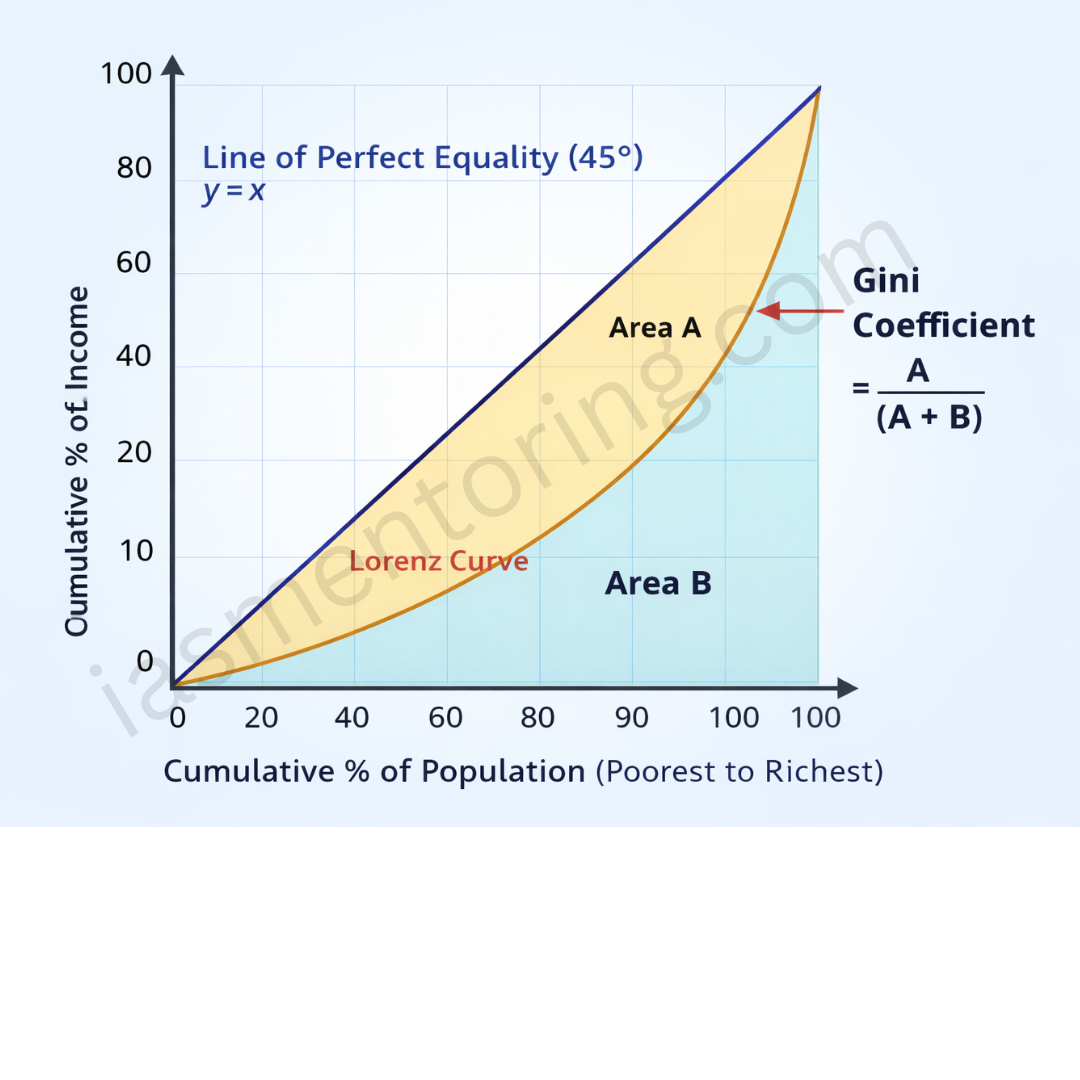
Lorenz Curve and Gini Coefficient:
|
Key Dimensions of the Issue
1. Jobless Growth
One of the most pressing concerns is that India’s growth has not been employment-intensive.
-
The services sector has driven much of the growth, but it does not absorb labor at the scale required.
-
Manufacturing, which traditionally generates mass employment, has not expanded sufficiently.
-
Automation and technological shifts further limit job creation.
As a result, even as the economy grows, employment opportunities—especially for youth—remain constrained.
2. Stress in the Informal Sector
The informal sector employs a significant proportion of India’s workforce. However:
-
It lacks social security and income stability.
-
Policy shocks and economic disruptions disproportionately affect this sector.
-
Transition to formalization remains slow and uneven.
This leads to a situation where a large population remains outside the benefits of formal economic growth.
3. Rising Wealth Concentration
Another major concern is the increasing concentration of wealth in the hands of a small section of society.
-
High-income groups benefit more from capital gains, financial assets, and policy incentives.
-
The gap between the richest and the poorest continues to widen.
This concentration not only raises ethical concerns but also affects overall economic stability and consumption patterns.
4. Regional and Social Inequalities
Growth has been uneven across regions and social groups.
-
Certain states and urban centers have advanced rapidly, while others lag behind.
-
Marginalized communities continue to face structural disadvantages in accessing opportunities.
This uneven distribution reinforces existing socio-economic hierarchies.
Implications of Rising Inequality
1. Social Consequences
Persistent inequality can lead to social unrest, reduced social cohesion, and increased polarization.
2. Economic Consequences
When wealth is concentrated, overall demand in the economy weakens, as a large section lacks purchasing power. This can eventually slow down growth itself.
3. Political Consequences
Inequality can influence governance outcomes, policy priorities, and democratic participation.
Policy Challenges
Addressing inequality while maintaining growth presents a complex policy challenge:
-
Excessive redistribution may discourage investment.
-
Insufficient intervention may worsen inequality.
Thus, policymakers must strike a careful balance between efficiency and equity.
Way Forward: Towards Inclusive Growth
1. Employment-Centric Growth Strategy
-
Focus on labor-intensive sectors like manufacturing, textiles, and MSMEs.
-
Promote skill development aligned with industry needs.
2. Strengthening the Informal Sector
-
Expand social security coverage.
-
Facilitate easier access to credit and markets.
3. Progressive Redistribution Policies
-
Rationalize taxation to ensure fairness.
-
Increase spending on health, education, and welfare.
4. Regional Development Policies
-
Target investments in lagging regions.
-
Improve infrastructure and connectivity.
5. Enhancing Human Capital
-
Invest in quality education and healthcare to improve productivity and opportunities.
India’s economic growth story is impressive, but its sustainability depends on how inclusive it becomes. Growth that excludes large sections of society is neither socially desirable nor economically stable in the long run. The real challenge lies not just in achieving high GDP numbers, but in ensuring that the benefits of growth reach every segment of society. Only then can development be truly meaningful and transformative.
Prelims Questions:1. Consider the following statements about the Lorenz Curve:
Which of the statements given above is/are correct? Answer: A 2. Informal sector in India is characterized by:
Select the correct answer: Answer: A 3. Which of the following policies directly help in reducing inequality?
Select the correct answer: Answer: C |