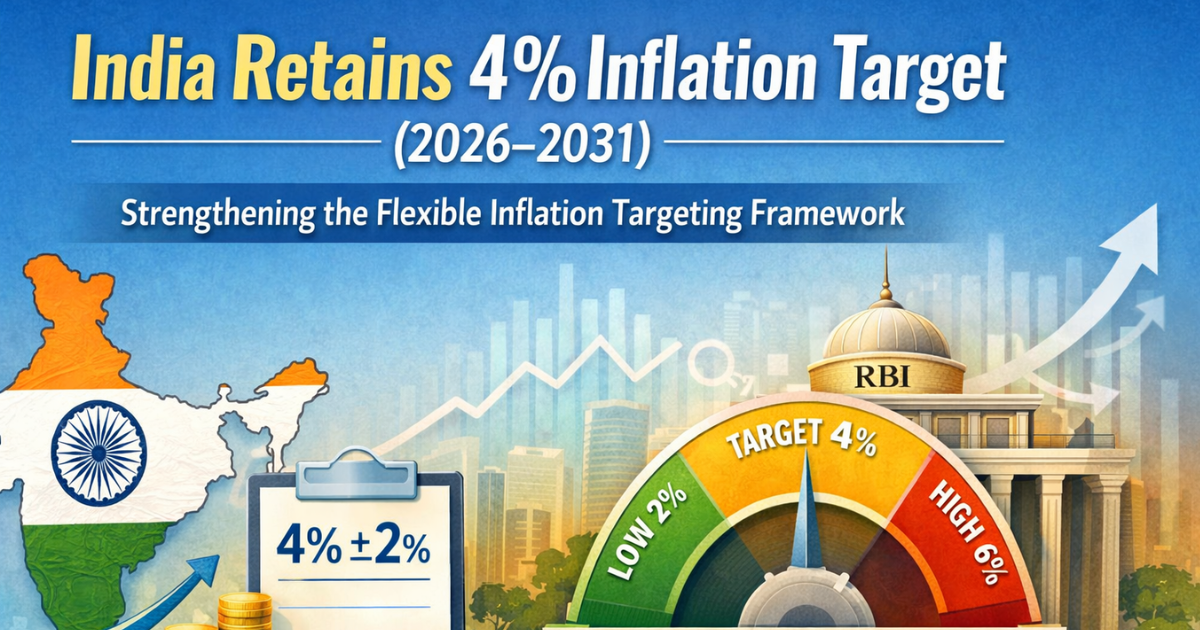
India retains 4% inflation target (±2%) for 2026–2031, reinforcing flexible inflation targeting, RBI’s policy credibility, and long-term macroeconomic stability.
Syllabus Areas:GS III - Economy |
In a significant reaffirmation of its commitment to macroeconomic stability, the Government of India has retained the retail inflation target at 4% (±2%) for the five-year period from April 2026 to March 2031. This decision continues the Flexible Inflation Targeting (FIT) framework introduced in 2016, signaling policy continuity, institutional credibility, and a balanced approach between price stability and economic growth.
What is Inflation Targeting?
Inflation targeting is a monetary policy framework where the central bank aims to keep inflation within a predefined range.
Flexible Inflation Targeting (FIT)
India follows a Flexible Inflation Targeting (FIT) system, meaning:
-
The primary objective is price stability, but
-
It also considers growth, employment, and financial stability
Unlike strict inflation targeting, FIT allows room for policy adjustments during economic shocks such as pandemics or global crises.
Legal and Institutional Framework in India
India formally adopted inflation targeting in 2016, based on:
-
Amendment to the RBI Act, 1934
-
Formation of the Monetary Policy Committee (MPC)
Monetary Policy Committee (MPC)
The MPC is responsible for setting interest rates to control inflation.
-
Consists of 6 members (3 from RBI + 3 appointed by Government)
-
Decisions are taken by majority vote
-
Meets at least 6 times a year
Its main tool is the repo rate, which influences borrowing costs in the economy.
What Does the 4% ±2% Target Mean?
The government has set:
-
Target inflation: 4%
-
Lower limit: 2%
-
Upper limit: 6%
Interpretation
-
If inflation stays between 2% and 6%, it is considered acceptable
-
If it breaches this range for three consecutive quarters, RBI must explain:
-
Why it failed
-
What corrective steps will be taken
This ensures accountability and transparency in monetary policy.
Why 4% Inflation Target? – The Economic Logic
The choice of 4% is not arbitrary. It balances multiple macroeconomic objectives:
1. Growth vs Stability Trade-off
-
Very low inflation → slows growth (reduced demand)
-
Very high inflation → erodes purchasing power
4% is considered a “golden mean” that supports growth without instability.
2. Developing Economy Context
India is a developing economy with structural issues:
-
Supply-side constraints
-
Food price volatility
-
Informal sector dominance
Hence, a moderate inflation target is more practical than very low inflation (like 2% in advanced economies).
3. Anchoring Inflation Expectations
When people trust that inflation will remain stable:
-
Consumers spend more confidently
-
Businesses invest more
-
Financial markets remain stable
This is called anchoring expectations, a key goal of modern monetary policy.
How RBI Achieves the Inflation Target
The RBI uses several tools:
1. Repo Rate
-
Increasing repo rate → reduces borrowing → lowers demand → reduces inflation
-
Decreasing repo rate → boosts growth
2. Liquidity Management
-
Open Market Operations (OMO)
-
Cash Reserve Ratio (CRR)
3. Communication Strategy:
Clear forward guidance helps influence expectations without drastic actions.
Performance of Inflation Targeting in India (2016–2026)
Achievements
-
Inflation moderated compared to pre-2016 period
-
Improved policy credibility
-
Better coordination between RBI and Government
Challenges
-
Food inflation remains volatile
-
Supply shocks (COVID-19, global conflicts) disrupted targets
-
Imported inflation due to crude oil price fluctuations
Despite these challenges, the framework has largely stabilized macroeconomic conditions.
Significance of the 2026–2031 Extension
1. Policy Continuity
Ensures stability in monetary policy, reducing uncertainty for investors.
2. Investor Confidence
Stable inflation boosts:
-
Foreign investment
-
Credit rating outlook
-
Financial market trust
3. Institutional Strengthening
Reinforces:
-
RBI’s autonomy
-
MPC’s role
-
Rules-based policymaking
4. Alignment with Global Best Practices:
Most modern economies follow inflation targeting. India’s continuation signals policy maturity.
Criticism and Concerns
1. Growth Sacrifice Debate
Some argue:
-
Excess focus on inflation may hurt growth and employment
2. Supply-Side Inflation
Monetary policy is less effective against:
-
Food price shocks
-
Fuel price spikes
These require fiscal and administrative measures, not just RBI action.
3. One-Size-Fits-All Issue:
India’s diverse economy may not suit a uniform inflation target across regions.
Way Forward
To strengthen the framework:
-
Improve agricultural supply chains to control food inflation
-
Enhance data quality for better policy decisions
-
Strengthen fiscal-monetary coordination
-
Focus on core inflation alongside headline inflation
The decision to retain the 4% inflation target for 2026–2031 reflects India’s commitment to macroeconomic discipline and policy credibility. While challenges remain—especially from supply-side shocks—the flexible inflation targeting framework has emerged as a cornerstone of India’s monetary policy architecture.
Going forward, its success will depend not just on RBI actions, but also on structural reforms, fiscal responsibility, and global economic conditions.